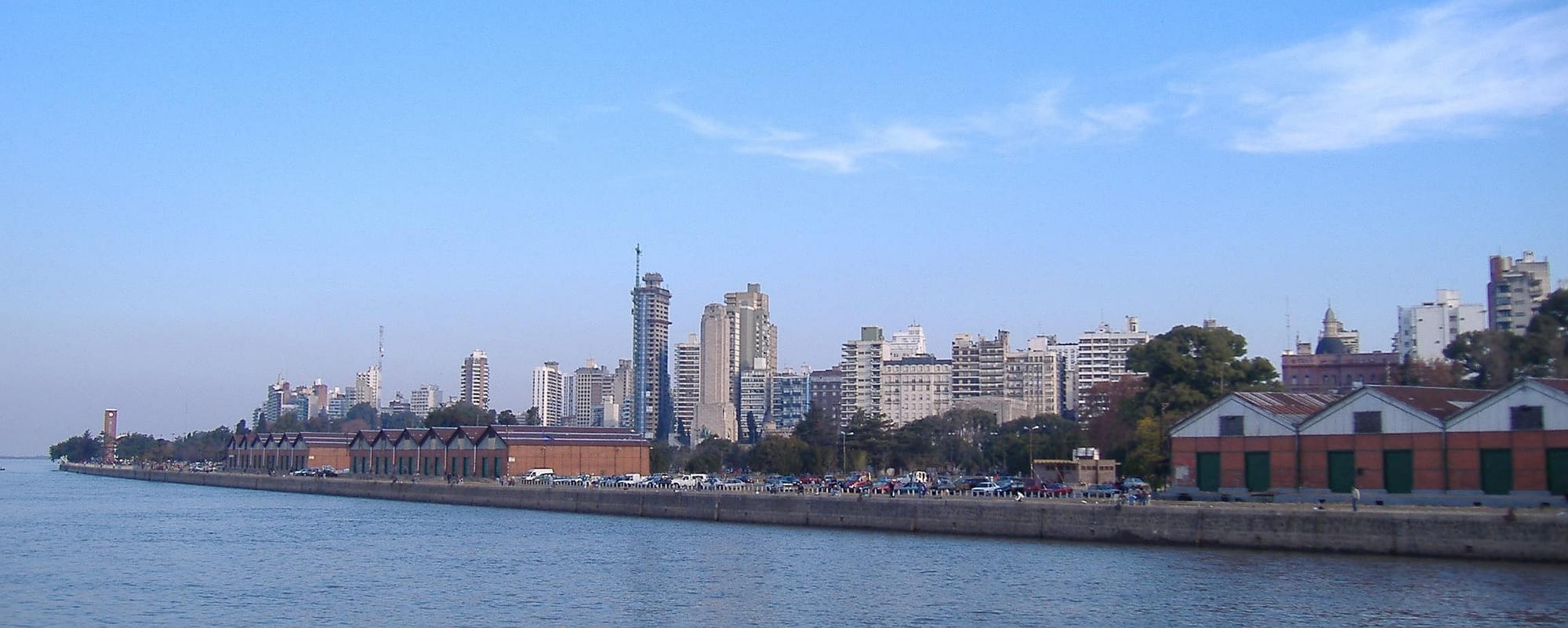
Rosario's riverside towers and red-brick port warehouses along a quay, seen across the blue water of the Paraná under a clear sky

Córdoba & the Pampas, Argentina

Rosario

Central Rosario and its riverfront seen from a boat on the Paraná. (Pablo D. Flores / Wikimedia Commons · CC BY-SA 3.0)

Argentina's third city, on the west bank of the Paraná about 300 km north-west of Buenos Aires. The place where Manuel Belgrano first raised the national flag in 1812 grew into the grain port of the Pampas and a city of immigrants; today its riverfront parks, museums in old port buildings and football rivalry define it, alongside a long struggle with drug-gang violence.

Neighbourhoods

  • Centro
    • First-time visitors
    • Historic district
    • Close to public transport

    The old core between the river, Oroño Boulevard and Pellegrini Avenue. Plaza 25 de Mayo holds the Cathedral and the town hall, the Flag Memorial stands just below, and Córdoba Street becomes a pedestrian street, part of it known as the Paseo del Siglo.

    Open in Maps
  • The riverfront
    • Parks
    • Views
    • Bars and cafés

    A chain of parks and promenades on land recovered from the port and the railways, running north from the Flag Memorial past the Parque de España and the Parque de las Colectividades. Former port grain silos now hold the contemporary art museum, facing the Paraná islands.

    Open in Maps
  • Pichincha
    • Nightlife
    • Antiques
    • Best for food

    A district whose brothels made it the city's red-light quarter in the early 20th century, now a cultural hub known for its bars, restaurants, antique shops and the Sunday antiques fair, Feria Retro La Huella.

    Open in Maps
  • Alberdi and La Florida
    • Beaches
    • Families
    • Summer

    The riverside in the north of the city, with La Florida's public river beach and its views of the islands and the Rosario–Victoria Bridge.

    Open in Maps
  • Fisherton
    • Quiet and residential
    • Close to the airport

    A leafy district at the western edge of the city, formerly home to senior staff of the English railway companies, near the international airport.

    Open in Maps

Things to do

Famous landmarks

  • National Flag Memoriallandmark

    The monumental complex by the Paraná, inaugurated on 20 June 1957, with a 70-metre tower and a civic courtyard, commemorating Belgrano's first raising of the flag nearby in 1812.

    Open in Maps
  • Rosario Cathedrallandmark

    The late 19th-century cathedral on Plaza 25 de Mayo, on the site of the parish church of 1731, with an Italian altar of Carrara marble.

    Open in Maps
  • Palacio de los Leoneslandmark

    The neo-Renaissance town hall of 1898, named for the two lions on its steps, copied from those of Genoa's cathedral.

    Open in Maps
  • Oroño Boulevardlandmark

    A palm-lined boulevard laid out in 1868, running from the river through the centre past the mansions of the city's old families.

    Open in Maps
  • Che Guevara's birthplacelandmark

    The apartment building at the corner of Urquiza and Entre Ríos streets where Ernesto Guevara was born in 1928; a bronze statue of him was unveiled in the city in 2008.

    Open in Maps

Museums

  • Castagnino Fine Arts Museummuseum

    One of the most important art museums in Argentina outside Buenos Aires, in a building of 1936 in Parque de la Independencia.

    Open in Maps
  • Museum of Contemporary Art of Rosariomuseum

    The MACRo, opened in 2004 in a set of brightly painted former grain silos on the riverfront at the end of Oroño Boulevard.

    Open in Maps
  • Estévez Decorative Art Museummuseum

    A wealthy family's mansion on Plaza 25 de Mayo, bequeathed to the city with its furniture, paintings and sculpture and opened as a museum in 1968.

    Open in Maps
  • Julio Marc Provincial Historical Museummuseum

    A provincial museum founded in 1939 in Parque de la Independencia, with archaeology, colonial Spanish-American art, coins and pre-Columbian textiles and silverwork.

    Open in Maps

Parks and the river

  • Parque de la Independenciapark

    The city's great central park, holding museums, Newell's Old Boys' stadium, sports clubs and the former Jockey Club racecourse.

    Open in Maps
  • Parque de Españapark

    A riverside park and Spanish cultural centre near the historic centre, with a theatre and exhibition halls, partly designed by Oriol Bohigas.

    Open in Maps
  • La Florida beachbeach

    The public river beach in the north of the city, busy on hot summer days, with views of the islands and the bridge.

    Open in Maps
  • Boat trips to the Paraná islandsattraction

    Boats leave from the terminal near the Flag Memorial for the islands of the delta opposite the city, with river beaches and views back to the skyline.

    Open in Maps

Football

  • Estadio Marcelo Bielsaattraction

    Newell's Old Boys' ground in Parque de la Independencia, opened in 1911 and named in 2009 after the former coach.

    Open in Maps
  • Estadio Gigante de Arroyitoattraction

    Rosario Central's stadium in the north of the city, opened in 1926 and a venue of the 1978 World Cup.

    Open in Maps

Short trips from the city

  • San Carlos Conventlandmark

    In San Lorenzo, north of the city, the convent beside which San Martín's grenadiers won the battle of San Lorenzo; convent and battlefield are National Historic Monuments.

    Open in Maps
  • Rosario–Victoria Bridge and Victoriaattraction

    A 59 km road link of bridges and embankments across the Paraná delta, opened in 2003, leading to the Entre Ríos town of Victoria with its riverside beach and casino.

    Open in Maps

Seasonal events

  • Flag Day20 June

    The national celebration of the flag, held at the National Flag Memorial on the anniversary of Belgrano's death, with official ceremonies and crowds in the riverside park.

  • Carnival in Victoriasummer weekends, January to early March

    Parades and dances across the bridge in Victoria through a long carnival season.

Eat and drink

Long-standing places and food districts in Rosario. Hours, ratings and directions come from your maps app, always current.

Rosario classics

  • Carlitocafe

    Rosario's own toasted sandwich of ham and cheese with ketchup, served in the city's bars and cafés.

    Open in Maps
  • Riverside fish restaurantsneighborhood

    Rosario's cooking uses fish from the Paraná, such as boga, pacú and surubí.

    Open in Maps

Food districts and markets

  • Pichinchaneighborhood

    The city's busiest district for eating and drinking out, with bars and restaurants in old houses.

    Open in Maps
  • The riverfrontneighborhood

    Bars along the river, including the finger-food bars of La Florida.

    Open in Maps

Experience Rosario

History

Rosario has no founder and no founding date. The area was settled slowly in the 18th century as the Pago de los Arroyos, the land of the streams; a parish church stood on the site of today's cathedral from 1731, and the settlement is usually dated to 1793, when it had a few hundred inhabitants. On 27 February 1812 General Manuel Belgrano raised the newly created Argentine flag for the first time on the banks of the Paraná here, and Rosario has called itself the cradle of the flag ever since.

The town was declared a city in 1852. Rosas had shut the port to foreign trade in 1841; after his fall Rosario became the export port for the grain of the Pampas and grew at speed: by 1887 it had about 50,000 people, 40 per cent of them European immigrants, and by 1926 more than 400,000, almost half foreign-born. The immigrants made it a politically progressive city, in contrast to the more conservative provincial capital, Santa Fe.

The 20th century brought industry and hard times too: in 1995 unemployment in the area reached 21 per cent. The Socialist Party governed the city from 1989 to 2019, and the riverbank, long closed off by port and railway land, was opened as a chain of parks. The Flag Memorial was inaugurated in 1957 and the Rosario–Victoria Bridge in 2003. From the 1990s the city became a centre of the drug trade, and gang violence made it the most violent large city in Argentina, with 2022 the worst year on record.

Culture & Customs

Rosario is the city of the flag, and its identity is built around the memorial and the river. It is also known as the birthplace of Che Guevara, born here in 1928, and of the footballers Lionel Messi and Ángel Di María, whose murals appear around the city. In December 2022 more than 700,000 people gathered at the Flag Memorial to celebrate Argentina's World Cup win.

Football is close to a religion. Newell's Old Boys, who play in Parque de la Independencia, and Rosario Central, from Arroyito in the north, share one of the fiercest rivalries in the country, dividing the city's loyalties. Music matters too: in the 1980s the Trova rosarina, launched by Juan Carlos Baglietto's album Tiempos difíciles, brought a generation of local songwriters to the whole country, among them Fito Páez, now one of Argentina's best-known musicians.

The city has a large university population, about 70,000 students, a strong theatre and arts scene, and cultural centres in converted port buildings along the river. The riverbank is the shared living room: on warm evenings rosarinos walk, run and drink mate along the costanera, and on summer weekends they cross to the islands or crowd the beach at La Florida.

Daily Life

About a million people live in the city, and about 1.46 million in Greater Rosario, the third-largest urban area in Argentina, according to the 2022 census. The metropolitan area spreads along the Paraná to the north and south but not east, where the river and its islands begin.

The economy is the Pampas' grain trade: the ports of Greater Rosario are among the world's largest exporters of grain, flour and vegetable oils, and the region also makes cars, food-industry machinery and bus bodies. Services, banking and the universities employ many more. Wealth divides sharply between the comfortable central districts and poor settlements on the city's edges, where most of the violence has been concentrated.

Daily life follows the Argentine rhythm of late dinners and long weekends around the asado, football and the river. Insecurity has been a dominant local issue since the late 2000s, alongside inflation and jobs; between 2021 and 2022 the city was also repeatedly covered by smoke from fires in the wetlands of the Paraná delta.

Food

Rosario's own contribution to Argentine food is the carlito, a toasted sandwich of ham and cheese with ketchup, eaten in bars and cafés at any hour. Beyond it, the city eats the classics of the Pampas: asado on Sundays, milanesas, empanadas and big pizzas, washed down with chopp, draught beer.

The river gives Rosario a second tradition. Fish from the Paraná — surubí, a large catfish, boga and pacú — are a feature of the city's cooking, and the town of Victoria across the delta is at the centre of the river fishing industry. Chupín, a stew of river fish such as surubí, belongs to the same river tradition.

The bakeries sell facturas and medialunas for breakfast and merienda, and the alfajor santafesino of the province — round biscuits filled with dulce de leche and coated in Italian meringue — is the province's own. Pichincha and the converted warehouses of the riverfront are where the city goes to eat and drink out.

Planning tools

Budget

Rosario is cheaper than Buenos Aires and close in cost to Córdoba, helped by a large student population that keeps bars and cafés affordable. Hotels are concentrated in the centre and near the river. Riverfront parks, the Flag Memorial plaza and the La Florida beach cost little or nothing; boat trips to the islands are the main extra.

Daily Budget Midrange
USD 80–150 (central hotel, parrilla or river-fish dinners, museums, an island boat trip)
Daily Budget Shoestring
USD 35–60 (hostel bed, bakery and bar meals, city buses)

Stay in the centre or near the river, and treat all peso prices as provisional.

Best Time to Visit

Spring (September–November) and autumn (March–May) are the most comfortable for walking the riverfront. Summer is hot and humid, but it is the season for the river beaches and the islands. On 20 June the Flag Memorial hosts the main Flag Day celebrations.

Suggested Number of Days

Two days suit a first visit to the city itself. An extra day or two allows for time out on the water and across the delta in Entre Ríos, and summer, when the river beaches are open, is when most people stay longer.

First Visit
2 days
With Surroundings
3–4 days

Transportation

City buses and a trolleybus line cover the city, and taxis are plentiful. The centre and the riverfront are walkable, and the riverside paths suit cycling. Boats run from the terminal near the Flag Memorial to the islands opposite the city.

Use app or radio taxis at night, and buy a rechargeable card for the buses.

Airport & Station Connections

Rosario – Islas Malvinas International Airport is about 13 km west-north-west of the centre, with domestic flights and some regional international routes. Buenos Aires is about 300 km away by long-distance bus or car. Córdoba is reached by bus or air, and the Rosario–Victoria Bridge carries the road east into Entre Ríos.

Walkability

The centre is flat, laid out on a grid and easy to walk, with the pedestrian stretch of Córdoba Street and the riverside promenades the pleasant routes. The parks along the river run for several kilometres to the north, and La Florida and the stadiums need a bus or taxi.

Safety

Argentina is relatively safe by regional standards, and violent crime against visitors is uncommon. Rosario has had the highest murder rate of any large Argentine city because of drug-gang violence, largely in outlying barrios well away from the riverfront and centre. In the centre the usual risks are bag-snatching and phone theft.

Stay in central Rosario, use app or radio taxis at night, and avoid the informal settlements on the city's edges. Check current official travel advice before travelling.

Climate

Humid subtropical, like Buenos Aires, and known for changeable weather. The seasons are those of the southern hemisphere — summer is December to February.

Summer
hot and humid, with highs above 35°C when northerly winds bring humid air from Brazil
Winter
usually milder than in other Argentine cities, with average lows of about 4°C in the coldest month

Local Customs

Rosarinos are proud of the flag, the river and their footballers, and the city's loyalties divide sharply between Newell's Old Boys and Rosario Central; wearing either club's colours to the wrong ground is unwise. Life runs late, with dinner after nine, and friends greet each other with a kiss on the cheek.

A tip of about 10 per cent is usual in restaurants. Treat the Flag Memorial as a national monument, and dress modestly in churches.

Common Payment Methods

The currency is the Argentine peso. Cards and bank transfers are widely accepted, and cash machines are common in the centre; carry some cash for buses, kiosks, fairs and island boats, and some US dollars in good condition as a backup.