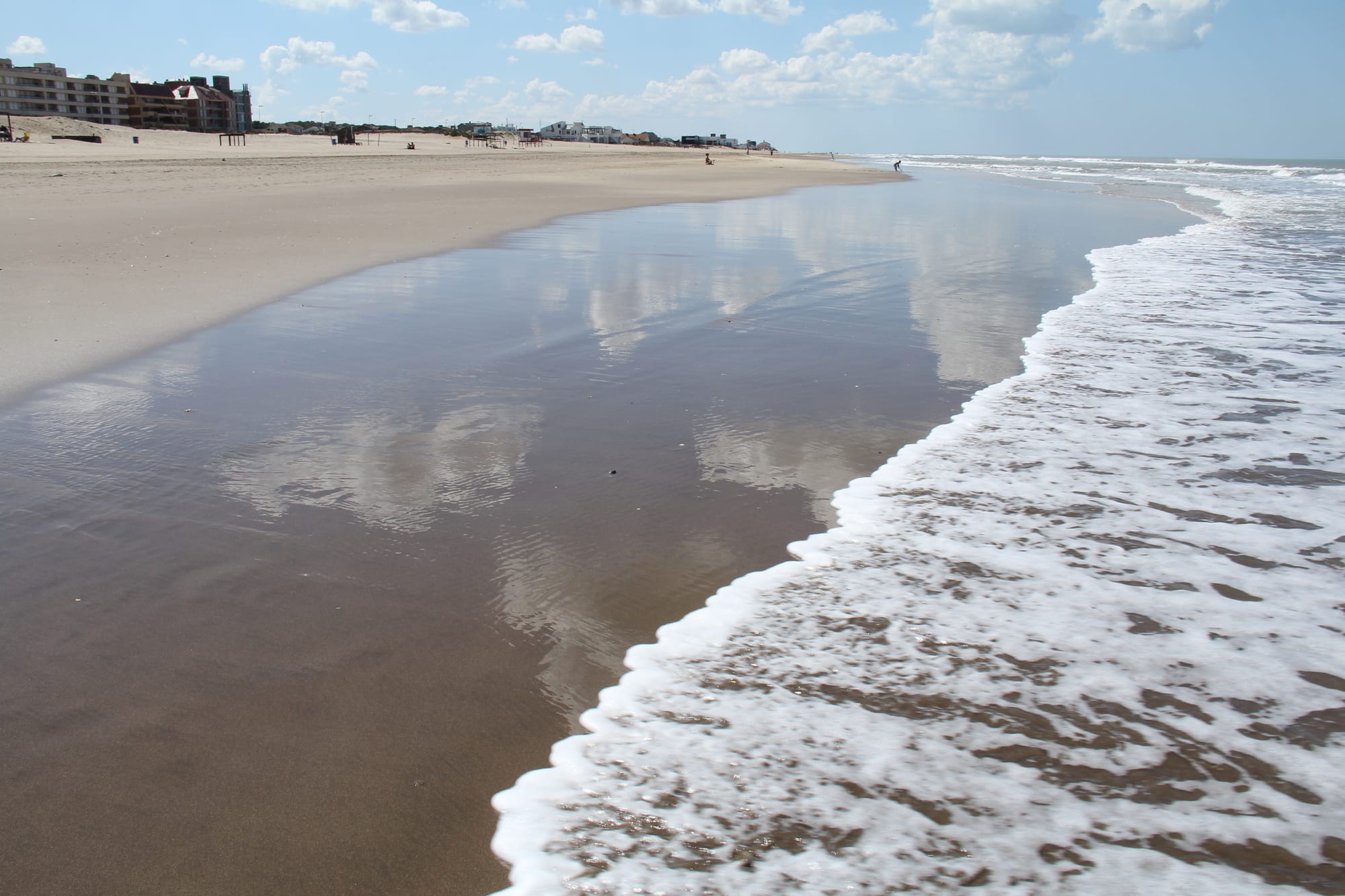
A wide pale beach at Pinamar, wet sand reflecting the clouds beside white surf, with low apartment blocks along the shore

Buenos Aires, Argentina

Pinamar

The beach at Pinamar on the Atlantic coast of Buenos Aires Province. (FERNANDA.CORTI / Wikimedia Commons · CC BY-SA 4.0)

A planned seaside resort on the Atlantic coast of Buenos Aires Province, about 350 km south-east of the capital. Laid out from 1941 by the architect Jorge Bunge on shifting dunes that were fixed with planted pines, it opened in 1943 and is now a town of curving streets, gardens and forest that fills with visitors from December to February.

Neighbourhoods

  • Central Pinamar
    • First-time visitors
    • Beaches
    • Best for food

    The original town laid out by Jorge Bunge, with streets that curve to follow the dunes. Avenida Bunge, the main avenue, runs down to the sea past shops, restaurants and the bus terminal, and at its seaward end the Parque del Mar opens onto the beach.

    Open in Maps
  • Ostende
    • Quiet and residential
    • Historic district
    • Beaches

    The first town founded in what is now the Partido de Pinamar, in 1913, by Belgian and Italian investors who hoped to copy the Belgian resort it is named after. Lying just south of central Pinamar, it is quieter, and its beaches keep their original dunes, covered with tamarisks.

    Open in Maps
  • Valeria del Mar
    • Families
    • Quiet and residential

    A small resort south of Ostende, founded in 1947 by Valeria Guerrero, the landowner who partnered Bunge, on the coastal land she still held. It is calmer than the centre.

    Open in Maps
  • Cariló
    • Nature and forest
    • Upmarket stays

    The southernmost of the district's resorts, a dense planted forest of pines on about 5 km of seafront where the roads are all sandy tracks. Houses and hotels stand among the trees, and a small centre of shopping galleries holds restaurants and cafés.

    Open in Maps

Things to do

Beaches and the town

  • Pinamar's beachesbeach

    A long, wide sandy shore running the length of the district, about 25 km in all, lined with beach clubs that rent tents and sunshades in summer; the town rebuilt its balnearios on a smaller scale to win back space on the sand.

    Open in Maps
  • Pinamar pierlandmark

    The town's pier, from which boats go out for sport fishing; Pinamar's first pier was opened in 1945.

    Open in Maps
  • Plazoleta Arquitecto Jorge Bungepark

    A small square on the town's main avenues with monuments to the pioneers and to Bunge, the architect who planned the town.

    Open in Maps

The forest resorts

  • Carilóneighborhood

    A resort set inside a planted forest begun in the 1920s by Héctor Manuel Guerrero, with sandy lanes good for walking, cycling and riding, a golf course and wide sandy beaches, most of them free and open to the public.

    Open in Maps
  • Ostendeneighborhood

    The first town founded in what is now the Partido de Pinamar, in 1913, whose early promenade and buildings were partly buried by the moving dunes before the area was forested.

    Open in Maps

Short trips from the town

  • Villa Gesellattraction

    A larger and livelier resort to the south, founded in 1931 by Carlos Gesell as a pine plantation on the dunes, with about 10 km of beach.

    Open in Maps
  • Mar de las Pampasneighborhood

    A quiet, low-density resort of pine forest and dunes south of Villa Gesell.

    Open in Maps
  • Mar del Plataattraction

    Argentina's biggest seaside resort and one of its major fishing ports, with a seaside casino complex of 1939, further south along the coast.

    Open in Maps

Seasonal events

  • Concerts in the ForestJanuary

    A long-running summer music programme held in Cariló's hotels and at its tennis club.

  • Verano Planetaweekly in January and February

    A free weekly meeting between well-known Argentine writers and their readers, organised by the publisher Editorial Planeta.

Eat and drink

Long-standing places and food districts in Pinamar. Hours, ratings and directions come from your maps app, always current.

Food districts

  • Avenida Bungeneighborhood

    The town's main avenue and commercial centre, with shops, restaurants and cafés running down towards the beach.

    Open in Maps
  • Cariló's shopping galleriesneighborhood

    More than 20 rustic and modern shopping galleries among the pines, with cafés and restaurants alongside clothing shops.

    Open in Maps
  • The beach clubscafe

    The balnearios along the shore serve drinks, snacks and simple meals to people spending the day on the sand.

    Open in Maps

Experience Pinamar

History

In the 19th century this stretch of the Atlantic coast was a belt of bare, moving dunes, part of the estates of Felicitas Guerrero, which later passed to her family. Early attempts at resorts struggled with the sand: at Ostende, founded in 1913 by the Belgian Fernando Robette and the Italian Agustín Poli, the dunes buried much of the promenade. To the south, Héctor Manuel Guerrero began planting pines on his land in the early 1920s, the start of the forest of Cariló.

In the late 1930s the architect Jorge Bunge formed a partnership with Valeria Guerrero, owner of the dunes north of Ostende. From 1941 the company fixed the sand on a large scale with pines and other trees, and Bunge drew a town plan whose curving streets followed the shape of the dunes. Pinamar opened as a resort on 14 February 1943, the provincial government approved the master plan in 1944, and the first lots were sold in 1945, the year the church, school, golf course and first pier were completed. A railway service from Buenos Aires ran from 1949 to 1967.

Valeria Guerrero founded Valeria del Mar on her own land in 1947, and Cariló was later divided into lots. Bunge died in 1961. In 1978 the resorts were separated from General Madariaga to form a new municipality, renamed the Partido de Pinamar in 1983, which takes in Pinamar, Ostende, Valeria del Mar and Cariló. The town has kept a strict building code.

Culture & Customs

Pinamar is above all a summer place. The town's identity rests on Bunge's plan — low houses with open gardens set among trees — and on its reputation as one of the more fashionable resorts on the coast, popular with families from Buenos Aires who return to the same street and the same beach club every year. Cariló, with its forest and unpaved lanes, has an even quieter and more exclusive image.

Summer brings a calendar of shows and concerts. The Teatro Municipal de la Torre and the Cine-Teatro Oasis stage theatre during the season, a free weekly series of meetings with Argentine writers runs through January and February, and Cariló holds a long-running series of concerts in its hotels and tennis club. The town has also hosted a film meeting between Argentine and European cinema organised with the national film institute, INCAA.

Life outdoors is the point: surfing, bodyboarding, windsurfing and sailing at sea, sport fishing from boats leaving the pier, golf on the district's courses, and riding, cycling and walking in the forest. Residents and visitors take pride in the trees, and local campaigns have pressed for rules to keep plastic off the beaches.

Daily Life

The Partido de Pinamar, which takes in the four towns, had 39,449 residents at the 2022 census. The population rises many times over in summer, when the district receives well over a million visitors across the season, and falls back to a small-town routine from autumn to spring, when many shops, restaurants and beach clubs close.

Tourism and the services that support it are the economy, and many residents work hard during the summer months to carry them through the year. Most homes are detached houses in gardens, and the town's strict planning rules and the protection of the forest are part of local life. Traffic, on the streets and on the beaches, is the summer complaint.

Out of season the pace is slow: people walk dogs on the empty beach, the forest is quiet, and weekend visitors from Buenos Aires keep some places open. The loss of the passenger train service in 2025 left the town depending on roads and long-distance buses.

Food

Pinamar eats in the Argentine coastal manner: parrillas grilling beef, chorizo and morcilla, pizzerias and pasta houses, and seafood such as rabas, fried squid rings. Long evenings end at heladerías, ice-cream shops making Italian-style ice cream, where dulce de leche, milk caramel, is the favourite flavour.

The beach day has its own food: sandwiches and snacks from the beach clubs, facturas, the sweet pastries from the bakeries, and mate passed round under the tents. Medialunas, small sweet croissants, with coffee are the standard breakfast and afternoon merienda.

Avenida Bunge and the streets around it hold most of the town's restaurants and cafés, and Cariló's galleries among the pines have their own cluster of cafés and restaurants. Many visitors rent houses with their own grill, and the family asado in the garden, with beef, sausages and salad shared slowly over the afternoon, is as much a part of a Pinamar summer as any restaurant meal.

Planning tools

Budget

Pinamar and Cariló are among the more expensive resorts on the Argentine coast. Prices peak in January and early February, when accommodation is hard to find and beach-club tents are charged by the day or the season; outside summer many places close and rooms are much cheaper. Renting a house or flat for a week is the usual way Argentine families stay.

Daily Budget Midrange
USD 120–220 (hotel or apartment, parrilla dinners, a beach-club tent, taxis)
Daily Budget Shoestring
USD 50–80 (hostel bed or shared rental, bakery breakfasts, pizza and empanadas, local buses)

Book well ahead for January and the Carnival long weekend, and treat all peso prices as provisional.

Best Time to Visit

The beach season runs from December to February, when the town is full, the beach clubs are open and the summer events are on. March is calmer, with warm days and fewer people. From April to November Pinamar is quiet, many businesses shut, and the appeal is walking in the forest and on empty beaches.

Suggested Number of Days

A weekend gives a feel for the town and the beach. Most Argentine visitors stay a week or more in summer, and the forest resorts to the south and the larger towns along the coast justify extra days.

First Visit
2–3 days
With Surroundings
4–7 days

Transportation

Pinamar is spread out along the coast, and many visitors bring a car. Local buses link the centre with Ostende, Valeria del Mar and Cariló, and taxis and bicycles are common. Cariló's roads are unpaved sand, and four-wheel drives and quad bikes use some stretches of beach and dune.

Cycling is the easiest way between the resorts in summer, when parking near the beach is scarce.

Airport & Station Connections

Most people arrive by road from Buenos Aires, about 350 km to the north-west, on Provincial Route 11 and National Route 2, by car or by long-distance bus to the terminal on Avenida Bunge. Passenger trains to the nearby Divisadero de Pinamar station were suspended in April 2025. The nearest airport is at Villa Gesell, and Astor Piazzolla International Airport at Mar del Plata lies further south.

Walkability

The centre is easy on foot, and Avenida Bunge leads straight to the beach. The district stretches a long way along the shore, so the walk to Valeria del Mar or Cariló is long, and the soft sand of the beach and forest lanes is tiring. Many streets curve and change direction, following Bunge's plan.

Safety

Argentina is relatively safe by regional standards, and violent crime against visitors is uncommon. Pinamar is a calm resort; the usual risks are theft from cars and unattended bags on the beach in the busy season. The sea brings strong waves and currents, and vehicles on the sand are a hazard in places.

Swim where lifeguards are on duty, keep valuables out of sight on the beach and in cars, and take care where quad bikes and 4x4s use the dunes. Check current official travel advice before travelling.

Climate

A mild oceanic climate, moderated by the sea, with an average annual temperature of about 15°C. The seasons are those of the southern hemisphere — summer is December to February — and the coast is often windy.

Summer
warm rather than hot, well above the annual mean of about 15°C, with cooler evenings and cool sea water
Winter
cool, damp and windy, below the annual mean of about 15°C, with a largely empty town

Local Customs

Pinamar's summer follows the Argentine rhythm: late breakfasts, long days on the beach, dinner after nine and nights out that start late. Greetings among friends are a single kiss on the cheek. Families often rent a beach tent for the whole season and share mate on the sand.

A tip of about 10 per cent is usual in restaurants. Keep swimwear for the beach and town streets, and respect the rules that protect the dunes and trees.

Common Payment Methods

The currency is the Argentine peso. Cards and transfers are widely accepted in shops and restaurants, and cash machines are found in the centre; carry some cash for beach stalls and small purchases, and some US dollars in good condition as a backup.