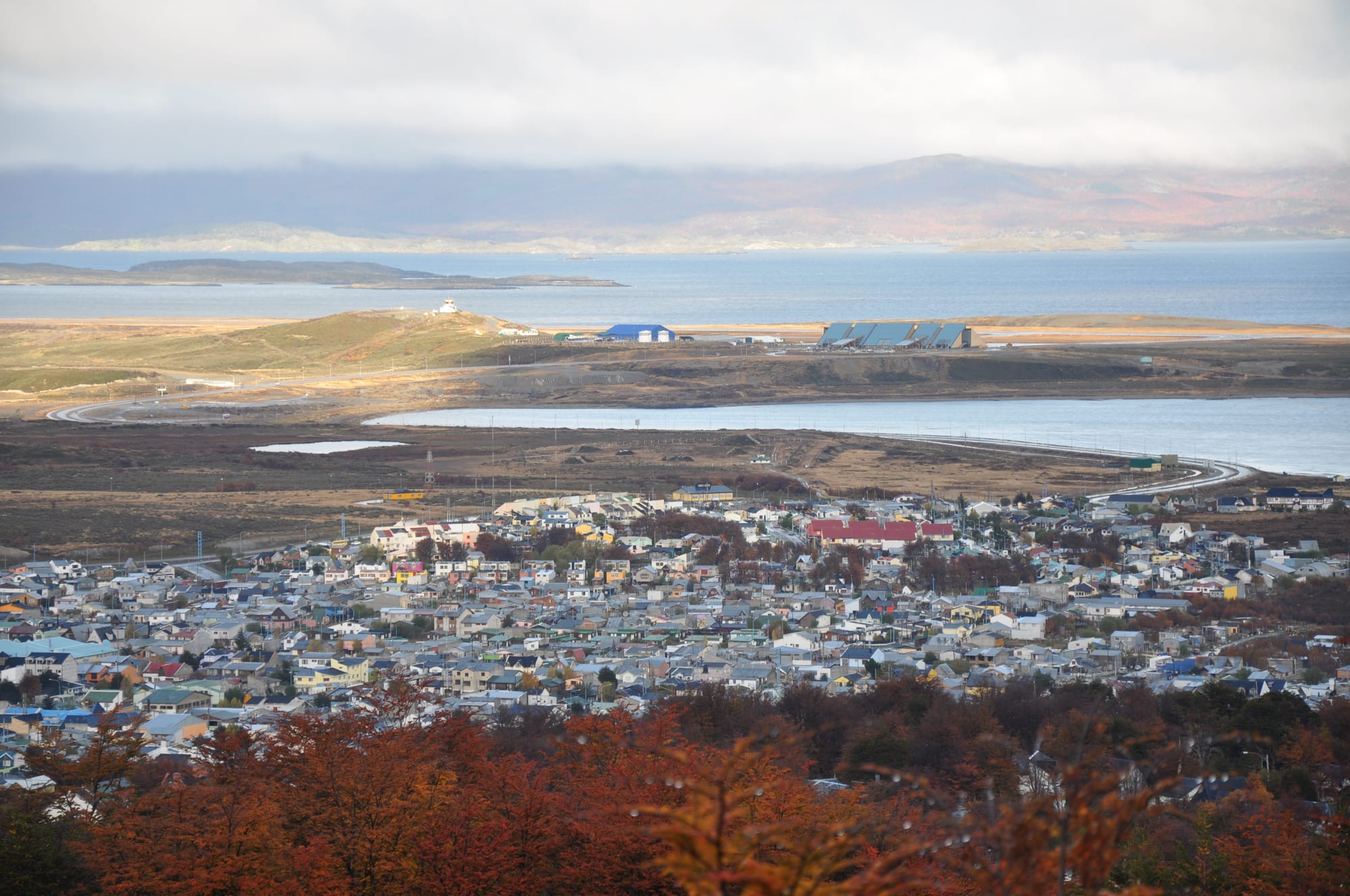
Rows of low houses in Ushuaia above autumn-red trees, with a lagoon, the airport and the Beagle Channel beyond

Patagonia, Argentina

Ushuaia

Ushuaia's houses on the shore of the Beagle Channel, seen from the wooded slopes above the town in autumn. (Jorge Láscar from Australia / Wikimedia Commons · CC BY 2.0)

The capital of Tierra del Fuego Province, on a wide bay of the Beagle Channel below the Martial mountains, which claims the title of the world's southernmost city. Founded as a mission and then a prison town, it is now a port, a small industrial centre and the main departure point for tourist ships to the Antarctic Peninsula, with a national park on its doorstep.

Neighbourhoods

  • City centre and San Martín
    • First-time visitors
    • Best for food
    • Shopping

    The grid of streets a block or two up from the bay, with San Martín as the main shopping street. Outdoor-gear and souvenir shops, the tourist office, restaurants and cafés are here, and most of the town's sights can be reached on foot.

    Open in Maps
  • The waterfront and Maipú
    • Harbour views
    • Museums
    • Boat trips

    The seafront avenue along Ushuaia Bay, with the pier where Beagle Channel boats and Antarctic expedition ships tie up, and the Malvinas memorial square. Many restaurants line Maipú and the streets just behind it.

    Open in Maps
  • The Martial road and the hillside
    • Mountain views
    • Quiet stays
    • Hiking

    The road that climbs north-west from the centre through forest towards the Martial glacier. Many of the larger hotels stand along it, with views over the town and the channel, and walking trails start at its top.

    Open in Maps

Things to do

Museums and memorials

  • Museo Marítimo y del Presidiomuseum

    The old prison, which held re-offenders and some political prisoners from 1896 until it closed in 1947, now a group of museums on the prison, maritime history, Antarctica and art.

    Open in Maps
  • Museo del Fin del Mundomuseum

    A museum of Tierra del Fuego's history and natural history, in two buildings on the seafront avenue Maipú.

    Open in Maps
  • Plaza Malvinaslandmark

    A seafront square on Maipú with a memorial to the 1982 war over the Falkland Islands (Malvinas), a place of national remembrance in Argentina.

    Open in Maps

The Beagle Channel

  • Beagle Channel boat tripsattraction

    Catamarans and smaller boats sail from the town pier past islands where sea lions and cormorants gather, on the strait between Tierra del Fuego and the Chilean islands to the south.

    Open in Maps
  • Les Eclaireurs Lighthouselandmark

    A lighthouse on one of the small Les Eclaireurs islands east of the town in the Beagle Channel, reached on short boat tours — not, despite the name often given to it, Jules Verne's lighthouse at the end of the world.

    Open in Maps

Walks and viewpoints

  • Martial Glaciertrail

    A small glacier on the ridge directly above the town, reached by a hiking trail from the end of the Martial road, with wide views over Ushuaia and the channel; it has retreated considerably over the past century.

    Open in Maps
  • Laguna Esmeraldatrail

    A green glacial lake in the mountains about 15 km north-east of the town, reached by a popular trail across the Tierra Mayor valley.

    Open in Maps

Short trips from the city

  • Tierra del Fuego National Parkpark

    A park of southern beech forest, lakes and coast created in 1960, a short way west of the town, with the Coastal Path to Lapataia Bay and the southern end of the Pan-American Highway.

    Open in Maps
  • End of the World Trainattraction

    A narrow-gauge steam railway that revives the prison's old freight line for timber and stone, now running as a heritage train into the national park.

    Open in Maps
  • Cerro Castorattraction

    The southernmost ski resort in the world, opened in 1999 about 26 km from the city, with one of the longest seasons among Argentina's ski centres.

    Open in Maps
  • Estancia Harbertonattraction

    The farm founded in 1886 by the missionary Thomas Bridges, still run by his descendants, with gardens, replica Yaghan huts and a marine mammal museum; penguins nest on nearby Isla Martillo.

    Open in Maps

Seasonal events

  • MarchablancaAugust

    A cross-country ski march open to all, held each year in the Tierra Mayor valley and created in the 1980s by the Club Andino Ushuaia.

  • Ushuaia Loppetwinter

    A cross-country skiing marathon, held since 1986.

Eat and drink

Long-standing places and food districts in Ushuaia. Hours, ratings and directions come from your maps app, always current.

Ushuaia classics

  • Centolla (southern king crab)restaurant

    The city's signature — centolla, the southern king crab, served by many of the seafood restaurants in the centre.

    Open in Maps
  • Patagonian lambrestaurant

    Lamb roasted slowly al asador, split on an iron cross beside an open fire, served at the city's grill restaurants.

    Open in Maps

Food districts

  • San Martín and Maipúneighborhood

    Most of Ushuaia's restaurants, cafés and bars are clustered on the main shopping street and the seafront avenue, a block apart.

    Open in Maps

Experience Ushuaia

History

The Yaghan, or Yámana, people lived along the shores of the Beagle Channel for thousands of years, travelling by canoe between the islands to hunt sea lions and gather shellfish; the name Ushuaia comes from their language and means roughly "deep bay". HMS Beagle, under Robert FitzRoy, reached the channel in January 1833. British missionaries of the South American Mission Society came next: Waite Stirling lived with the Yámana in 1869, and in 1870 a mission was set up around a prefabricated house brought from the Falklands for the Reverend Thomas Bridges.

Argentina asserted its rule after the 1881 boundary treaty with Chile. On 12 October 1884 Commodore Augusto Lasserre's South Atlantic expedition established an official subprefecture here, and the next year Ushuaia was named capital of the territory. Epidemics of typhus, measles and whooping cough devastated the Yámana, and by 1911 the mission had closed. The state chose to settle the far south with a prison: re-offenders and some political prisoners arrived from 1896, a military prison was merged in 1910, and the convicts cut timber, built much of the town and laid the railway that is now the End of the World Train.

President Perón closed the prison in 1947 because of reports of abuse and harsh conditions; most guards stayed, and the buildings passed to the navy before becoming a museum. The naval base was active in the 1982 Falklands/Malvinas War, and the cruiser General Belgrano, later sunk, had sailed from the port. Tierra del Fuego became a province in 1990, and a special tax and customs regime for industry, along with fishing and tourism, has helped turn a remote outpost into a growing city.

Culture & Customs

Ushuaia's identity is built on its position: "the end of the world", fin del mundo, appears on the train, the museum, the post office and countless signs. The claim to be the world's southernmost city is part of that pride; Puerto Williams on the Chilean side of the channel lies farther south, but it is a village of a couple of thousand people, and Argentina's tourism authorities keep using the slogan.

The town also carries a strong sense of national memory. The Malvinas war is commemorated on the seafront, a radio station in the city carries the islands' name, and the province's official name includes the South Atlantic islands and the Antarctic sector that Argentina claims. The Yaghan heritage is remembered in museums and at Harberton, although the last native speaker of the language died in 2022.

Winter sport is unusually central for an Argentine city. Ice hockey has a local league and an international Copa del Fin del Mundo, an Olympic-size outdoor rink opened in 2010, and cross-country races are held in the Tierra Mayor valley. Since 2007 the city has also hosted the Bienal del Fin del Mundo, a contemporary art biennial with artists from around the world.

Daily Life

About 80,000 people lived in Ushuaia at the 2022 census, up from 1,558 in 1914, drawn from all over Argentina by industrial jobs, public employment and tourism. The original grid along the bay is now ringed by newer neighbourhoods climbing the slopes towards the mountains.

The economy rests on fishing, oil and gas, tourism and assembly factories — electronics plants operate under the special tax regime that applies to Tierra del Fuego — along with the provincial government, the navy and two universities, including the National University of Tierra del Fuego, founded in 2010. The port handles freight and cruise ships, and is the world's major departure port for tourist and scientific expeditions to the Antarctic Peninsula.

Life follows the extremes of the light: summer evenings stay bright until late, while in midwinter there are only around seven hours of daylight. Prices are high because so much arrives by road or sea from far to the north. Winters bring skiing, skating and snow-clearing, and summer brings crowds of visitors on the main streets.

Food

Seafood from the cold southern waters defines Ushuaia's cooking. Centolla, the southern king crab, is the dish visitors come for, and many restaurants in the centre are known for it. Mussels and local fish are also widely served, among them merluza negra, the Patagonian toothfish, and trout. Most of the city's restaurants are clustered around San Martín and Maipú, close to the bay.

Meat is the other half of the menu. Cordero patagónico, Patagonian lamb, is roasted slowly al asador, split and fixed to an iron cross beside an open fire, and many grill restaurants serve it with the usual Argentine beef cuts and chimichurri.

Sweet things follow the rest of Patagonia: jams, sweets and ice cream made from the calafate, the purple berry of the southern steppe. Local beers are served in the town's pubs, and mate, coffee and hot chocolate are the drinks that carry people through the long, cold afternoons.

Planning tools

Budget

Ushuaia is one of the most expensive places in Argentina. Food and most goods are brought thousands of kilometres from the north, rooms are in short supply in the summer season, and boat trips, the train and the national park are paid separately. Antarctic voyages from the port are a separate and very much larger cost.

Daily Budget Midrange
USD 140–260 (hotel, a channel boat trip or the train, crab and lamb dinners)
Daily Budget Shoestring
USD 55–90 (hostel bed, supermarket food and set lunches, local vans and walking)

Book rooms and flights early for January and February, and budget boat trips and park entry separately.

Best Time to Visit

November to March is the main season, when days are long, the boats and trails are busy, and the Antarctic ships come and go. Summer is still cool and windy, with snow possible in any month. From about June to October the town becomes a ski and cross-country centre, with short days and snow on the streets.

Suggested Number of Days

Two or three days cover the town, a boat trip on the channel and the national park. Four or five allow for longer hikes and trips east of the city. Wind and weather often cancel boats and flights, so a spare day is useful, especially before an Antarctic departure.

First Visit
2–3 days
With Surroundings
4–5 days

Transportation

The centre is small and walkable. Minivans and taxis run to the national park, the Martial glacier road and trailheads such as Laguna Esmeralda, and many visitors join tours or hire a car for trips east along the roads into the mountains and to Estancia Harberton.

Roads beyond the city include gravel stretches and can be icy from autumn to spring.

Airport & Station Connections

Ushuaia – Malvinas Argentinas International Airport is about 4 km south of the centre, a short taxi ride, with flights from Buenos Aires, El Calafate and Santiago in Chile. By road, National Route 3 crosses the Andes of Tierra del Fuego to reach the city, and long-distance buses cross the island from the north. Expedition cruise ships for Antarctica sail from the port.

Walkability

The centre and the waterfront are easy to walk, though streets climb steeply up from the bay and are often icy in winter. The wind off the channel makes even short walks cold, and the hillside hotels on the Martial road are a taxi ride or a long uphill walk from the centre.

Safety

Argentina is relatively safe by regional standards, and violent crime against visitors is uncommon. Ushuaia has little crime of concern to visitors. The dangers are natural: sudden changes of weather, cold, wind and snow on mountain trails at any time of year.

Carry warm, waterproof layers on every outing, tell someone the route before hiking, and check road and weather conditions before driving. Check current official travel advice before travelling.

Climate

A cool, cloudy, ocean-moderated climate with little difference between the seasons. Monthly averages stay between about 1°C and 10°C all year, frost and snow are possible in any month, and daylight runs from more than 17 hours in December to just over seven in June. Summer is December to February.

Summer
cool, cloudy and windy — daytime highs around 14°C and nights around 5°C, with occasional snow even in midsummer
Winter
cold but not severe — highs around 4–5°C and lows a little below freezing, with frequent snow, sleet and rain

Local Customs

Customs follow the rest of Argentina: a greeting with a kiss on the cheek among friends, late dinners and shared mate. The Malvinas are a sensitive national subject here, where the naval base played a part in the 1982 war; the islands are called the Malvinas in Argentina, and the memorials are treated with respect.

Tipping around 10 per cent in restaurants is customary. Dress for the cold rather than for style; casual outdoor clothing is normal everywhere, including restaurants.

Common Payment Methods

The currency is the Argentine peso. Cards are widely accepted in hotels, restaurants and tour agencies, and ATMs are found in the centre. A little cash is useful for taxis, vans and small shops, and prices in pesos change quickly with inflation.