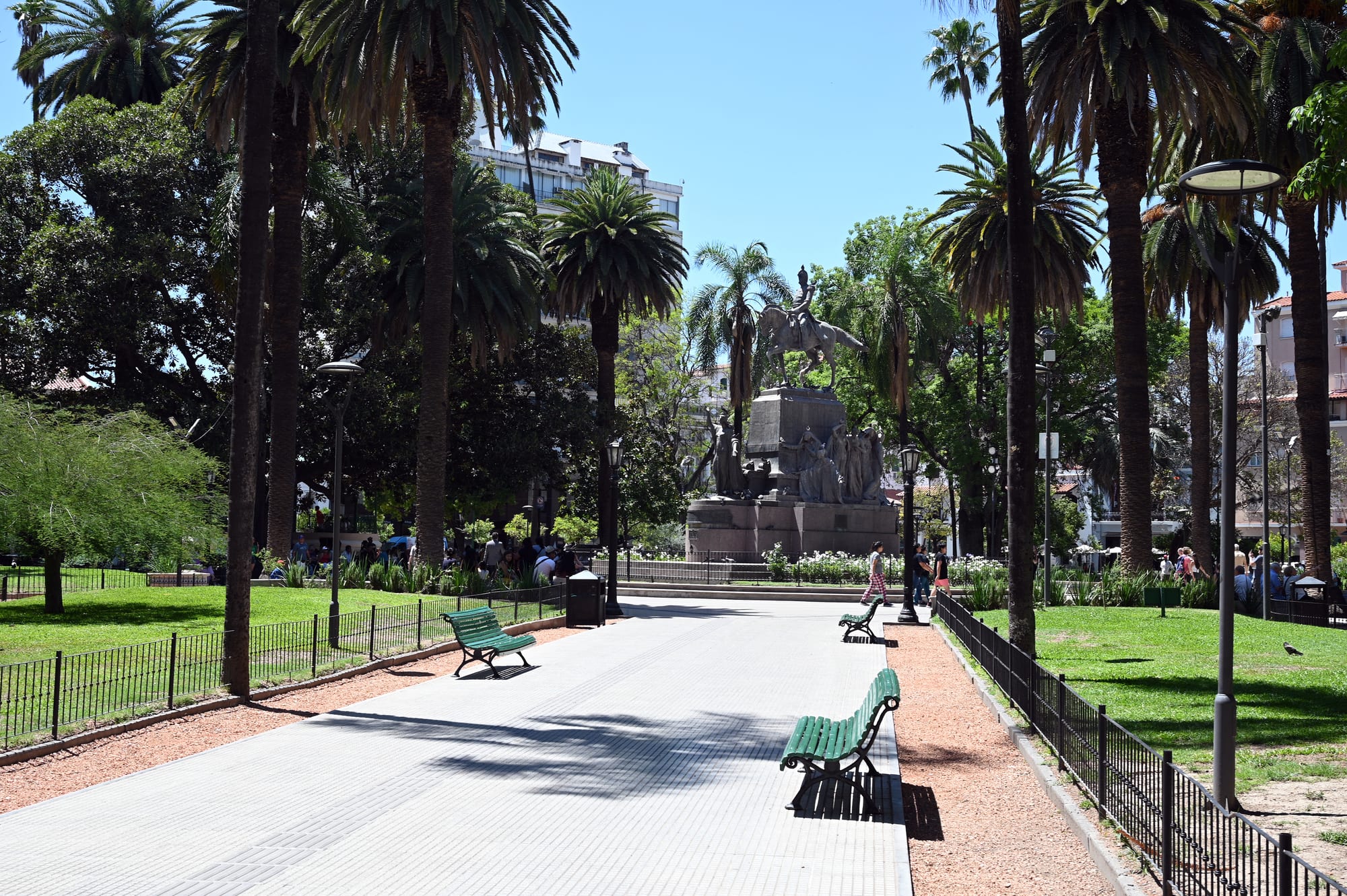
A paved path with green benches between tall palms and lawns leading to an equestrian statue in a sunny square

Salta & the Northwest, Argentina

Salta

Palms and paths in Plaza 9 de Julio, the main square of Salta. (P. Hughes / Wikimedia Commons · CC BY 4.0)

The capital of Salta Province, at about 1,200 metres in the Lerma Valley below the Andes. Founded in 1582 as a staging post between Lima and Buenos Aires and defended by Güemes's gauchos in the independence wars, it keeps an arcaded colonial plaza, painted churches and a lively folk-music scene, and is the base for the Calchaquí valleys and the Train to the Clouds.

Neighbourhoods

  • The historic centre
    • First-time visitors
    • Historic district
    • Museums

    The blocks around Plaza 9 de Julio, the heart of the colonial city, with the cathedral, the arcaded Cabildo, the MAAM and the basilica of San Francisco within a few minutes of each other. Pedestrian streets such as Florida carry shoppers, cafés and the city's oldest buildings.

    Open in Maps
  • La Balcarce
    • Nightlife
    • Folk music
    • Sunday craft fair

    The stretch of Balcarce Street nearest the railway station, the centre of Salta's nightlife. Peñas, restaurants, bars and clubs fill the pavements at night, and on Sundays the street closes to traffic for an arts and crafts fair.

    Open in Maps
  • Parque San Martín and the foot of San Bernardo
    • Views
    • Parks
    • Walks

    The green east side of the centre, where the cable car leaves Parque San Martín for the summit of Cerro San Bernardo. Nearby, the Güemes monument stands at the foot of the hill, at the start of the long stairway to the top.

    Open in Maps
  • Tres Cerritos
    • Quiet and residential
    • Local life

    A garden-suburb district to the north-east, laid out on the hillsides in the 20th century with curving streets, named after three natural mounds. It is residential and leafy, a short taxi ride from the centre.

    Open in Maps
  • San Lorenzo
    • Quiet and green
    • Day out

    A separate town just west of the city, with homes set on green hillsides; it began as a summer retreat and is known for its fresher, cooler climate.

    Open in Maps

Things to do

Famous landmarks

  • Salta Cathedrallandmark

    The cathedral on Plaza 9 de Julio, seat of the Archbishop of Salta and home of the images of the Lord and the Virgin of the Miracle, a national monument since 1941.

    Open in Maps
  • Cabildo of Saltalandmark

    The colonial town hall on the plaza, seat of the city's authorities from 1626 to 1888, with a long two-storey arcade; the present building dates from the 1780s and is often called the most complete surviving cabildo in Argentina.

    Open in Maps
  • Basilica of San Franciscolandmark

    The Franciscan church and convent in the centre, with a terracotta-and-ivory façade and a bell tower 54 metres high, a national monument and a minor basilica since 1992.

    Open in Maps
  • Convent of San Bernardolandmark

    One of the oldest buildings in the city, built in the late 16th or early 17th century and a national monument since 1941.

    Open in Maps
  • Güemes Monumentlandmark

    A monument about 25 metres high to Martín Miguel de Güemes at the foot of San Bernardo hill, at the end of the Paseo Güemes, where the stairway to the summit begins.

    Open in Maps

Museums

  • Museum of High Altitude Archaeology (MAAM)museum

    A museum on the plaza devoted to the Inca capacocha ceremonies, which conserves the Children of Llullaillaco, three children found on the summit of the volcano in 1999.

    Open in Maps
  • Museo Histórico del Nortemuseum

    The history museum housed in the colonial Cabildo on the main square.

    Open in Maps
  • Museum of Contemporary Artmuseum

    A gallery of contemporary art on Plaza 9 de Julio, opened in 2004, with changing exhibitions of artists from Salta and beyond.

    Open in Maps

Parks and viewpoints

  • Cerro San Bernardoviewpoint

    The hill rising about 285 metres above the city to the east, a municipal nature reserve whose summit looks over Salta and the whole Lerma Valley; it is reached by road, by a stairway of about 1,020 steps, or by cable car.

    Open in Maps
  • San Bernardo cable carattraction

    A cable car opened in 1988 that climbs about a kilometre from Parque San Martín to the summit of San Bernardo hill.

    Open in Maps

Markets and nights out

  • Balcarce Streetneighborhood

    The nightlife strip by the railway station, with peñas where folk musicians play late into the night, and an arts and crafts fair on Sundays.

    Open in Maps
  • Estadio Padre Ernesto Martearenaattraction

    The 20,000-seat stadium built for the 2001 FIFA World Youth Championship, home ground of Juventud Antoniana and Central Norte and an occasional venue for the Pumas rugby team.

    Open in Maps

Short trips from the city

  • Tren a las Nubesattraction

    The Train to the Clouds, a tourist service on the Salta–Antofagasta line: travellers ride by bus from Salta to San Antonio de los Cobres and take the train to the La Polvorilla viaduct, about 4,220 metres above sea level.

    Open in Maps
  • Los Cardones National Parkpark

    A national park of dry slopes covered in giant cardón cacti, west of the city in the Cachi and San Carlos departments.

    Open in Maps
  • Cachiattraction

    A small adobe town in the Calchaquí Valleys, the capital of its department, below snow-capped peaks.

    Open in Maps
  • San Antonio de los Cobresattraction

    A high Puna town, capital of the Los Andes Department, where the Tren a las Nubes now begins its run to the viaduct.

    Open in Maps

Seasonal events

  • Festival of the Lord and the Virgin of the MiracleSeptember

    The feast of Salta's patrons, culminating on 15 September, when huge processions carry the two images from the cathedral and pilgrims arrive on foot from across the province.

  • Homage to GüemesJune

    The anniversary of the death of Martín Miguel de Güemes on 17 June 1821, marked with gaucho cavalcades, vigils, parades, guitar sessions and serenades.

  • CarnivalFebruary or March

    Comparsas and murgas parade in the weeks before Lent; the district of Villa Cristina is known for its carnival groups.

  • April Culture FestivalApril

    A month of cultural performances, a craft exhibition and orchestral concerts across the city.

Eat and drink

Long-standing places and food districts in Salta. Hours, ratings and directions come from your maps app, always current.

Salta classics

  • Empanadas salteñasrestaurant

    Small, juicy empanadas filled with knife-cut beef, potato, hard-boiled egg, chives and pepper, baked in a clay oven or fried.

    Open in Maps
  • Peñas on Balcarce Streetneighborhood

    Restaurants and clubs where folk musicians play while guests eat regional dishes such as empanadas and locro.

    Open in Maps

Food districts and markets

  • The central marketmarket

    The city's central market, a few blocks from the main square, where locals shop for food.

    Open in Maps
  • Cafés around Plaza 9 de Julioneighborhood

    Cafés under the arcades around the main square, where people sit over coffee and medialunas in the afternoon.

    Open in Maps

Experience Salta

History

Diego de Almagro's expedition crossed the plains west of the present city in 1536 on its way to Chile, skirmishing with the peoples of the valley. The city itself was founded on 16 April 1582 by Hernando de Lerma, who meant it as an outpost on the long road between Lima and Buenos Aires. Its position made it rich: Salta prospered as a supplier of goods to the silver city of Potosí, and a seat of colonial authority whose Cabildo was rebuilt in the late 18th century.

In the War of Independence Salta lay on the front line against royalist armies coming from Peru. Manuel Belgrano defeated them at the Battle of Salta in 1813, and between 1816 and 1821 the local leader Martín Miguel de Güemes, working with José de San Martín, defended the city and the north with gaucho guerrillas. Güemes died of his wounds in June 1821 and became the city's great hero.

The city came out of the wars in political disarray and financially bankrupt, a condition that lasted for much of the 19th century. Recovery came in the late 19th and early 20th centuries with Italian, Spanish, British and Arab immigrants — Syrians and Lebanese above all — who revived trade and farming, and with the railway. In recent decades Salta has grown into the seventh-largest city in Argentina and the main tourist gateway to the north-west.

Culture & Customs

Salta is often called the most Spanish-looking city in Argentina, with an arcaded plaza and churches that remind Spanish visitors of Andalusia. Its culture, though, is a blend of Spanish, gaucho and Indigenous Andean traditions, and the city is proud of that identity. Gauchos turn out on horseback for the Güemes anniversary in June, and the poncho salteño is the best known of Argentina's provincial ponchos.

Faith is central. Every September the Lord and the Virgin of the Miracle, the city's patrons, are carried in procession from the cathedral, and pilgrims arrive on foot from across the province. Carnival, with comparsas and murgas from districts such as Villa Cristina, and an April culture festival fill other parts of the calendar.

Music is the city's other great tradition. Salta is one of the homes of Argentine folk music, and its peñas — restaurants and clubs with live folk music — are concentrated along Balcarce Street. Football is followed passionately, above all Juventud Antoniana, Gimnasia y Tiro and Central Norte, and Salta players are known nationally for baseball.

Daily Life

The city had about 630,000 people at the 2022 census and is the centre of the Lerma Valley metropolitan area, which holds more than half of the province's population. As the provincial capital it lives from government, commerce, education — the city has the National University of Salta and the Catholic University of Salta — health services and a large tourist trade, while the surrounding province farms tobacco, beans and sugar cane.

The centre keeps its colonial grid, offices and shops; around it spread residential districts from leafy Tres Cerritos to large newer neighbourhoods on the city's edges, and the metropolitan area takes in valley towns such as Cerrillos and Vaqueros. The provincial government moved its offices to the Grand Bourg civic centre in 1987 to relieve the congested centre.

The day has a long midday break: shops close for the siesta and reopen into the evening, when the plaza and the pedestrian streets fill again and dinner rarely starts early.

Food

Salta's food is the cooking of the Andean north-west, built on maize, potatoes, squash and beef. The empanada salteña is its pride: small and juicy, filled with knife-cut beef, potato, hard-boiled egg, chives and pepper, and baked in a clay oven or fried. Since 2003 the city has marked 4 April as Empanada Salteña Day.

Maize appears everywhere. Humitas are fresh maize paste with onion and cheese cooked in maize husks; tamales are maize dough filled with meat and wrapped in husks; locro, a thick stew of maize, beans and squash with sausage and other meats, is a regional staple. Quesillo, a soft fresh cheese, is eaten with honey or cayote, a squash preserve, as dessert.

Wine comes from Cafayate, a few hours to the south, and Torrontés, the floral white grape of the Calchaquí valleys, is poured in restaurants all over the city. Salta also has its own local beer. The peñas of Balcarce Street serve regional food with live folk music, and the cafés under the arcades of Plaza 9 de Julio are the place for coffee and medialunas.

Planning tools

Budget

Salta is one of the cheaper Argentine cities: empanadas, set lunches and peña dinners cost less than in Buenos Aires, and guesthouses near the centre are good value. The bigger costs are the excursions — the Tren a las Nubes, the day tours to Cafayate, Cachi and the Puna, or a hire car.

Daily Budget Midrange
USD 80–160 (colonial-style hotel, peña dinners, museum tickets, guided tours or a hire car)
Daily Budget Shoestring
USD 30–55 (hostel bed, empanadas and set menus, local buses)

Several of the best things — the plaza, the churches, the walk up San Bernardo and the Sunday fair on Balcarce — cost nothing.

Best Time to Visit

April to November, the dry season, has clear skies and open mountain roads, and is the best time for excursions to the Puna. The September fiesta fills the city. Summer (December–March) is warm and green but brings almost daily thunderstorms, and heavy rain can cut the mountain roads.

Suggested Number of Days

Two or three days are enough for the city itself. Most visitors use Salta as a base for the valleys and the Puna, and with those excursions a stay grows to five days or a week; the long distances and the need to get used to altitude are what stretch the number.

First Visit
2–3 days
With Surroundings
5–7 days

Transportation

The centre is compact and walkable, and city buses and plentiful taxis cover the rest. A limited commuter train runs west to Campo Quijano via Rosario de Lerma. For the valleys and the Puna most visitors take tours or hire a car, as bus links on some routes are sparse.

Plan trips to high altitude after a few days in Salta, and carry identification for road checkpoints.

Airport & Station Connections

Martín Miguel de Güemes International Airport is about 7 km south-west of the centre, a short taxi ride, with flights to Buenos Aires and other Argentine cities and to Lima. The bus station is about eight blocks from the main plaza, with long-distance coaches across the country and to Cafayate, about four hours south.

Walkability

The colonial centre is flat, compact and pleasant on foot, with arcades and pedestrian streets around the plaza; Balcarce, Parque San Martín and the foot of San Bernardo are within walking distance. The stairway up the hill is steep, and the city sits at about 1,200 metres, so the climb takes effort.

Safety

Argentina is relatively safe by regional standards, and violent crime against visitors is uncommon. In Salta the usual risk is petty theft, especially around the bus station.

Keep phones and bags out of sight in busy places, use registered taxis at night, and take time to adjust before excursions to the Puna. Check current official travel advice before travelling.

Climate

A subtropical highland climate with four seasons. In the southern hemisphere summer is December–February: here it is warm with thunderstorms on most days, and more than 80 per cent of the year's rain falls between December and March. Winters are very dry, with sunny days and cold nights.

Summer
warm and stormy — days around 26–28°C, nights around 15–16°C
Winter
dry and sunny — days around 19°C, nights about 3°C, with frequent frost

Local Customs

Salta is more traditional and more religious than Buenos Aires: the September fiesta is a major act of faith, and processions are not tourist shows. Greetings with a kiss on the cheek are normal, and life follows a long afternoon siesta, with shops reopening into the evening and dinner late. A tip of about 10 per cent is usual in restaurants.

Dress modestly in churches, ask before photographing people in processions, and treat the Llullaillaco children at the MAAM with the respect due to human remains.

Common Payment Methods

The currency is the Argentine peso. Cards are widely accepted in hotels, restaurants and larger shops, and ATMs are common in the centre; cash is still useful for markets, taxis and small shops, and some US dollars are a sensible backup.