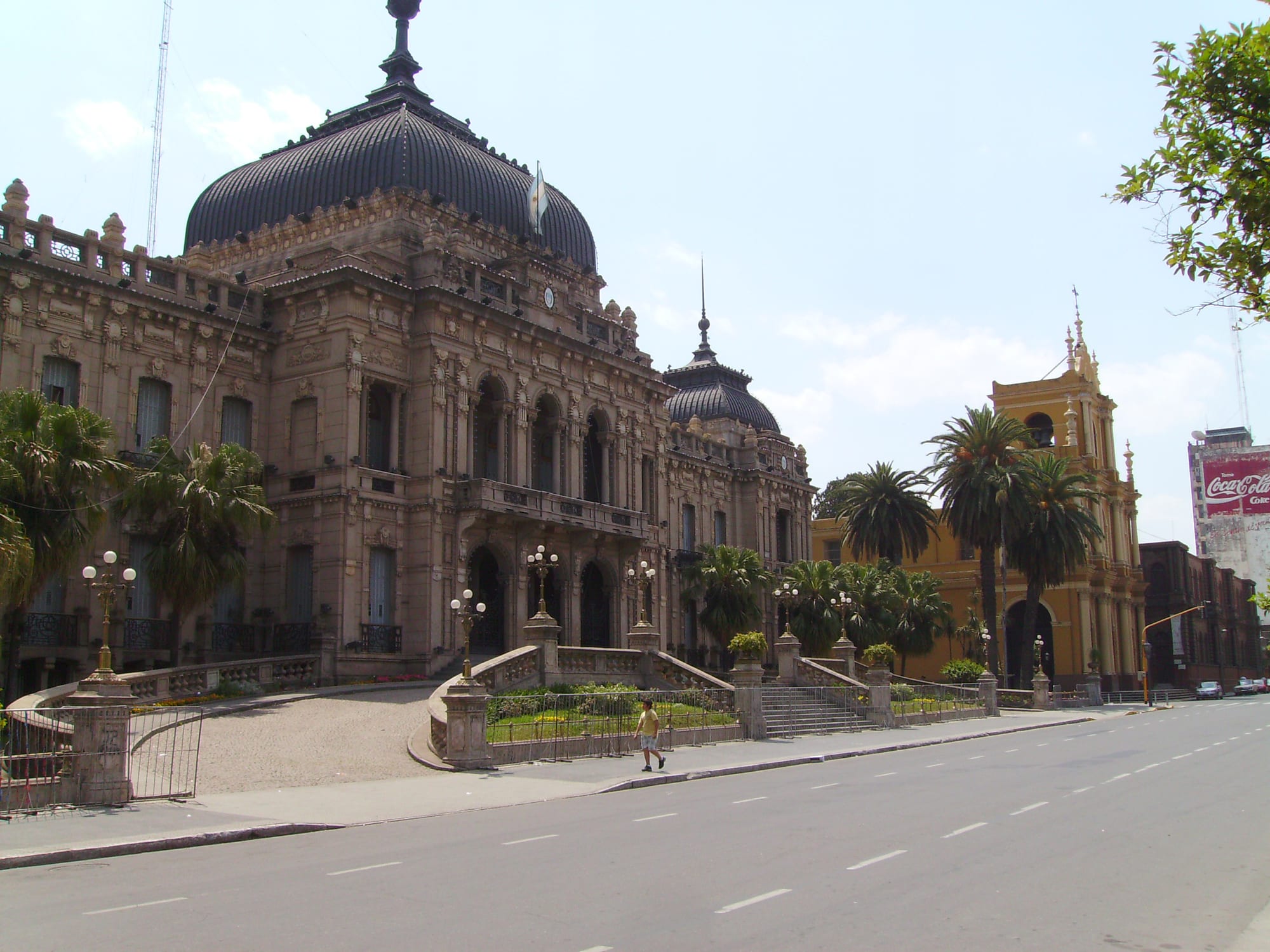
The domed stone Government House beside palm trees, with the yellow San Francisco church further along the street

Salta & the Northwest, Argentina

San Miguel de Tucumán

The Government House on Plaza Independencia in San Miguel de Tucumán, with the church of San Francisco beyond. (bullit / Wikimedia Commons · CC BY 3.0)

The capital of Tucumán Province and the largest city of Argentina's north-west, set on the plain below the forested Sierra de San Javier. Independence was declared here in 1816, and sugar cane made it rich in the century that followed. Today it is a busy university and commercial city of plazas, ornate public buildings and two fiercely rival football clubs.

Neighbourhoods

  • The historic centre
    • First-time visitors
    • Historic district
    • Close to public transport

    The grid of streets around Plaza Independencia, the old Plaza Mayor, where the Government House, the cathedral and the church of San Francisco face the square. The Casa Histórica is a few blocks south, and the shopping streets, theatres and most of the city's hotels and cafés are close by.

    Open in Maps
  • Parque 9 de Julio and the bus station
    • Parks
    • Close to public transport

    The eastern side of the centre, about five blocks from the main square, where the large park laid out by Charles Thays meets the city's big long-distance bus station. Joggers, families and weekend picnics fill the park; the streets around the terminal are busier and plainer.

    Open in Maps
  • Yerba Buena
    • Quiet and residential
    • Bars and restaurants

    A separate, fast-growing town on the western edge of the conurbation, at the foot of the Sierra de San Javier. Mostly residential, with gated communities and shopping centres, it comes alive at weekends along Avenida Aconquija, lined with restaurants, bars and cafés, and is the way up to the hill.

    Open in Maps
  • Ciudadela
    • Football
    • Local life

    A working district south-west of the centre, near the site of La Ciudadela, the circular fortress Belgrano built after the 1812 battle. It is the home of San Martín de Tucumán, whose stadium takes the district's name, and its streets fill with the club's supporters on match days.

    Open in Maps

Things to do

Famous landmarks

  • Casa Histórica de la Independenciamuseum

    The colonial house where the Congress of Tucumán declared independence on 9 July 1816. Demolished almost entirely in 1903, it was rebuilt to its original layout in the 1940s and is now a national museum and historic monument.

    Open in Maps
  • Government Houselandmark

    The seat of the provincial government, facing Plaza Independencia, completed in 1910 and inaugurated on 9 July 1912; it remains one of the most architecturally significant buildings in the region.

    Open in Maps
  • San Miguel de Tucumán Cathedrallandmark

    The cathedral on the main square, whose foundations date from the city's move to its present site in 1685; its present appearance comes from the architect Pierre Etcheverry's rebuilding, inaugurated in 1856.

    Open in Maps

Museums

  • Timoteo Navarro Museum of Fine Artsmuseum

    The province's leading art museum, with Argentine painting and sculpture in the city centre.

    Open in Maps

Parks and the hills

  • Parque 9 de Juliopark

    The city's largest park, designed by Charles Thays and opened on the centenary of independence in 1916, with a lake, a rose garden and the house of Bishop Colombres, who introduced sugar cane to Tucumán in 1821.

    Open in Maps
  • Cerro San Javierviewpoint

    The forested hill west of the city, covered in cloud forest and yungas, with views over the plain, paragliding and walking trails, and the 28-metre Cristo Bendicente statue by the Tucumán sculptor Juan Carlos Iramain.

    Open in Maps

Music, sport and nights out

  • Estadio Monumental José Fierroattraction

    The home ground of Atlético Tucumán, the province's oldest football club, founded in 1901; it has also hosted the national rugby team.

    Open in Maps
  • Estadio La Ciudadelaattraction

    The stadium of San Martín de Tucumán, opened in 1932 in the Ciudadela district, with room for about 30,000 supporters.

    Open in Maps

Short trips from the city

  • Tafí Viejoattraction

    A town about 15 km north of the centre, now part of the wider metropolitan area, at the foot of the hills.

    Open in Maps
  • Famailláattraction

    A sugar and strawberry town about 30 km south that calls itself the national capital of the empanada and holds a festival in its honour every September.

    Open in Maps
  • San Isidro de Lulesattraction

    A farming town south-west of the city, founded in 1851 on the site of a former Jesuit reduction and known for its strawberries and blueberries.

    Open in Maps
  • Tafí del Valleattraction

    A cool highland valley about 126 km away by road, where the Jesuits introduced cheese-making; the reservoir of La Angostura and the Parque de los Menhires, a collection of ancient standing stones, are near El Mollar.

    Open in Maps
  • Ruins of Quilmesattraction

    The largest pre-Columbian settlement in Argentina, in the Calchaquí Valleys beyond Tafí, where about 5,000 Quilmes people are thought to have lived at its height.

    Open in Maps

Seasonal events

  • Independence Day9 July

    The national holiday marking the declaration of 1816, which was signed in this city, in the house now known as the Casa Histórica.

  • Fiesta Nacional de la EmpanadaSeptember

    The national empanada festival in Famaillá, south of the city, with music on the stage of the town's amphitheatre.

Eat and drink

Long-standing places and food districts in San Miguel de Tucumán. Hours, ratings and directions come from your maps app, always current.

Tucumán classics

  • Empanadas tucumanasrestaurant

    Juicy empanadas filled with knife-cut beef, baked in a clay oven or fried — a source of provincial pride.

    Open in Maps
  • Humitas, tamales and locrorestaurant

    The northern repertoire of maize dishes — steamed humitas in husks, filled tamales and the thick stew locro — served in regional restaurants and peñas.

    Open in Maps

Food districts and markets

  • The indoor market at Mendoza and Muñecamarket

    A covered city-centre market with stalls selling empanadas, tamales, fruit and vegetables.

    Open in Maps
  • Avenida Aconquija, Yerba Buenaneighborhood

    The main avenue of the western suburb, lined with restaurants, bars and cafés that draw crowds from across the city at weekends.

    Open in Maps

Experience San Miguel de Tucumán

History

The city was first founded on 31 May 1565 by the conquistador Diego de Villarroel, who came south with an expedition from Peru and settled at Ibatín, about 60 km south-west of the present site. Poor water drove the settlers to move in 1685 to La Toma, where the old centre stands today, and the town grew as a waypoint on the route that carried mules, cloth and food north to the silver mines of Potosí.

In the wars of independence Tucumán was on the front line against royalist armies coming from Peru. In September 1812 Manuel Belgrano, ordered by Buenos Aires to fall back to Córdoba, stayed at the request of the townspeople and defeated a royalist army twice the size of his own just outside the city. He then built a circular fortress, La Ciudadela, a kilometre from the main square. Four years later the Congress of Tucumán met in a colonial house in the town and on 9 July 1816 declared the independence of the United Provinces. The house later decayed, was almost entirely demolished in 1903 and was rebuilt to the original plans in the early 1940s.

Bishop José Colombres introduced sugar cane in 1821, and after the railway arrived in the late 19th century sugar mills made the province the "Garden of the Republic". The city added a great park, opened on the centenary of independence in 1916, and its population doubled again by 1930. In 1975 the army's Operativo Independencia against guerrillas in the province brought disappearances and secret detention centres, and since 2008 the city has hosted trials of former military officers for crimes of that era.

Culture & Customs

For decades Tucumán has been one of the country's cultural centres, shaped above all by the National University of Tucumán, founded in 1914, and by a strong folk-music tradition. The singer Mercedes Sosa, the voice of the nuevo cancionero movement, was born here, as was Leda Valladares, who collected and recorded the folk songs of the north. The Teatro San Martín and the Teatro Alberdi stage plays, concerts, opera and ballet through the year.

Independence is the city's defining story: the hall where the declaration was signed survived the demolition of 1903 and stands inside the rebuilt Casa Histórica, now the national museum of independence, and 9 July, the national holiday, carries special weight here. Most people in the city are Catholic, and there are also evangelical, Jewish and Muslim communities.

Football divides the city. Atlético Tucumán, founded in 1901, plays at the Monumental José Fierro, and San Martín, founded in 1909, at La Ciudadela, and the rivalry between their supporters runs through families and workplaces. Rugby is popular too, and the Monumental has hosted the national team.

Daily Life

The Gran San Miguel de Tucumán, which spreads beyond the city into Yerba Buena, Banda del Río Salí, Alderetes and other neighbouring towns, counted about 800,000 people at the 2010 census and is the fifth-largest urban area in Argentina. The city is the commercial centre of a densely populated province whose irrigated fields grow sugar cane, lemons, rice, tobacco and fruit, and the universities, provincial government and hospitals employ many more.

Growth has been uneven. Yerba Buena on the western slopes has become the prosperous side of the conurbation, with gated communities, shopping centres and the busiest weekend restaurant strip, while informal neighbourhoods have spread on the edges of the city since the 1990s. Sewers, housing and public security are constant subjects of local debate, and coordinating services between the capital and its fast-growing neighbours is a long-running problem.

The day follows the rhythm of the north: an early start, a long break after lunch when many shops close, and busy streets again in the evening, when families walk the plazas and Parque 9 de Julio. In summer the heat pushes people up into the hills of San Javier at weekends, and in winter the dry, sunny days bring life outdoors.

Food

Tucumán is fiercely proud of its empanadas: juicy and filled with beef cut by knife rather than minced, baked in a clay oven or fried. The town of Famaillá, just south of the city, calls itself the national capital of the empanada and holds a national empanada festival each September. Humitas, fresh maize paste steamed or boiled in the husk, and tamales, maize dough filled with meat, are everyday food, and locro, a thick stew of maize, beans, squash and pork, is the dish of cold days and of national holidays.

The surrounding countryside supplies the rest of the table. Tafí del Valle has made cheese since the Jesuits introduced dairy farming there, and quesillo, a fresh cheese, is eaten across the north-west with cane syrup or cayote preserve. The province's lemons, strawberries and blueberries reach the city's markets, and its sugar mills explain a sweet tooth for preserves and pastries.

Regional restaurants and peñas, where folk musicians play late into the night, serve these dishes with grilled meat, and the white Torrontés wine of the Calchaquí Valleys is the local choice. Mate is shared everywhere.

Planning tools

Budget

Tucumán is one of the cheaper cities in Argentina to stay in, with inexpensive empanadas, set lunches and city buses. The main extra costs are a hire car or tours for the hills and the valleys to the west. Peso prices change quickly with inflation, so any figure dates fast.

Daily Budget Midrange
USD 80–150 (city-centre hotel, regional restaurants and peñas, taxis, a tour or hire car for the hills)
Daily Budget Shoestring
USD 30–55 (hostel bed, empanadas and market meals, city buses)

Hotel rooms fill around 9 July and big football matches; the plazas, the park and the Casa Histórica's courtyards cost little or nothing.

Best Time to Visit

April to June and August to November are the most comfortable months: warm days, cooler nights and less rain. Summer, from December to February, is hot and wet, though the hills are green and Tafí del Valle is a cool escape. July is mild and dry by day and brings the Independence Day ceremonies.

Suggested Number of Days

The city itself takes a day or two. Allow three or four days to add the hills above the city and a night or more in the highland valleys to the west; mountain roads and bus timetables, rather than distance, set the pace.

First Visit
1–2 days
With Surroundings
3–4 days

Transportation

Around 40 city bus lines serve the centre, and official taxis are white with yellow and black stripes. Traffic is heavy, so a car is little use in the city itself, but it is the easiest way to reach the hills, the valleys and the smaller towns of the province.

Use only official licensed taxis or app-based rides, and allow extra time for the winding road up to Tafí del Valle.

Airport & Station Connections

Teniente General Benjamín Matienzo International Airport is about 12 km east of the city, a short taxi ride, with flights from Buenos Aires and Córdoba. The large central bus station, opened in 1994 beside Parque 9 de Julio, has services to most cities in Argentina; Buenos Aires is about 1,300 km away, an overnight journey by bus.

Walkability

The flat grid of the centre is easy to walk: the main square, the Casa Histórica, the cathedral and the shopping streets are a few blocks apart, and Parque 9 de Julio and the bus station are within walking distance. Pavements are narrow and crowded, and summer heat makes the middle of the day hard going. Yerba Buena and the hills need a bus, taxi or car.

Safety

Argentina is relatively safe by regional standards, and violent crime against visitors is uncommon. In Tucumán the usual urban risks apply: bag-snatching and phone theft in crowded streets and around the bus station, and quieter streets late at night. Football matches between the two big clubs bring large, tense crowds.

Keep phones and bags out of sight in busy streets, use licensed taxis at night, and avoid the area around the stadiums on derby days. Check current official travel advice before travelling.

Climate

A humid subtropical climate with most of the rain in summer. Summer is December to February, and heat waves can push temperatures to 40°C or more; autumn stays warm well into April. Winter is mild and dry, with light frosts on a few nights.

Summer
hot and humid, with daytime highs around 30–31°C, nights near 20°C and frequent thunderstorms
Winter
mild and dry — July averages about 12°C, with sunny days and occasional light frosts

Local Customs

Tucumán keeps the long midday break of the north: many shops close after lunch and reopen in the evening, and dinner starts late. People greet friends with a single kiss on the cheek and are proud of the city's part in independence. Football loyalties, to Atlético or to San Martín, run deep and are best not mocked.

Leaving around 10 per cent in restaurants is customary. Dress modestly in churches, and ask before photographing people at religious events or in markets.

Common Payment Methods

The currency is the Argentine peso. Cards and app payments are widely accepted in the centre, but markets, empanada counters and small shops often prefer cash, and inflation means prices change often. ATMs are common in the centre; carry a few clean US dollar notes as a backup.