History · Czechia
Why does Prague's astronomical clock still run after 600 years?
It has stopped many times. A long line of keepers, a Victorian precision upgrade and a rescue after the 1945 fire have kept Prague's clock going.
By Globeway Editorial · 13 October 2026
The short answer
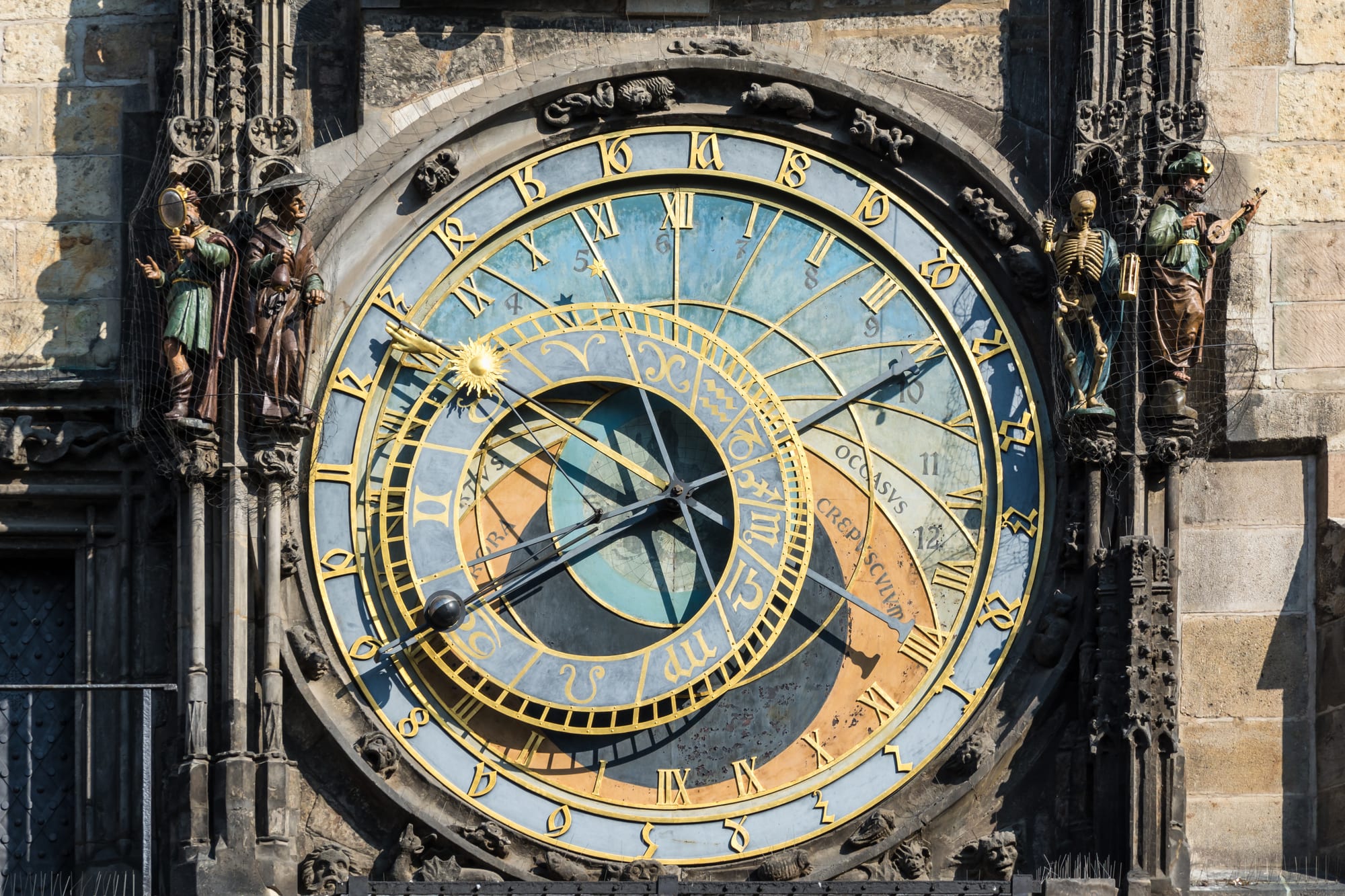
Prague's astronomical clock, the Orloj, has not run without a break for six centuries. It has stopped many times since it was first recorded on 9 October 1410, and it keeps going today because the city has repeatedly paid to repair, improve and rebuild it rather than let it go. It is described as the third oldest astronomical clock in the world and the oldest still working.
Three moments did most of the saving. Repairs in 1787 to 1791 rescued it when the city was thinking of selling it for scrap. In 1865 and 1866 a precise new regulator made it keep good time. After a fire gutted the Old Town Hall in May 1945, it was painstakingly restored and restarted in 1948. A specialist keeper still checks it every week.
A city that kept a clockkeeper
The clock was built in 1410 by the clockmaker Mikuláš of Kadaň, probably to a design by Jan Šindel, a professor of mathematics and astronomy at Prague's university. A document from that year, surviving as a later copy, shows the town council thanking Mikuláš for good work and rewarding him with a house and a large yearly salary. For centuries the credit went instead to a later clockmaster, Jan Růže, known as Hanuš. Legend says the councillors had him blinded so he could never build another, and that in revenge he disabled the clock. Historians now regard his authorship as a mistake, traced to a misread record.
What the legend gets right is that the machine needed constant expert care. From the beginning the city appointed an orlojník, or clockkeeper. Hanuš held the post from 1475 until his death in 1497. A later keeper, Václav Zvůnek, could not keep the complex machine running properly, and after his death in 1552 the council handed it to Jan Táborský of Klokotská Hora, who repaired and improved it, wrote a description of it in 1570 and trained his successor in its secrets.
Prague also told itself stories about the clock. One says the city will suffer if it is neglected; another holds that when the machine stops, war will follow.
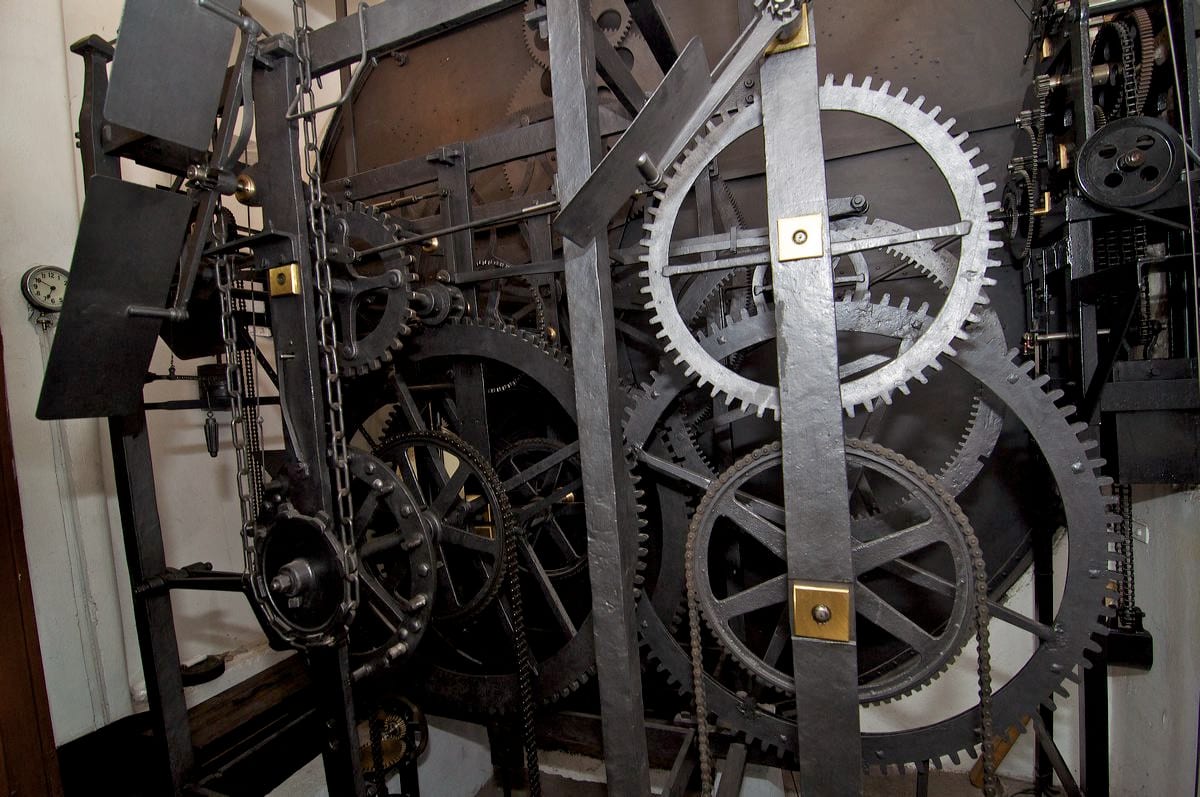
At the heart of the astronomical display are three forged wheels, each 116 centimetres across, with 365 teeth for the zodiac ring, 366 for the Sun and 379 for the Moon, all once turned by a single small gear. The slight differences in tooth count make the Sun creep round the zodiac once a year and the Moon fall behind the Sun.
Saved from the scrapyard
Interest faded over the centuries. By the 18th century the clock was in a critical state, and the city authorities considered selling it as scrap iron. It was rescued by Antonín Strnad, a meteorologist and professor at Charles University, who understood its historical value and persuaded the council to fund a repair. Under his supervision the clockmaker Šimon Landsperger restored it between 1787 and 1791 for 793 gulden. The moving figures of the apostles appear to have been added around this time or a little later.
The upgrade that made it accurate
For most of its life the Orloj was not a precise timekeeper. Its original escapement, the part that releases the gears in steady steps, was a simple type that could drift by up to a quarter of an hour a day. During the great repair of 1865 and 1866 the astronomical functions were set working again and the city commissioned Romuald Božek to fit a new regulator: a chronometer with a seconds pendulum and mercury to compensate for changes in temperature.
Božek's device was not forced into the old machine. Instead it sits beside it and gives the medieval gearing a push once every minute. From midnight on New Year's Day 1866 the clock has been governed by this chronometer, and since then it has erred by no more than about three seconds a week. All the parts are still driven by falling weights; the main drive once hung from a weight of 80 kilograms.
Fire in May 1945
The worst damage came in the last days of the Second World War. During the Prague uprising, German forces fired on the Old Town Square, and on 8 May 1945 the Old Town Hall caught fire. The clock's brick casing shielded the machinery from the worst, but the wooden structure holding the apostles burned, along with the wooden sculptures and the painted calendar dial. The damage looked so serious that replacing the clock with a modern machine was considered.
After a long effort, led above all by the Vesecký brothers, the repaired Orloj started again in 1948, with new apostles carved by Vojtěch Sucharda. Not everything was right: the coloured bands for dawn, day and night were painted wrongly on the dial, so it misreported twilight by up to six hours until the error was fixed in 1979.
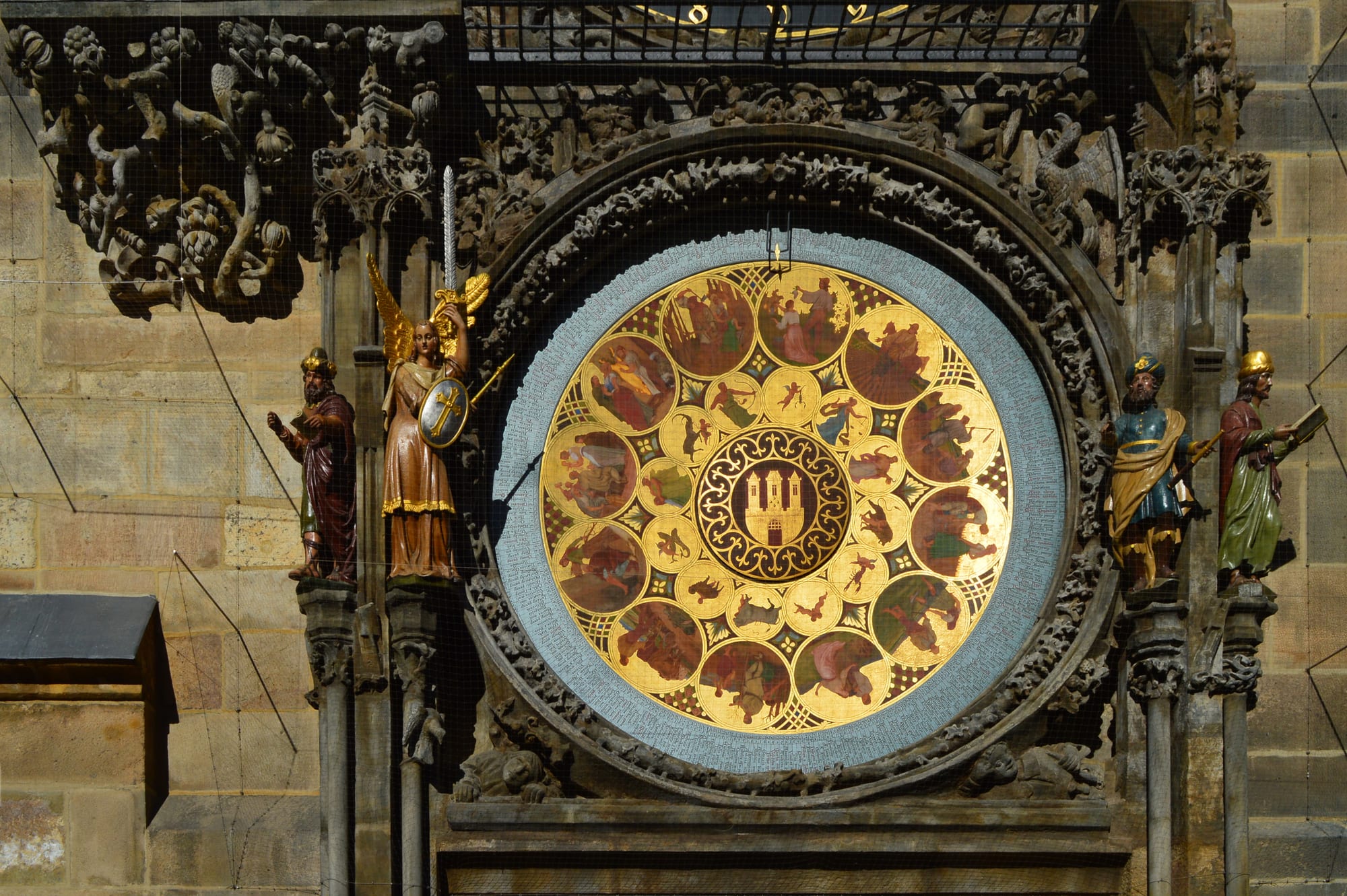
The plate turns by one day each midnight and shows the months, the signs of the zodiac and a church calendar of 365 days. The 2018 copy by Stanislav Jirčík drew complaints that its figures departed from Mánes's originals in age, dress and even gender.
Ropes, weights and a camera
The most recent full restoration ran from January to September 2018. The electric drive fitted in 1948 was removed and the clock returned to its old way of working, with hemp ropes and stone weights, now wound by electric motors hidden in wooden drums. It restarted on 28 September 2018, at the opening of celebrations for the centenary of Czechoslovakia, although on that first run a jammed chain meant the apostles had to be moved by hand. The work cost almost 10 million crowns.
Today the keeper, Petr Skála, inspects the clock every Friday and watches it at home on a monitor fed by a camera in a house opposite. In 2025 a working three-dimensional computer model of the mechanism was made. Every hour in the daytime the skeleton of Death rings its bell, the apostles file past two windows above the dial, and a gilded cockerel crows to end the show.
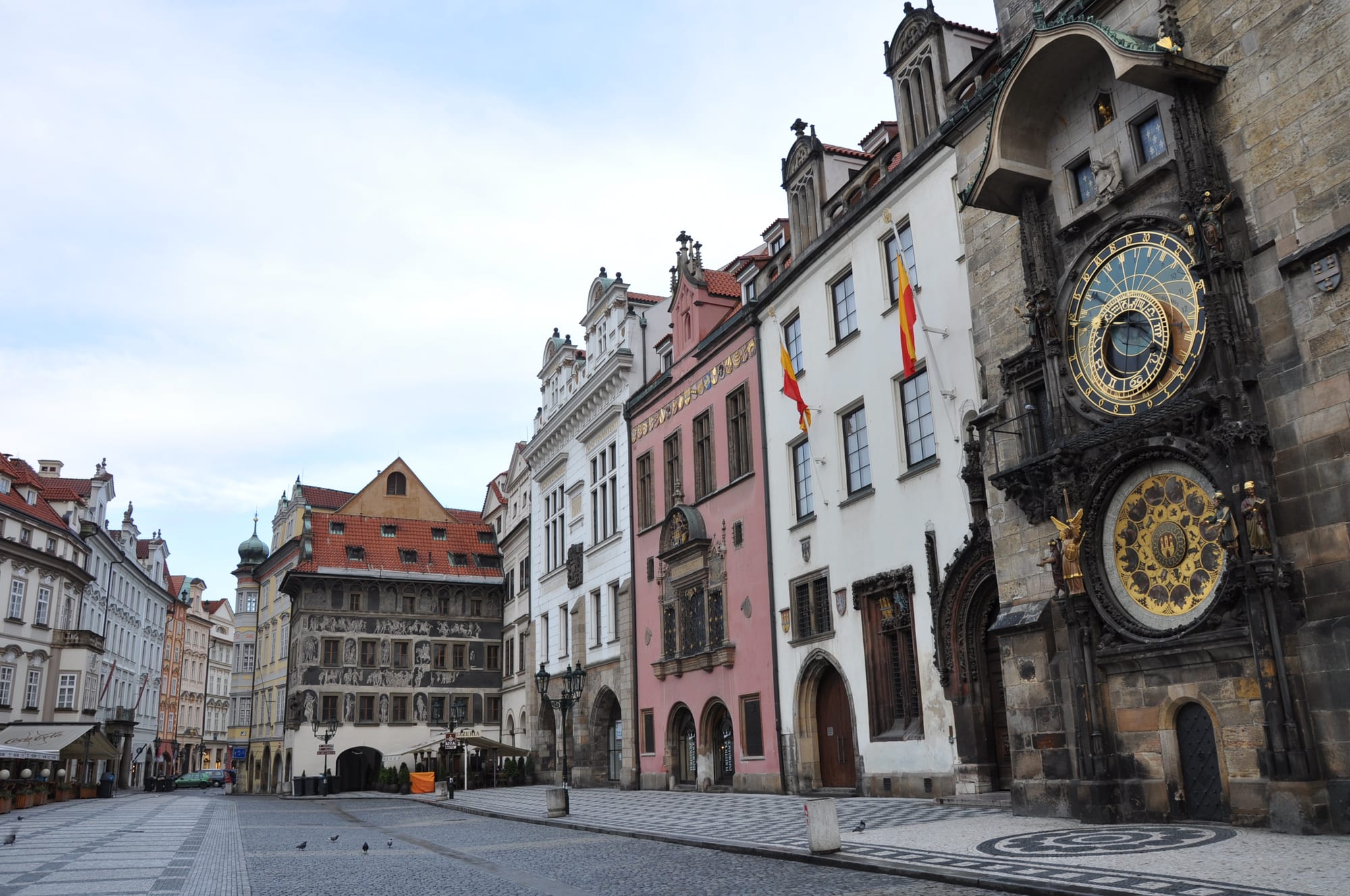
The clock is part of the historic centre of Prague, which is on the UNESCO World Heritage list. It now shows Central European Time; summer time appears only on the small side dials and the tower clocks, because changing the main dial would put its Sun and stars in the wrong place.
Six centuries of the Orloj
- 1410
First record
Mikuláš of Kadaň completes the clock, probably to Jan Šindel's design.
- 1552
New keeper
Jan Táborský takes over a machine his predecessor could not keep running.
- 1787
Rescue
After talk of selling it for scrap, a four-year repair begins under Antonín Strnad.
- 1866
Precision
Romuald Božek's chronometer takes control from New Year's Day.
- 1945
Fire
The Old Town Hall burns during the Prague uprising.
- 1948
Restart
The restored clock runs again with new apostles by Vojtěch Sucharda.
- 2018
Back to weights
A full restoration replaces the 1948 electric drive with ropes and weights.