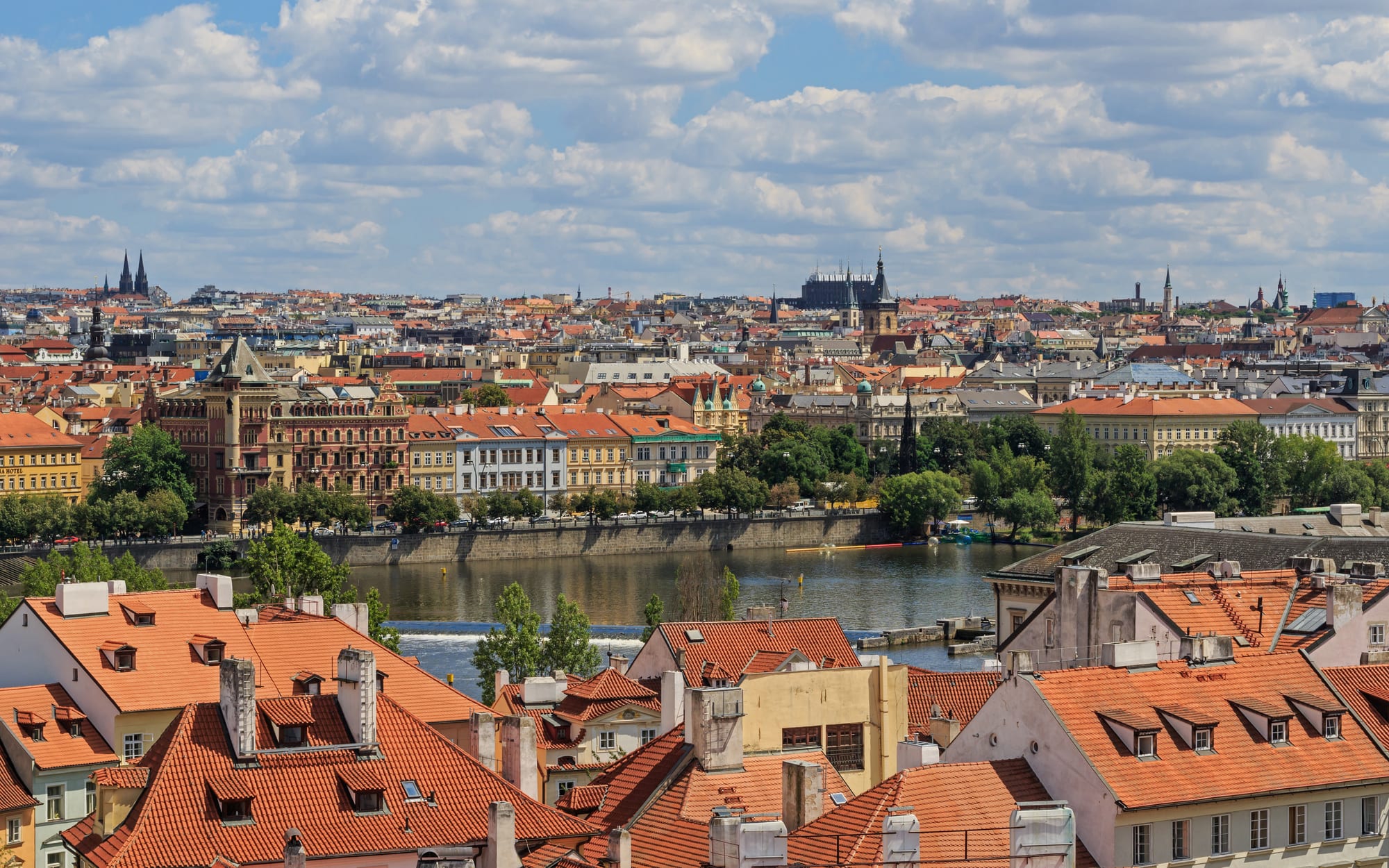
Orange tiled roofs of the Lesser Town in front of the Vltava, with the Old Town's spires and facades spread across the far bank

Prague & Central Bohemia, Czechia

Prague

The roofs of Malá Strana and the Old Town across the Vltava, seen from the Lesser Town tower of Charles Bridge. (A.Savin / Wikimedia Commons · FAL)

The Czech capital, spread over hills on both banks of the Vltava. A castle begun in the 9th century and the imperial building of Charles IV made it one of the great cities of Central Europe, and it came through the Second World War with little damage. Today it is a city of about 1.4 million and one of the most visited in Europe.

Neighbourhoods

  • Old Town (Staré Město)
    • First-time visitors
    • Historic district
    • Close to public transport

    The medieval town on the east bank, once enclosed by a moat and wall whose line is now traced by Národní, Na Příkopě and Revoluční streets. Old Town Square, the astronomical clock and the approach to Charles Bridge are here, among lanes that fill with visitors from morning to late evening.

    Open in Maps
  • Josefov
    • Historic district
    • Museums

    The former Jewish ghetto and the smallest cadastral area of Prague. Its synagogues, the Old Jewish Cemetery and the collections of the Jewish Museum sit among buildings from the early 20th century, crossed by the boutique-lined Pařížská street.

    Open in Maps
  • Malá Strana (Lesser Town)
    • Historic district
    • Architecture

    The Baroque quarter below the castle on the west bank, founded in 1257 and long the district of German and Italian burghers and noble palaces. Embassies, gardens and churches fill its steep streets between Charles Bridge and Petřín hill.

    Open in Maps
  • Hradčany
    • Famous sights
    • Views

    The castle district on the hill, made up mostly of noble palaces around Prague Castle and St Vitus Cathedral. It is busy by day and much quieter in the evening, with lookouts over the roofs of the city.

    Open in Maps
  • New Town (Nové Město)
    • Shopping
    • Nightlife
    • Close to public transport

    Laid out by Charles IV in the 14th century around broad market squares, it is now the commercial heart of the city. Wenceslas Square, the National Museum, the National Theatre and the riverside Dancing House are all in the New Town.

    Open in Maps
  • Vinohrady
    • Quiet and residential
    • Best for food
    • Cafés and bars

    A residential district named after the vineyards that once covered it, with hundreds of restaurants, bars and pubs; the historic part of the main railway station stands at its edge.

    Open in Maps
  • Žižkov
    • Pubs
    • Local life

    An independent town until 1922, named after the Hussite leader Jan Žižka and lying below Vítkov hill, where his army won its victory in 1420. Said to have more pubs per head than any other district in Europe, with the Žižkov Television Tower rising above its hilly streets.

    Open in Maps
  • Holešovice
    • Arts and culture
    • Parks

    A former industrial suburb on a meander of the Vltava, now home to the National Gallery's Trade Fair Palace and the National Technical Museum, with Letná Park and Stromovka close by.

    Open in Maps

Things to do

Famous landmarks

  • Prague Castlelandmark

    Built in the 9th century and long the seat of Bohemian kings, Holy Roman emperors and presidents, listed by Guinness as the largest ancient castle in the world and the most visited sight in the country.

    Open in Maps
  • St Vitus Cathedrallandmark

    The Gothic cathedral inside the castle, begun in 1344 and finished only in the 20th century, holding the tombs of many Bohemian kings and emperors under a main tower about 100 metres high.

    Open in Maps
  • Charles Bridgelandmark

    The stone bridge begun under Charles IV in 1357, 516 metres long, guarded by towers at each end and lined with 30 mostly Baroque statues, now all replicas.

    Open in Maps
  • Old Town Squarelandmark

    The historic square of the Old Town, where 27 Protestant leaders were executed in 1621, and where the Christmas market is held in December.

    Open in Maps
  • Prague astronomical clocklandmark

    The medieval astronomical clock, or Orloj, on the wall of the Old Town Hall, which draws crowds on the hour.

    Open in Maps
  • Wenceslas Squarelandmark

    The long boulevard of the New Town, once a horse market, the traditional setting for demonstrations and celebrations and the busiest pedestrian street in the country.

    Open in Maps
  • Dancing Houselandmark

    The curving riverside office building by Vlado Milunić and Frank Gehry, completed in 1996 and nicknamed Ginger and Fred after the dancing pair it resembles.

    Open in Maps
  • Municipal Houselandmark

    The civic building beside the Powder Gate on Náměstí Republiky, home to Smetana Hall, a celebrated concert venue.

    Open in Maps

Museums and galleries

  • Jewish Museum in Praguemuseum

    One of the oldest Jewish museums in Europe, founded in 1906, presenting the heritage of Bohemia and Moravia's Jewish communities across Josefov.

    Open in Maps
  • Old New Synagoguelandmark

    The synagogue of 1270 in Josefov, still standing at the heart of the former Jewish quarter.

    Open in Maps
  • National Museummuseum

    Founded in 1818, its Neo-Renaissance main building of 1891 closes the top of Wenceslas Square and reopened in 2018 after seven years of restoration.

    Open in Maps
  • Trade Fair Palacemuseum

    The largest site of the National Gallery Prague, in Holešovice, housed in the first functionalist building in the city, reopened in 1995 after a fire.

    Open in Maps
  • Mucha Museummuseum

    A museum of the work of Alphonse Mucha, run by the Mucha Foundation in part of the historic Savarin Palace.

    Open in Maps
  • National Technical Museummuseum

    The country's largest museum of the history of technology, founded in 1908 and beside Letná Park since 1941.

    Open in Maps

Hills, parks and viewpoints

  • Petřín Lookout Towerviewpoint

    A steel tower 63.5 metres tall on Petřín Hill, built in 1891 to resemble the Eiffel Tower; the funicular up the hill resumed service in September 2026.

    Open in Maps
  • Vyšehradlandmark

    A historic fort on the east bank, likely founded in the 10th century, with the Basilica of St Peter and St Paul, the 11th-century Rotunda of St Martin and the cemetery where Dvořák, Smetana, Čapek and Mucha are buried.

    Open in Maps
  • Letná Parkpark

    A park on a plateau above the Vltava with commanding views of the Old Town, where about 750,000 people protested in November 1989; the Prague Metronome stands on the site of a demolished Stalin monument.

    Open in Maps
  • Stromovkapark

    A 95-hectare park on the Vltava floodplain in Bubeneč, a royal game reserve from the 13th century, now maintained as an English landscape garden.

    Open in Maps
  • Strahov Monasterylandmark

    A Premonstratensian abbey founded in 1143 on the hill above Malá Strana.

    Open in Maps

Music and nights out

  • National Theatreattraction

    The riverside opera house known as the alma mater of Czech opera, whose opera, ballet and drama companies also play at the State Opera and the Estates Theatre.

    Open in Maps
  • Rudolfinumattraction

    The Neo-Renaissance home of the Czech Philharmonic on Jan Palach Square, opened in 1885, whose Dvořák Hall is noted for its acoustics.

    Open in Maps
  • Lucerna Palaceattraction

    An entertainment and shopping arcade in the New Town, named a national cultural monument in 2017.

    Open in Maps

Short trips from the city

  • Karlštejn Castlelandmark

    The large Gothic castle founded by Charles IV in 1348 to keep the imperial regalia and the Bohemian crown jewels, under an hour from Prague by train.

    Open in Maps
  • Lidiceattraction

    The village rebuilt near the site of the one destroyed on 10 June 1942 in reprisal for the assassination of Reinhard Heydrich, now a memorial.

    Open in Maps
  • Konopiště Castlelandmark

    The four-winged château near Benešov that was the last home of Archduke Franz Ferdinand, whose assassination in Sarajevo set off the First World War.

    Open in Maps

Seasonal events

  • Prague Half MarathonMarch or April

    The spring half marathon through the city, followed in May by the full Prague Marathon, first run in 1995 with the support of Emil Zátopek.

  • Prague Spring International Music FestivalMay to early June

    The classical music festival held since 1946, which opens each year on 12 May, the anniversary of Smetana's death, with his cycle Má vlast.

  • Prague Fringe FestivalMay and June

    An annual fringe festival of theatre, comedy, cabaret and spoken word in eight venues around Malá Strana.

  • Signal FestivalOctober

    Four nights of light installations and digital art across the city, held every October since 2013.

  • Christmas marketsDecember

    Stalls on the main squares sell crafts, food and drink through Advent, the largest on Old Town Square.

Eat and drink

Long-standing places and food districts in Prague. Hours, ratings and directions come from your maps app, always current.

Prague classics

  • U Flekůrestaurant

    A pub and microbrewery around a central courtyard in the New Town, near the National Theatre, behind a facade with an old decorated clock above the door.

    Open in Maps
  • Café Slaviacafe

    The riverside café opposite the National Theatre, opened in 1884, where Rilke sat, and where dissidents including Václav Havel met during the communist years.

    Open in Maps

Food districts

  • Vinohradyneighborhood

    Residential streets with hundreds of restaurants, bars and pubs, a short way from the tourist centre.

    Open in Maps
  • Žižkov pubsneighborhood

    A district known for its dense concentration of pubs pouring Czech beer.

    Open in Maps

Experience Prague

History

A fortified settlement stood on the castle hill by 800, and masonry building there dates from 885 at the latest; the Přemyslid fort of Vyšehrad followed about seventy years later. Merchants from across Europe settled at the ford, the Judith Bridge crossed the river in the 1170s, and in 1257 King Ottokar II founded the Lesser Town below the castle. Under Charles IV, king of Bohemia and Holy Roman Emperor from 1346 to 1378, Prague became an imperial capital: he founded Charles University in 1347, laid out the New Town and began Charles Bridge. By the 1470s the city was the third largest in the Empire.

The Jewish quarter was sacked in 1389. Jan Hus preached at the Bethlehem Chapel, and after his execution in 1415 the first defenestration of 1419 opened the Hussite Wars. Rudolf II made the castle a home for astronomers, alchemists and artists, among them Tycho Brahe and Johannes Kepler, but the second defenestration in 1618 set off the Thirty Years' War; after defeat at White Mountain, 27 Protestant leaders were executed on Old Town Square in 1621 and the city was forced back to Catholicism. Fire, plague and Prussian bombardment followed before 18th-century prosperity brought the Baroque palaces and churches.

The four towns were merged in 1784, and industry and the Czech National Revival had made the city overwhelmingly Czech-speaking by the early 20th century. Prague became the capital of Czechoslovakia in 1918. German troops entered in March 1939, most of the Jewish population was deported and killed, and the May 1945 uprising preceded the Red Army's arrival. In 1989 the Velvet Revolution filled its streets, and in 1993 it became capital of the Czech Republic. On 21 December 2023 fourteen people died in a mass shooting at Charles University.

Culture & Customs

Prague is one of the traditional cultural centres of Europe, and music sits at the heart of it. Mozart's Don Giovanni and La clemenza di Tito had their premieres at the Estates Theatre; the National Theatre is the home of Czech opera; the Czech Philharmonic plays at the Rudolfinum and the Prague Symphony Orchestra at the Municipal House. The Prague Spring festival opens every 12 May with Smetana's Má vlast, and the autumn, organ, jazz and Dvořák festivals fill the rest of the year, alongside hundreds of concert halls, galleries, cinemas and music clubs.

The city is also a museum of architecture — Romanesque, Gothic, Renaissance and Baroque, then Art Nouveau, Cubist and functionalist buildings, Adolf Loos's Villa Müller and the Dancing House. Its Jewish heritage runs from the Old New Synagogue, Europe's oldest active synagogue, to the collections of the Jewish Museum. Writers, film festivals, the Fringe and the World Roma Festival keep a busy calendar, and since 2013 the Signal light festival has taken over the streets each October.

Everyday culture is quieter. The pub is the great social institution, beer has been brewed here since the Břevnov monks of 993, and a greeting on entering a shop or bar is expected. Letná and Wenceslas Square remain the places where the country gathers in moments of protest or celebration.

Daily Life

The city has a population of about 1.4 million, with about 2.3 million in its metropolitan area. Many residents are not registered in the city, so the real number living and working here is higher, and hundreds of thousands of commuters arrive on weekdays. About 350,000 foreign residents were counted in 2025. Prague's population is the oldest and best educated in the country.

The economy produces about a quarter of Czech GDP and is one of the strongest regional economies in the European Union. Services account for about 80 per cent of jobs — finance, trade, public administration, tourism and hospitality — and industry continues in pharmaceuticals, printing, food processing and engineering. The government, parliament, national bank, broadcasters and Radio Free Europe are all based here. Almost half the country's tourism income is spent in the city, which received about 8.3 million overnight guests in 2025, four out of five from abroad.

Inner districts such as Vinohrady, Žižkov, Karlín and Smíchov, once separate towns or suburbs, are where many residents live, eat and drink, away from the tourist streets of Prague 1. Daily life runs on public transport: about 1.2 billion journeys a year are made on the metro, trams and buses, and some 120,000 commuters are among the 800,000 people who work in the city. Wages are well above the national average, and many international film productions have been shot here since the late 1990s.

Food

Prague eats in the Czech tradition, heavy on meat, sauce and dumplings. Bread dumplings, knedlíky, are steamed and sliced like bread and served with most main dishes; roast duck comes with bread or potato dumplings and braised red cabbage; and guláš, a stew of beef, pork or game with onions and spices, is eaten with dumplings or bread, not to be confused with the Hungarian soup. Goulash soup, gulášovka, and broths with liver dumplings are common in Czech restaurants, and klobása is a smoked sausage of minced meat.

Two specialities carry the city's name. Prague ham, pražská šunka, is brine-cured, stewed and mildly smoked over beechwood, first marketed in the 1860s by a butcher on Zvonařka Street and now protected as a Traditional Speciality Guaranteed in the EU; cooked on the bone it is called šunka od kosti. Prague cake, pražský koláč, is a yeast bun topped with cinnamon streusel and filled with vanilla cream. The trdelník, a sugared chimney cake sold all over the Old Town, is popular with visitors but not a traditional Czech food.

Beer is central. The city has long-established brewery pubs such as U Fleků, U Medvídků and the monastery breweries of Strahov and Břevnov, the Staropramen brewery in Smíchov, and many newer microbreweries, while the Old Town, Žižkov and Vinohrady hold hundreds of restaurants, bars and pubs. Prague's restaurants also earned the first Michelin star in post-communist Central Europe, in 2008.

Planning tools

Budget

Prague is the most expensive place in the country, and the historic centre the most expensive part of Prague: rooms, menus and souvenirs around Old Town Square and Charles Bridge cost well above the national average. A few metro or tram stops out, in districts such as Vinohrady, Žižkov or Holešovice, prices fall towards normal Czech levels, and public transport tickets are cheap.

Daily Budget Midrange
USD 140–260 (mid-range hotel, restaurant dinners, castle and museum tickets, a day trip)
Daily Budget Shoestring
USD 60–100 (hostel bed, pub lunches, a public-transport pass, free churches and viewpoints)

Eat and drink a few streets away from Old Town Square, change money only at reputable offices, and buy a multi-day transport ticket rather than using taxis.

Best Time to Visit

May, June and September bring warm weather without the peak crowds of July and August, when the centre is at its busiest; May also has the Prague Spring festival. Winters are cold and grey, but December brings the Christmas markets, and the museums and concert halls run all year.

Suggested Number of Days

Three or four days covers a first visit to the city, which is large and has far more museums, churches and concerts than a weekend allows. Add two or three days to include the castles and towns of Central Bohemia, all easy to reach by train or bus.

First Visit
3–4 days
With Surroundings
5–6 days

Transportation

The integrated PID system covers the city: three metro lines (A, B and C) with 61 stations on 65 km of track, a dense tram network, buses, the Petřín funicular, several river ferries and suburban trains. Prague has one of the highest rates of public transport use in the world. Some metro stations lie deep underground, the deepest 52 metres down. Bike sharing is available but most visitors walk and use the trams.

Buy and validate a ticket before boarding; time-based and 24-hour tickets cover the metro, trams and buses.

Airport & Station Connections

Václav Havel Airport Prague lies 12 km west of the centre. City buses connect it with metro stations, the Airport Express bus runs to the main railway station, and official taxis wait outside both terminals. Praha hlavní nádraží is the main railway station, with trains to every part of the country and international services, about two and a half hours to Dresden.

Walkability

The historic centre is compact and best seen on foot: Old Town Square sits between Wenceslas Square and Charles Bridge, and the castle is a climb up through Malá Strana from the bridge. Streets are cobbled and the castle hill, Petřín and Vyšehrad are steep, so comfortable shoes matter. Trams fill the gaps between districts.

Safety

Czechia is a safe country with low levels of violent crime. In Prague the national problems come in concentrated form: pickpockets on crowded trams and around Charles Bridge, Old Town Square and the astronomical clock, dishonest taxis, rigged exchange booths, and late-night noise in the party streets of the Old Town.

Use official or app-based taxis, avoid exchange offices advertising '0% commission', and keep bags closed on trams and in crowds. Check current official travel advice before travelling.

Climate

An oceanic climate bordering on a humid continental one. Summers are usually sunny, with thunderstorms and a growing number of days above 30°C; winters are cold and grey, with very little sunshine.

Summer
warm and mostly sunny — temperatures around 25°C, with a growing number of days above 30°C
Winter
cold and dull — average temperatures about 0°C, with very little sunshine

Local Customs

Tipping is a sign of appreciation rather than a fixed share of the bill; around 10 per cent is standard in restaurants used to visitors, and it is not normally added to the bill. Greetings matter: a 'dobrý den' on entering a shop or pub is expected.

Dress modestly and keep quiet in churches and synagogues, and keep noise down in residential streets late at night.

Common Payment Methods

The currency is the Czech koruna (CZK, written Kč); the euro is not the local currency. Cards and contactless payment are accepted almost everywhere, and ATMs are common. Carry a little cash for small pubs and markets, and withdraw from bank ATMs rather than changing money at street booths.