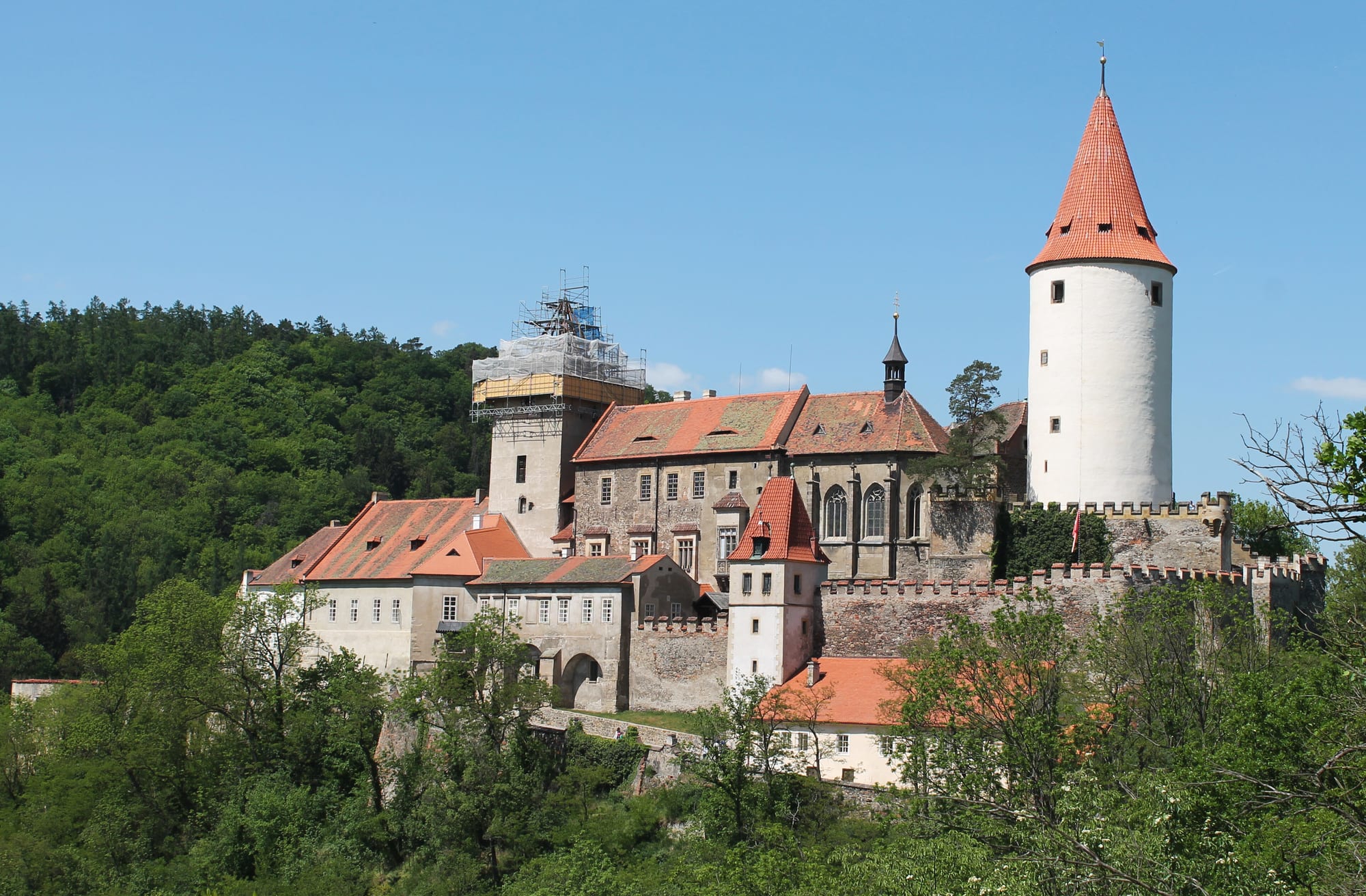
A medieval castle with red-tiled roofs, battlemented walls and a tall white round tower, set among thickly wooded hills, with one tower under scaffolding

Czechia

Prague & Central Bohemia

Křivoklát Castle in the forests of the Rakovník District, Central Bohemia. (Harold / Wikimedia Commons · CC BY-SA 3.0)

The heart of the Bohemian basin, where the capital sits on the Vltava inside a ring of rolling farmland, forest and river valleys — the old royal core of the Czech state, with the silver town of Kutná Hora, the castles of Karlštejn and Konopiště, and the vineyards of Mělník above the meeting of the Vltava and the Elbe.

Explore Prague & Central Bohemia

History

The Celtic Boii, who gave Bohemia its name, built fortified settlements such as Závist above the Vltava south of Prague, before Germanic and then, from the 6th century, Slavic peoples settled the basin. By the late 9th century the Přemyslid princes ruled from Prague, and the story of the young state played out nearby: Duke Wenceslas was murdered at Stará Boleslav in the early 10th century and soon revered as the country's patron saint.

Silver found around Kutná Hora in the late 13th century made the Bohemian crown rich, and from shortly after 1300 the Prague groschen was minted there. Charles IV turned Prague into an imperial capital in the 14th century, founding the New Town and the university in 1348, beginning the Charles Bridge and building Karlštejn to hold the imperial regalia. The Hussite revolution began in Prague with the defenestration of 1419 and was decided at Lipany in 1434. The Protestant estates were beaten at the White Mountain, on Prague's western edge, in 1620.

In the 19th century Prague became the centre of the Czech national revival, Kladno grew on coal and iron, and in 1895 Laurin & Klement began building bicycles at Mladá Boleslav, the origin of Škoda's car works. After the assassination of Reinhard Heydrich in Prague in 1942, the Nazis razed the village of Lidice. The region's modern turning points also happened here: the Soviet-led invasion of 1968, and the student march of 17 November 1989 that set off the Velvet Revolution.

Culture & Customs

Prague is the stage on which Czech national culture was built, from the National Theatre, paid for by public collection in the 19th century, to the café and cabaret life of the First Republic. It was also for centuries a city of three communities, Czech, German and Jewish, and Kafka's Prague survives in the Josefov quarter and its synagogues. The capital's speech, with its casual "common Czech" forms, is heard across the whole of Bohemia and is the model for everyday spoken Czech.

Central Bohemia's identity is quieter and bound up with the capital: much of it is Prague's commuter belt and weekend country, full of chaty in the Sázava and Berounka valleys where Prague families spend summers. Castles, rather than folk costume, are its heritage, and many are run as state monuments with guided tours in Czech and English.

The calendar includes the St Wenceslas pilgrimage to Stará Boleslav on 28 September, the national holiday, and the wine harvest festival at Mělník in September. Prague adds the Prague Spring classical festival, the Christmas markets, and a strong puppet and black-light theatre tradition. Religion follows the national pattern: most people do not practise, though the great churches remain the backdrop of city life.

Daily Life

Prague has about 1.3 million people and Central Bohemia, which surrounds it completely, about 1.4 million more. The region has no dominant city of its own; its authorities sit in Prague, and its largest towns are Kladno, with around 70,000 people, and Mladá Boleslav, Příbram and Kolín, each much smaller.

The capital produces a large share of the national economy through government, finance, IT, universities and tourism, and wages here are the highest in the country. Central Bohemia depends on Škoda Auto at Mladá Boleslav, logistics warehouses along the motorways, farming on the Elbe plain and daily commuting into Prague. Kladno and Příbram, once coal, steel and mining towns, have had to find new work since the 1990s.

The day starts early, with trams full before seven, and a hot lunch is still the main meal for many workers. Evenings in Prague run to pubs, wine bars and concerts; at weekends many residents leave for cottages outside the city. Housing is the dominant issue: flat prices and rents in Prague are among the highest in Central Europe relative to wages, and tourist short-term lets have emptied parts of the historic centre of residents.

Food

Prague cooking is the Czech pub classics in their home setting: svíčková, beef in a cream sauce of root vegetables served with bread dumplings and cranberries, roast pork with dumplings and sauerkraut, and guláš. Pražská šunka, Prague ham brine-cured, cooked and lightly smoked, has been made in the city since the 1860s, and chlebíčky, small open sandwiches topped with ham, egg and potato salad, were popularised by a Prague delicatessen in the early 20th century. Nakládaný hermelín, a soft cheese marinated in oil with garlic and chilli, and utopenec, pickled sausage, are the standard beer snacks.

Beer is brewed across the region. Staropramen has brewed in Smíchov since the 19th century, Velkopopovický Kozel comes from Velké Popovice south-east of Prague, and U Fleků in the New Town serves its own dark lager in a pub that has brewed since the 15th century. Prague also has a large number of small craft breweries.

Mělník is the centre of Bohemian wine, with white Müller-Thurgau and Riesling and red Pinot Noir from the slopes above the Elbe. Trdelník, the sugared spit-cake sold throughout Prague's old centre, is a recent tourist import rather than a local tradition.

Attractions & Natural Wonders

Prague's historic centre is a UNESCO World Heritage Site: Prague Castle with St Vitus Cathedral and the Golden Lane, the Baroque Lesser Town and St Nicholas Church, the statue-lined Charles Bridge, the Old Town Square with its astronomical clock, the Jewish Quarter's synagogues and Old Jewish Cemetery, and Wenceslas Square in the New Town. Vyšehrad, the older fortress hill with the national cemetery, and the Petřín hill with its lookout tower give the best views, and the landscape park at Průhonice lies on the south-eastern edge.

East of Prague, Kutná Hora, a UNESCO World Heritage Site, has the Church of St Barbara, the Italian Court where the groschen were minted, and at Sedlec an ossuary decorated with the bones of tens of thousands of people.

South-west of Prague, Karlštejn rises above the Berounka in the limestone country of the Bohemian Karst, where the Koněprusy caves can be visited; upriver lies the forest castle of Křivoklát. To the south-east, Konopiště near Benešov is the château of Archduke Franz Ferdinand, whose assassination in 1914 started the First World War, with his hunting trophies and armoury. North of Prague, Mělník looks from its château and vineyards over the confluence of the Vltava and the Elbe; nearby are the sandstone valleys and castle of Kokořínsko, Dvořák's birthplace at Nelahozeves and the château park at Veltrusy. The memorial at Lidice and the Škoda Museum at Mladá Boleslav cover the 20th century.

Cities in Prague & Central Bohemia

Planning basics

Budget

Prague is the most expensive place in the country, and its historic centre is the most expensive part of Prague: hotels, restaurant menus and souvenirs around the Old Town Square and the Charles Bridge run well above the national average. A few metro stops out, and in the towns of Central Bohemia, prices fall to normal Czech levels, and the day trips by train or bus are cheap.

Daily Budget Midrange
USD 140–260 (mid-range hotel, restaurant dinners, castle and museum tickets, day trips)
Daily Budget Shoestring
USD 60–100 (hostel, pub lunches, a public-transport pass, free churches and viewpoints)

Eat and drink a few streets away from the Old Town Square, and buy a multi-day public-transport ticket rather than using taxis.

Safety

The region is safe. Prague's issues are the national ones in concentrated form: pickpockets in crowded trams and around the main sights, overcharging taxis, rigged exchange offices and late-night noise in the party streets of the Old Town. The countryside's risks are ordinary ones such as ticks in the forests and slippery paths up to castles.

Use app-based or official taxis, keep bags closed on trams and in crowds, and check for ticks after forest walks. Check current official travel advice before travelling.

Climate

The region lies in the sheltered Bohemian basin and is one of the drier and milder parts of Czechia. Summers are warm with thunderstorms, and Prague's centre can pass 30°C in heat waves; winters are cold and grey, with snow that rarely lasts long in the city but lies longer in the Brdy hills and the Křivoklát forests.

Summer
warm, 22–30°C, with occasional heat waves and afternoon storms
Winter
cold and often overcast, around -3 to 3°C, with light snow

Transportation

Prague has a metro of three lines, a dense tram network and buses, and the integrated PID system extends by train and bus across Central Bohemia. Karlštejn is under an hour by train from Prague, Kutná Hora about an hour, Benešov for Konopiště about an hour followed by a walk, and Mělník around 40 minutes by bus. A car is useful only for the forests and smaller villages.

Castle visits are by guided tour at set times, so arrive early at Karlštejn and Konopiště in summer and check the season's opening days.

Best Time to Visit

May, June and September give warm weather and green or golden countryside without the peak crowds of July and August, when Prague's centre and Karlštejn are at their busiest. The Mělník grape harvest falls in September. Advent brings Christmas markets to Prague's squares; many castles in the region close or open only at weekends from November to March.