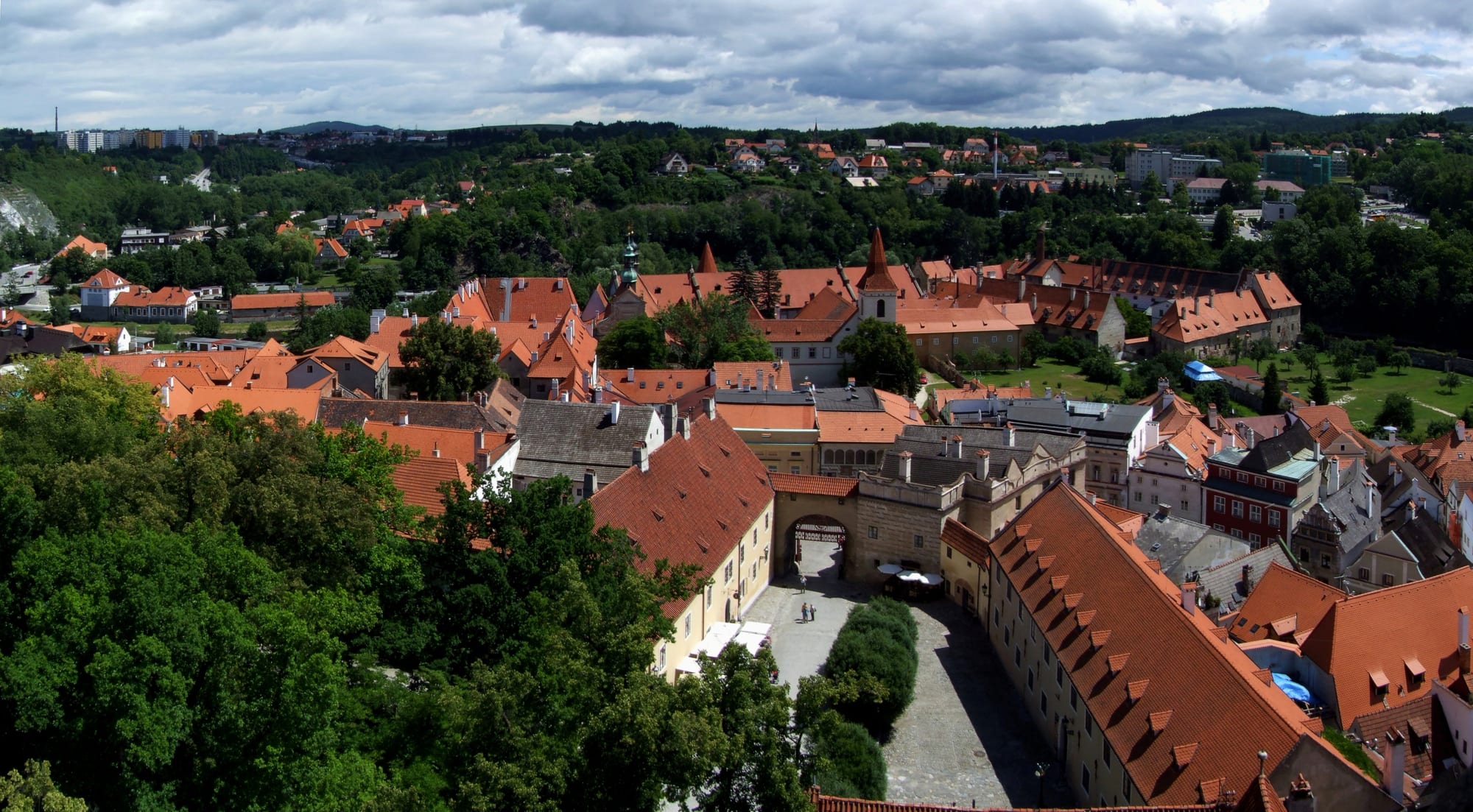
Red-tiled roofs, a church spire and a cobbled courtyard with an arched gateway, surrounded by trees and green hills

Czechia

South Bohemia

The old town of Český Krumlov seen from the castle tower above the Vltava. (Pudelek (Marcin Szala) / Wikimedia Commons · CC BY-SA 3.0)

Czechia's southern region on the Austrian and Bavarian borders, a land of fishponds, pine woods and quiet market towns once ruled by the Rosenberg and Schwarzenberg families — home to the castle town of Český Krumlov, the brewing city of České Budějovice and the Šumava forest along the upper Vltava.

Explore South Bohemia

History

For much of its history South Bohemia was the domain of one family. The Rosenbergs (Rožmberks), whose emblem was a five-petalled rose, held Český Krumlov from 1302 and built up the largest estate in the kingdom, while King Ottokar II founded České Budějovice as a royal town in 1265. During the Hussite wars the radical Taborites founded Tábor on a hill in 1420 as a community of the faithful, and the one-eyed general Jan Žižka led their armies; the Catholic Rosenbergs and Budějovice held out against them.

In the 16th century the Rosenberg estates were transformed by pond-builders such as Jakub Krčín, who dug the great fishponds and canals of the Třeboň basin. The last Rosenberg, Petr Vok, died in 1611, and after the Eggenbergs the estates passed in 1719 to the Schwarzenbergs, who ruled much of the region until the 20th century and rebuilt Hluboká in the 19th.

České Budějovice grew into a trading town on the salt route from Austria, and from 1832 a horse-drawn railway linked it to Linz, one of the first public railways on the continent. The Šumava and the Krumlov area were largely German-speaking, and they were annexed to Germany in 1938 and emptied by the expulsions after 1945. Under communism the border became a closed zone of barbed wire, and villages along it disappeared. After 1989 the Šumava became a national park, Český Krumlov was restored, and the Temelín nuclear power station opened in 2002, long opposed across the Austrian border.

Culture & Customs

South Bohemians see themselves as calm, practical country people, and the region is often held up as the most rural and least hurried part of Bohemia. Its visual identity is the village: the farmhouses of the Blata area around Soběslav and Veselí nad Lužnicí, with curving Baroque gables in stucco, are known as South Bohemian folk Baroque, and the village of Holašovice is the best-preserved example.

The Rosenberg past is celebrated each June at Český Krumlov's Five-Petalled Rose festival, when the town fills with costumed processions, jousting and music. The autumn fishing of the ponds is a public event: crowds gather to watch the nets drawn in at the big ponds around Třeboň, and fish are sold on the banks. Christmas carp, kept alive in the bath at home before Christmas Eve in many families, comes largely from here.

Summer on the Vltava belongs to the vodáci, the canoeists who paddle between campsites from Vyšší Brod to Český Krumlov and beyond, a Czech tradition that grew up alongside the tramping movement. Catholicism is somewhat stronger here than in northern Bohemia, and the pilgrimage churches and wayside chapels of the countryside are kept up.

Daily Life

About 640,000 people live in South Bohemia, one of the least densely settled regions in the country. České Budějovice, with about 95,000 people, is the only large city; Tábor, Písek, Strakonice and Jindřichův Hradec are market towns of roughly 20,000 to 35,000, and Český Krumlov has about 13,000.

The economy mixes manufacturing, including car parts and the pencils of Koh-i-noor Hardtmuth in České Budějovice, with brewing, farming, forestry, fish farming, the Temelín power station and tourism. Wages are below the national average, and younger people tend to leave for Prague, though the university in České Budějovice keeps the city lively.

Life is tied to the landscape: weekends at the cottage, fishing, mushroom picking in autumn and cycling on the dikes between the ponds. Český Krumlov's old town has become heavily dependent on tourism, with many houses turned into guesthouses and shops, and residents debate how to keep it a living town. In the Šumava the management of the forest after bark-beetle outbreaks has been a long-running political argument.

Food

The ponds define South Bohemian food. Třeboň carp, fried in breadcrumbs, is the centrepiece of the Czech Christmas Eve dinner, and the rest of the year it is served baked, smoked or in a fish soup made with the roe and head; pike, zander and tench from the same ponds appear on local menus. Kulajda, a creamy sour soup with potatoes, dill, mushrooms and a poached egg, is a well-loved Czech soup, and potato dishes such as bramboráky and potato dumplings reflect the poor soils of the uplands.

Beer is the other staple. Budějovický Budvar, the state-owned brewery founded in 1895, makes the Budweiser lager whose name has been disputed with the American brewer for over a century, and Samson also brews in the city. Třeboň's Regent brewery traces its history to the 14th century, and Český Krumlov has its own brewery, long known as Eggenberg.

Forest foods complete the table: mushrooms, blueberries picked in the Šumava in summer, game dishes of venison and wild boar, and honey. South Bohemian cheeses include the smoked and soft cheeses from local dairies, and fruit dumplings stuffed with plums or apricots are eaten as a sweet main course.

Attractions & Natural Wonders

Český Krumlov, a UNESCO World Heritage Site, is the region's centrepiece: the castle with its painted tower, bear moat, Baroque theatre and cloak bridge, the garden with its revolving open-air auditorium, the Egon Schiele Art Centrum, and the lanes of the old town inside the river bends. Nearby are the Cistercian monasteries of Zlatá Koruna and Vyšší Brod and the Kleť hill with its lookout tower.

České Budějovice has its vast arcaded Přemysl Otakar II Square with the Samson Fountain and the Black Tower, and the Budvar brewery tour. Hluboká castle, the Schwarzenbergs' white neo-Gothic château, lies about 7 km north with a deer park and art gallery, and the UNESCO-listed village of Holašovice is to the west.

Třeboň, with its Renaissance square, château and Schwarzenberg tomb, sits in the Třeboň Basin protected landscape area, among ponds such as Svět and Rožmberk, the largest in the country. Further north are Tábor's square and underground passages, Písek's 13th-century stone bridge, the oldest in the country, and the castle of Jindřichův Hradec.

In the south-west, the Šumava National Park takes in the source of the Vltava, the Boubín virgin forest, the glacial Plešné lake, and the plateau villages around Kvilda, while the Lipno reservoir, the largest lake in Czechia, has a treetop walkway and beaches.

Cities in South Bohemia

Planning basics

Budget

South Bohemia is cheaper than Prague and close to the national average. Český Krumlov is the exception: hotels and restaurants in the old town are priced for day-trippers and tour groups, and summer rooms book up early. České Budějovice, Třeboň, Tábor and the Šumava villages cost less, and pensions and campsites around Lipno are good value outside July and August.

Daily Budget Midrange
USD 110–190 (old-town hotel or pension, restaurant dinners, castle tours, bike or canoe hire)
Daily Budget Shoestring
USD 45–80 (hostel, pension or campsite, pub meals, buses and trains)

Stay overnight in Český Krumlov to see the old town after the coaches leave, or base in České Budějovice and travel in by bus.

Safety

South Bohemia is safe, with little crime beyond the occasional pickpocket in crowded Český Krumlov. Outdoor risks matter more: summer canoe trips on the Vltava involve weirs and busy stretches, the Šumava has remote trails with weak mobile signal and changeable weather, and ticks are common in the forests and around the ponds.

Wear a life jacket on the river, carry a map in the Šumava and check for ticks after walks. Check current official travel advice before travelling.

Climate

The Budějovice and Třeboň basins are low and relatively mild, with warm summers and cold, often foggy winters. The Šumava is one of the coldest and snowiest parts of Czechia: its high plateaus around Kvilda record some of the lowest temperatures in the country, and snow lies for months. Summer storms are common across the region.

Summer
warm, 20–28°C in the basins; cooler and wetter in the Šumava
Winter
cold, around -4 to 2°C in the lowlands; much colder with deep snow in the Šumava

Transportation

České Budějovice is about two and a half hours from Prague by train and a little less by road, and it is the regional hub for trains and buses. Český Krumlov is reached by bus from Prague in about three hours or by a slow branch line from České Budějovice. Tábor lies on the Prague line. The Šumava villages have thin bus and train services, and a car or a bike makes the fishpond country and the forest far easier.

The direct buses from Prague to Český Krumlov fill up in summer, so book a seat ahead.

Best Time to Visit

May, June and September are best for Český Krumlov and the towns, before and after the summer crowds; July and August suit canoeing on the Vltava, swimming at Lipno and walking in the Šumava. Český Krumlov's Five-Petalled Rose festival is held in June. The Třeboň ponds are drained and fished in October and November, and winter brings cross-country skiing in the Šumava.