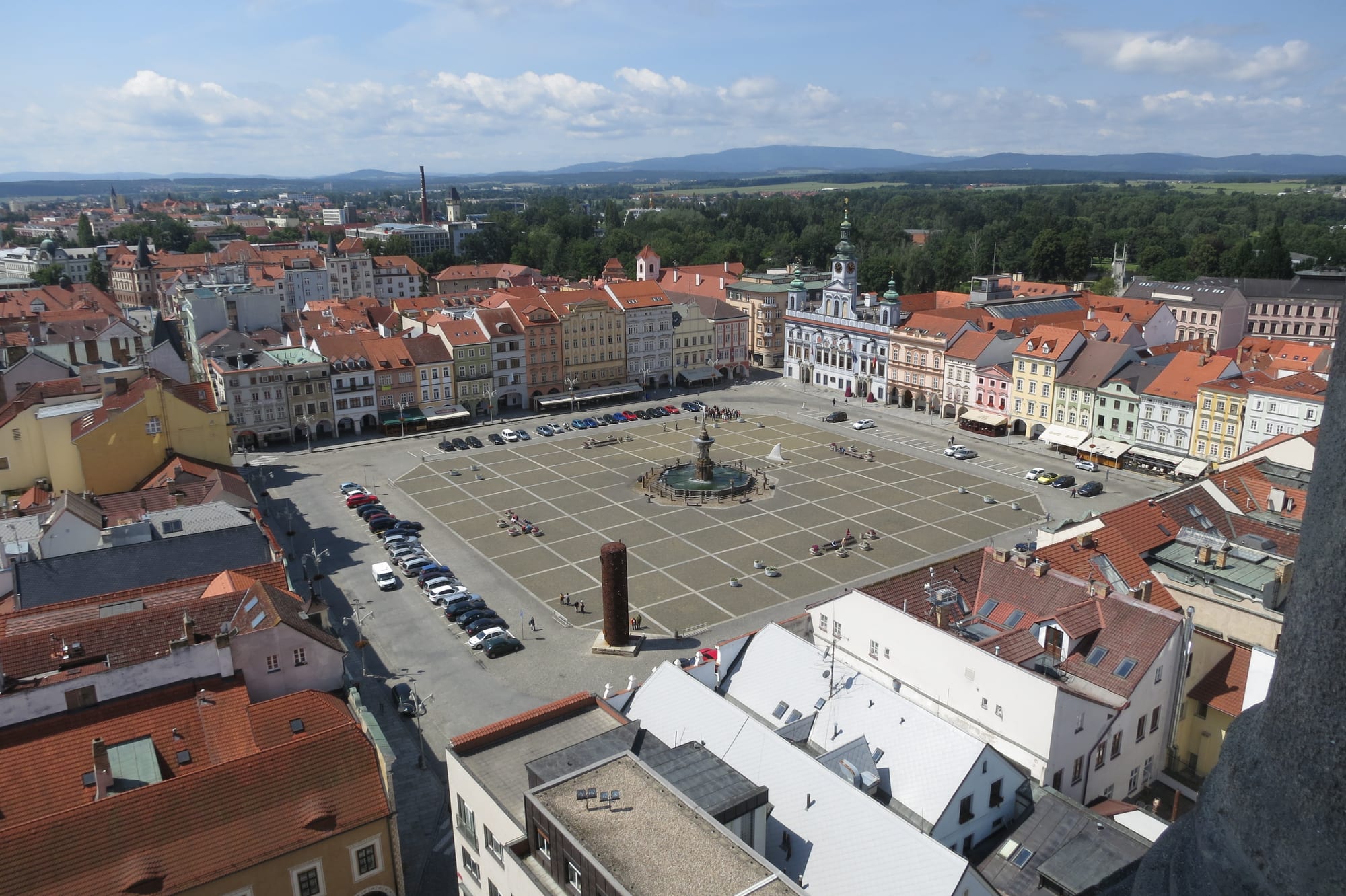
A huge paved square with a central fountain, ringed by colourful gabled houses and a towered town hall, with wooded hills on the horizon

South Bohemia, Czechia

České Budějovice

Přemysl Otakar II Square in České Budějovice, seen from the Black Tower. (Jiří Sedláček / Wikimedia Commons · CC BY-SA 3.0)

The capital of South Bohemia, about 120 km south of Prague where the Malše meets the Vltava. Founded as a royal city in 1265, it grew rich on trade, silver and beer, became the Budweis of the original Budweiser lager, and is now a university and regional city built around one of the largest squares in the country, due to be European Capital of Culture in 2028.

Neighbourhoods

  • Historic centre
    • First-time visitors
    • Historic district
    • Best for food

    The grid of streets laid out in 1265 around the great square, protected as an urban monument reservation. Arcaded Renaissance and Baroque houses, the town hall, the cathedral and the Black Tower stand here, with pubs and restaurants in the surrounding lanes and remains of the walls along the Malše.

    Open in Maps
  • Lannova třída
    • Close to public transport
    • Shops

    A pedestrianised street leading from the railway station to the old town, lined with shops including a supermarket and a department store.

    Open in Maps
  • Budvar and the outer districts
    • Beer
    • Quiet and residential

    Outside the old centre, a bus ride from the square, the Budvar brewery complex offers tours of the city's largest brewery.

    Open in Maps

Things to do

The square and the old town

  • Přemysl Otakar II. Squarelandmark

    One of the largest squares in the country, a regular square lined with arcaded houses with Gothic cores, with the Lost Rock, the only surviving stone of the original paving.

    Open in Maps
  • Samson Fountainlandmark

    The Baroque fountain of 1721–1727 in the middle of the square, 17 metres across and the largest in the Czech Republic, which once supplied the city with water from the Vltava.

    Open in Maps
  • Black Towerviewpoint

    The 72-metre watch and bell tower of 1550–1577 beside the cathedral; 225 wooden steps lead to a gallery with views over the square and the countryside.

    Open in Maps
  • Town Halllandmark

    A Renaissance house rebuilt in Baroque style in 1727–1730, with three towers, allegorical statues and a carillon; it is still the city hall and offers guided tours.

    Open in Maps
  • Cathedral of St Nicholaslandmark

    A three-nave church founded in 1265, rebuilt after the fire of 1641 and a cathedral since 1785.

    Open in Maps
  • Dominican Monasterylandmark

    The oldest monument in the centre, founded with the city in 1265, with the Church of the Presentation of the Virgin Mary.

    Open in Maps
  • Iron Maiden and Rabenštejn towerslandmark

    Two 14th-century prison towers, among the last remains of the Gothic walls; one holds a pub and the other an exhibition of armour and weapons.

    Open in Maps

Museums and beer

  • Budweiser Budvar Breweryattraction

    The state-owned brewery of 1895 that makes the original Budweiser lager with artesian water, Moravian barley and Saaz hops, with tours.

    Open in Maps
  • Samson breweryattraction

    The city's oldest operating brewery, founded in 1795 as Budweiser Bürgerbräu and renamed Samson in the communist period.

    Open in Maps
  • Museum of South Bohemiamuseum

    The regional museum, founded in 1870, in a Neo-Renaissance building of 1899–1901, with archaeological, natural science, geological and ethnographic exhibitions.

    Open in Maps
  • Museum of the Horse-Drawn Railwaymuseum

    A branch of the regional museum in the former guardhouse where the horse-drawn railway to Linz began in 1832.

    Open in Maps

Sport

  • Budvar Arenaattraction

    The ice hockey arena of Motor České Budějovice, which plays in the top Czech league.

    Open in Maps
  • Swimming Stadiumattraction

    A swimming complex with a 50-metre indoor pool and outdoor pools, protected as a cultural monument since 2017 for its architecture.

    Open in Maps

Short trips from the city

  • Hluboká Castlelandmark

    The Schwarzenbergs' white château in Hluboká nad Vltavou north of the city, rebuilt in the 19th century and considered one of the most beautiful castles in the country.

    Open in Maps
  • Zoo Ohradapark

    A zoo near Hluboká nad Vltavou, about 8 km from the city, open all year.

    Open in Maps
  • Holašoviceattraction

    A village 16 km west of the city whose medieval plan and South Bohemian folk Baroque farmhouses survived intact.

    Open in Maps
  • Zlatá Koruna Monasterylandmark

    A former monastery on the Vltava about 15 km south-west of the city, protected as a national cultural monument.

    Open in Maps

Seasonal events

  • Múzy na voděearly July

    A traditional festival held at the confluence of the Vltava and Malše.

  • Ema Destinnová festivalAugust and September

    A series of classical music concerts in the city centre, its churches and theatres.

  • Christmas marketsAdvent

    Traditional Christmas markets fill the main square from the start of Advent.

Eat and drink

Long-standing places and food districts in České Budějovice. Hours, ratings and directions come from your maps app, always current.

České Budějovice classics

  • Masné krámyrestaurant

    A well-known local restaurant in the former butchers' market near the main square.

    Open in Maps
  • Budvarkarestaurant

    A restaurant owned by Budvar, with four of its beers on draught and traditional Czech dishes.

    Open in Maps

Food districts

  • Pubs around the main squareneighborhood

    The arcades and side streets around the square hold pubs, restaurants and cafés serving Czech food and local beer.

    Open in Maps

Experience České Budějovice

History

Budějovice is first recorded as a village in 1251. In 1265 King Ottokar II founded a royal city on its site, planned by his knight Hirzo, fortified with three gates and immediately the political and economic centre of south Bohemia. Trade, crafts and silver mining nearby made it rich, and German-speaking settlers came from the Bohemian Forest and Upper Austria. A Jewish community lived within the walls from 1341 until a pogrom and expulsion in 1505–1506. The city's walls held out against the Hussites, but the Thirty Years' War and a fire in 1641 that destroyed two-thirds of the city set it back, and the rebuilding gave it its Baroque face. In 1785 it became the seat of a new diocese.

The 19th century brought industry. The horse-drawn railway to Linz, built in 1825–1832, was the second public railway line in continental Europe, Koh-i-Noor Hardtmuth moved its pencil works here from Vienna in 1847, and in 1895 Czech burghers founded the brewery now known as Budvar. Germans were the majority until about 1880, when Czech immigration tipped the balance.

During the German occupation the city was part of the Protectorate. American bombing in March 1945 caused heavy damage, Soviet troops arrived on 9 or 10 May, and about 6,000 German residents were expelled. Today the city is the economic and political centre of the region, with a university and a bishop, and it has been chosen as European Capital of Culture for 2028.

Culture & Customs

Beer and its name shape the city's identity. Budweiser Bier, beer from Budweis, became one of the best-known lagers alongside pilsner, and the American Budweiser began as an imitation of it. For more than a century Budvar and Anheuser-Busch have fought over the name, and the Czech government has refused every offer to buy the state-owned brewery, treating the Czech Budweiser name as a matter of national pride.

The city appears in literature as a major setting of Jaroslav Hašek's The Good Soldier Švejk and as the setting of Albert Camus's play The Misunderstanding. Its biggest annual event is Země Živitelka, an agricultural and food exhibition held at the exhibition grounds since 1973. Summer brings the Múzy na vodě festival at the confluence of the rivers and the Ema Destinnová classical concerts, and the former Church of St Anne has been a concert hall since the 1980s.

Sport is close to the heart of local life. Motor České Budějovice plays ice hockey in the top league at the Budvar Arena, SK Dynamo plays football, the city has a football stadium on Střelecký ostrov, and clubs range from volleyball and rugby to canoe slalom and cricket. Between 1956 and 1973 speedway racing drew crowds to a stadium that held 30,000 spectators. The city is preparing for its year as European Capital of Culture in 2028.

Daily Life

About 97,000 people live in České Budějovice, the largest city in South Bohemia, and about 180,000 in the wider agglomeration. It is the region's economic centre and the seat of many large companies, with brewing still a major industry alongside the Koh-i-Noor Hardtmuth pencil works, and the University of South Bohemia keeps it lively.

The city is nearly flat in its inner parts and hillier in the eastern suburbs. Large fishponds lie in the north-west of the municipal area, some of them in the Vrbenské rybníky nature reserve. Most people live in residential districts and housing estates around the old centre, and travel by bus and trolleybus, by bike or by car; the D3 motorway now links the city with Prague, and the modernised railway brings Prague within about two hours.

Evenings centre on the pubs and arcades of the old town and, in winter, on hockey at the Budvar Arena. Lannova třída, a pedestrianised street from the station to the old town, is lined with shops, and Christmas markets fill the square from the start of Advent.

Food

Beer is the city's signature. Budvar's Budweiser is a pale lager brewed with artesian water, Moravian barley and Saaz hops; it is sold as Budweiser Budvar in much of Europe and as Budvar or Czechvar elsewhere. Samson, the oldest operating brewery in the city, was founded in 1795. Brewing rights here go back centuries: from 1351 no pubs could stand within about 10 km of the city, and from 1410 no breweries either.

The food that goes with it is South Bohemian and Czech. Kulajda, the traditional soup of the region, is made with cream, mushrooms, dill, potatoes and an egg. Carp is the traditional Christmas fish, served in a fish soup. Restaurant menus also offer svíčková, beef with a thick root-vegetable sauce and bread dumplings; roast pork with dumplings and cabbage; roast duck with red cabbage; and smažený sýr, breaded fried cheese.

Pub snacks follow Czech habits: pivní sýr, beer cheese mixed with onion and mustard and spread on toast, and utopenci, sausages pickled in sweet-sour vinegar. Fruit dumplings filled with plums or apricots are a popular sweet.

Planning tools

Budget

České Budějovice is cheaper than Prague and costs less than nearby Český Krumlov, which makes it a good base for the region. Prices are close to the national average, and local beer is inexpensive.

Daily Budget Midrange
USD 100–170 (mid-range hotel, restaurant dinners, the brewery tour and a castle visit)
Daily Budget Shoestring
USD 45–80 (hostel or pension, pub meals, buses and trolleybuses)

Staying here and taking the bus to Český Krumlov or Hluboká costs less than staying in the old town of Český Krumlov.

Best Time to Visit

May to September is the warmest and liveliest time, with the river festival in early July and classical concerts in late summer. Advent brings the Christmas markets to the square, while winters are otherwise murky and cold.

Suggested Number of Days

One day covers the centre and a brewery tour. Using the city as a base for the castles, towns and fishpond country of South Bohemia easily adds two or three more, and good transport links make that simple.

First Visit
1–2 days
With Surroundings
3–5 days

Transportation

The historic centre is entirely walkable. Buses on 16 lines and trolleybuses on 7 lines serve the rest of the city, and bicycles can be hired, including through a bike-sharing app. The city is a regional hub for trains and buses.

Buy tickets from the machines at stops or by card at the terminal on board, validate paper tickets on the bus, and use the buses for the brewery and the outer districts.

Airport & Station Connections

Trains from Prague take about 1½ to 2 hours on the modernised line, and the D3 motorway links the two cities. Other lines run to Linz, Plzeň and Jihlava. České Budějovice Airport, 6 km south-west of the city, is small; most international visitors fly into Prague and continue by train or coach.

Walkability

Very good. The centre is nearly flat, and the square, the cathedral, the museums and the riverside walls are a few minutes apart. The brewery and the outer districts are a bus ride away.

Safety

Czechia is a safe country with low levels of violent crime. České Budějovice is a calm regional city where crime affecting visitors is uncommon; ordinary care with belongings in busy places is enough.

Keep an eye on bags at the station and in crowds on festival days. Check current official travel advice before travelling.

Climate

A cool, wet inland climate with an annual average of about 8.3°C and four clear seasons: a murky, dry winter from early December to early March, a sunny spring, a rainy, warm summer and a dry autumn lasting until late November.

Summer
rainy and warm; in South Bohemia's valleys July averages 17–18°C
Winter
murky and dry, with temperature inversions in the basin; the record low, about −40°C, was set in February 1929

Local Customs

Beer is a matter of local pride, and the Budweiser name is too: the city sees its lager as the original. Tipping is a sign of appreciation, and rounding up the bill by a few crowns is common. Ice hockey is followed closely.

Drivers must have no alcohol in their blood. Quiet behaviour is expected in churches during services.

Common Payment Methods

The currency is the Czech koruna (CZK), often written Kč. Cards are accepted almost everywhere; carry a little cash for small pubs and market stalls.