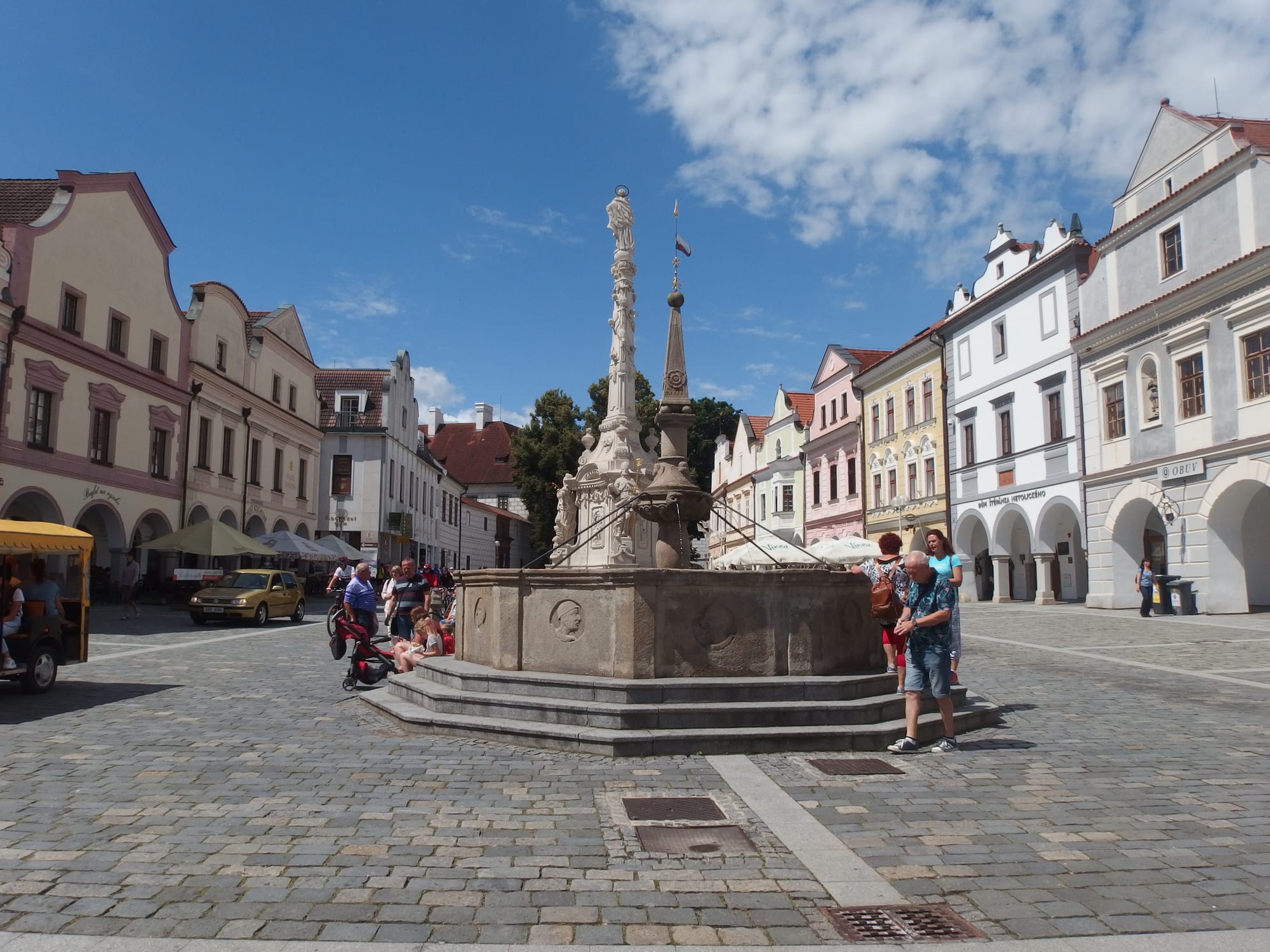
A carved stone fountain on a cobbled square lined with gabled houses under a blue sky

South Bohemia, Czechia

Třeboň

The Renaissance stone fountain on Masarykovo náměstí, the main square of Třeboň. (Palickap / Wikimedia Commons · CC BY-SA 4.0)

A small walled spa town in the Třeboň Basin, 19 km east of České Budějovice, on the shore of the Svět fishpond. Enriched by the Rosenbergs, whose pond-builders dug the great fish farms around it in the 16th century, it keeps a Renaissance square and château, and today lives on carp farming, a peat spa, an old brewery and cyclists touring the pond country.

Neighbourhoods

  • The old town
    • First-time visitors
    • Historic district
    • Best for food

    The walled core around Masarykovo náměstí, entered through old gates, with arcaded Renaissance and Baroque houses, the town hall tower, the château and its park, and most of the town's restaurants, cafés and small shops.

    Open in Maps
  • The spa and Svět shore
    • Spa
    • Walks
    • Cycling

    Beside the old town the Svět pond, one of the largest in the country, has fish holding tanks and an old fish shop below its dam, boat trips on the water and a marked trail around its shore.

    Open in Maps
  • South of the centre
    • Beer
    • Quiet and residential

    The residential part of town stretching south of the historic centre beyond the Regent brewery, towards Nové Hrady, Domanín and the villages to the south.

    Open in Maps

Things to do

The town

  • Třeboň Châteaulandmark

    One of the largest château complexes in the country, rebuilt in 1565–1575 as a Renaissance seat for the Rosenbergs, with an English-style park, the regional archives and a pharmacy museum.

    Open in Maps
  • Masarykovo náměstílandmark

    The main square, lined with burghers' houses, with a stone fountain of 1569, a Baroque Marian column and the Old Town Hall of 1563, whose 31-metre tower was added in 1638.

    Open in Maps
  • Church of Our Lady Queen and St Gileslandmark

    The church of a former Augustinian monastery founded by the Rosenbergs in 1367, the largest building in the old monastery complex.

    Open in Maps
  • Regent Breweryattraction

    A brewery founded in 1379 and one of the oldest in the world, with guided tours of the historic buildings and a beer tasting.

    Open in Maps
  • Schwarzenberg Tomblandmark

    The Schwarzenberg family tomb at Domanín, just south-east of the town, a national cultural monument passed on the trail around the Svět pond.

    Open in Maps
  • Kotěr water towerattraction

    A former water tower of 1909, now a gallery of Buddhist art.

    Open in Maps

Ponds and trails

  • Around the World trailtrail

    A marked 12.5-kilometre loop with information boards around the Svět pond, easy on foot or by bike, returning over the Svět dam.

    Open in Maps
  • Rožmberk Pondpark

    The largest fishpond in the world, 489 hectares, built in 1584–1590 and fed by the Lužnice.

    Open in Maps
  • Fishponds of the Třeboň Basinpark

    More than five hundred fishponds dug from the 13th century onwards and still farmed today, on the UNESCO World Heritage Tentative List; the 39-kilometre Around Třeboň cycle trail leads through them.

    Open in Maps

Seasonal events

  • Třeboňská Nocturnaearly July

    An annual festival of classical music held in the town.

  • Rožmberk pond harvesttraditional harvest, dates vary

    The traditional harvest of Rožmberk, the largest fishpond in the world, draws tens of thousands of visitors and comes with a cultural programme.

Eat and drink

Long-standing places and food districts in Třeboň. Hours, ratings and directions come from your maps app, always current.

Třeboň classics

  • Šupina and Šupinkarestaurant

    One of the better-known restaurants in town, in a place where fish dishes are numerous.

    Open in Maps
  • Regent brewery restaurantrestaurant

    A restaurant in the historic princely brewery serving its own beer.

    Open in Maps
  • Fish shop at the Svět holding tanksmarket

    A timbered fish shop beside the holding tanks below the Svět dam, selling fish from the local ponds.

    Open in Maps

Food districts

  • Masarykovo náměstíneighborhood

    Most of the town's restaurants, cafés and ice-cream shops are on and around the old town square.

    Open in Maps

Experience Třeboň

History

Třeboň was founded around the middle of the 12th century, was fortified by about 1300 and is first called a town in 1341. In 1366 the Rosenberg family took over the estate, and under them the town grew rich: it gained royal town privileges in 1376, the Rosenbergs founded an Augustinian monastery in 1367, a brewery was founded in 1379, and strengthened walls helped it resist attack in the Hussite Wars.

The town's great age came in the 16th and early 17th centuries, when the Rosenberg administrator Jakub Krčín and pond-builders before him dug a system of fishponds and canals across the basin; Svět was laid out in the 1570s and Rožmberk, still the largest fishpond in the world, in 1584–1590. The château was rebuilt in the Renaissance style in 1565–1575, the English alchemists John Dee and Edward Kelley worked here in the late 1580s, and in 1602 the last Rosenberg, Petr Vok, moved his seat here from Český Krumlov and founded the family archive.

Decline followed the extinction of the Rosenbergs, fires and the Thirty Years' War, when Scottish troops under Sir John Seton held the town from 1620 to 1622. From 1660 the Schwarzenbergs owned the town and estate. It became a district town in the 19th century, when the first peat spa opened beside the Golden Canal; the first modern spa followed in 1883. After 1945 a clothing factory and large-scale farming arrived, and in 1960 Třeboň was given spa status.

Culture & Customs

Ponds and fish define the town. The surrounding fishpond system, more than five hundred ponds covering about 6,370 hectares, is on the UNESCO World Heritage Tentative List, and the whole municipal territory lies in the Třeboňsko Protected Landscape Area. The traditional harvest of Rožmberk pond draws tens of thousands to its banks, and a vocational school in the town trains fish farmers and water engineers in Krčín's name.

The town's name appears in the folk song Okolo Třeboně, and an international multicultural festival of the same name has been held in Třeboň and the surrounding area since 1992. Each July begins with the classical music festival Třeboňská Nocturna. For many years Třeboň was also known for animation: the AniFest festival was held here from 2002, and the Anifilm festival followed from 2010 until it moved to Liberec in 2020.

The flat landscape has made the area a centre of cycling since the late 20th century, and in summer large numbers of cyclists follow the dams and trails between the ponds. Their presence is a source of income for many local businesses, though not every resident welcomes them. The town has also produced several Olympic champion rowers and the footballer Karel Poborský.

Daily Life

About 8,200 people live in Třeboň. Tourism is the main economic activity, together with agriculture, the spa and other services. The spa company Slatinné lázně Třeboň is the largest employer, with more than 500 staff, treating musculoskeletal and rheumatic problems and recovery after injuries and surgery with peat from the local bogs in two spa houses, Bertiny lázně and Aurora.

The town is also home to Rybářství Třeboň, the largest fishery in Europe, and to the Regent brewery, and the State Regional Archive for South Bohemia is based here, drawing researchers tracing family histories; much of it moved from the château to municipal offices in 2014.

Life is shaped by the water and the seasons. Summer brings spa guests, cyclists and boat trips on the Svět, the big pond harvests draw crowds, and winter is quiet. The town sits on the Prague–Vienna railway and at the junction of the roads to České Budějovice, Jindřichův Hradec and the border.

Food

Fish is the obvious speciality, and local menus are full of it. Fish soup made with carp, rybí polévka, is a traditional Czech Christmas dish. Through the year the restaurants around the square serve fish in many forms, and fresh fish can be bought at the timbered shop beside the holding tanks below the Svět dam.

Beer comes from the Regent brewery, founded in 1379 and one of the oldest in the world, whose historic buildings can be toured with a tasting; it also has a restaurant. The wider South Bohemian table includes kulajda, a traditional regional soup of cream, mushrooms, dill, potatoes and egg, and mushrooms foraged in autumn appear on menus across the region.

Classic Czech dishes complete the menus: svíčková, beef with a thick root-vegetable sauce and bread dumplings; roast pork with dumplings and cabbage; roast duck with red cabbage; and fruit dumplings filled with plums or apricots as a sweet.

Planning tools

Budget

Třeboň costs less than Český Krumlov and sits close to the national average. Spa stays with treatments are sold as packages, and pensions and guesthouses in and around town are reasonably priced outside the summer holidays.

Daily Budget Midrange
USD 110–190 (spa hotel or pension, restaurant dinners, the château and brewery tours)
Daily Budget Shoestring
USD 45–80 (pension or campsite, pub meals, buses and bike hire)

Walking or cycling the marked trails around the ponds costs nothing, and the old town square is free to wander.

Best Time to Visit

May to September suits cycling and walking around the ponds, and early July brings classical concerts. The traditional harvest of Rožmberk pond draws large crowds. The spa is open all year.

Suggested Number of Days

The old town and the walk around the Svět pond fit into one day. Allow two or three days to cycle the longer pond trails, take spa treatments or combine the town with České Budějovice.

First Visit
1 day
With Surroundings
2–3 days

Transportation

The old town is small and easily walked, and the flat land around the town is ideal for cycling, with marked trails and information boards. Paid car parks surround the historic centre. A car or bike makes the wider pond country easier to explore.

Cyclists are numerous in summer, so walkers should keep to the side on shared paths and dams.

Airport & Station Connections

Buses from České Budějovice's main bus station take about 50 minutes and stop near the centre. The town lies on the Prague–Vienna railway line, but its two stations, Třeboň and Třeboň-lázně, are some way from the old town. By road, the town sits where the I/24 and I/34 meet.

Walkability

Excellent in the compact old town and along the Svět dam and the parks around the château. The flat paths around the ponds suit walkers and cyclists alike.

Safety

Czechia is a safe country with low levels of violent crime. Třeboň is a quiet small town, and the practical risks are outdoors: ticks in the woods and meadows around the ponds and busy cycle paths in summer.

Check for ticks after walks and rides, and take care around deep water and dams. Check current official travel advice before travelling.

Climate

A transitional Central European climate, as across South Bohemia, with warm summers and cold winters; July is usually the warmest month.

Summer
warm; in South Bohemia's valleys July averages 17–18°C
Winter
cold, cloudy and often snowy, with January usually the coldest month; the national record low, −42.2°C, was measured near České Budějovice in 1929

Local Customs

Fishing and the ponds are the core of local identity, and the pond harvests are public events. Tipping is a sign of appreciation, and rounding up the bill by a few crowns is common. Cycling tourism brings crowds in summer, and not every resident welcomes them.

Ride considerately in the old town and on the dams. Drivers must have no alcohol in their blood.

Common Payment Methods

The currency is the Czech koruna (CZK), often written Kč. Cards are accepted almost everywhere; carry a little cash for small shops, the fish stall and bike hire.