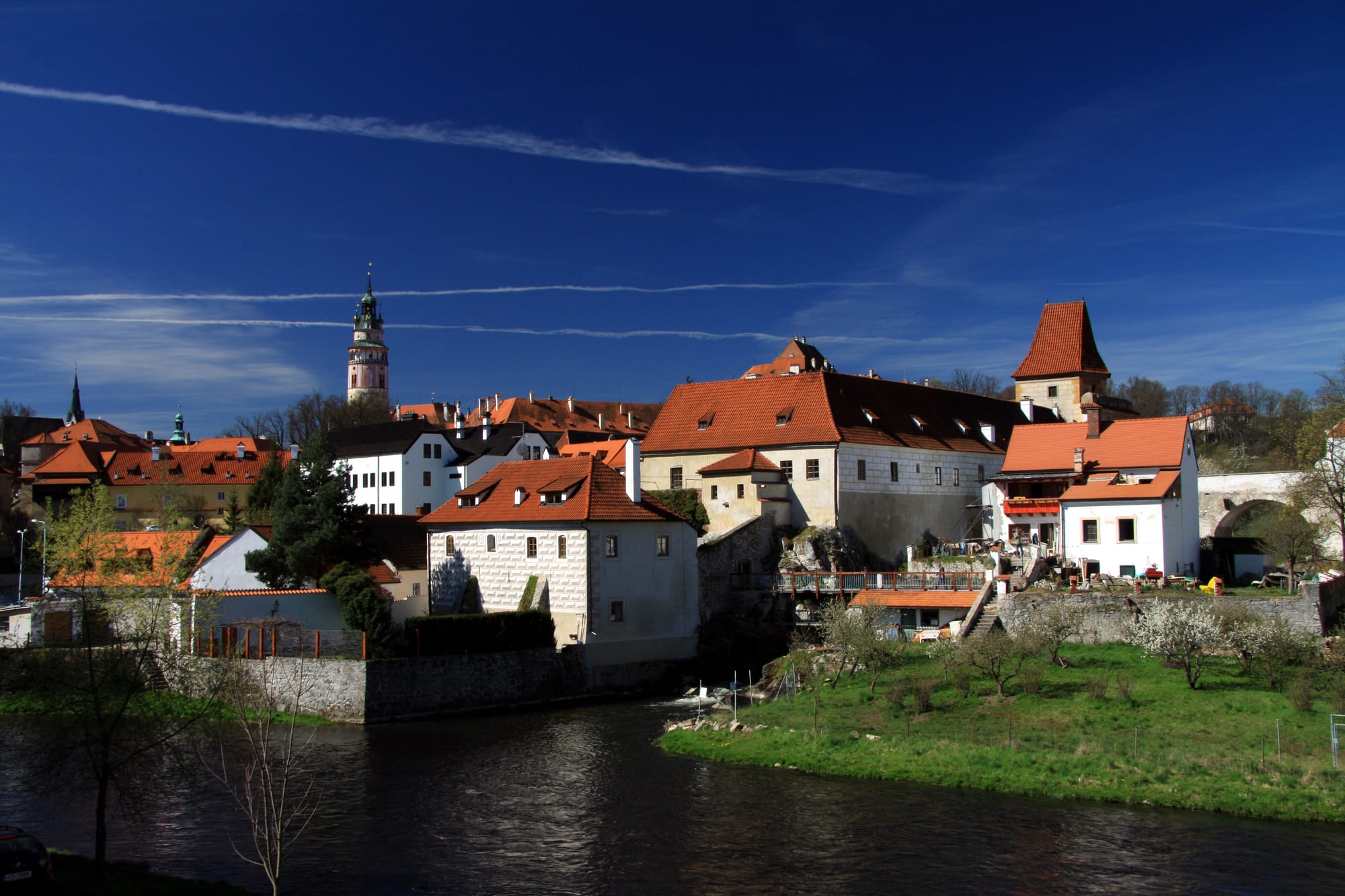
Red-roofed old houses above a dark river and a grassy bank, with a slender painted castle tower rising behind under a deep blue sky

South Bohemia, Czechia

Český Krumlov

The old town of Český Krumlov above the Vltava, with the castle tower behind. (Chmee2 / Wikimedia Commons · CC BY-SA 3.0)

A small town in the Bohemian Forest Foothills, wrapped around a horseshoe bend of the Vltava about 20 km south-west of České Budějovice. Seat of the Rosenbergs, Eggenbergs and Schwarzenbergs, it grew up below one of the largest castle complexes in central Europe, and its Gothic, Renaissance and Baroque centre, a UNESCO World Heritage Site since 1992, is among the most visited places in the country.

Neighbourhoods

  • Inner Town
    • First-time visitors
    • Historic district
    • Best for food

    The old town proper, Vnitřní Město, inside the horseshoe meander of the Vltava. Its medieval street plan leads to Náměstí Svornosti and the town hall of 1597, past the Church of St Vitus, museums, cafés and guesthouses in old burghers' houses.

    Open in Maps
  • Latrán and the castle
    • Historic district
    • Views

    The oldest part of the town, which grew up below the castle across the river and was joined to the Old Town in 1555. Latrán street climbs from the Budějovice Gate towards the castle, and a former monastery complex here opened in 2015 after reconstruction.

    Open in Maps
  • Nádražní Předměstí and Plešivec
    • Close to public transport
    • Quiet and residential

    The outer districts where most residents live. The railway station is on the north side of town, a walk of 15 to 20 minutes downhill to the centre, and the main bus terminal lies east of the square.

    Open in Maps

Things to do

The castle and the old town

  • Český Krumlov Castlelandmark

    The second-largest castle complex in the country after Prague Castle, with a painted 13th-century tower, the Bear Moat, the five-storey Cloak Bridge and one of the best-preserved Baroque theatres in the world.

    Open in Maps
  • Castle gardens and revolving auditoriumpark

    Late Baroque gardens with an 18th-century cascade fountain and, since 1959, an open-air theatre whose seating turns to face the scenery.

    Open in Maps
  • Church of Saint Vituslandmark

    The late Gothic church of 1407–1438 above the river, the town's most valuable church and a national cultural monument.

    Open in Maps
  • Lazebnický mostlandmark

    The bridge between Latrán and the Old Town, probably dating from 1834, with a statue of St John of Nepomuk and a cross.

    Open in Maps

Museums

  • Egon Schiele Art Centrummuseum

    A museum and gallery devoted to the Austrian painter Egon Schiele, who lived in the town.

    Open in Maps
  • Museum Fotoateliér Seidelmuseum

    A museum of photography, one of the town's many small museums.

    Open in Maps
  • Regional Museummuseum

    The town's museum of local history, one of several small museums along with those of marionettes and moldavite.

    Open in Maps

Short trips from the town

  • Zlatá Koruna Monasterylandmark

    A former monastery on the Vltava about 6 km north-east of the town, protected as a national cultural monument.

    Open in Maps
  • Kleťviewpoint

    A 1,087-metre mountain in the Bohemian Forest Foothills near the town.

    Open in Maps
  • Vyšší Brod Monasterylandmark

    A Catholic monastery upriver near the Lipno dam, where the classic canoe trip down the Vltava to Český Krumlov usually begins.

    Open in Maps
  • Holašoviceattraction

    A small village whose medieval plan and farmhouses in the South Bohemian folk Baroque style survived intact after it was deserted after the Second World War.

    Open in Maps

Seasonal events

  • Five-Petalled Rose Festivalsummer solstice weekend, June

    The town turns medieval for a weekend in honour of the Rosenbergs, with craftsmen, musicians and residents in costume, jousting, fencing, dancing and folk theatre, ending with fireworks.

  • Open Air Krumlovlate June

    A blues, rock and soul festival held in the garden of the old Eggenberg brewery.

  • International Music Festival Český KrumlovJuly and August

    An annual summer festival of international music in many genres, held since 1992.

Eat and drink

Long-standing places and food districts in Český Krumlov. Hours, ratings and directions come from your maps app, always current.

Český Krumlov classics

  • Historický pivovar Krumlovrestaurant

    A small craft brewery founded in 2016 in the old Eggenberg brewery, where beer was brewed from the 1620s until 2014.

    Open in Maps

Food districts

  • Restaurants of the Inner Townneighborhood

    Cafés, pubs and restaurants fill the Baroque houses around the main square and along the river.

    Open in Maps
  • Latránneighborhood

    The street below the castle, with places to eat and drink on the way up to the castle.

    Open in Maps

Experience Český Krumlov

History

The bend of the Vltava has been settled since the Stone Age, and Celts and later Slavs lived here before the Vítkovci family founded the castle shortly before 1250; the town is first mentioned in 1253 as Chrumbenowe, from a German phrase meaning crooked meadow. It grew in two parts, Latrán below the castle and the Old Town inside the river bend, with Czech and German speakers from the start and a Jewish community recorded from 1334. In 1302 the castle passed to the Rosenbergs, who made it their main residence, and the town reached its greatest prosperity under Oldřich II in the 15th century. Gold found nearby brought German miners, and in 1555 William of Rosenberg united the two halves of the town and rebuilt the castle in the Renaissance style.

The last Rosenberg, Peter Vok, sold Krumlov to Emperor Rudolf II in 1602. After the Battle of White Mountain in 1620 it went to the Eggenbergs as the seat of the Duchy of Krumlov, and from 1719 to 1947 the Schwarzenbergs owned the castle. By 1910 about 85 per cent of the town's 8,662 people were German-speaking. Annexed to Nazi Germany in 1938, the town lost its German majority through expulsion after 1945.

Under communism the old town fell into disrepair. Since 1989 most of it has been restored; it became a UNESCO World Heritage Site in 1992, one of the first in the country, and grew into one of the most visited places in the Czech Republic. The 2002 European floods caused serious damage.

Culture & Customs

The town's cultural calendar celebrates its past. On the summer solstice weekend the Five-Petalled Rose Festival, named after the rose of the Rosenberg crest, turns the centre into a medieval town of craftsmen, musicians and residents in costume, with jousting, fencing, historical dance and folk theatre in the castle precincts and along the river, ending in fireworks. The International Music Festival, held every July and August since 1992, brings international performers of many genres, and Open Air Krumlov fills the old brewery garden with blues, rock and soul in late June.

The castle theatre, built in 1680–1682 and re-equipped in the 1760s, is the oldest of the four 18th-century theatres in the world that still have their scenery, props and stage machinery, and it holds performances only on special occasions. The revolving open-air auditorium in the castle gardens has staged summer plays since 1959. The painter Egon Schiele lived in the town, and an art centre now bears his name. Film-makers have used the streets for The Illusionist and The Scarlet Pimpernel.

Summer on the Vltava belongs to the canoeists, who paddle from Vyšší Brod past the town towards České Budějovice, and night rafting under the floodlit castle is popular. Local legend says the White Lady, the ghost of Perchta of Rosenberg, haunts the castle.

Daily Life

About 13,000 people live in Český Krumlov. Tourism dominates the old town, which is among the most visited places in the country, while most residents live outside the historic core. The everyday town lies in the outer districts of Plešivec, Domoradice and around the railway station.

Industry is more important than the crowds suggest. The largest employers include Linde Pohony, which makes drive and control systems for forklifts, the welding-equipment maker Fronius and two divisions of Schwan-Stabilo, while the hospital is the largest non-industrial employer. The I/39 road links the town with České Budějovice, the regional centre, and direct buses run to Prague, Linz, Salzburg and Munich.

The rhythm of the year is sharply seasonal: crowded summers of tour groups and canoeists, quieter springs and autumns, and long winters when the old town belongs mostly to residents. The northern part of the municipal territory lies in the Blanský les protected landscape area, and walking, cycling and the river are part of local life.

Food

The town's food is South Bohemian country cooking with the river and the forest close at hand. Kulajda, a traditional South Bohemian soup, is made with cream, mushrooms, dill, potatoes and an egg, often a quail's egg. Mushrooms, foraged in autumn, appear widely, and potato dishes and potato dumplings, sometimes filled with smoked meat, are standard. Carp is the traditional Christmas fish, made into a fish soup, and roast duck with dumplings and red cabbage, roast pork with dumplings and cabbage, and svíčková, beef in a thick root-vegetable sauce, fill restaurant menus.

Beer has been brewed in the town since 1336. The Rosenbergs acquired a brewery in 1522 and moved it to its present site in the 1620s, and as the Eggenberg brewery it produced beer for centuries until it closed in 2014; Eggenberg beer is now brewed in Pardubice. In 2016 a small craft brewery, Historický pivovar Krumlov, opened in the old buildings, and the rest of the complex is being turned into a brewing museum. Sweet fruit dumplings filled with plums, apricots or strawberries are a popular dessert.

Planning tools

Budget

Český Krumlov is the costly exception in South Bohemia: hotels and restaurants in the old town are priced for day-trippers and tour groups, and summer rooms book up early. Staying in České Budějovice and travelling in costs less.

Daily Budget Midrange
USD 110–190 (old-town hotel or pension, restaurant dinners, castle tours, canoe hire)
Daily Budget Shoestring
USD 45–80 (hostel or pension, pub meals, buses and trains)

The castle courtyards and gardens can be walked through without a ticket; only the museum, the tower and the guided interiors charge.

Best Time to Visit

May, June and September are best, before and after the summer crowds. July and August bring the music festival and the canoeists on the Vltava, but the river is overcrowded and the old town busy with tour groups. The Five-Petalled Rose festival fills the town in June.

Suggested Number of Days

The old town and castle fill one full day, and an overnight stay shows the streets after the coaches leave. Add a day or two for the river, the monasteries and the hills nearby, or to combine the town with České Budějovice.

First Visit
1–2 days
With Surroundings
3–4 days

Transportation

The old town is small and mostly pedestrian, with uneven cobbles. Local buses link the railway station and the bus terminal, though walking is the easiest way to get around. In summer many people arrive by canoe, kayak or raft down the Vltava, and rental firms bring boats to the starting point.

Wear solid shoes for the cobbles, and on the river follow the rental firm's advice on weirs and wear a life jacket.

Airport & Station Connections

The town is about 134 km south of Prague. Buses from Prague's Na Knížecí station, calling at Písek and České Budějovice, are often the quickest way, and a direct train runs from Prague in about three hours; other trains change at České Budějovice, from which a local bus takes about 45 minutes. Shuttle services link the town with Linz, Salzburg, Vienna and Munich.

Walkability

Excellent for its size: the Inner Town, Latrán and the castle are all walkable, and walking the length of Latrán to the square and on to the castle takes about an hour with stops. The streets are steep in places and cobbled throughout, and the railway station is a 15 to 20 minute walk above the centre.

Safety

Czechia is a safe country with low levels of violent crime. Český Krumlov sees little crime beyond the occasional pickpocket in summer crowds; the main risks are on the river, where weirs and busy stretches call for care.

Watch belongings in crowded lanes, wear a life jacket on the river and check for ticks after walks in the hills. Check current official travel advice before travelling.

Climate

A transitional Central European climate, as across South Bohemia, with warm summers and cold winters. July is usually the warmest month, and higher ground nearby is cooler.

Summer
warm; in South Bohemia's valleys July averages 17–18°C
Winter
cold, cloudy and often snowy, with January usually the coldest month; the national record low, −42.2°C, was measured near České Budějovice in 1929

Local Customs

Tipping is a sign of appreciation rather than a percentage, and rounding up the bill by a few crowns is common. The old town is still home to residents as well as guesthouses. The Church of St Vitus is still used for worship.

Dress modestly in churches during services, and remember that drivers must have no alcohol in their blood.

Common Payment Methods

The currency is the Czech koruna (CZK), often written Kč. Cards are accepted almost everywhere; carry a little cash for small pubs, stalls and local buses.