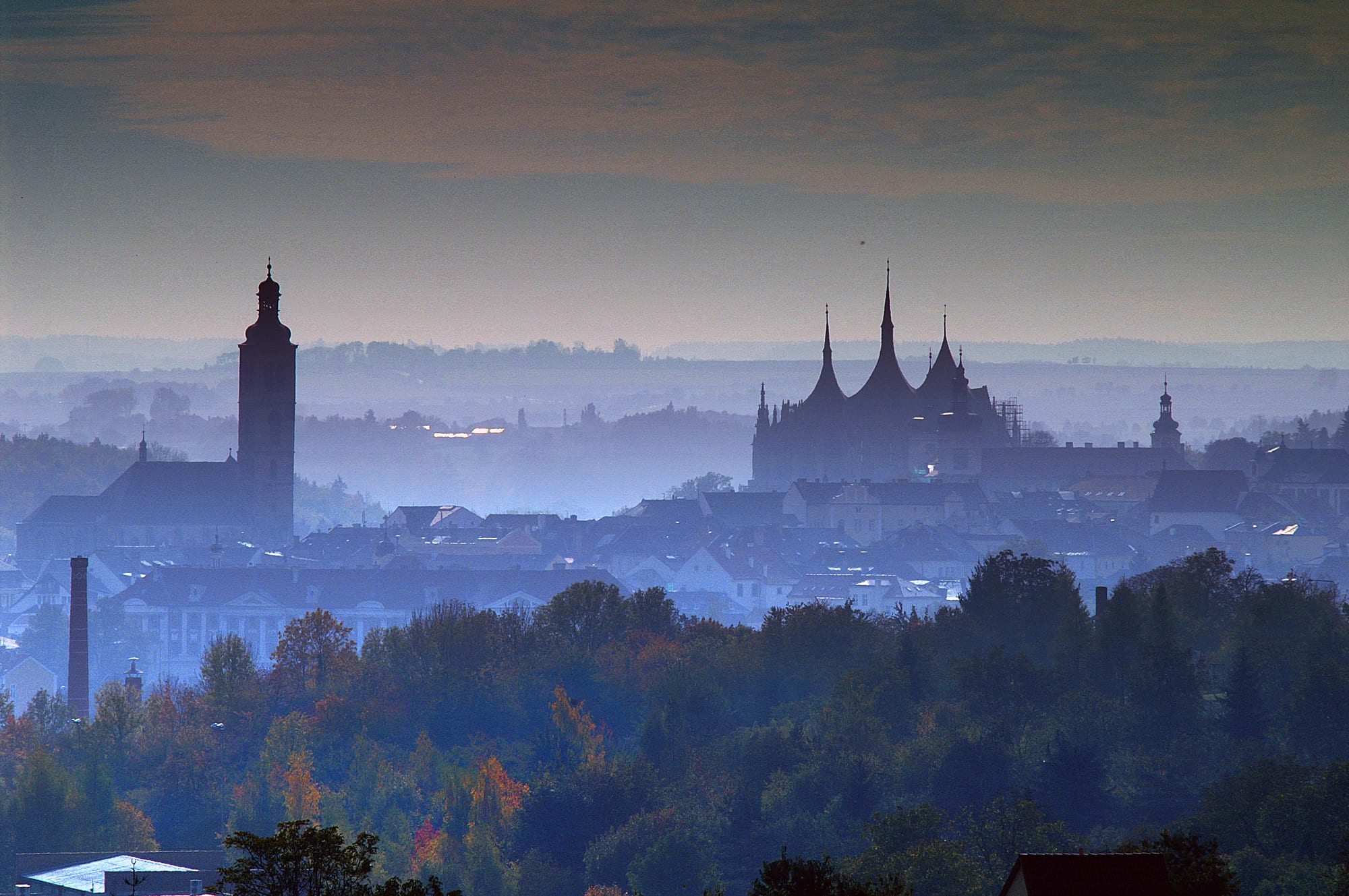
Misty view over Kutná Hora's rooftops, with the tall tower of St James on the left and the tented spires of St Barbara on the right

Prague & Central Bohemia, Czechia

Kutná Hora

The silhouettes of the churches of St James and St Barbara above the rooftops of Kutná Hora. (Milan Nykodym from Kutna Hora, Czech Republic / Wikimedia Commons · CC BY-SA 2.0)

A town of about 22,000 people some 50 km east of Prague, made rich by silver mining from the 13th century, when it held the royal mint and ranked second only to Prague in Bohemia. Its Gothic Church of St Barbara, the Italian Court and the bone-decorated ossuary at Sedlec form a UNESCO World Heritage Site.

Neighbourhoods

  • Historic town centre
    • First-time visitors
    • Historic district

    The old mining town on its hill above the Vrchlice valley, protected since 1961 as the fourth-largest urban monument reservation in the country. St Barbara, the Jesuit College, the Italian Court and more than 300 listed buildings sit in its streets, with cafés and restaurants gathered below the church.

    Open in Maps
  • Sedlec
    • Famous sights
    • Close to the railway

    The suburb that grew around the first Cistercian monastery in Bohemia, founded in 1142, a walk of half an hour or more from the centre. The abbey church and the ossuary draw large crowds; the former monastery buildings house a tobacco factory.

    Open in Maps
  • Malín
    • Quiet and residential

    A village within the town, site of an early medieval fort where silver coins were struck in the 10th century. Its landmark is the Church of St Stephen with a wooden bell tower from the end of the 15th century.

    Open in Maps

Things to do

Gothic and Baroque landmarks

  • Church of St Barbaralandmark

    One of the main works of European Gothic, begun in 1388 probably to a design by Johann Parler, son of Peter Parler, and dedicated to the patron saint of miners.

    Open in Maps
  • Italian Courtlandmark

    The Gothic court built between 1260 and 1300, which held the royal mint from 1300 to 1727 and has a chapel of about 1400.

    Open in Maps
  • Jesuit Collegelandmark

    The long early Baroque college beside St Barbara, built from 1666, approached by a promenade lined with statues by František Baugut.

    Open in Maps
  • Church of St Jameslandmark

    The Gothic church next to the Italian Court, built in 1300–1370, whose 80-metre tower dominates the old town's skyline.

    Open in Maps
  • Plague Columnlandmark

    A Baroque column of 1714–1715 by František Baugut, raised for the victims of the plague of 1713, with statues of saints and miners.

    Open in Maps

Sedlec

  • Sedlec Ossuaryattraction

    A cemetery chapel decorated with the bones of more than 40,000 people who died of plague and in the Hussite Wars, arranged by the carver František Rint around a chandelier of human bones.

    Open in Maps
  • Sedlec Abbeylandmark

    The Cistercian abbey founded in 1142, whose church, destroyed in 1421, was rebuilt from 1699 to 1707 to designs by Paul Ignaz Bayer and Jan Santini Aichel.

    Open in Maps

Museums and the mines

  • Gallery of the Central Bohemian Region (GASK)museum

    A regional art gallery of 20th- and 21st-century art in the restored Jesuit College.

    Open in Maps
  • Hrádek and the Czech Museum of Silvermuseum

    A fortress of 1312 rebuilt as a palace, now the silver museum, where tours enter the town's medieval mine workings between April and November.

    Open in Maps

Short trips from the town

  • Kačina Castlelandmark

    An Empire-style château in Svatý Mikuláš, protected as a national cultural monument.

    Open in Maps
  • Kolínattraction

    The neighbouring town, a short train ride away on the main line towards Prague.

    Open in Maps

Seasonal events

  • Royal Silvering of Kutná Hora (Královské stříbření)late June

    A Gothic pageant held since 1992 that re-enacts a visit by King Wenceslas IV six hundred years before the current year, with sword fighting, theatre, music and many residents in period costume.

Eat and drink

Long-standing places and food districts in Kutná Hora. Hours, ratings and directions come from your maps app, always current.

Food in the old town

  • Restaurants below St Barbaraneighborhood

    Bars, restaurants and cafés gathered beneath the church, some with views over the valley to the south.

    Open in Maps
  • Palackého náměstíneighborhood

    A square in the old town with restaurants and cafés.

    Open in Maps

Experience Kutná Hora

History

Silver lay in the hills here long before the town: coins were already being struck at the fort of Malín in the late 10th century. In 1142 monks from Waldsassen in Bavaria founded Sedlec Abbey, the first Cistercian house in Bohemia, and the discovery of silver on its land drew settlers, many from German-speaking regions. Mining began in earnest around 1260, and the town is first recorded as Mons Cuthna in 1289. In 1300 King Wenceslas II issued a royal mining code, and soon afterwards the Italian Court became the central mint of the Czech lands, striking the Prague groschen. Kutná Hora grew into the second town of the kingdom and its financial centre.

The wealth paid for the Church of St Barbara, begun in the 1380s to rival St Vitus. In 1409 Wenceslas IV signed the Decree of Kutná Hora here, reshaping Prague University in favour of the Czechs. The Hussite Wars brought battle, the burning of Sedlec Abbey in 1421 and the expulsion of part of the German population; a religious peace was agreed in the town in 1485.

Flooding in the deepest shafts and poorer ore cut mining back in the 1530s, the groschen ceased in 1547 and mining stopped in 1625. The Jesuits arrived in 1626 and made the town a centre of education, while Swedish raids in 1639 and 1643 caused heavy damage. The mint closed in 1727, ending the mining era. The Jewish community was destroyed by deportations during the Nazi occupation. In 1995 the historic centre and Sedlec were inscribed as a UNESCO World Heritage Site.

Culture & Customs

Kutná Hora's identity is still that of a mining town. Miners stand alongside the saints on the plague column, Baugut's statues line the promenade to St Barbara, and the church itself, dedicated to the patron saint of miners, is the town's emblem. The silver museum in Hrádek and the tours through the medieval workings keep that history close, and silver jewellery is sold in the shops of the centre.

The biggest event of the year is the Royal Silvering, held at the end of June since 1992. It re-creates a visit by King Wenceslas IV to the town as it would have been six hundred years earlier, with historical sword fighting, theatre and music, and many residents in costume. The town also hosts a recitation competition named after the poet Jiří Orten, an international guitar competition every two years and a folk festival.

In 2023 the Sedlec area and St Barbara drew about 290,000 and 250,000 visitors, and the town lives with a steady flow of day visitors from Prague. The Sedlec Ossuary, its bones arranged as garlands, a coat of arms and a chandelier, is both a sight and a consecrated chapel, and visitors are expected to behave accordingly. The GASK gallery in the Jesuit College brings 20th- and 21st-century art to the old town, and the town's past was recreated in the Czech video game Kingdom Come: Deliverance II.

Daily Life

About 22,000 people live in Kutná Hora, spread across twelve municipal parts that include the historic centre, Sedlec and Malín. The town sits between the farming country of the Central Elbe Table to the east and the Upper Sázava Hills to the west.

Tourism is one of the main sources of work, but industry matters as much. A tobacco factory has occupied the buildings of the former Cistercian monastery in Sedlec since 1812, making cigarettes since 1882; owned by Philip Morris since 1992, it employs more than 800 people. The largest employer based in the town is an electronics manufacturer with more than 1,500 staff. The I/2 road from Prague to Pardubice runs through the town, and the Prague–Brno railway gives easy access to Kolín and the capital.

Daily life in the old town follows the rhythm of the visitors: busy streets around St Barbara and the main square by day, and quiet after the last trains back to Prague have gone. Beyond the centre most of the town is residential, and the walk from the main station to the sights passes through ordinary streets of homes.

Food

Kutná Hora's pubs and restaurants serve the Bohemian standards. Bread dumplings, knedlíky, steamed and sliced like bread, come with most main courses; roast duck is served with dumplings and braised red cabbage; and guláš, a stew of beef, pork or game with onions and spices, comes with dumplings or bread. Goulash soup, gulášovka, and broths with liver or nutmeg dumplings are common starters, and potato dumplings filled with smoked meat, uzené, and served with sauerkraut are another country classic.

Brewing has a long history in the town. A brewery is recorded from 1538, founded by the Dačický of Heslov family, and it kept brewing until it closed in 2010. The cellars of the Ursuline convent, designed by Kilian Ignaz Dientzenhofer in the 18th century, are used commercially as wine cellars.

The best-placed places to eat are the bars, restaurants and cafés gathered below St Barbara, some with views across the valley to the south, and the restaurants around Palackého náměstí. Souvenir shops near the ossuary sell some of the town's more unusual keepsakes.

Planning tools

Budget

Kutná Hora is cheaper than Prague, and most visitors come for the day by train, so the main costs are tickets for the churches, the ossuary, the silver museum and the mine tour. Prices in the restaurants by St Barbara are higher than elsewhere in town, and a night in a pension here costs less than a room in central Prague.

Daily Budget Midrange
USD 120–220 (mid-range hotel, restaurant dinners, sight tickets and the mine tour)
Daily Budget Shoestring
USD 50–90 (pension or hostel, pub meals, train from Prague, a combined church ticket)

Arrive early to see the ossuary before the tour groups, and consider staying the night to see the old town quiet.

Best Time to Visit

April to October, when the mine tours run and the old town's cafés use their terraces; late June brings the Royal Silvering festival. July and August are the busiest months at the ossuary. In winter the churches stay open but the mines close and the town is very quiet.

Suggested Number of Days

Most visitors see the town and Sedlec in a single long day from Prague. Staying overnight allows a slower pace, a quiet evening in the old town and time for the nearby towns and châteaux.

First Visit
1 day
With Surroundings
2 days

Transportation

The town has four stations. Express trains stop at Kutná Hora hlavní nádraží, near Sedlec, from where a local train meets most arrivals and runs to Kutná Hora město, close to the old town. Local buses, a private shuttle minibus and a few taxis link the station, Sedlec and the centre, and walking between Sedlec and St Barbara takes 35–45 minutes.

Use Kutná Hora město station for the centre and hlavní nádraží for the ossuary, so arriving at one and leaving from the other saves backtracking.

Airport & Station Connections

Kutná Hora lies about 52 km east of Prague on the Prague–Brno railway. Trains leave Prague's main station roughly hourly; buses, also roughly hourly, run from Prague's Háje bus station but are slower. The nearest airport is Václav Havel Airport Prague.

Walkability

The old town is compact and best explored on foot, with hilly, cobbled streets between St Barbara, the Italian Court and the main squares. Sedlec is a separate area beside the main station, about a 35–45-minute walk from the centre, so many visitors take the local train or bus one way.

Safety

Czechia is a safe country with low levels of violent crime. Kutná Hora is a quiet town; the main care needed is with belongings in the crowds at the ossuary and St Barbara in summer, and with uneven cobbles and steps around the old town.

Wear sturdy shoes on the cobbles and for the mine tour, and keep bags closed in busy sights. Check current official travel advice before travelling.

Climate

The eastern part of the town's territory lies in the flat farmland of the Central Elbe Table. Summers are warm and winters cold, much as in Prague, 52 km to the west.

Summer
in Prague, 52 km west, usually sunny, around 25°C, with more days above 30°C in recent years
Winter
in Prague, 52 km west, cold, averaging about 0°C, with very little sunshine

Local Customs

Tipping is a sign of appreciation rather than a fixed share of the bill; around 10 per cent is usual in restaurants used to visitors, and less is expected in local pubs. A greeting on entering a shop or pub is polite. The ossuary and the churches are consecrated places as well as sights.

Behave quietly and respectfully in the ossuary and churches, and follow the rules on photography posted at each site.

Common Payment Methods

The currency is the Czech koruna (CZK, written Kč). Cards are accepted at the main sights, hotels and most restaurants, and there are ATMs in the centre. Carry a little cash for local buses, small pubs and souvenir stalls.