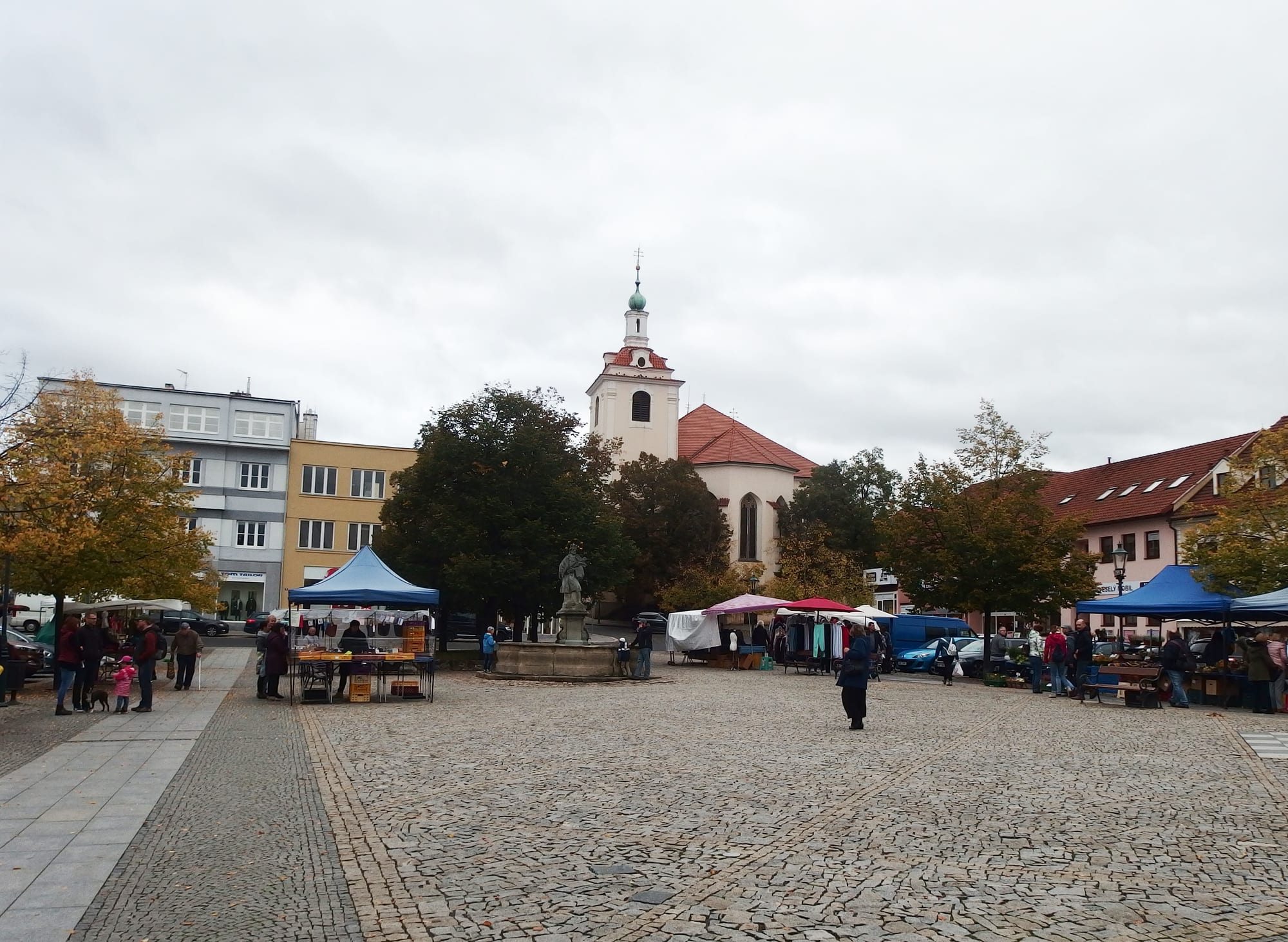
Market stalls on a wide cobbled square with a statue fountain, autumn trees and a white church tower beyond

Prague & Central Bohemia, Czechia

Beroun

Husovo náměstí, the main square of Beroun. (Palickap / Wikimedia Commons · CC BY-SA 4.0)

A town of about 22,000 people where the Litavka joins the Berounka, some 26 km south-west of Prague on the old road to Plzeň. A royal town from 1303, it keeps a walled medieval centre and two town gates, and serves as the base for the limestone hills, caves and castles of the Bohemian Karst, Karlštejn among them.

Neighbourhoods

  • Historic centre and Husovo náměstí
    • First-time visitors
    • Historic district

    The medieval core laid out under Wenceslas II in 1295, around the square of Husovo náměstí with its Renaissance town hall and the Church of St James. Stretches of the town walls and the Plzeň and Prague gates still frame it, and the regional museum stands on the square.

    Open in Maps
  • Závodí and the station
    • Close to public transport
    • Local life

    The area by the Berounka and the railway, with the town's two stations and the old industrial sites, including the former sugar factory that now holds a family brewery.

    Open in Maps
  • Městská hora
    • Parks
    • Families

    The wooded town hill near the centre, with a lookout tower and the enclosure where the town keeps its bear, the symbol on Beroun's coat of arms.

    Open in Maps

Things to do

In town

  • Husovo náměstí and the Church of St Jameslandmark

    The main square of well-preserved houses and the Renaissance town hall of 1560–1564, with the originally Gothic parish church of St James, as old as the town itself.

    Open in Maps
  • Town walls and gateslandmark

    Fortifications built under Wenceslas II that once ran 1,170 metres around the town; the Plzeň and Prague gates carried the main road between the two cities until 1842.

    Open in Maps
  • Medvědáriumpark

    The bear enclosure on Městská hora, first home to bears from Czech children's television, with a playground and a small lookout tower.

    Open in Maps
  • Museum of the Bohemian Karstmuseum

    The regional museum on Husovo náměstí, covering the history and nature of the Beroun area and the geology and fossils of the Bohemian Karst.

    Open in Maps

The Bohemian Karst

  • Koněprusy Cavesattraction

    A cave system in the limestone of the Bohemian Karst, 6 km south of Beroun, also known as Zlatý kůň.

    Open in Maps
  • Klonkviewpoint

    A national nature monument near Suchomasty, about 6 km south of Beroun, recognised worldwide as a reference site where geologists mark a boundary in the rock record.

    Open in Maps
  • Svatý Jan pod Skaloulandmark

    A village below a limestone cliff, known for the Baroque complex of a former Benedictine monastery, protected as a national cultural monument.

    Open in Maps
  • Velká Amerikaattraction

    A partly flooded, abandoned limestone quarry near Mořina with sheer walls above a lake.

    Open in Maps

Castles nearby

  • Karlštejn Castlelandmark

    The Gothic castle founded by Charles IV in 1348 to keep the imperial regalia and the Bohemian crown jewels, a short train ride east along the Berounka on the S7 line.

    Open in Maps
  • Točník Castlelandmark

    A castle built for Wenceslas IV at the end of the 14th century above the older castle of Žebrák, now a ruin open to visitors.

    Open in Maps
  • Křivoklát Castlelandmark

    A royal castle on a rocky spur above a tributary of the Berounka, protected as a national cultural monument.

    Open in Maps

Seasonal events

  • Berounské Letorostylate summer

    A music festival held at the end of summer since 2005.

Eat and drink

Long-standing places and food districts in Beroun. Hours, ratings and directions come from your maps app, always current.

Beer and local food

  • Berounský medvěd breweryrestaurant

    A family brewery and large restaurant with traditional decoration, hidden in the grounds of the old sugar factory a couple of minutes' walk from the main station.

    Open in Maps
  • Husovo náměstí and the riversideneighborhood

    Pubs and restaurants on the main square and along the river.

    Open in Maps

Experience Beroun

History

A settlement called Na Brodě, "by the ford", was recorded here in 1088. In 1265 King Ottokar II chose the site, on the shortest and easiest route between Prague and Plzeň, for a new town first named Verona — perhaps after merchants from the Italian city, though nobody is sure why. The name drifted through Berona and Beraun to Beroun. Wenceslas II resettled and enlarged the town in 1295, laying out the core that survives today and founding a Dominican convent, and in 1303 he made Beroun a royal town. It prospered under Charles IV.

In 1421 Hussite forces under Jan Žižka stormed the town and demolished the convent; the town was retaken and devastated after the Battle of Lipany, but has remained mainly Czech ever since. It reached its greatest prosperity under King Vladislaus II, before the Habsburgs seized its estates after 1526. The Thirty Years' War brought sackings by Imperial, Saxon and Swedish armies, and French and Bavarian troops followed in the First Silesian War. Beroun became a garrison town and recovered only in the 1860s, when limestone quarries, iron ore mines, ironworks and textile mills brought new growth.

Communist rule changed the town sharply. Heavy industry expanded, and housing quotas were met by demolishing medieval buildings in the cramped valley and putting up prefabricated tower blocks; in the 1980s the D5 motorway was carried over the town on a bridge. Since the fall of communism medieval buildings have been restored, the walls conserved and heavy industry has left, and in the 21st century Beroun has become a popular place to live, with fast population growth.

Culture & Customs

The bear is Beroun's emblem. A brown bear walks beneath the portcullis on the town's coat of arms, one story derives the name from the German word for bear, and the town keeps a bear in an enclosure on Městská hora — originally cubs known from Czech children's bedtime television — which remains a favourite family walk. The local ice hockey club is called the Bears.

Music has a strong place. The international music festival Talich's Beroun has been held every year since 1983, named after Václav Talich, the conductor who lived and died in the town. Since 2005 the Berounské Letorosty festival has filled the end of summer, and the pottery markets held every year in the town are of national importance.

The Museum of the Bohemian Karst on the main square reflects another part of local identity: the limestone landscape around the town, its caves and its fossils; at Klonk, just south of the town, a rock face serves as a world reference point for geologists. Marked paths leave the town for Městská hora, Děd hill and the Karst, and the surrounding countryside offers cycling, inline skating and walks. Sport is local and amateur: hockey, ball hockey, football, rowing and swimming clubs all have their home here.

Daily Life

About 22,000 people live in Beroun, across seven municipal parts, and the town forms one built-up area with Králův Dvůr, which was part of Beroun until 1990. Its quality of environment and health care are above the national average, and the population has grown quickly this century.

The largest employer is Tipsport, the biggest betting company in the country, with more than 1,000 staff. Industry continues on a smaller scale than under communism, with manufacturers of air-conditioning equipment and fibre-cement building materials among the main employers.

The town is a rail junction for lines towards Prague, Plzeň, České Budějovice, Rakovník and Blatná, and the D5 motorway, part of the route from Prague to Nuremberg, crosses above it. The town has a cinema, a few museums, sports clubs and a swimming pool, and its centre is quiet at weekends. Communist-era tower blocks and the motorway bridge still mark the townscape beside the restored medieval streets.

Food

Beroun eats in the Central Bohemian tradition. Bread dumplings, knedlíky, steamed and sliced like bread, accompany most main dishes; roast duck comes with dumplings and braised red cabbage; and guláš, a stew of beef, pork or game with onions and spices, is eaten with dumplings or bread. Goulash soup, gulášovka, broths with liver dumplings and klobása, the smoked sausage, are pub staples.

Brewing has deep roots here. Before the Second World War the town had a burghers' brewery alongside its sugar refinery, mills and factories, and today the family-run Berounský medvěd brewery, brews and serves its own beer in a large restaurant hidden in the grounds of the old sugar factory near the main station.

Most other places to eat are on the main square and along the river. Food has a place in the town's industrial past too: a 1932 list of Beroun's businesses included a sugar refinery, mills, a pasta factory and a factory making bakery machines, alongside the burghers' brewery.

Planning tools

Budget

Beroun is priced at ordinary Czech levels, well below central Prague, and the commuter trains that link it to the capital and Karlštejn are cheap. Most of the nearby sights, from castles to caves, are visited on guided tours with an entry fee, which is the main daily cost.

Daily Budget Midrange
USD 110–200 (mid-range hotel or pension, restaurant dinners, castle and cave tours)
Daily Budget Shoestring
USD 50–85 (pension, pub meals, local trains and buses)

Staying in Beroun rather than Prague puts Karlštejn, the caves and the Berounka valley within easy reach by local train.

Best Time to Visit

May to September, when the castles and caves run their full seasons and the paths of the Bohemian Karst are dry; many castles in the region close or open only at weekends from November to March. Summer weekends bring the biggest crowds to Karlštejn.

Suggested Number of Days

The town itself can be seen in a few hours. Two or three days allow time for the castles, caves and walking country of the Bohemian Karst around it, which is the main reason to stay.

First Visit
1 day
With Surroundings
2–3 days

Transportation

Beroun is a rail junction, with lines to Prague, Plzeň, Rakovník and Blatná, and two stations, Beroun and Beroun-Závodí. The S7 commuter line runs often along the Berounka valley to Prague, stopping at Karlštejn on the way, and local trains and buses reach the villages of the Karst. A car or bicycle helps for the smaller sights.

Use the S7 train for Karlštejn and the river valley, and allow time for the walk up from Karlštejn station to the castle.

Airport & Station Connections

Beroun lies about 26 km south-west of Prague. Fast trains between Prague and Plzeň stop here, commuter trains run from Prague's main station and Smíchov, and the D5 motorway passes above the town on a bridge. The nearest airport is Václav Havel Airport Prague.

Walkability

The historic centre is small and flat, and the station, the square and the riverside are within walking distance of each other. Marked footpaths lead out of town to Městská hora and Děd hill and on into the limestone countryside of the Karst.

Safety

Czechia is a safe country with low levels of violent crime. Beroun is a quiet town; the main risks lie in the countryside around it, with ticks in the forests and steep, slippery paths up to castles and along the limestone cliffs.

Check for ticks after forest walks and keep to marked paths near quarries and cliffs. Check current official travel advice before travelling.

Climate

The town lies in a deep river valley in the hilly country south-west of Prague, with warm summers, afternoon thunderstorms and cold, grey winters.

Summer
in nearby Prague summers usually bring plenty of sunshine and temperatures around 25°C, with heavy rain in thundershowers
Winter
in nearby Prague winters are relatively cold, averaging about 0°C, with very little sunshine

Local Customs

Tipping is a sign of appreciation rather than a fixed share of the bill; leaving a tip on the table is not the usual local practice away from places used to foreign visitors. A greeting on entering a shop or pub is polite. The town centre is quiet at weekends.

Castle tours follow set times and are often in Czech, so ask for an English tour or text in advance where available.

Common Payment Methods

The currency is the Czech koruna (CZK, written Kč). Cards are accepted almost everywhere, and there are ATMs in the centre. Carry a little cash for small pubs, markets and rural buses.