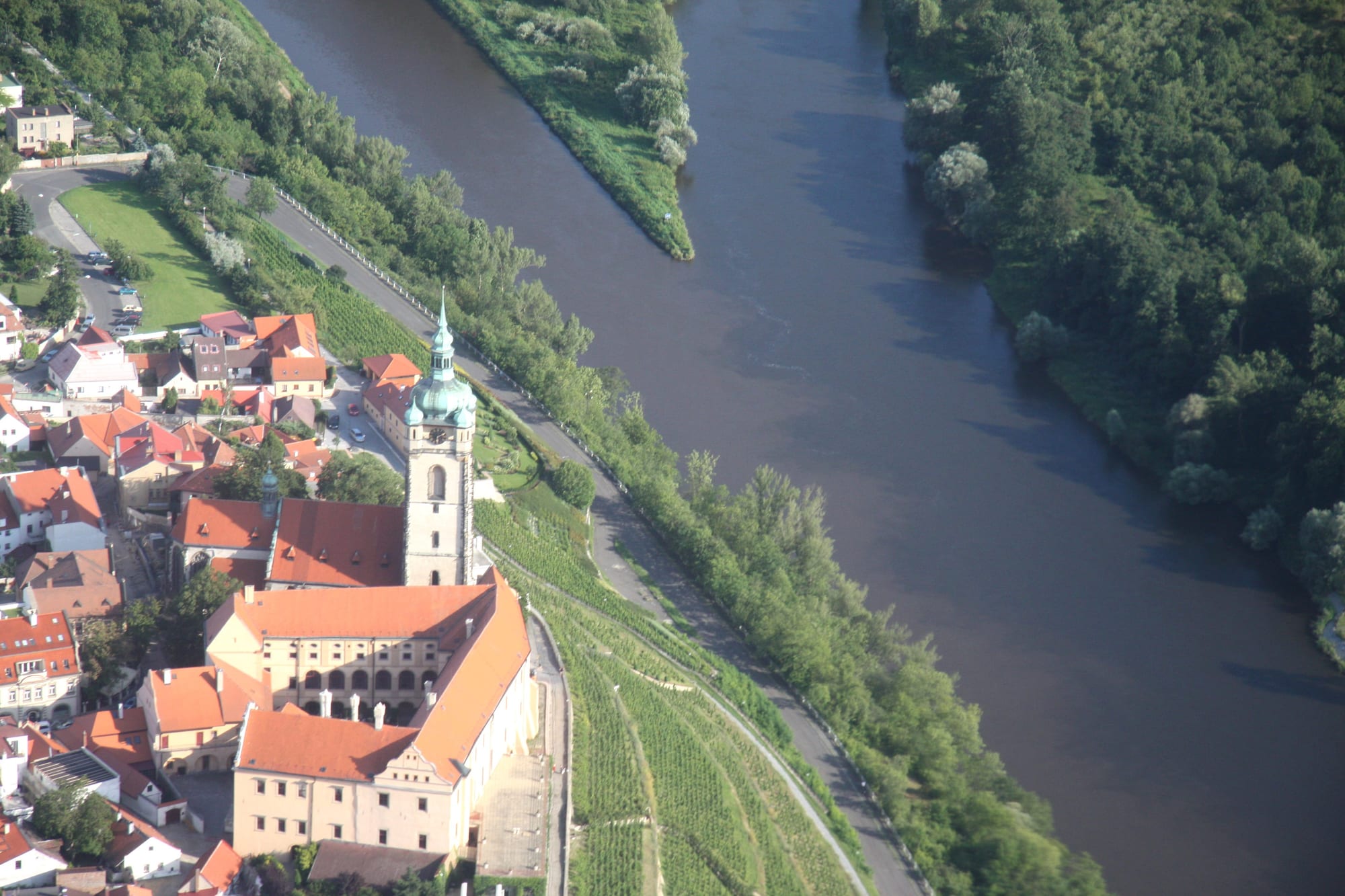
Aerial view of a château and church tower above rows of vines sloping down to a wide river, with red-roofed houses alongside

Prague & Central Bohemia, Czechia

Mělník

Mělník Castle above the confluence of the Elbe and the Vltava. (melechovsky / Wikimedia Commons · CC BY 3.0)

A wine town of about 20,000 people some 27 km north of Prague, on a hill above the confluence of the Vltava and the Elbe. Once a dowry town of Bohemia's queens, it keeps a Renaissance château with vineyards falling to the river, a church with a large ossuary and an arcaded main square, and is also one of the country's largest river ports.

Neighbourhoods

  • Old town and Náměstí Míru
    • First-time visitors
    • Historic district

    The historic centre on the hill, around an arcaded square of Renaissance and Neo-Renaissance houses with the town hall, the Church of the Fourteen Holy Helpers and the former Capuchin monastery. The château and the parish church stand at its edge, looking out over the confluence about 80 metres below.

    Open in Maps
  • The riverside and the port
    • Walks
    • River views

    The low ground along the Elbe and the Vltava canal below the vineyards, with riverside paths and one of the largest river ports in the country, built from a transhipment depot of the late 19th century.

    Open in Maps
  • The station quarter
    • Close to public transport

    The newer town around the railway and bus stations, about a kilometre and a half's walk from the historic centre.

    Open in Maps

Things to do

Old town sights

  • Mělník Châteaulandmark

    The Renaissance château above the confluence, with large wine cellars below it, confiscated by the communists and returned to the Lobkowicz family; one of the few Czech châteaux that can be visited without a guide.

    Open in Maps
  • Church of St Peter and St Paul and its ossuarylandmark

    The parish church begun around the turn of the 10th and 11th centuries, rebuilt several times, whose tower gives views over the confluence and whose crypt holds the arranged remains of 10,000–15,000 people.

    Open in Maps
  • Náměstí Míru and the town halllandmark

    The main square, lined with arcaded houses, where the town hall combines Renaissance arches, the Gothic bay window of the Chapel of St Barbara and a Baroque tower.

    Open in Maps
  • Prague Gate and the water towerlandmark

    The best-preserved part of the town fortifications, a gate of the 1530s, with a 16th-century water tower 20 metres high nearby.

    Open in Maps
  • Regional Museum Mělníkmuseum

    A museum in the former Capuchin monastery on the main square, devoted to the history of Bohemian wine-making and to the town's tradition of making prams.

    Open in Maps

Short trips from the town

  • Veltrusy Mansionlandmark

    A Baroque château by Giovanni Battista Alliprandi near the Vltava, open for guided tours.

    Open in Maps
  • Nelahozevesattraction

    A village on the Vltava known for its Renaissance castle and as the birthplace of Antonín Dvořák.

    Open in Maps
  • Kokořín Castlelandmark

    A 14th-century castle in sandstone country to the north-east, ruined in the Hussite Wars and rebuilt in 1911–1918.

    Open in Maps
  • Libliceattraction

    A village in the Mělník district known for its château.

    Open in Maps

Seasonal events

  • Mělník wine festival (Mělnické vinobraní)late September

    The town's harvest festival, held every year at the end of September around the feast of St Wenceslas, patron saint of winemakers, with tastings and a cultural programme.

Eat and drink

Long-standing places and food districts in Mělník. Hours, ratings and directions come from your maps app, always current.

Mělník wine and food

  • Château wine cellarsmarket

    The large wine cellars below the Lobkowicz château, part of the town's long wine tradition.

    Open in Maps
  • Náměstí Míruneighborhood

    The arcaded main square and the lanes around it, where local wine and Czech dishes are served.

    Open in Maps

Experience Mělník

History

Mělník is among the longest continuously inhabited places in the country. In the 5th and 6th centuries Slavic tribes settled the area, and the Pšovans made their main settlement here, at the fort of Pšov on the hill above the confluence. Their most famous daughter was St Ludmila, who married the Bohemian prince Bořivoj I and was grandmother of St Wenceslas. Coins of the princess Emma, who died in 1005 or 1006, are the first evidence of the town's existence. The name comes from the Slavic mělnit, "to crumble", after the crumbling Cretaceous rock of the hill.

In November 1274 King Ottokar II raised Mělník to a town, and it became a dowry town held by the queens of Bohemia; in 1449 it won the right to run its own affairs through councillors headed by a mayor. Vines had grown here since the end of the 9th century, but Charles IV laid the ground for real development by bringing vines from Burgundy, and wine made the town famous in the first half of the 16th century.

The town joined the Bohemian Revolt of 1618–1620 and paid with confiscations and re-Catholicisation; Saxon and Swedish raids, plague and fires in 1646, 1652 and 1681 followed. A fire in 1765 destroyed 42 houses, including the town hall and the Capuchin monastery, and prompted a new phase of Baroque rebuilding. Mělník became a district town in 1850, gained a sugar factory in 1869, a railway in 1874 and a bridge over the Elbe in 1888, and a late 19th-century transhipment depot grew into its river port. Under communism the château was confiscated; it has since been returned to the Lobkowicz family.

Culture & Customs

Wine is Mělník's identity. The town gives its name to the Mělník wine region, one of the most northerly in Europe, and the legend runs that Ludmila had vines brought from Moravia and planted near Pšov after the Great Moravian prince Svatopluk sent her husband a barrel of wine to celebrate the birth of their son. Her grandson Wenceslas is said to have tended the vineyards himself and became the patron saint of winemakers, and the town's wine festival is held at the end of September on his feast day.

The confluence is the other part of the town's self-image. Mělník is known as the place where the Vltava flows into the Elbe, though by tradition rather than hydrology, since the Vltava is the bigger river at the meeting point. The view from the château terraces and the church tower down to the two rivers, with the vineyards between, is the town's classic image.

The regional museum tells two stories that matter here: wine-making in Bohemia and the town's tradition of making prams. The ossuary under the church of St Peter and St Paul, whose remains the anthropologist Jindřich Matiegka arranged between 1915 and 1919, is a sombre counterpart to the wine cellars under the château. The Villa Carola near the château houses the town library, part of the Mělník Culture Centre.

Daily Life

About 20,000 people live in Mělník, and some of them commute to Prague every day. The town lies in one of the most important farming areas of the country, on the Polabí lowlands where the Central Elbe Table meets the Jizera Table, and its fields and vineyards spread across the flat country around it.

The economy rests on more than wine. The river port, one of the largest in the Czech Republic, handles container transhipment on 42 hectares of land, and the town sits at the crossing of the I/9 and I/16 roads between the D8 motorway, Česká Lípa, the German border and Mladá Boleslav. The largest industrial employers make grinding tools and rubber products, each employing more than 500 people, and the hospital is the largest non-industrial employer.

Life divides between the old town on the hill, with its square, château and church, and the newer districts, the stations and the port below. Railway lines run towards Ústí nad Labem, Kolín and Prague, and the line along the right bank of the Elbe carries freight as well as express trains. The protected landscape area of Kokořínsko, has its administration in Mělník, and its sandstone canyons and Kokořín Castle are a short trip away.

Food

Wine comes first. The local wine is usually dry; large wine cellars lie beneath the château, and the regional museum holds tastings in its Gothic cellars. Charles IV's Burgundian vines are the founding story of local viticulture, and wine tastings can be arranged through the regional museum. At the end of September the wine festival brings tastings, music and a cultural programme to the town, as the biggest Czech harvest festivals do.

The food is Bohemian. Bread dumplings, knedlíky, steamed and sliced like bread, come with most main courses; roast duck is served with dumplings and braised red cabbage; and guláš, a stew of beef, pork or game with onions and spices, is eaten with dumplings or bread. Goulash soup, gulášovka, and broths with liver dumplings are common starters, and klobása, a smoked sausage, is sold at markets and festivals.

The best places to eat and drink are on Náměstí Míru and in the lanes around it, where restaurants serve local wine with Czech dishes, and near the château, whose terraces look over the confluence.

Planning tools

Budget

Mělník is priced at ordinary Czech levels, well below central Prague, and is usually visited as a day trip by bus or train. The château, the church tower and ossuary and the regional museum each charge modest entry fees, and wine tastings are the main extra.

Daily Budget Midrange
USD 110–200 (mid-range hotel, restaurant dinners with local wine, château and museum tickets)
Daily Budget Shoestring
USD 50–85 (pension or campsite, pub meals, bus from Prague)

Arrange a wine tasting through the regional museum, and time a visit for the September wine festival.

Best Time to Visit

May to September, when the vineyards are green and the riverside paths dry; late September brings the grape harvest and the wine festival. In summer a historic steamboat sails from Prague. Winters are cold and grey, and the town is quiet.

Suggested Number of Days

The old town, the château and the church can be seen in a single day from Prague. Two or three days allow for the châteaux and castles of the surrounding countryside, the sandstone country to the north-east and a slower pace with the local wine.

First Visit
1 day
With Surroundings
2–3 days

Transportation

The historic centre is small and walkable, about a kilometre and a half from the train and bus stations. The area around the town is flat and good for cycling, and local buses serve the surrounding villages. A car helps for the castles further out.

Parking in the centre is paid on weekdays, with the first 90 minutes free.

Airport & Station Connections

Mělník lies about 27 km north of Prague. Direct buses run from Prague about every half hour, usually from Ládví metro station, and take about 45 minutes; by train the journey takes about an hour with a change at Všetaty. In summer a historic steamboat sails from Rašínovo nábřeží in Prague. The nearest airport is Václav Havel Airport Prague.

Walkability

The old town on the hill is compact and easy on foot, with the square, the château and the church a few minutes apart. The town stands some 80 metres above the confluence, so reaching the river means a steep descent past the vineyards, and the stations are about a kilometre and a half from the centre.

Safety

Czechia is a safe country with low levels of violent crime. Mělník is a quiet town; the main care needed is on the steep paths and steps between the old town and the river, and with traffic where two main roads cross the town.

Wear good shoes for the steps down to the river and take care with traffic when cycling on the main roads. Check current official travel advice before travelling.

Climate

The town lies in the Polabí lowlands, with warm summers and cold, grey winters.

Summer
in nearby Prague summers usually bring plenty of sunshine and temperatures around 25°C, with heavy rain in thundershowers
Winter
in nearby Prague winters are relatively cold, averaging about 0°C, with very little sunshine

Local Customs

Tipping is a sign of appreciation rather than a fixed share of the bill; leaving a tip on the table is not the usual local practice away from places used to foreign visitors. A greeting on entering a shop or wine bar is polite. The ossuary is part of a working church.

Behave quietly in the church and ossuary, and dress modestly for services.

Common Payment Methods

The currency is the Czech koruna (CZK, written Kč). Cards are accepted in most hotels, restaurants and at the château, and there are ATMs in the centre. Carry a little cash for bus drivers, small pubs and wine stalls.