History · Mali
Why did Timbuktu gather hundreds of thousands of old manuscripts, and where are they now?
Gold, salt and scholarship made books the city's most prized goods, and families hid them for centuries. Most now sit far to the south, in Bamako.
By Globeway Editorial · 13 October 2026
The short answer
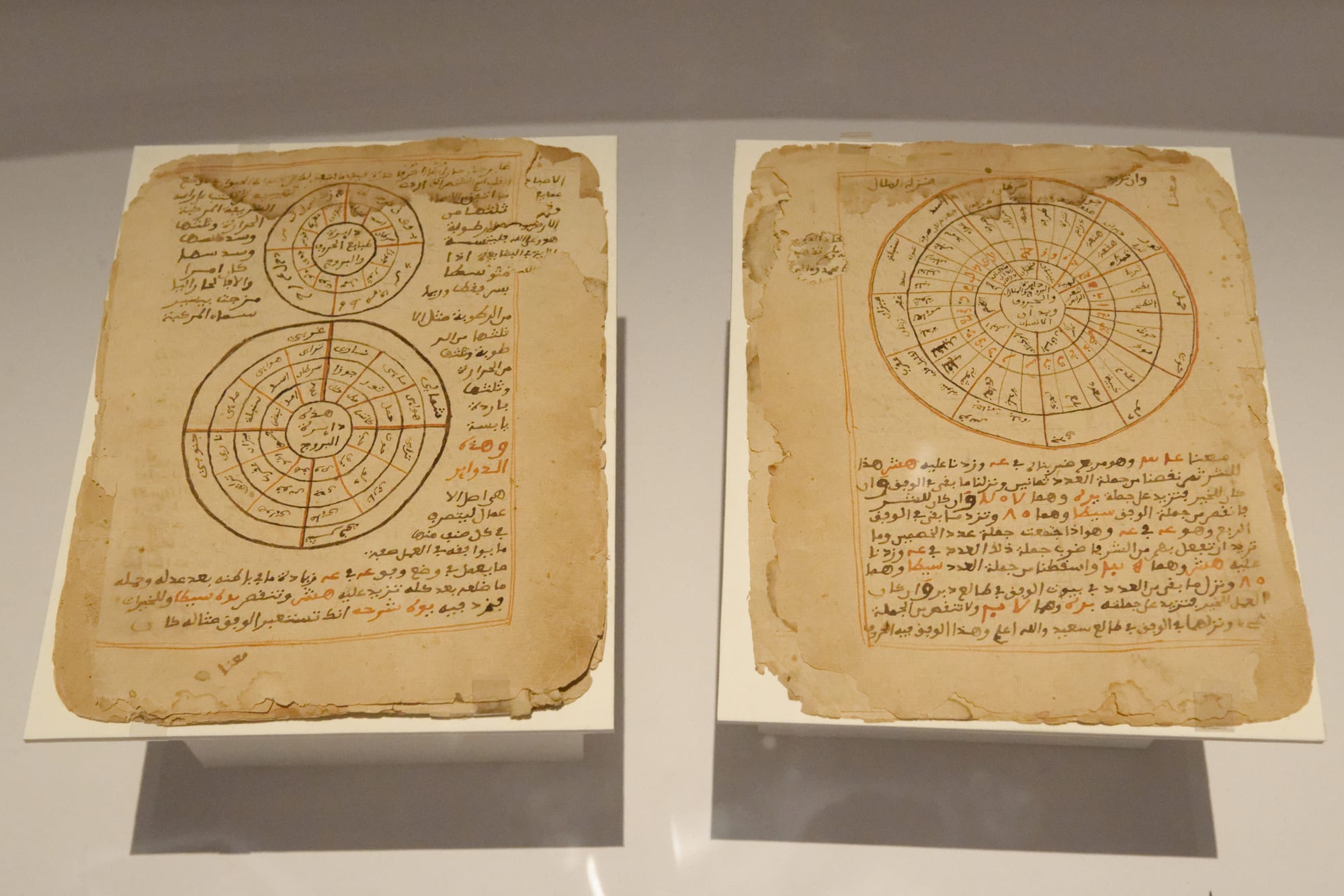
Timbuktu sat where the camel caravans of the Sahara met the Niger River, and the gold, salt and ivory that passed through it paid for something unusual: a city of scholars. From the 13th century onwards teachers and students gathered there, books were bought from across the Islamic world and copied by hand, and learned families built private libraries that they passed from generation to generation. Over the centuries those collections grew into hundreds of thousands of manuscripts, kept not in one great library but in households.
The question needs two corrections, though. The manuscripts are not all medieval: they date from the late 13th century to the early 20th, and the city's only public library holds mostly works from the 14th to 16th centuries. And most of them are no longer in Timbuktu. When armed Islamist groups occupied the city in 2012, about 350,000 manuscripts were smuggled south to the capital, Bamako, and 300,000 were still there in 2022.
A market town where books outsold everything
Timbuktu began as a seasonal camp on the southern edge of the Sahara and became a permanent town early in the 12th century. Its fortune was its position: the southern end of a trans-Saharan trade route, a meeting point between North, West and Central Africa. Mansa Musa, the ruler of the Mali Empire, visited around 1325, and the Djinguereber Mosque was built under him in 1327. His famous pilgrimage to Mecca put Timbuktu on the map of the wider Islamic world, and he recruited scholars to come and teach there.
Under the Songhai Empire, which absorbed the city in 1468, the boom continued. Askia Mohammed, the Songhai emperor, strongly supported learning, and the 15th and 16th centuries became Timbuktu's golden age. In the city's culture, literacy and books stood for wealth, power and blessing, so acquiring them was a scholar's first concern. The traveller Leo Africanus, who visited around 1510, noted that manuscripts brought across the desert "are sold for more money than any other merchandize".
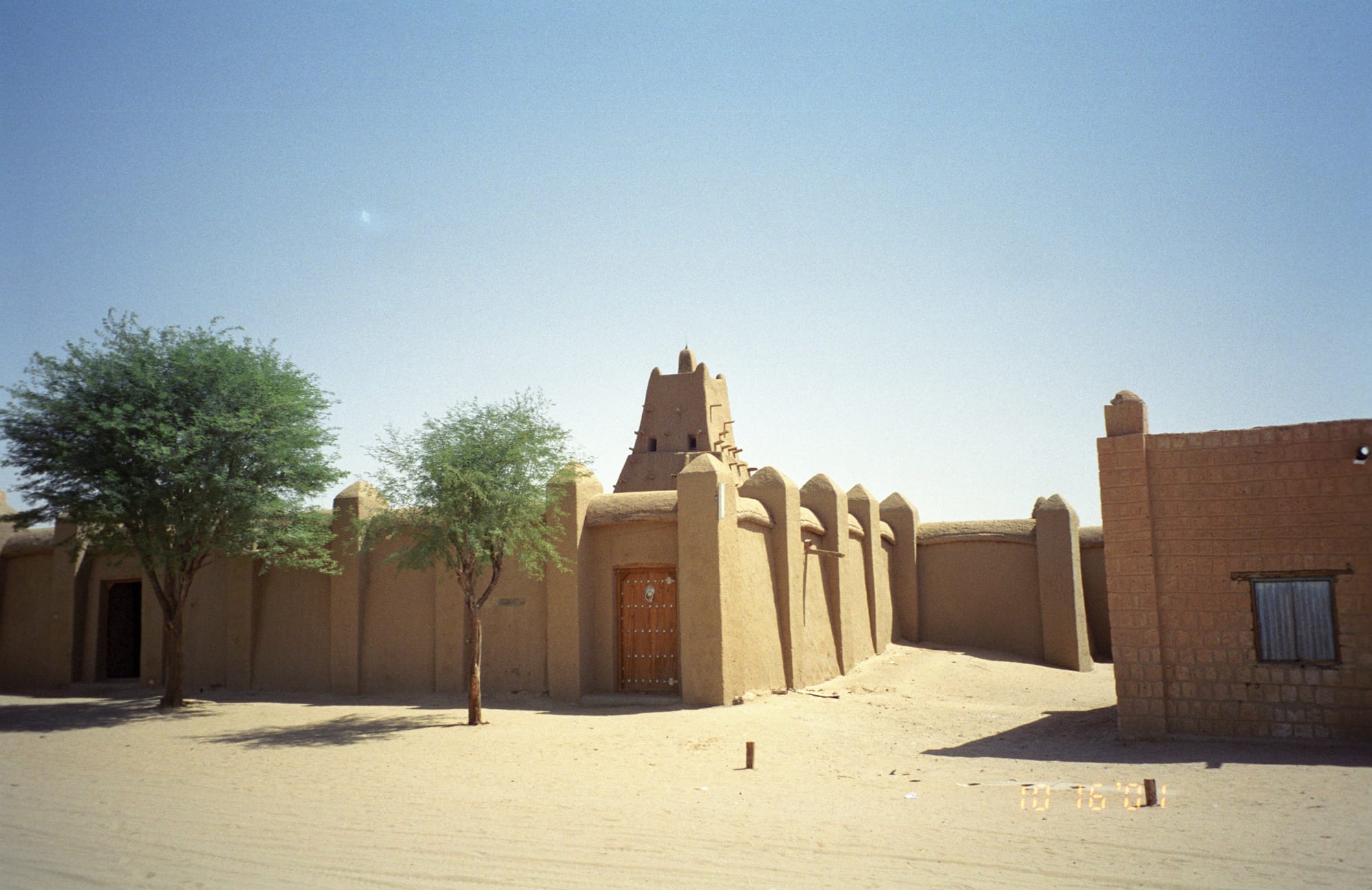
Teaching happened in and around three mosques, Djinguereber, Sidi Yahya and Sankoré, which together are now known as the University of Timbuktu. Sankoré had no central administration, no student register and no fixed course of study. Instead, individual scholars taught their own private students, and the mosques served as places for lectures and classes.
Scholars, copyists and family libraries
Because there was no public or university library, the books belonged to people. Some scholars at Sankoré built private collections of more than 1,600 manuscripts. Students earned their keep by copying texts, so every book that arrived could multiply. Scribes reproduced works by Plato, Hippocrates and Avicenna, and even a 28-volume Arabic dictionary written by an Andalusian scholar in the 11th century.
Timbuktu also produced books of its own, and exported them. The best known of its scholars, Ahmad Baba, wrote more than 40 works; his biographical dictionary of Maliki jurists, the Nayl al-ibtihaj, became popular across North Africa. Chronicles such as the Tarikh al-Sudan, written in the 17th century, recorded the history of the region itself.
What the pages contain
Most of the manuscripts are in Arabic, but some use Arabic script to write African languages, a practice called Ajami, including Fula, Songhay, Tamasheq, Bambara and Soninke. They range from scholarly treatises to short letters. There are copies of the Quran, works of Islamic law, history, philosophy and poetry, and texts on medicine and on the healing properties of desert plants. Others debate polygamy, moneylending and slavery, and some deal with astrology, divination and spells.
Astronomy appears too, partly because the movement of the stars mattered for the Islamic calendar and for telling the time. Most of the collections remain unstudied and uncatalogued, which is why every total is only an estimate.
Hidden for four centuries
The libraries survived because families kept them out of sight. In 1591 a Moroccan army defeated the Songhai and occupied Timbuktu. In 1594 many scholars, Ahmad Baba among them, were arrested and deported to Morocco with their manuscript collections; he lost his own library of 1,600 books, one of the richest of his day. Other scholarly households kept their books at home. The Haidara family's collection, begun in the 16th century and now the Mamma Haidara Library, stayed in the family home through the occupation.
Over the following centuries manuscripts were hidden in cellars, buried, or tucked between the mud walls of mosques. A family member traditionally swears in public to protect the library for as long as he lives. Not everything survived. As Arabic education declined, especially under French colonial rule, many manuscripts were sold off, and in October 2008 a flood in one household destroyed 700. By 2003 estimates put the total held in Timbuktu's libraries at up to 700,000, spread across as many as 60 collections, some of them little more than a bookchest.
The Ahmed Baba Institute, a public research library founded in 1973 and named after Ahmad Baba, moved into a new building in 2009. Its collection is mostly from the 14th to 16th centuries, mainly in Arabic but with works in local languages and one manuscript each in Turkish and Hebrew.
The great evacuation of 2012
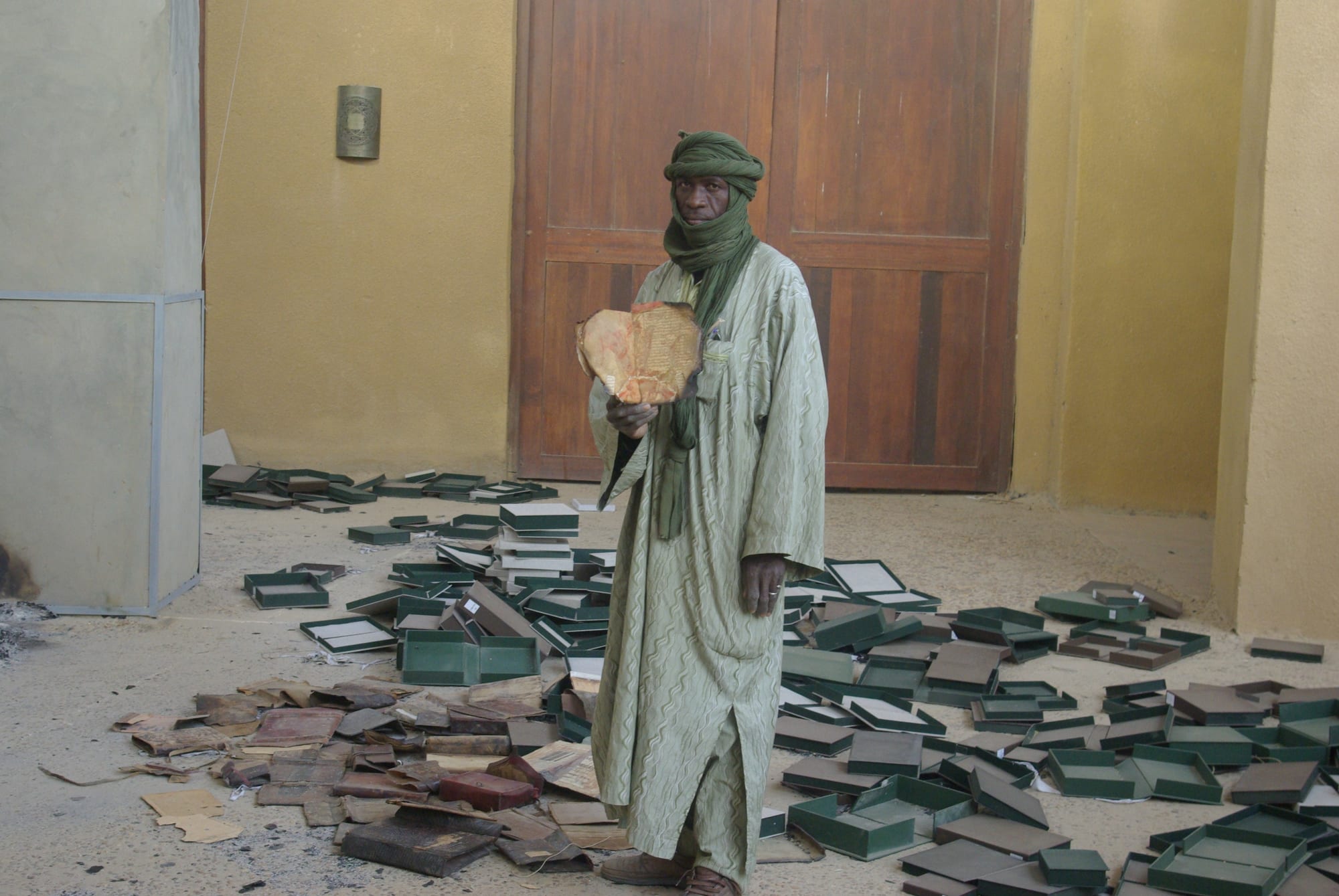
On 1 April 2012 Tuareg rebels and the Islamist group Ansar Dine captured Timbuktu. The occupiers destroyed shrines they regarded as idolatrous, and the manuscripts were feared to be a target too. Abdel Kader Haidara, whose family had guarded its library for generations, organised a rescue with the association of Timbuktu's private libraries, SAVAMA-DCI, and the book conservator Stephanie Diakité. Manuscripts were packed into metal footlockers, each holding up to 300, hidden in safe houses across the city, and then moved south by mule cart, vehicle and boat.
In January 2013, as French and Malian troops approached, fleeing fighters set fire to the Ahmed Baba Institute, and more than 4,000 manuscripts were burned or stolen. But about 90 per cent of the city's manuscripts were saved. Their new danger was Bamako's climate, far more humid than Timbuktu's, which threatens the fragile paper with mould.
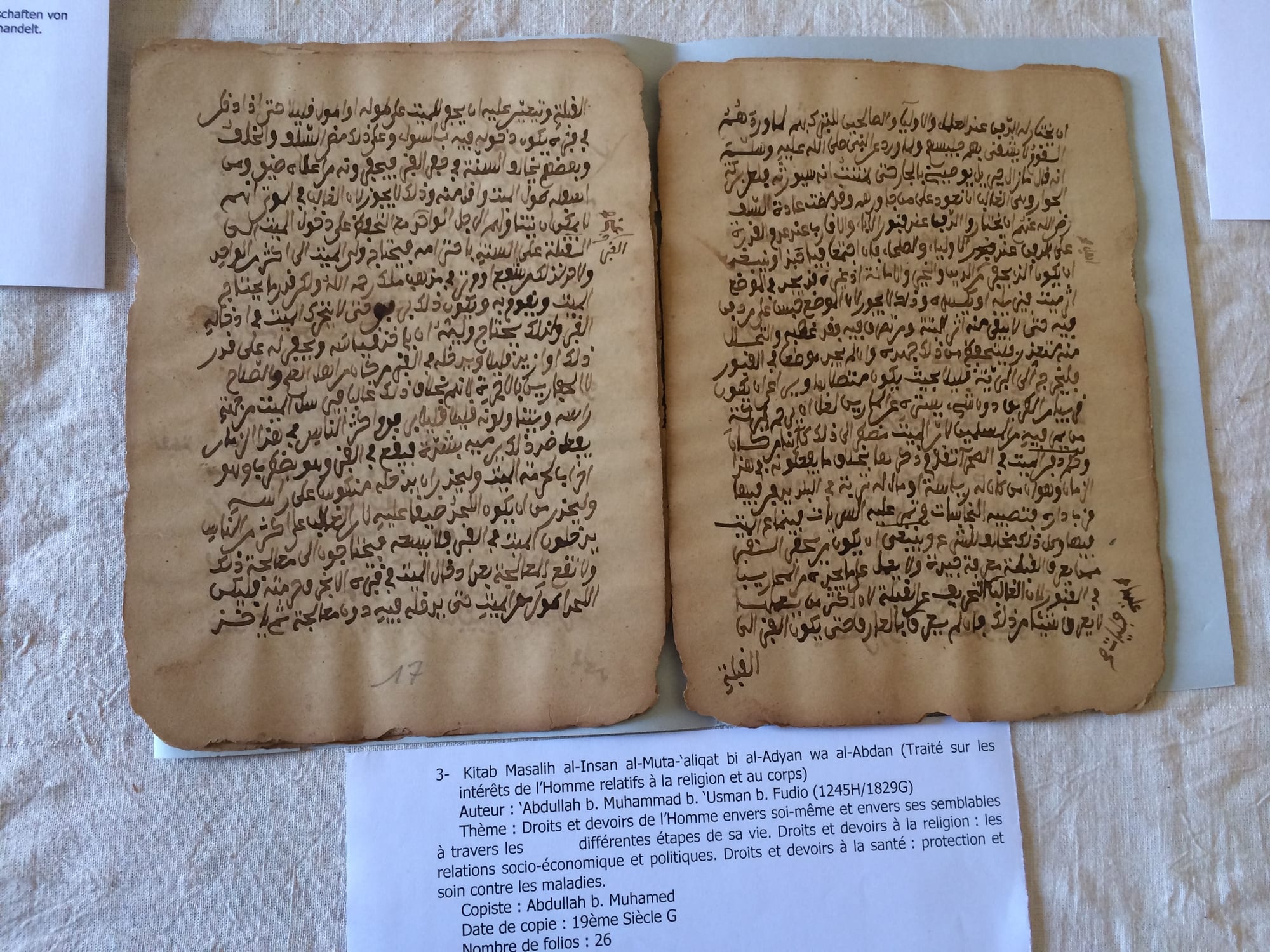
Since 2013 the Hill Museum and Manuscript Library in Minnesota has worked with SAVAMA-DCI to photograph more than 150,000 manuscripts and publish them online, so the texts can be read even while the originals stay in storage.
The city itself remains in danger. In August 2023 the jihadist group JNIM placed Timbuktu under a blockade, part of an insurgency that now reaches across Mali. For now, the answer to where Timbuktu's manuscripts are is mostly Bamako, and, increasingly, online.