💰 Budget
There is essentially no tourism industry. Any travel is by aid workers, diaspora Malians, and journalists, generally with local contacts and security arrangements, which makes it expensive and constrained. Bamako has hotels priced for that market. Cash in CFA francs is essential.
- Source
- Very limited data — verify everything against current advice.
- Daily Budget Midrange
- USD 150–300+ per day for a Bamako hotel, driver, and fixer
- Daily Budget Shoestring
- Not realistically applicable given the security situation
Independent tourism outside Bamako is not feasible; movement depends on security advice.
Source: Very limited data — verify everything against current advice.
✈️ Visa Requirements
A visa is required for nearly all visitors and must be arranged in advance: applications are now made online through Mali's foreign ministry, which issues an electronic entry permit. A yellow fever vaccination certificate is mandatory for entry.
- Typical Validity
- 30 to 90 days, single entry
Most governments advise against all travel, so consular assistance is minimal to none.
🛡️ Safety
This is the decisive planning fact for Mali. Most governments advise against all travel to the entire country: an active jihadist insurgency spans the north and centre and is creeping toward Bamako, with a very high risk of terrorism and of kidnapping of Westerners for ransom, inter-communal massacres, banditry and illegal checkpoints, landmines, the presence of Russian mercenaries implicated in atrocities, and almost no capacity for consular help. Even Bamako has seen attacks: the jihadist group JNIM imposed a blockade on fuel imports from the neighbouring countries in September 2025, crippling the state's functioning in the south until a prisoner-exchange truce lifted it in March 2026, and from 25 April 2026 JNIM and the Azawad Liberation Front launched the largest coordinated offensive since 2012, with attacks in Bamako, Kati, Gao, Kidal, Sévaré and Mopti that killed the defence minister. The offensives were renewed on 4 July 2026 and brought on a national water and power crisis. JNIM has declared a siege of Bamako and enforces blockades on key routes in the south and west, and the UK and France have urged their nationals to leave on the commercial flights still available.
- Source
- US Department of State, UK FCDO, and French diplomatic advisories — check for the latest wording.
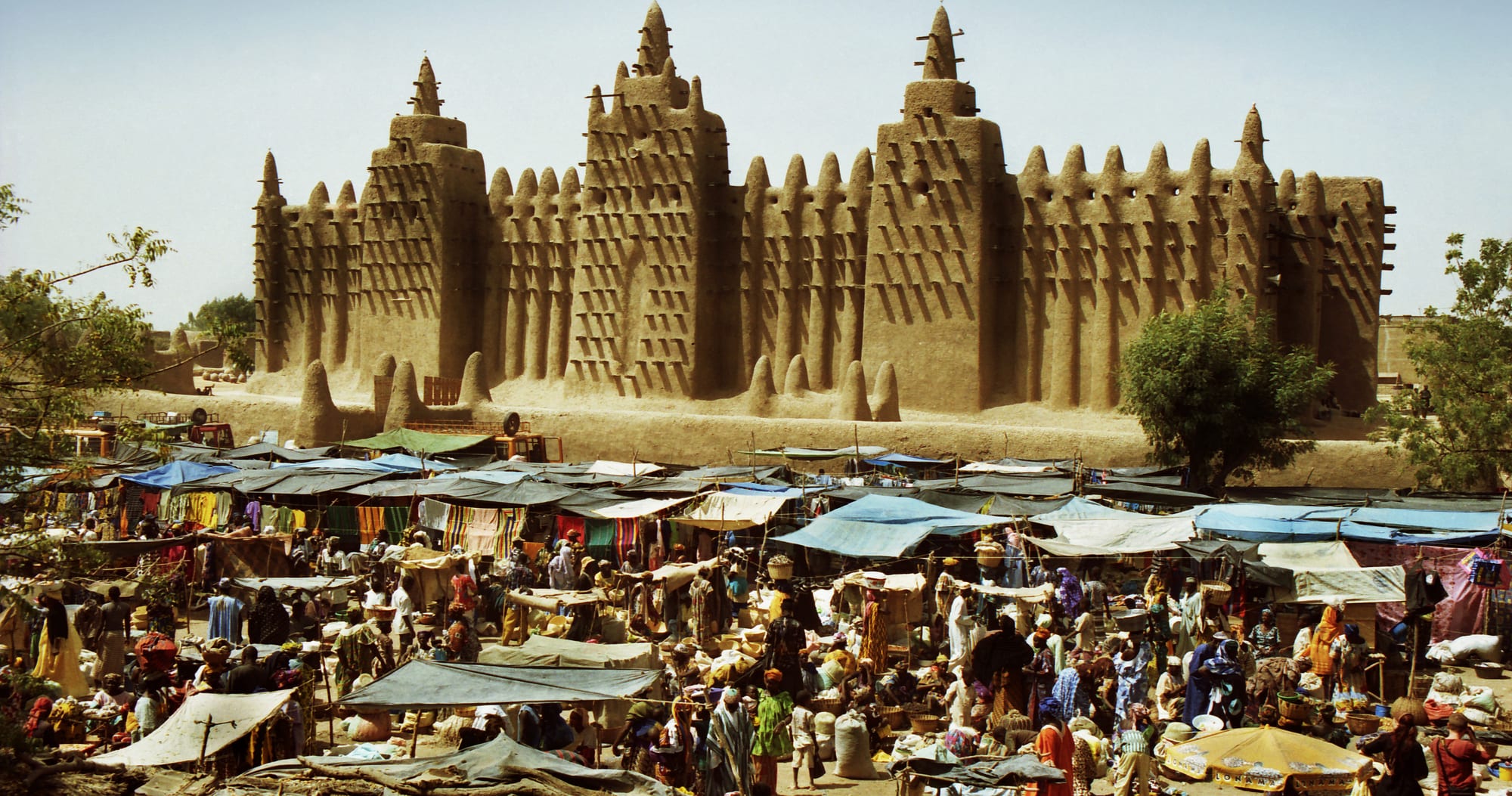
Worldlore covers Mali so its history and culture can be understood — the empires, the manuscripts, the music, the mud architecture — not to suggest that a visit is currently possible or wise.
Source: US Department of State, UK FCDO, and French diplomatic advisories — check for the latest wording.
🌦️ Climate
Hot and dry. The south has a single rainy season from about June to September; the rest of the year is dry, including the dusty Harmattan haze (December–February) and building heat (April–May can exceed 45°C). The far north is true desert with almost no rain.
- North
- desert; extreme heat, cold nights, dust
- South
- one wet season; hot and hazy the rest of the year
🚆 Transportation
Modibo Keita International Airport, formerly Bamako-Sénou, is the main airport, with limited service. A single railway line to Dakar has had no international passenger trains since 2010. Road travel between regions passes through insecure territory with checkpoints and the risk of ambush; the Niger River is travelled by pirogue and slow public boats when the water is high.
Overland travel outside the immediate area of Bamako is dangerous and generally not advised.
📅 Best Time to Visit
In principle, November to February is the cooler dry season. In practice, the security situation — not the weather — determines whether any travel is possible, and at present it largely is not.
💱 Currency
The currency is the West African CFA franc (XOF), shared by eight countries and pegged to the euro at a fixed rate.
- Symbol
- FCFA
- Cash To Bring
- Euros in cash
- Currency Code
- XOF — West African CFA franc
💬 Language
Since the 2023 constitution, French is no longer the official language but the working language of government and schooling, and thirteen national languages are official instead. Bambara (Bamanankan) is the most widely spoken language and the lingua franca of the south and the markets, with Fula, Songhai, Tamasheq, Dogon, Soninke, and others across the country. English is rarely spoken.
- English
- Very limited
- Lingua Franca
- Bambara (Bamanankan)
- Official Language
- Thirteen national languages, including Bambara, Fula, Songhai, Tamasheq and Soninke; French is the working language