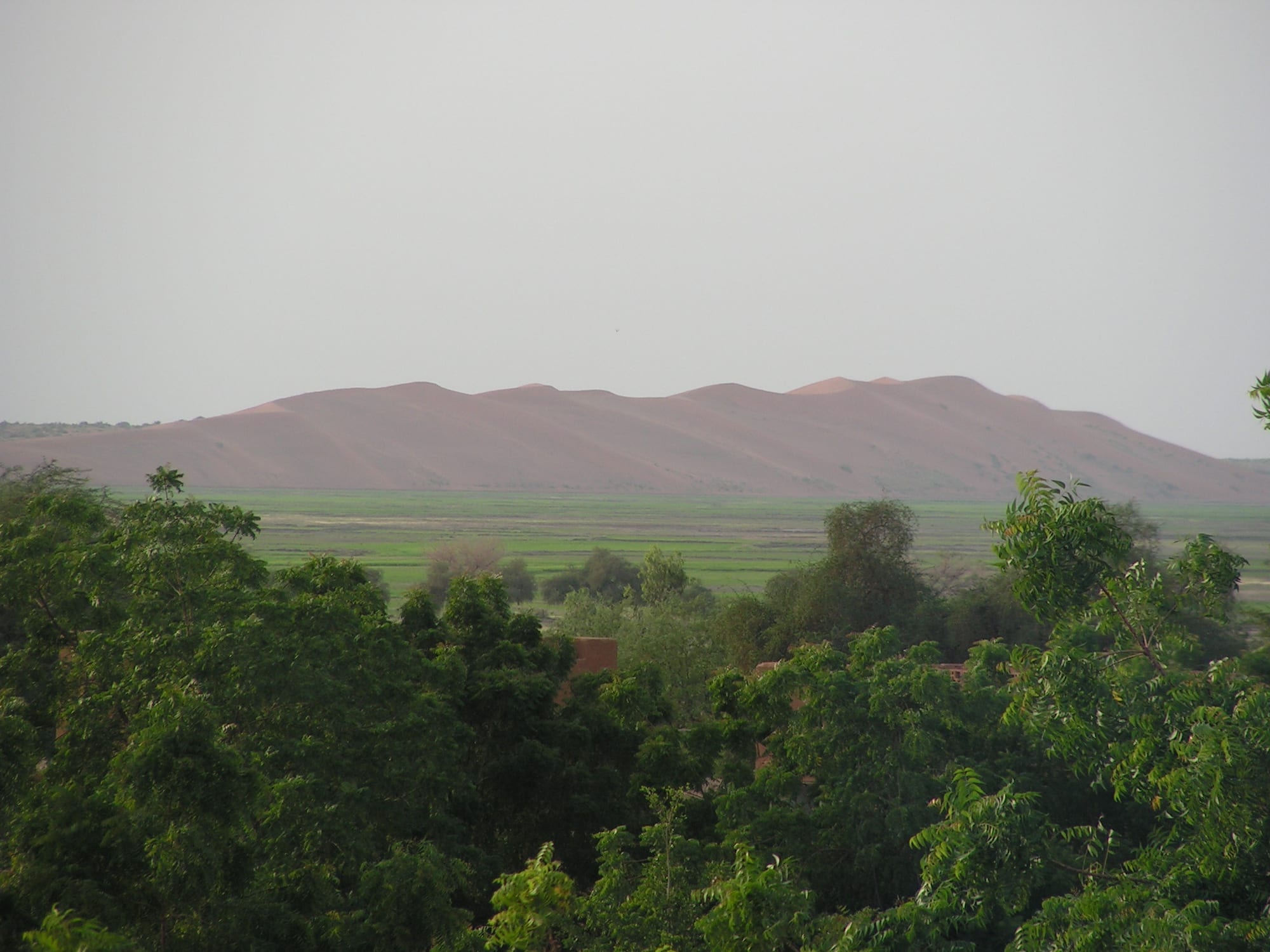
A long pink sand dune rising beyond green riverside fields and the tops of trees, under a pale hazy sky

Timbuktu & the Sahara, Mali

Gao

La Dune Rose, the sand dune on the far bank of the Niger opposite Gao, seen from the Tomb of Askia. (Exereo (Jonathon Hicks) / Wikimedia Commons · CC BY-SA 3.0)

A town on the left bank of the Niger in eastern Mali, at the desert's edge where the river turns south towards Niger. A trading power by the 9th century and later the capital of the Songhai Empire, it keeps the stepped mud Tomb of Askia and a large riverside market, and has been fought over since 2012. This page is written to explain the city, not to encourage travel.

Neighbourhoods

  • The old centre
    • First-time visitors
    • Historic district

    The core of the town on the east bank, holding the Tomb of Askia, the mosque beside it and the administrative buildings, in a grid of sandy streets and single-storey mud-brick and concrete compounds.

    Open in Maps
  • The riverside and the market
    • Markets
    • Local life
    • Boats and the river

    The strip along the Niger where pirogues and pinasses land, fish is sold and the town's large market spreads out in sheds and open ground. Grain, salt, livestock and goods from Niger and Algeria change hands here.

    Open in Maps
  • The outer quarters
    • Quiet and residential
    • Local life

    Sandy residential quarters spreading north and east towards the desert, where displaced families from the surrounding countryside have settled alongside long-standing households, with wells, small shops and market gardens.

    Open in Maps
  • The west bank
    • Walks and viewpoints
    • Quiet and residential

    Across the river, reached by the Wabaria bridge that replaced the ferry in 2006, a scatter of villages and fields below the long pink dune known as La Dune Rose, which turns colour in the late light.

    Open in Maps

Things to do

Songhai monuments

  • Tomb of Askialandmark

    The stepped mud pyramid, 17 metres high, built at the end of the 15th century for the Songhai ruler Askia Mohammad, with two mosques, a cemetery and an assembly ground; a UNESCO World Heritage Site since 2004, on the List of World Heritage in Danger since 2012, and still a place of worship.

    Open in Maps
  • Gao-Saneyattraction

    A large settlement mound about seven kilometres from the town, thought to be the ancient trading centre, where marble tombstones carved in Almería in southern Spain were found in 1939.

    Open in Maps
  • Kankou Moussa Mosquelandmark

    The town's mosque of the 14th century, named after the Mali emperor known in Songhai as Kankou Moussa and elsewhere as Mansa Musa.

    Open in Maps

The river and the desert

  • La Dune Roseviewpoint

    The long sand dune on the west bank of the Niger opposite Gao, whose sand takes on a pink cast at sunrise and sunset.

    Open in Maps

Short trips from the town

  • Ansongoattraction

    A riverside town on the left bank about 90 kilometres downstream, towards the border with Niger, where fishing along the river shapes the local economy.

    Open in Maps
  • Bouremattraction

    A small town on the left bank of the Niger upstream from Gao, at the turn of the great bend, with unpaved roads running north into the desert.

    Open in Maps

Eat and drink

Long-standing places and food districts in Gao. Hours, ratings and directions come from your maps app, always current.

Gao staples

  • The riverside marketmarket

    The town's main market, selling millet, rice, dried and smoked fish, desert salt, dates, vegetables from the riverside gardens and goods trucked in from Niger and Algeria.

    Open in Maps
  • Grilled river fishrestaurant

    Capitaine, the Nile perch of the Niger, along with catfish and tilapia, grilled over charcoal or fried and eaten with rice.

    Open in Maps
  • Rice with fakoyerestaurant

    Floodplain rice with the northern sauce of dried, pounded jute leaves that is a mark of Songhai cooking along the river.

    Open in Maps
  • Tea poured in three roundscafe

    Green gunpowder tea boiled with sugar and poured from a height in three small glasses, the standing ritual of hospitality across the Sahel.

    Open in Maps

Experience Gao

History

Gao is one of the oldest towns on the Niger. Archaeology has found two settlements on the east bank — Gao Ancien, within the modern town near the Tomb of Askia, and Gao-Saney about seven kilometres east — and Arabic writers describe it as a regional power by the 9th century, at the point where trans-Saharan routes from Egypt and North Africa met the river. Royal tombstones found at Gao-Saney, some carved in Spain, show how far its trade and its rulers' contacts reached.

Its greatest period came with the Songhai Empire. Sonni Ali, and after him Askia Mohammad, who seized power in 1493, built from Gao one of the largest states in African history, controlling the Niger from beyond Timbuktu to the edge of Hausaland. Askia's pilgrimage to Mecca and his patronage of scholars are part of the town's memory, and the stepped mud tomb raised for him at the end of the 15th century still stands. In 1591 a Moroccan army with firearms defeated the Songhai at Tondibi, near Gao, and the empire broke apart.

The town declined into a river port under Arma, Tuareg and then French rule, and after independence became the administrative capital of Mali's east. In 2012 it was taken from the Malian army by rebel groups, then held by jihadist fighters after the Battle of Gao, until French forces recaptured it in early 2013. It has remained a garrison town in a war zone since, with attacks, blockades and displacement shaping the years that followed; it was among the places attacked in the coordinated offensive that began on 25 April 2026.

Culture & Customs

Gao is a Songhai town, and Songhai is what is spoken in its streets and markets — the language carried by the empire along the river and still the common tongue of the Niger Bend. Songhai identity here rests on the river and on the memory of Askia Mohammad, whose tomb is both a national monument and a working mosque, tended by a family of guardians.

Around that core the town is mixed. Tuareg from the desert north and east, Arab and Moorish traders, Fula herders and Bozo and Sorko fishermen all have a place in its markets, and Gao has long been the point where desert and river societies meet to exchange salt, dates and livestock for grain, fish and manufactured goods. Islam frames daily life, with a Sufi tradition of saints' tombs and Quranic schooling, and older river beliefs survive in healing and possession rites among Songhai communities.

Hospitality follows Sahelian form: long greetings that ask after the whole household, tea poured in three rounds, and a duty to feed a guest. Music is Songhai praise singing and drumming, and the guitar styles of the river and the desert, which have carried northern Malian music far beyond the country. Since 2012 public life has narrowed — festivals, weddings and gatherings scaled back under the pressures of conflict and armed groups' rules.

Daily Life

The urban commune had a population of about 87,000 at the 2009 census, up sharply from some 52,000 in 1998, and the town has since taken in people displaced from the surrounding countryside. It is a low, sandy town of mud-brick and concrete compounds on the left bank of the Niger, with the market, the port and the administration at its heart and quarters spreading outward towards the desert.

Work is the river, the market and the state. Fishing, rice and millet on the floodplain, market gardens along the bank, and trade in salt, dates, livestock, fuel and goods with Niger and Algeria support most households, alongside jobs with the administration, the army and aid organisations. Smuggling of fuel and other goods across the desert borders is woven into the economy, as it is across the north.

The war sets the rhythm. Checkpoints, curfews, roadside bombs and the danger of travel outside town limit movement; schools and clinics have been disrupted; prices rise when the roads or the river are cut. Many families depend on money sent from relatives in Bamako or abroad, and on aid, and large numbers live in displacement in and around the town.

Food

Gao eats from the river. Rice grown in the Niger floodplain is the staple, cooked in a tomato and oil sauce with meat or served with fakoye, the northern sauce of dried, pounded jute leaves that marks Songhai kitchens along the Bend. Millet is eaten as a stiff porridge with sauces of baobab leaf, okra or groundnut in poorer and more rural households.

Fish is the town's signature: capitaine, the Nile perch, along with catfish and tilapia, grilled over charcoal on the riverside, fried, or smoked and dried for trade. Mutton and goat are grilled as brochettes at street stalls, camel meat appears from the desert side, and milk, fresh or soured, comes in from the herders. Dates from the oases and the Algerian trade, and slabs of rock salt cut in the desert mines, arrive by the same routes as the herds.

Vegetables from the riverbank gardens — onions, tomatoes, lettuce and pumpkin — go into the sauces, and mangoes and melons are seasonal treats. Tea is boiled with a great deal of sugar and poured from a height into small glasses, served in three rounds, and hibiscus, tamarind and baobab juices are sold cold in the hot months. Alcohol has no public place in the town.

Planning tools

Budget

There is no tourism in northern Mali. Outsiders in Gao are aid workers, officials and journalists moving with security arrangements, usually arriving by air, and local prices are pushed up by blockades, fuel shortages and the cost of bringing goods across insecure roads.

Daily Budget Midrange
USD — not realistically applicable; costs depend entirely on security arrangements
Daily Budget Shoestring
USD — not realistically applicable given the security situation

Do not plan travel to northern Mali; there are no functioning services for visitors.

Best Time to Visit

In principle November to February, when days are warm rather than punishing and nights are cool. April to June regularly passes 40°C, and the short rains fall in July and August. In practice the conflict rules out any travel to the region, whatever the season.

Suggested Number of Days

The town's monuments are few and close together, so a short stay covers them; the river, the dune and the archaeological sites outside town account for the extra time. Any stay depends entirely on security conditions rather than on interest.

First Visit
1–2 days
With Surroundings
3 days

Transportation

Gao has an airport and stands on the river, which was the traditional link with Mopti and Timbuktu by boat when the water was high. The road south follows the Niger towards the border with Niger, and desert tracks run north and east. In town, movement is by motorbike, shared car, cart and on foot over sand.

Do not travel overland in northern Mali; road and river routes have been attacked and blockaded.

Airport & Station Connections

Air is the only practical way in for the few outsiders who come, into the airport on the edge of town. Overland, the routes are the river road down from Bourem and Timbuktu, the road south along the Niger and the desert tracks towards Kidal and the Algerian border, all of which have been mined, ambushed or blockaded repeatedly.

Walkability

The centre is flat, low-built and small enough to cross on foot, but the streets are sand rather than pavement, shade is scarce and the heat is severe for much of the year. The archaeological sites and the dune are several kilometres out and need transport, with the river crossed by the Wabaria bridge.

Safety

Northern Mali is an active war zone, and most governments advise against all travel. The army and its Russian allies are fighting both the al-Qaeda-linked JNIM and the Islamic State Sahel Province, which is most active around Ménaka and on the Niger border, while Tuareg-led separatist groups resumed fighting in 2023. Towns have been besieged and blockaded, river boats attacked, and civilians killed by all sides. The risk of kidnapping of foreigners is extreme. Gao was captured by rebel groups in 2012 and retaken by French forces in early 2013. The military side of the airport was attacked with drones and mortar fire in March 2026, and the town was among those attacked in the coordinated offensive that began on 25 April 2026.

Globeway covers Mali so its history and culture can be understood — the empires, the manuscripts, the music, the mud architecture — not to suggest that a visit is currently possible or wise. Do not travel to northern Mali. Check current official travel advice before travelling.

Climate

Hot and very dry, on the southern edge of the Sahara. Rain is limited to brief storms in July and August, the hot season from April to June is severe, and dust and sandstorms are frequent through the dry months.

Summer
extremely hot, often 40–45°C, with brief storms in July and August
Winter
warm, dry days around 28–32°C and cool nights

Local Customs

Gao is a Muslim town and prayer times shape the day. Songhai is the language of the streets, with Tamasheq and Arabic heard from desert and trading families and French in offices. Greetings are long and come before any business, elders are addressed first, and food is eaten and handed over with the right hand. Modest dress is expected of men and women.

Ask before photographing people, soldiers, checkpoints or official buildings; alcohol has no public place; accept tea when it is offered.

Common Payment Methods

The currency is the West African CFA franc (XOF), pegged to the euro. The town runs almost entirely on cash, cards are not usable, banking is limited, and blockades and fuel shortages have driven prices above those in southern Mali.