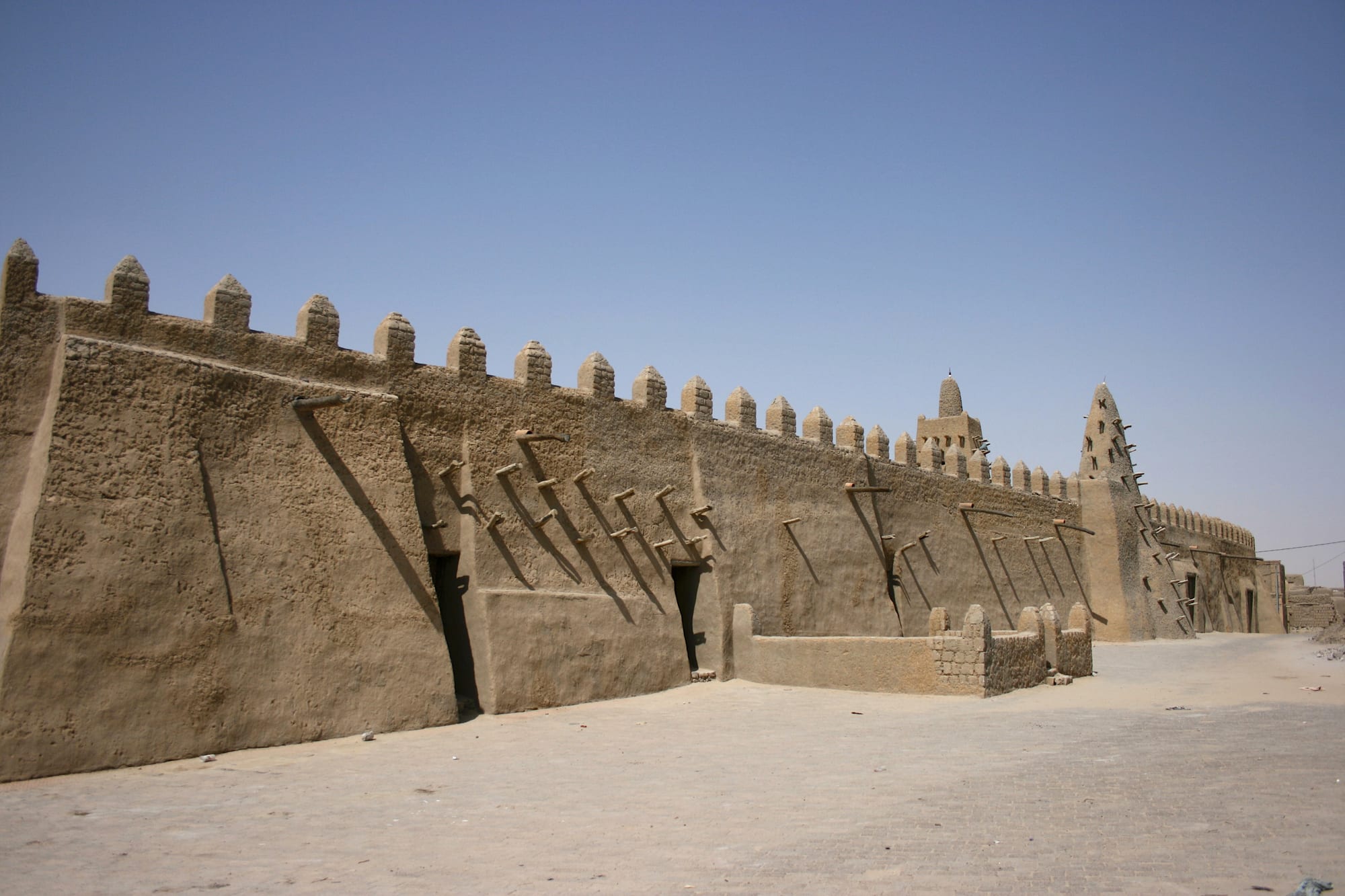
A long mud-brick mosque wall with buttresses and a battlemented parapet, two earthen towers behind it, on sand under a clear sky

Timbuktu & the Sahara, Mali

Timbuktu

The east front of the Djinguereber Mosque in Timbuktu, built of mud brick and re-plastered by hand. (Ousmane Garba Kounta / Wikimedia Commons · CC BY-SA 4.0)

A desert-edge town in northern Mali, a few kilometres north of the Niger at the point where the river swings closest to the Sahara. Founded by Tuareg nomads at a desert well, it became the meeting point of camel caravan and river boat and a centre of Islamic scholarship whose mud mosques and manuscript libraries survive. This page is written to explain the city, not to encourage travel.

Neighbourhoods

  • The old town
    • Historic district
    • First-time visitors

    The listed heart of Timbuktu, a low maze of mud-brick and stone houses, sandy lanes and small squares, holding the three great mosques, the mausoleums of the saints and the houses where 19th-century European travellers lodged, each marked with a plaque.

    Open in Maps
  • Sankoré quarter
    • Historic district
    • Libraries and manuscripts

    The northern quarter around the Sankore mosque, once the centre of the city's teaching, where students gathered around scholars in the courtyards. Family libraries and manuscript collections are still kept in houses here.

    Open in Maps
  • Abaradjou and the outer quarters
    • Quiet and residential
    • Local life

    The newer quarters spreading out from the old town towards the desert, of concrete and mud-brick compounds, with the market gardens, wells and the road south to the river. Sand drifts constantly against the walls.

    Open in Maps
  • Kabara and the river
    • Local life
    • Boats and the river

    The port settlement 8 kilometres south, where the Niger comes closest to the town and boats have always unloaded for the desert crossing. A canal dug under colonial rule links it to Timbuktu and was re-excavated in 2007, and the port can work only in December and January, when the river is in full flood.

    Open in Maps

Things to do

The mosques and the old town

  • Djinguereber Mosquelandmark

    The city's great mud-brick mosque, built in 1327 under Mansa Musa, re-plastered by hand and part of the UNESCO World Heritage Site inscribed in 1988.

    Open in Maps
  • Sankoré Madrasahlandmark

    The mosque at the heart of Timbuktu's medieval learning, founded in the 14th or early 15th century, its pyramidal minaret studded with projecting wooden beams; rather than a formal college it was the focus for scholars teaching their own students.

    Open in Maps
  • Sidi Yahya Mosquelandmark

    The third of the old town's mosques, begun in 1400 and much rebuilt in 1939, with doors that legend held were not to be opened until the end of time and that were broken down in 2012.

    Open in Maps

Manuscripts and learning

  • Ahmed Baba Institutemuseum

    The state manuscript centre, founded in 1973 and named after the scholar Ahmad Baba, deported to Morocco after the Moroccan invasion; its building was set on fire by fleeing fighters in January 2013, as French-led troops took the airport.

    Open in Maps
  • Timbuktu Manuscriptsattraction

    Hundreds of thousands of handwritten texts on law, astronomy, medicine and poetry, held in institutional and family libraries, many smuggled to Bamako for safekeeping in 2012.

    Open in Maps
  • Mamma Haidara Memorial Librarymuseum

    One of the city's private family libraries, built around a collection begun in the 16th century and handed down through the Haidara family, catalogued with foreign support and digitised from 2008.

    Open in Maps

Arriving and the surroundings

  • Timbuktu Airporttransit hub

    The airport a few kilometres out of town, long the only practical way in for officials, aid workers and journalists; commercial flights from Bamako resumed in 2021, and the airport was shelled in a coordinated attack on the town in June 2025.

    Open in Maps

Eat and drink

Long-standing places and food districts in Timbuktu. Hours, ratings and directions come from your maps app, always current.

Timbuktu staples

  • The Grand Marchémarket

    The town market, selling millet and rice, dried and smoked fish brought up the river, salt from the desert mines, dates, cloth and household goods.

    Open in Maps
  • Rice with fakoyerestaurant

    Rice from the river floodplain served with fakoye, a northern sauce of dried and pounded jute leaves, one of the dishes most associated with the Niger Bend.

    Open in Maps
  • Taguellarestaurant

    The Tuareg flatbread of wheat or millet, baked in hot sand under the embers of a fire, broken into pieces and eaten with a meat or tomato sauce.

    Open in Maps
  • Tea poured in three roundscafe

    Green gunpowder tea boiled with a great deal of sugar and poured from a height to raise a froth, served in three small glasses, each said to taste different from the last.

    Open in Maps

Experience Timbuktu

History

Timbuktu began, by tradition, as a seasonal camp of Maghsharan Tuareg herders at a well a few kilometres north of the Niger, at the point where the river runs closest to the desert. That position made it: goods coming up the river by boat could be transferred to camel caravans for the Sahara crossing, and salt, cloth and books came the other way. Under the Mali Empire it grew into a town, and Mansa Musa, returning from his pilgrimage to Mecca in 1325, is credited with commissioning the Djinguereber mosque, built in 1327.

Its great age came under the Songhai Empire, ruled from Gao, when Timbuktu became a city of scholars. Teaching centred on the mosques — Sankore above all, where students gathered around individual masters — and on a trade in books that produced the libraries the town is still known for. A Moroccan army crossed the desert with firearms in 1591, defeated Songhai and sent Timbuktu's leading scholar, Ahmed Baba, into exile; the Arma, descendants of those soldiers, ruled the town for generations while Tuareg confederations held the desert around it.

By then Timbuktu had become a byword in Europe for remoteness. Alexander Gordon Laing reached it in 1826 and was killed on the way out; René Caillié came back alive in 1828. The French occupied the town in the 1890s. In 2012 jihadist groups took Timbuktu, destroyed Sufi shrines and mausoleums and damaged manuscripts, and the monuments were returned to UNESCO's List of World Heritage in Danger, until a French-led intervention in 2013; the destruction led to the first International Criminal Court conviction for attacks on cultural heritage, and UNESCO set up a fund to rebuild the shrines. Work on the 14 destroyed mausoleums began in 2015, and their rebuilding by the town's masons was celebrated in February 2016.

Culture & Customs

The town's identity is built on learning and on Sufi Islam. It is called the City of 333 Saints, and the mausoleums of those scholars and holy men, scattered through the old town and its cemeteries, are visited and maintained by families who consider themselves their keepers. The mosques are not monuments but working places of prayer, re-plastered with mud and rice husk by masons and volunteers, a job passed down in particular families.

Manuscripts are the other inheritance. Private libraries, held by families for centuries, contain texts on Islamic law, theology, astronomy, mathematics, medicine, music and poetry, many copied locally and many bought from across the Muslim world. When the town was occupied in 2012, large numbers were packed into trunks and moved south to Bamako, an operation that became well known outside Mali.

Timbuktu is also a meeting of peoples: Songhai townspeople and farmers along the river, Tuareg from the desert with their indigo veils and silver work, Arab and Moorish traders in salt and cloth, and Fula and Bozo communities. Songhai is the language of the streets, with Tamasheq and Arabic alongside it. Tea is served in three small glasses, hospitality to a traveller is a point of honour, and Tuareg music — the tende drum, the imzad fiddle, and since the 1980s the electric guitar — carries the culture of the desert around it.

Daily Life

Timbuktu is a town of a few tens of thousands, and smaller than it was: fighting, occupation and blockade have pushed families south and into Mauritania, and some 33,000 people left the city and its surroundings after the blockade began in August 2023. Houses are mud-brick and stone, single storey, built around courtyards, and sand blows constantly through the streets; holding it back from the buildings has been part of the town's work for centuries.

The economy is small and squeezed. Trade is the old business — salt from the desert mines, dates, livestock, grain and dried fish moving between the river and the Sahara — alongside market gardening, government jobs, aid work and, until 2012, a visitor trade of guides, hotels and craft shops that has gone. Rice and millet come from the floodplain, and much else has to be brought in.

The blockade dominates daily life. Fuel and goods are hard to get and prices are high, road and river routes are dangerous, schooling and health services are disrupted, and aid arrives irregularly. For many families the connection to relatives in Bamako or abroad is what keeps the household going.

Food

Timbuktu eats between the river and the desert. Rice, grown in the Niger floodplain and brought up from the south, is the staple of the town, commonly served with fakoye, a sauce of dried, pounded jute leaves, or in a tomato and oil sauce with meat. Fish from the river — the Nile perch known as capitaine, catfish and tilapia — comes smoked or dried as often as fresh, since it travels that way. Dishes of rice or couscous with mutton are the town's festive food.

From the desert side come taguella, the Tuareg flatbread baked in hot sand beneath the embers of a fire and broken into a sauce; milk from camels and goats, drunk fresh or soured; dried cheese carried on journeys; and grilled goat and mutton. Dates from the oases and the Algerian trade are everyday food, and slabs of rock salt cut at Taoudénit and carried south by camel caravan still season cooking across the region.

Tea is the ritual that frames everything. Gunpowder green tea is boiled with a great deal of sugar, sometimes with mint, poured from a height into small glasses to raise a froth and served in three rounds, each weaker and sweeter than the last. Hibiscus, tamarind and baobab juices are made at home in the hot months, and alcohol has no public place in the town.

Planning tools

Budget

There is no tourism in northern Mali. The few outsiders who reach Timbuktu are aid workers, officials and journalists travelling with security arrangements, usually by air, and ordinary prices in the town are inflated by blockade, fuel shortages and the difficulty of bringing goods in.

Daily Budget Midrange
USD — not realistically applicable; costs depend entirely on security arrangements
Daily Budget Shoestring
USD — not realistically applicable given the security situation

Do not plan travel to northern Mali; there are no functioning services for visitors.

Best Time to Visit

In principle November to February, the cooler season in which the Festival au Désert was once held in the dunes nearby. From April to June the heat regularly passes 40°C, and sandstorms are common through the dry months. At present the conflict rules out any travel to the region.

Suggested Number of Days

The old town is small and can be walked through in a morning, though its monuments and libraries reward longer. More time was once spent on the river at Kabara and in the dunes north of the town. Any stay now depends entirely on security conditions.

First Visit
2 days
With Surroundings
3–4 days

Transportation

Distances in the north are vast and roads few. The town has an airport, and the Niger was the traditional link with Mopti by boat, reached from the port of Kabara a few kilometres south. Desert tracks run north towards Taoudénit and the Algerian border. Within the town, movement is on foot, by motorbike, by cart and by four-wheel drive over sand.

Do not travel overland in northern Mali; road and river routes have been attacked and blockaded.

Airport & Station Connections

Timbuktu has an airport, and for years flights have been the only practical way in for the few outsiders who come. The overland route is the road east from Mopti and Douentza or the river by boat and pinasse when the water is high, both of which have been repeatedly cut. The city has been under a blockade imposed by the armed group JNIM since 8 August 2023, and the siege is recorded as continuing.

Walkability

The old town is compact and entirely walkable, a quarter of an hour from end to end, but the streets are deep sand rather than pavement, there is almost no shade, and the heat and dust make midday walking hard. The outer quarters and the river port at Kabara are further out.

Safety

Northern Mali is an active war zone, and most governments advise against all travel. The army and its Russian allies are fighting both the al-Qaeda-linked JNIM and the Islamic State Sahel Province, while Tuareg-led separatist groups resumed fighting in 2023. Towns have been besieged and blockaded, river boats attacked, and civilians killed by all sides. The risk of kidnapping of foreigners is extreme. Timbuktu was placed under a total blockade by JNIM on 8 August 2023, after the withdrawal of the UN mission MINUSMA, raising prices and causing food shortages, and some 33,000 people fled the city and its surroundings. A military base near the city and the airport were attacked in June 2025, and from 25 April 2026 JNIM and the Azawad Liberation Front launched the largest coordinated offensive since 2012, with attacks in Bamako, Kati, Gao, Kidal, Sévaré and Mopti; the offensives were renewed on 4 July 2026.

Globeway covers Mali so its history and culture can be understood — the empires, the manuscripts, the music, the mud architecture — not to suggest that a visit is currently possible or wise. Do not travel to northern Mali. Check current official travel advice before travelling.

Climate

Desert-edge and among the hottest places in Mali, with a short, unreliable rainy season in July and August and dust and sandstorms through the dry months. Nights in the cool season are pleasant and can turn cold.

Summer
extremely hot, often 40–45°C, with brief storms in July and August
Winter
warm, dry days around 28–32°C and cold nights

Local Customs

Timbuktu is a conservative Muslim town with a long Sufi tradition, called the City of 333 Saints for the scholars and holy men buried in it. Prayer times order the day, dress is modest for men and women alike, and the mosques and mausoleums are places of worship rather than sights. Greetings are unhurried and asked in full before business, and tea is the standing ritual of hospitality.

Ask before entering a mosque or photographing people, a shrine or a manuscript; alcohol is not part of public life; use the right hand for eating and passing.

Common Payment Methods

The currency is the West African CFA franc (XOF), pegged to the euro. The town runs on cash; cards are effectively useless, banking services are thin, and blockades and fuel shortages have pushed prices well above those in southern Mali.