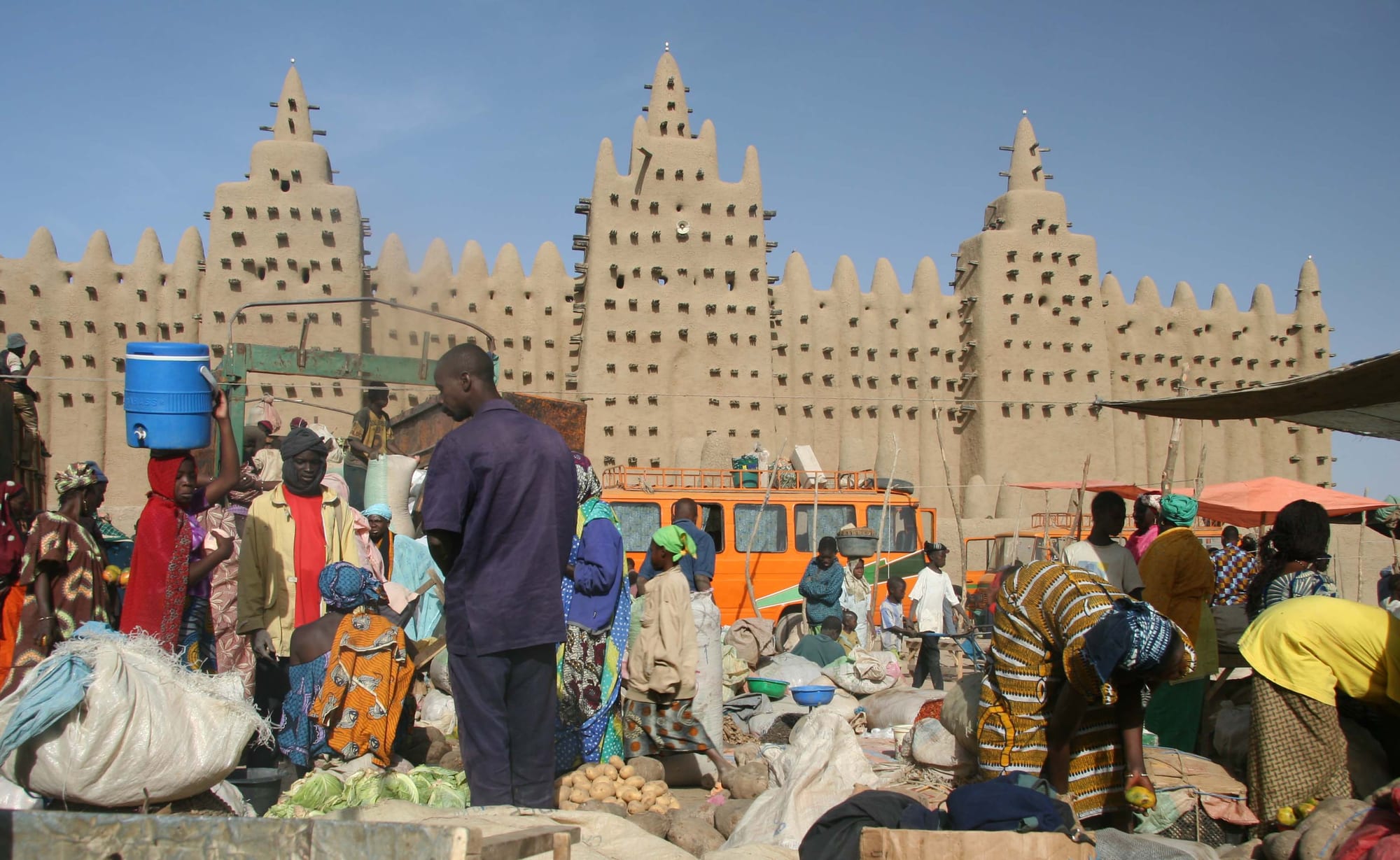
Market traders and sacks of produce in front of a vast mud mosque with three towers and protruding wooden beams

Ségou, Mopti & the Niger Bend, Mali

Djenné

The Monday market in front of the Great Mosque of Djenné. (Ferdinand Reus / Wikimedia Commons · CC BY-SA 2.0)

A town on an island in the Bani floodplain of central Mali, once the southern twin of Timbuktu in the trans-Saharan trade and a centre of Islamic learning. Its Great Mosque, rebuilt in 1907, is the largest mud-brick building in the world, and the whole town is a World Heritage Site. This page is written to explain the town, not to encourage travel.

Neighbourhoods

  • The mosque and the market square
    • First-time visitors
    • Historic district
    • Markets

    The centre of the town is the open square below the raised platform of the Great Mosque, empty for most of the week and packed with stalls on Mondays. The town's larger merchant houses, with their decorated façades and pinnacles, stand in the streets running off it.

    Open in Maps
  • The old quarters
    • Historic district
    • Quiet and residential
    • Architecture

    Narrow sand lanes of two-storey adobe houses in the Sudanese style, with buttressed walls, wooden window shutters and roof terraces where families sleep in the hot season. A survey in 1984 counted 134 houses of significant architectural importance, and a Dutch-funded project restored about a hundred of them between 1996 and 2003.

    Open in Maps
  • The ferry landing and the causeway
    • Transport
    • River views

    Djenné sits on an island, and the road from the Bamako–Mopti highway ends at a ferry across a branch of the Bani. The landing is the town's link to the outside world, with pirogues, traders and vehicles waiting their turn on the bank.

    Open in Maps

Things to do

The town's monuments

  • Great Mosque of Djennélandmark

    The largest mud-brick building in the world, raised on a platform above the market square; the present structure dates from 1907, on a site first built on around the 13th century, and palm-wood beams project from its walls as permanent scaffolding.

    Open in Maps
  • The merchant houses of the old townlandmark

    Two-storey adobe houses in the Djenné style, their façades marked by buttresses, pinnacles and carved wooden doors, listed with the mosque as a World Heritage Site in 1988.

    Open in Maps
  • The Monday marketmarket

    The weekly market that fills the square in front of the mosque with cloth, grain, dried fish, salt, pottery and vegetables brought in from across the inland delta.

    Open in Maps

Archaeology

  • Djenné-Djennoattraction

    The mound 2.5 kilometres south-east of the town, occupied from about the 3rd century BC and abandoned by around 1400, one of the earliest known urban sites in sub-Saharan Africa and famous for its terracotta figures.

    Open in Maps

Short trips from the town

  • Moptiattraction

    The river port downstream at the meeting of the Bani and the Niger, the region's commercial centre and the place the French made regional capital in Djenné's stead.

    Open in Maps
  • Sévaréattraction

    The crossroads town beside Mopti, with the region's airport and the junction of the roads to Bamako, Bandiagara and the north.

    Open in Maps

Seasonal events

  • The replastering of the Great Mosqueonce a year, before the rains

    A festival in which the whole town re-coats the mosque in mud plaster: the masons' guild directs the work, men climb the built-in palm-wood scaffolding to smear on the plaster, women and girls carry water to the mixing pits, and a race opens the day to see who delivers the first load.

  • Eid al-Fitrvaries with the lunar calendar

    The feast ending Ramadan, marked by open-air prayers and visiting between households in a strongly Muslim town.

  • Tabaskivaries with the lunar calendar

    The sheep festival, the largest family occasion of the year, with rams traded at market for weeks in advance.

Eat and drink

Long-standing places and food districts in Djenné. Hours, ratings and directions come from your maps app, always current.

Markets and local food

  • The Monday marketmarket

    The town's main source of food: rice and millet from the floodplain, dried and smoked fish, onions, baobab leaf, salt and cooked dishes sold from stalls around the square.

    Open in Maps
  • Street kitchens around the squareneighborhood

    Simple places and stalls serving rice with sauce, fried fish from the Bani, bean fritters and sweet tea; there is no restaurant scene beyond them.

    Open in Maps

Experience Djenné

History

Djenné's story begins across the water at Djenné-Djenno, a mound settled from about the 3rd century BC, where iron-working, rice growing and long-distance trade were established long before Islam reached the region. The site grew into one of the earliest cities in sub-Saharan Africa, then declined after about 1000 and was abandoned by around 1400, as the population moved to the present town 2.5 kilometres to the north-west.

Djenné itself rose on the southern end of the trans-Saharan trade. Gold from the forests to the south and salt mined at Taghaza in the desert changed hands in its markets, and goods moving in and out of Timbuktu passed through the town; a Songhai-era population of perhaps 40,000 has been estimated. With Timbuktu it became a centre of Islamic scholarship between the 14th and 17th centuries. Sonni Ali of Songhai took the town in 1471, after a siege of about six months, and Moroccan forces arrived after 1591.

Decline followed the sea. Once the Portuguese established trading posts on the Atlantic coast, gold flowed to the shore rather than across the Sahara, and Djenné's position weakened. The Massina and Tukulor states ruled in turn in the 19th century, and after the French conquest Mopti was made the regional capital, leaving Djenné a market town. Its architecture saved it: the Great Mosque was rebuilt in 1907 under the head of the masons' guild, Ismaila Traoré, and in 1988 the old town and Djenné-Djenno were inscribed together as a World Heritage Site.

Culture & Customs

The town's identity is built around mud. Djenné's masons form a guild with its own hierarchy and knowledge, and they direct not only the houses but the annual replastering of the Great Mosque, in which the whole population takes part: plaster is prepared in pits, women and girls carry water, men climb the building's permanent palm-wood scaffolding to smear it on, and elders who have done it many times watch from a place of honour in the square. The result is a building remade by hand every year.

Learning is the other tradition. Djenné was one of the great centres of Islamic scholarship in West Africa, and Quranic schools still take children through memorisation on wooden tablets. Manuscripts remain in family collections in the town, and efforts have been made to catalogue and preserve them. The population is overwhelmingly Muslim, and the mosque governs the shape of the day and the week.

Bozo fishermen, Fula herders, Bambara and Songhai farmers and Marka traders all meet here, and Monday brings the whole delta into the square. Manners follow the Malian pattern of unhurried greetings, respect for age and the three rounds of green tea; the town is small enough that strangers are noticed immediately, and photography of people is a sensitive matter rather than a casual one.

Daily Life

The commune, which takes in ten surrounding villages as well as the town, counted about 33,000 people at the 2009 census. Djenné lives from the floodplain: rice grown on land that the Bani covers each autumn, millet and onions on higher ground, cattle and sheep with Fula herders, and fish caught by Bozo families and dried or smoked for sale across West Africa. Pottery, weaving and above all building work fill out the local economy.

Everything turns on water. The flood arrives after the rains upstream, turns the plain into a sheet of water dotted with villages and makes Djenné an island in fact as well as in name, then withdraws and leaves grazing and planting behind it. The mud houses need repair every year once the rains have passed, which keeps the masons working and the town's appearance continuous with its past.

Two things weigh on daily life. The first is the loss of tourism, which until 2012 supported guides, guesthouses, restaurants and craftspeople and is now gone. The second is the conflict across central Mali: armed groups operate in the countryside around, roads are dangerous, schools in the wider region have closed and displaced families have moved into the larger towns. Djenné itself has stayed comparatively quiet, but it is cut off from much that once sustained it.

Food

Rice is the staple here, grown on the flooded plain and eaten at the main meal of the day with a sauce — groundnut, tomato and onion, baobab leaf or okra — and often with fish. The delta's fish is the town's other constant: capitaine, the Nile perch, along with catfish and tilapia, eaten fresh when caught and otherwise smoked or dried, a trade that has carried Djenné and Mopti fish across West Africa for centuries.

Millet appears as a stiff porridge eaten with the same sauces, and as moni, a thin breakfast gruel taken with sugar and sour milk. Soumbala, the fermented néré-seed seasoning, and shea butter give the cooking its base notes, and onions grown in the region go into almost everything. Fula households add milk, fresh or soured, and butter.

The market supplies the rest: rock salt from the Saharan mines, dates and dried fruit from the north, mangoes and vegetables from the south, and street food of bean fritters, fried dough and grilled meat. Drinks are water, hibiscus and ginger juices, sour milk and green tea boiled with a great deal of sugar and poured in three rounds.

Planning tools

Budget

Djenné lived on tourism until the 2012 crisis, with guides, guesthouses and craft sellers working around the mosque. That economy has gone. What remains is a market town where local prices are low, but any journey here depends on security arrangements whose cost has nothing to do with the town itself.

Daily Budget Midrange
USD 250–500+ (costs depend entirely on security arrangements rather than on the town)
Daily Budget Shoestring
USD 40–80 (a basic room, market food and shared transport — but no visitor services remain)

Do not plan travel to central Mali; the region's tourist infrastructure has largely closed.

Best Time to Visit

In principle the cool dry months from November to February, when the flood is still spread across the plain and the heat is bearable; the mosque is replastered once a year before the rains. April and May are fiercely hot, often above 40°C. In practice the conflict rules out travel in the region, whatever the season.

Suggested Number of Days

The town is small enough to see in a day, and Monday, when the market fills the square, changes the place completely. Two or three days would take in the archaeological site and the surrounding delta villages, if movement in the region were possible at all.

First Visit
1 day
With Surroundings
2–3 days

Transportation

Djenné is reached by a spur road off the Bamako–Mopti highway that ends at a ferry across a branch of the Bani; from the landing everything is done on foot, by donkey cart or by motorbike, and the sand lanes of the old town take nothing wider. Pirogues and pinasses work the river when the water is high.

Do not travel by road in central Mali; the risk of ambush, roadside bombs and armed checkpoints is high.

Airport & Station Connections

The town lies about 398 kilometres north-east of Bamako and 76 kilometres south-west of Mopti, whose airport at Sévaré is the nearest airfield; the turning from the main highway is around 30 kilometres from the town, and the last stretch ends at the ferry. Roads in the region have seen ambushes, roadside bombs and blockades.

Walkability

Everything in Djenné is within a few minutes' walk of the market square, and the old town is made for walking: sand underfoot, lanes too narrow for cars, and the mosque visible from almost everywhere. Shade is scarce and the heat from March to June is severe.

Safety

Central Mali is among the most dangerous parts of the country and most governments advise against all travel. Since 2015 jihadist groups, notably the Katiba Macina within the al-Qaeda-linked JNIM coalition, have operated across the inland delta around Djenné, fighting the army and its Russian allies, while self-defence militias and herding and farming communities have been drawn into the violence. Kidnapping, roadside bombs and sieges of villages are common in the surrounding countryside, though no recent attack in the town itself is on record.

Globeway covers Mali so its history and culture can be understood — the empires, the manuscripts, the music, the mud architecture — not to suggest that a visit is currently possible or wise. Do not travel to central Mali under any circumstances unless with professional security support. Check current official travel advice before travelling.

Climate

Sahelian and dry, with a short rainy season and a long hot one. The Bani and Niger floods reach the delta after the rains have ended, spreading across the plains from about September to December before falling back and leaving the land for rice and grazing.

Summer
rainy season July–September, humid and hot, around 25–37°C
Winter
dry, dusty Harmattan season from November to February, around 16–33°C with cool nights; very hot from March to June, often above 40°C

Local Customs

Djenné is a conservative Muslim town with a long scholarly tradition, and the mosque is the centre of its life rather than a monument to be treated casually. Non-Muslims are not allowed inside the Great Mosque, and the building is seen from the square. Greetings are long, the right hand is used for eating and giving, and elders and Quranic teachers are addressed first.

Dress modestly with shoulders and knees covered, ask before photographing anyone, expect requests for payment when photographing people or houses, and do not climb on the mosque's platform or walls.

Common Payment Methods

The currency is the West African CFA franc, pegged to the euro. Djenné is entirely a cash town: there is no reliable ATM, cards are not accepted, and CFA francs must be brought from Bamako or Mopti. Mobile money is used by residents for transfers.