Attractions & Natural Wonders · Turkmenistan
Why has a crater in Turkmenistan been burning for fifty years?
A Soviet-era collapse opened a pit over a natural gas reservoir, someone set it alight, and the gas beneath has fed the flames ever since, though they are now fading.
By Globeway Editorial · 13 October 2026
The short answer
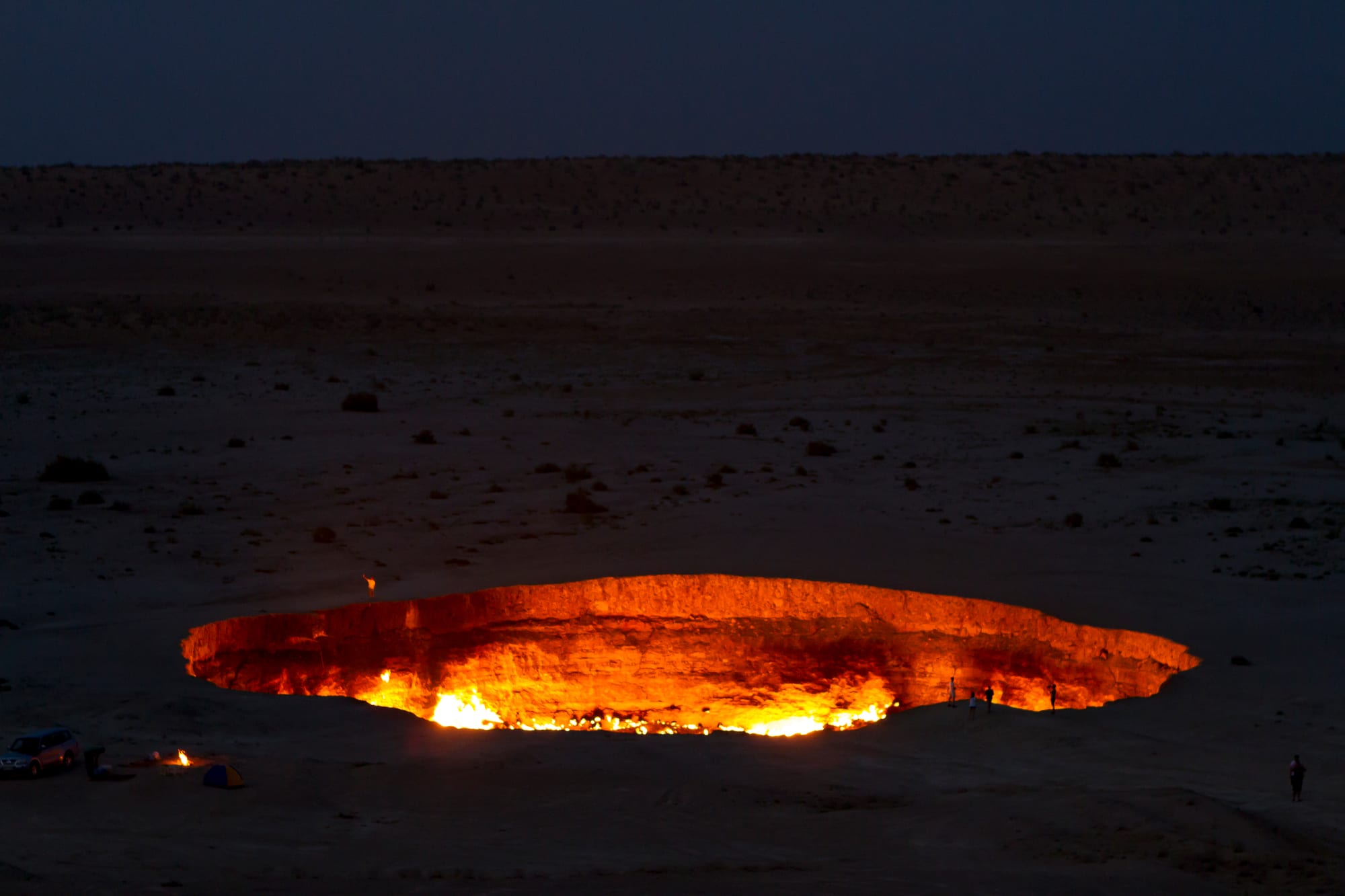
The Darvaza gas crater, nicknamed the Door to Hell, burns because it sits on top of a natural gas reservoir that keeps leaking gas into the pit. The most widely told account says Soviet geologists drilling near the village of Darvaza in 1971 punctured an underground cavern full of gas, the ground under the rig collapsed, and the crew set the gas alight so that poisonous fumes would not spread. They expected it to burn out in a few days. They underestimated how much gas was down there.
The "fifty years" in the question rests on that 1971 date, and it is not certain. Records from the period are missing, classified or inaccessible, and some local geologists say the collapse happened in the 1960s and the crater was only set on fire in the 1980s. Either way it has burned for decades. It is also no longer the inferno it was: since 2025 the fires have shrunk sharply, after new wells began drawing gas away from it.
A hole in the Karakum
The crater lies in the middle of the Karakum Desert, which covers about 70 percent of Turkmenistan, roughly 260 kilometres north of the capital, Ashgabat. It is 60 to 70 metres across and about 30 metres deep, and hundreds of separate gas fires flicker across its floor and around its rim. Its official name is Garagum ýalkymy, the Shining of Karakum.
The setting explains the fuel. The Karakum holds significant oil and gas deposits, and Turkmenistan has the world's fifth-largest reserves of natural gas, along with many leaks. Its Galkynysh field is ranked as the world's second-largest gas field. Darvaza is one small, spectacular escape point for that underground wealth.
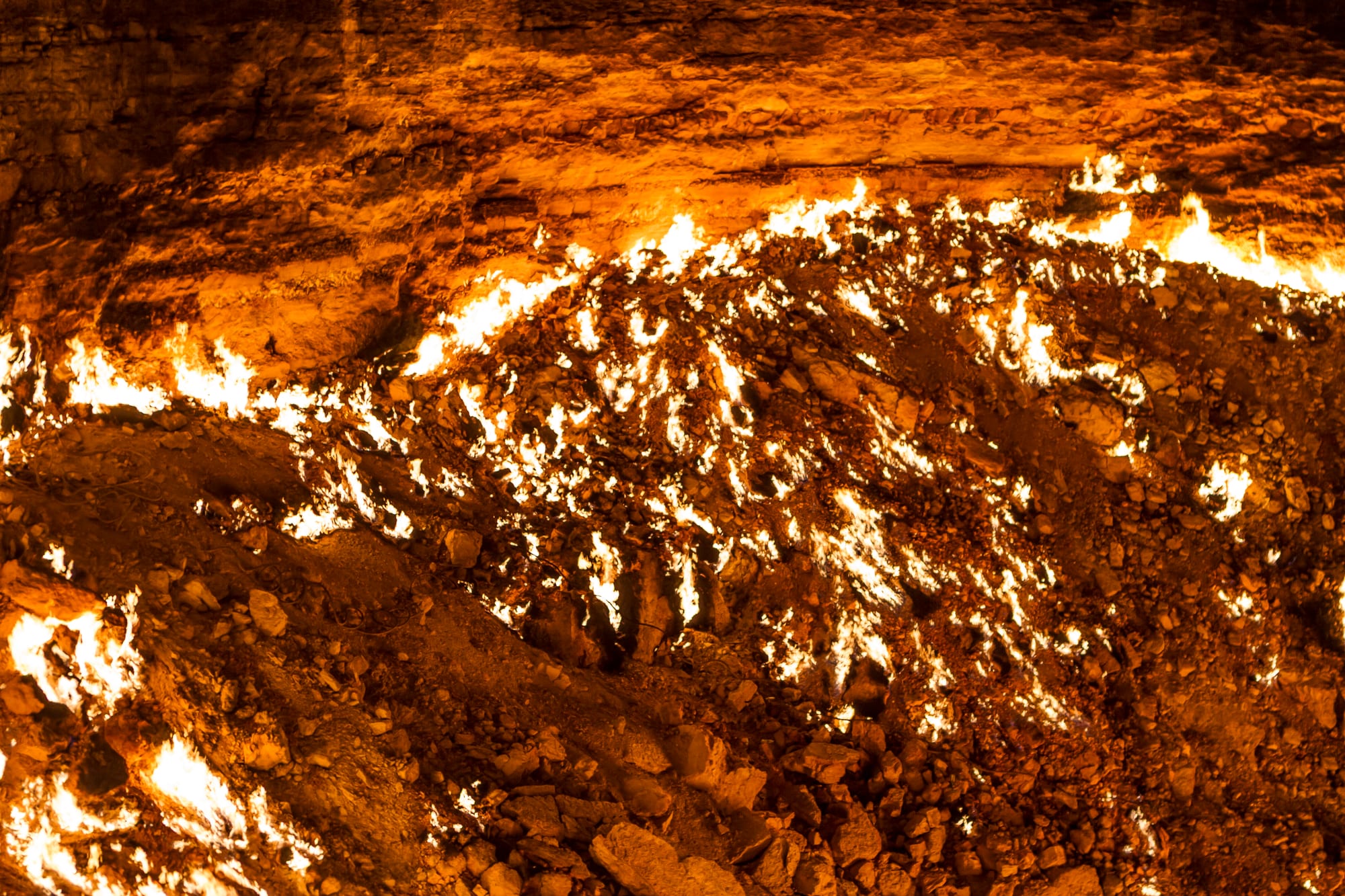
The flames are not one great fire but many small ones, each burning where gas seeps up through cracks in the rock.
Two versions of how it started
In the account usually told, the site was being drilled by Soviet engineers in 1971. The drill broke into a cavern, the roof collapsed within days, and the ground beneath the drilling rig gave way. To stop poisonous gas from pouring out across the desert, the team chose to flare it, meaning to burn it off deliberately, as oil and gas sites routinely do with gas they cannot capture.
The second version comes from some local geologists, who say the pit opened in the 1960s and stayed unlit until the 1980s. Neither story can yet be settled from the archives.
Another gas crater lies nearby; it is fenced off and has a distinct smell. Darvaza's own supply, by contrast, turned out to be far larger than the engineers who lit it had assumed.
Why not just put it out?
Setting the gas on fire was not as reckless as it sounds. Methane, the main component of natural gas, is a powerful greenhouse gas: over 20 years, a tonne of it warms the planet about as much as 82.5 tonnes of carbon dioxide. Burning it turns it mostly into carbon dioxide and water, which reduces the harm compared with letting it escape unburned.
But a burning crater still wastes valuable fuel and still leaks. Monitoring by Carbon Mapper, a nonprofit in California, found the crater released on average about 1,300 kilograms of methane an hour between 2022 and 2025, and 1,960 kilograms an hour in October 2025. The International Energy Agency counts Turkmenistan among the countries with the highest methane emissions.
1971 | Drilling near Darvaza is usually given as the date the crater opened and was lit. 2010 | President Berdimuhamedow calls for limits on the crater's effect on nearby gas fields. 2013 | The area is declared a nature reserve; George Kourounis reaches the crater floor. 2022 | In January, Berdimuhamedow orders a way found to extinguish it. 2025 | Officials say the fire has been cut three-fold as new wells capture gas. 2026 | Infrared images show the fires still declining.
The long fade
The government's attitude has shifted over time. In April 2010 President Gurbanguly Berdimuhamedow asked for measures to limit the crater's influence on other gas fields in the area. In January 2022 he announced plans to put it out, citing harm to the health of people living nearby, to the environment and to the gas industry, and pointing out that gas burned away was gas that could have been sold. A commission was set up to find the best method.
The crater was not snuffed out in one stroke. Instead, several wells were drilled around it to capture methane before it reached the pit. In 2025 the authorities said the size of the fire had been reduced three-fold, and by August that year only a few pockets of small fires were reported. Infrared images from 2026 show the decline continuing, and Capterio, a company that monitors gas flares, calculated that the heat from the flames had fallen by more than 75 percent over three years.
Seeing the crater today
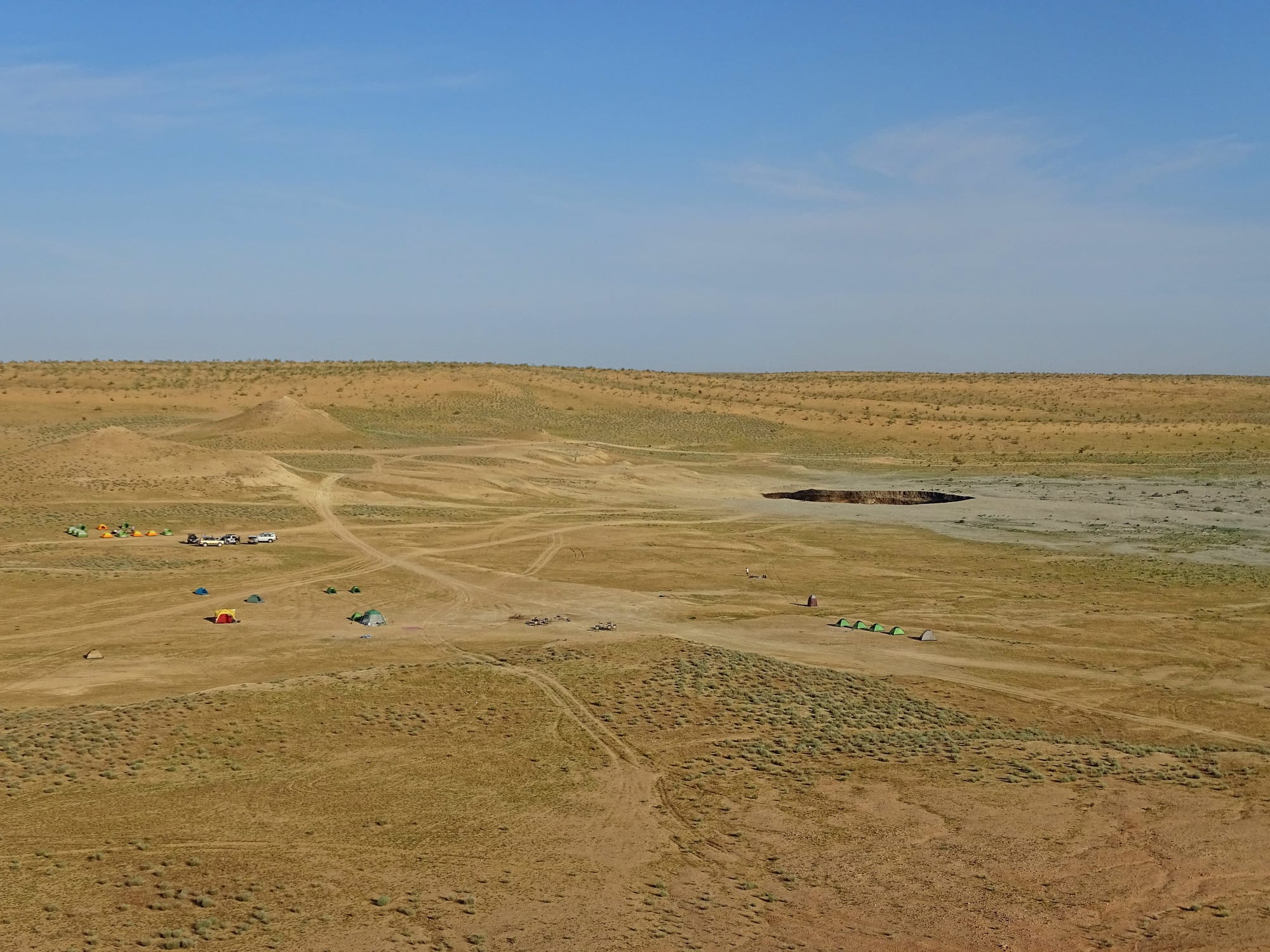
Despite the shrinking flames, the crater is still the country's best-known sight. It is about a four-hour drive from Ashgabat, the last stretch on a rough, unsigned track, and every foreign visitor needs a visa for Turkmenistan. Visitors usually camp nearby or stay in yurts set up close by, to watch it after dark. April to early June and September to October are the comfortable seasons; midsummer in the Karakum is dangerously hot.
In 2013 the Canadian explorer George Kourounis became the first person known to set foot on the crater floor, wearing an aluminised suit and breathing apparatus, to collect soil samples for a study of microbes.