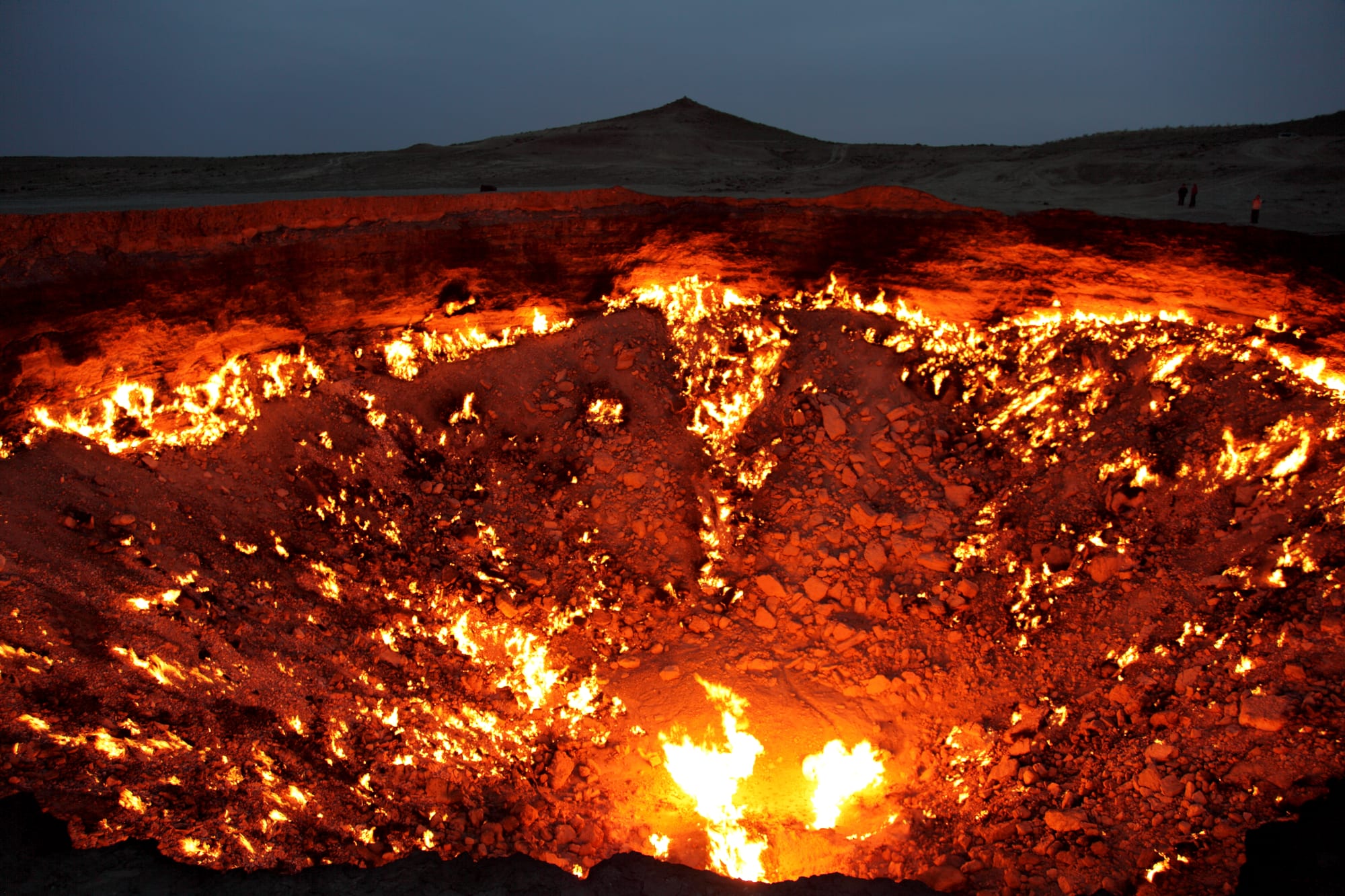
A wide pit in flat desert filled with flames and glowing embers, lighting the surrounding sand against a dark sky

Turkmenistan

The Darvaza gas crater in the Karakum Desert, a collapsed drilling site that has burned since 1971, known locally as the "Gates of Hell". (flydime / Wikimedia Commons · CC BY-SA 2.0)

A gas-rich Central Asian desert state — one of the most closed and tightly controlled countries in the world, ruled through a personality cult, with a white-marble capital, a permanently neutral foreign policy, and a burning gas crater as its unlikely tourist draw.

Explore Turkmenistan

History

The Turkmen are a Turkic people who arrived in the region around the tenth century as part of the Oghuz migration and long lived as tribal, largely nomadic horse- and camel-herders. The land held some of the great cities of the Silk Road: Merv, near modern Mary, was for a time one of the largest cities in the world before the Mongols destroyed it in 1221, and Konye-Urgench was a capital of the Khwarazmian empire.

The Russian Empire conquered the Turkmen in the 1870s–80s, a campaign marked by the massacre at Geok Tepe in 1881. Under the Soviet Union, Turkmenistan became a cotton-growing republic, its nomads forcibly settled and its identity suppressed.

Independence in 1991 brought Saparmurat Niyazov, the Communist Party leader, who styled himself "Türkmenbaşy" (Head of the Turkmen), built a personality cult without modern parallel — gold statues, a spiritual guidebook (the Ruhnama) made compulsory, months and places renamed after his mother and his book — and ran a closed, one-party state. On his death in 2006 he was succeeded by Gurbanguly Berdimuhamedow, who softened some excesses while building his own cult, and in 2022 handed the presidency to his son Serdar while keeping a powerful role as "National Leader", the title given to the chairman of the People's Council (Halk Maslahaty), the body holding supreme constitutional authority; parliament itself has been unicameral since January 2023. The country has declared itself permanently neutral, a status recognised by the UN in 1995, and sits on some of the world's largest natural gas reserves, with China the largest buyer.

  • Turkmenistan: The Desert Under One Man — A nation of former nomads on top of some of the world's largest gas reserves — a Silk Road land of Merv and the Turkmen tribes, absorbed late by Russia, and since independence one of the most closed and personality-cult-driven states on Earth

Culture & Customs

Turkmen identity remains strongly tribal — the five main tribes appear as the five carpet medallions (gül) on the national flag — and clan and regional loyalties matter beneath the surface of the unitary state. Society is Sunni Muslim, though decades of Soviet secularism and current state control of religion keep public practice muted, blended with older customs and reverence for ancestors and shrines.

Hospitality is central: guests are seated on carpets around a low table and offered tea, bread, and melon. Two national emblems carry deep pride — the hand-knotted Turkmen carpet, with its dense geometric patterns, and the Akhal-Teke horse, a slender, metallic-sheened breed that appears on the state emblem and has its own national holiday.

Public life is shaped by the state: mass choreographed celebrations, portraits of the leader, and strict codes on dress, appearance, and behaviour, with limited space for independent expression.

  • Turkmenistan: The Carpet, the Dutar and the State — A Muslim country where elders and guests are honoured in the old way, carpets are woven for every stage of life, the bard's two-stringed lute still carries the epics, and a closely managed state sets many of the rules of public life

Daily Life

About 7 million people live in Turkmenistan, most along the southern strip near the Kopet Dag mountains and the Amu Darya river, since the Karakum Desert covers around 80 per cent of the territory. Ashgabat, rebuilt after a devastating 1948 earthquake and then again in white marble under Niyazov and Berdimuhamedow, is a city of vast avenues, monuments, and record-setting buildings, often strikingly empty.

From independence the state provided citizens with a set free allowance of gas, electricity, water, and salt each month; caps were tightened under Gurbanguly Berdimuhamedow and the subsidies were abolished altogether on 1 January 2019, and there have been reports of food shortages and queues despite the gas wealth. Cotton and gas dominate the economy, jobs outside the state are limited, and a significant number of Turkmen work abroad, mainly in Turkey.

Everyday life is quiet, controlled, and family-centred, with weddings and seasonal festivals the main public occasions, and internet access heavily filtered.

  • Turkmenistan: A Life Lived Quietly — Extended families still sharing one household in the countryside, a bread-and-market economy that has had to relearn paying for gas and water, and an ordinary day shaped, more than in most places, by what the state permits it to look like

Food

Turkmen cooking is close to the wider Central Asian table, built on mutton, wheat, and rice. Palow (pilaf) — rice with mutton, carrots, and onions cooked in a cauldron — is the festive centrepiece. Dograma, a dish of torn bread with chopped meat and onion in broth and eaten by hand, is the Turkmen version of Central Asia's beshbarmak.

Other staples are chorba (a rich mutton-and-vegetable soup), manty (steamed dumplings), ichlekli (a meat-filled pie), and skewered grilled meat. Round tandoor-baked bread (chorek) is treated with respect and present at every meal.

Green tea is drunk at all hours, and çal, fermented camel's milk, white, sparkling, and sour, is the drink the country is known for. Turkmen melons and watermelons are famous and celebrated with their own national day.

Attractions & Natural Wonders

The Darvaza gas crater, a Soviet-era drilling accident set alight and still burning since 1971 in the middle of the Karakum, is the country's signature sight, best seen overnight on a desert camping trip from Ashgabat. In January 2022 the president announced plans to extinguish it, citing health, environmental, and gas-export reasons; in 2025 the authorities said the fire had been reduced three-fold, and it is still alight, though burning less fiercely.

Ancient Merv, a UNESCO World Heritage Site, is a vast field of earthen walls, fortresses, and mausolea — including the great domed tomb of Sultan Sanjar — spread across the desert near Mary. Konye-Urgench, inscribed by UNESCO in 2005, has the 60-metre Kutlug Timur minaret and a cluster of mausolea, and Nisa, just west of Ashgabat and a World Heritage Site since 2007, preserves the fortresses of the Parthian empire.

Ashgabat itself is an attraction of a kind: the white-marble ministries and apartment blocks, the Independence and Neutrality monuments and the Türkmenbaşy Ruhy Mosque just outside the city at Gypjak, with the city holding a Guinness record for the world's highest concentration of white marble buildings. Beyond, the Yangykala Canyon in the north-west glows with red rock in cliffs 60 to 100 metres high, and the underground lake at Kow Ata, sulphurous and a constant 33–38°C, can be swum in.

Planning basics

Budget

Independent travel is effectively impossible: almost all visitors come on a guided tour arranged through a licensed Turkmen agency. Tour costs are high for the region because a guide, driver, and permits are mandatory, and hotels for foreigners are state-priced. Ashgabat is expensive; the rest of the country has few facilities.

Daily Budget Note
Guided tours typically USD 150–300+/day including guide, driver, hotels, and permits

Arrange everything through an approved agency well in advance; budget for the guide and vehicle your itinerary needs.

Visa Requirements

Nearly everyone needs a visa, and a tourist visa requires an invitation letter issued by a travel agency licensed in Turkmenistan. With an invitation approved beforehand by the Ministry of Foreign Affairs, a visa on arrival valid for 10 days, extendable by another 10, is possible. A decree signed in April 2025 promises electronic visas and an end to the invitation-letter rule, but the details have not yet been settled.

Typical Validity
Visa on arrival 10 days with an approved invitation, extendable by 10 more

Start the invitation-letter process well ahead; airside transit at Ashgabat airport is visa-free for up to 24 hours.

Safety

Street crime against foreigners is very low, and the guided nature of travel adds a layer of security. The real issues are political: pervasive surveillance, restrictions on movement and photography, an unreliable currency and cash situation, extreme summer heat, and minimal Western consular presence if something goes wrong. Information and internet access are tightly censored.

Health
Medical facilities are poor by international standards; bring your own medicines; water should be bottled; heatstroke is a real risk in summer

Follow your guide's instructions on photography and movement, carry enough US dollars cash for the whole trip, and have comprehensive insurance with evacuation cover.

Climate

Extreme continental desert. Summers are very hot, regularly above 40°C in the Karakum, and winters are cold, with frost and occasional snow. Spring and autumn are short and mild. Rainfall is minimal, and dust storms occur.

Summer
Very hot, often 40°C+
Winter
Cold, sometimes below freezing

Transportation

Ashgabat International Airport is the main gateway, with a limited international network. Domestic flights link the main towns, and the railways carry domestic passenger services only. Foreigners on tours travel by chauffeured car with their guide; independent overland movement is restricted and checkpoint-heavy.

Expect your guide to accompany you almost everywhere and your route to be fixed; photography of official buildings is often forbidden.

Best Time to Visit

April to early June and September to October are the only comfortable windows for touring the desert, the ruins, and the gas crater. Midsummer is dangerously hot for sightseeing, and winter is cold and bleak.

Events
Novruz (spring equinox); Independence Day (27 September); Turkmen Horse Day (late April), celebrating the Akhal-Teke breed; Melon Day (August)

Currency

The currency is the manat. There is a fixed official exchange rate far below the black-market value, and access to foreign currency is heavily restricted. It is a cash economy for visitors; international cards do not work reliably, and ATMs are scarce and often empty. Bring US dollars cash.

Symbol
m
Currency Code
TMT — manat

Language

Turkmen, a Turkic language, is the state language, written in a Latin-based alphabet since the 1990s. Russian is still spoken by many older and urban people but has declined sharply. English is understood only in the tourism trade and a few institutions.

Also Spoken
Russian (declining)
State Language
Turkmen