A wide flat desert plain at dusk with a fire-lit crater glowing orange in the middle distance and a parked vehicle on the sand

Ashgabat, Kunya-Urgench & the Karakum, Turkmenistan

Darvaza

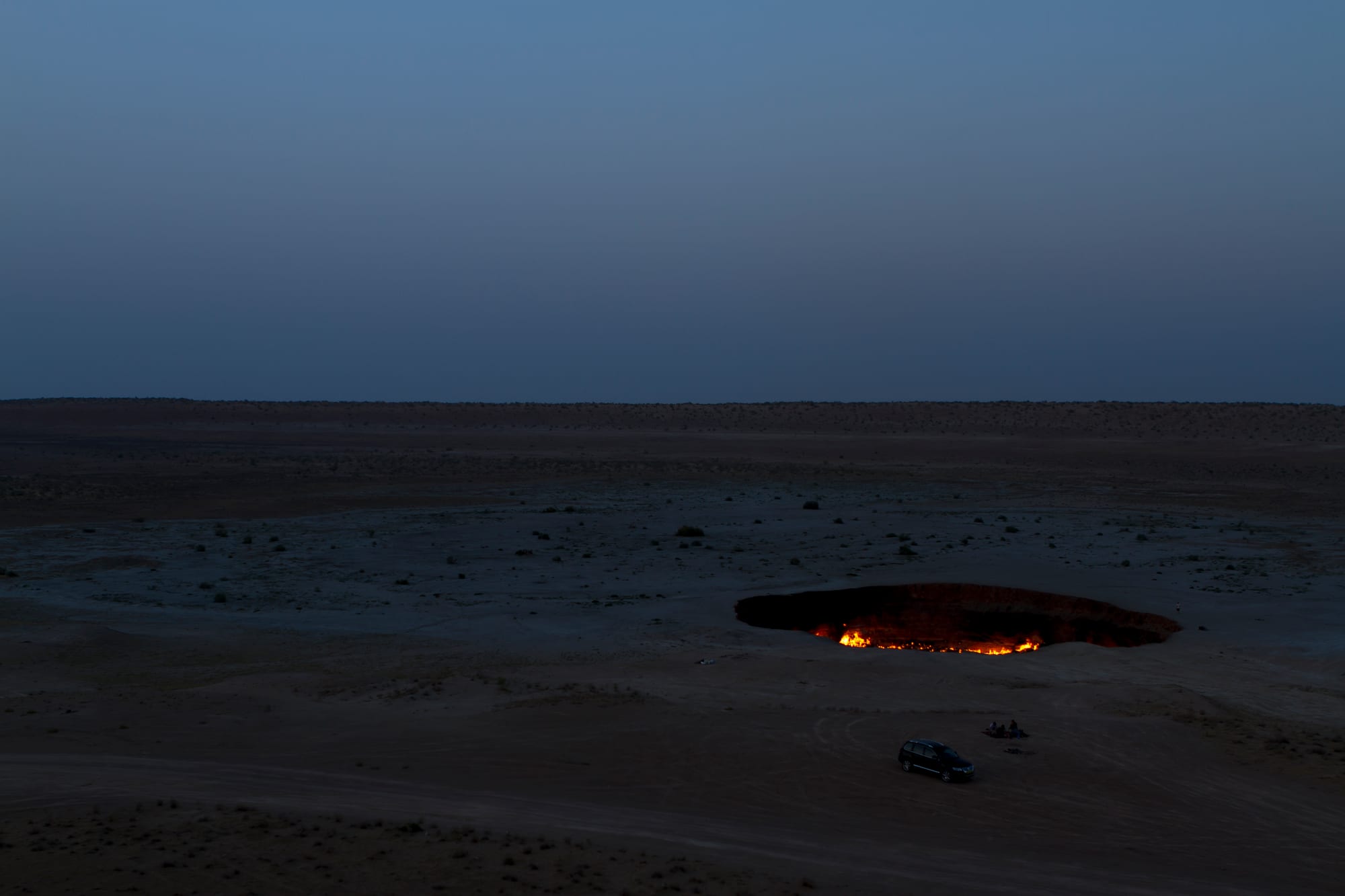
The burning Darvaza gas crater in the Karakum desert at dusk. (Benjamin Goetzinger / Wikimedia Commons · CC BY-SA 4.0)

A tiny desert settlement in the middle of the Karakum, on the road that crosses Turkmenistan from Ashgabat to Daşoguz. Its name is known because of the Darvaza gas crater nearby, a collapsed Soviet-era drilling site that has burned since 1971, though its fires have shrunk markedly in recent years, and is usually visited on an overnight camping trip. This page is written to explain the place, not to encourage travel.

Neighbourhoods

  • The crater and the camps
    • First-time visitors
    • Camping
    • Night views

    Open sand a short drive off the main road, where tour groups pitch yurts and tents at a distance from the burning pit. There are no buildings, no lighting and no fences, and the fires in the pit can be seen across the plain after dark.

    Open in Maps
  • The settlement and the road
    • Local life
    • Practical stops

    A small scatter of houses, a tea stop and fuel beside the north–south highway across the desert, used by lorry drivers and by tour vehicles breaking the long drive between Ashgabat and Daşoguz.

    Open in Maps
  • The open Karakum
    • Desert landscapes
    • Quiet

    Sand ridges, saxaul scrub and grazing land stretching in every direction, crossed by herders with camels and sheep and by tracks leading to gas wells. Distances are long and there is no shade.

    Open in Maps

Things to do

The crater and the desert

  • Darvaza gas craterattraction

    A burning pit 60 to 70 metres across and about 30 metres deep in the open desert, the result of a collapse at a Soviet gas drilling site, alight since 1971 and best seen after dark, though its fires have diminished sharply in recent years.

    Open in Maps
  • The Karakum desertattraction

    The sand desert covering most of Turkmenistan, with dunes, saxaul scrub, herders' camps and long empty roads all around the settlement.

    Open in Maps

Along the desert highway

  • Yerbentneighborhood

    A small desert village on the Ashgabat road, where camels, flat-roofed houses and a well give a picture of settled life in the Karakum.

    Open in Maps
  • Bokurdakneighborhood

    A roadside settlement in the desert south of Darvaza, one of the few fixed points on the highway.

    Open in Maps
  • Ashgabatneighborhood

    The marble capital below the Kopet Dag, about 260 kilometres south, from which almost every visit to the crater sets out.

    Open in Maps

Seasonal events

  • Nowruzlate March

    The spring new year, when desert families gather, cook and visit relatives; the Karakum briefly greens after the winter rain.

  • Spring and autumn camping seasonApril to May and late September to October

    The months when tour groups camp at the crater, with bearable days and cool rather than freezing nights.

  • Melon DayAugust

    A national holiday for the Turkmen melon, marked at roadside stalls and in the settlements along the desert highway.

Eat and drink

Long-standing places and food districts in Darvaza. Hours, ratings and directions come from your maps app, always current.

Eating in the desert

  • Camp cooking at the craterneighborhood

    Tour crews cook over open fires beside the tents — shashlik of mutton on skewers, chorba soup, bread, salad and endless green tea from a pot.

    Open in Maps
  • Roadside chaikhanas on the desert highwayneighborhood

    Simple tea houses and canteens along the road serving chorba, palow, manty and tandoor bread to drivers crossing the Karakum.

    Open in Maps
  • Melon and produce stallsmarket

    Seasonal stalls at settlements and junctions selling melons, watermelons, dried fruit and bottled water for the drive.

    Open in Maps

Experience Darvaza

History

The settlement began as a desert well on the caravan and herding routes across the Karakum, the name coming from a Persian word for gateway. Life here was pastoral until the Soviet period, when geologists began surveying the desert for natural gas and the road linking the capital with the northern province was pushed across the sand. The area proved to hold significant oil and natural gas deposits, and drilling camps, tracks and pipelines spread through country that had carried only camels and sheep.

The crater dates from that work. The usual account is that Soviet engineers drilling in 1971 punctured a gas cavern whose roof collapsed within days, opening a wide pit that leaked gas. The gas was flared to stop poisonous gases escaping, its volume badly underestimated, and it has burned since. Other accounts, from local geologists, put the collapse in the 1960s and the fire in the 1980s; the early records are absent, classified or inaccessible. The official Turkmen name means the Shining of the Karakum, but it is known everywhere as the Door to Hell.

The village itself did not last. In 2004 President Saparmurat Niyazov ordered the settlement at Darvaza disbanded and it was destroyed; a scatter of buildings and a roadside stop remain. The crater, meanwhile, became the country's best-known sight, and the area around it was declared a nature reserve in 2013. In 2022 President Gurbanguly Berdimuhamedov announced plans to extinguish it, citing effects on health, the environment and the gas industry. The pit remains open and alight, but the fire has shrunk: wells have been drilled around it to capture methane, and in 2025 the authorities said its size had been reduced three-fold, with infrared imagery in 2026 showing a further decline.

Culture & Customs

The culture here is that of the Karakum rather than of a town. The desert belongs to herding families who move sheep, goats and camels between wells and seasonal pasture of saxaul and sedge, living in flat-roofed houses or, in the older pattern, in felt yurts. Water comes from wells and cisterns, and knowledge of where it lies is passed down; hospitality is not a courtesy but a rule, since a traveller turned away from a well in this country is in danger.

Visitors meet that culture mainly through the camp. Tour crews set up tents or yurts, cook over a fire, and sit late while the crater glows; drivers and guides tell the crater's history in versions that differ from one another, and the site has become a set piece of Turkmen tourism, helped by the declaration of the surrounding area as a nature reserve in 2013. The crater also holds a place in local storytelling, as a landmark that everyone in the country knows by name.

Elsewhere on the road the customs are national: green tea poured from a small pot into bowls, bread broken by hand and never put down upside down, elders greeted first, and shoes left at the door. Camels are valuable and treated with care, and their milk is fermented into chal, the desert's own drink. Photography of gas installations and official vehicles is not welcome, and guides will say where a camera can be used.

Daily Life

Barely two thousand people are counted at Darvaza, most of them Teke Turkmen keeping a semi-nomadic life in the surrounding desert. The few around the road work at the tea stop and fuel point, herd animals, or are employed in the gas industry that dominates the region; the nearest sizeable settlements are hours away in either direction, and the provincial centres of Ashgabat and Daşoguz supply everything. Life for herding families in the surrounding desert follows water and pasture, with camels, sheep and goats and long distances between households.

Gas is the other economy. The Karakum holds significant oil and gas deposits, and gas dominates the country's exports; the desert is crossed by pipelines, tracks and worker camps, with lorries running north and south along the highway day and night. Work is rotational, and men often spend weeks away from families who live in oasis towns.

The rhythm of a desert day is set by heat. Activity happens in the early morning and the evening, and the middle of the day is spent in shade; in summer that gap is long. Water is trucked or drawn from wells, electricity is limited away from the road, and mobile coverage is patchy. For tour crews the season is spring and autumn, when convoys of 4x4s appear in the late afternoon, and the desert around the crater is quiet again for the rest of the year.

Food

Food at Darvaza is camp food and road food. Tour crews carry supplies from the city and cook over a fire: shashlik, skewers of mutton grilled over embers, chorba, a mutton and vegetable soup made in a single pot, tomato and cucumber salad, and chorek, the round tandoor loaf, bought before leaving the last town. Tea is constant — green tea poured from a small pot into bowls, sometimes black with milk in the cold.

The desert's own product is chal, fermented camel's milk, sour and slightly fizzy, drunk by herding families through the hot months and sold in bottles along the road. Gatyk, a thick sour yoghurt, and dried curd balls keep without refrigeration, which matters in a country of long distances. Meat is mutton or goat, and it is usually boiled or grilled rather than fried.

The roadside chaikhanas between Ashgabat and Daşoguz serve the national repertoire to drivers: palow, rice cooked with mutton, carrot and onion; manty, large steamed dumplings; lagman noodles in broth; somsa baked against the wall of a tandoor; and gutap, fried half-moon pastries filled with meat, pumpkin or greens. In late summer melons and watermelons appear at every junction, piled on the sand, and dried fruit, nuts and bottled water are the standard purchases for the drive.

Planning tools

Budget

There is nothing to buy here, so the cost is entirely the tour: a 4x4, a driver and guide, camping equipment and food carried in from Ashgabat. The crater trip is one of the standard add-ons to a Turkmen itinerary and raises the daily price above a straightforward city stay. Everything is arranged and paid in advance, in US dollars.

Daily Budget Midrange
USD 180–300 (private 4x4 and driver, yurt or tent camp with cooked meals, on a longer guided tour)
Daily Budget Shoestring
USD 120–180 (group desert trip with a guide, shared camping, food brought from the city)

Confirm with the agency what the camp provides — bedding, water and warm clothing matter more here than anything money can buy on the spot.

Best Time to Visit

April to May and late September to October. Those months give warm days and nights that are cool rather than cold, which matters when sleeping in a tent. Midsummer in the open Karakum is dangerously hot, with little shade on the drive, and winter nights at the crater fall well below freezing with a hard wind.

Suggested Number of Days

Most visits are a single night: arrive in the late afternoon, sleep in the desert and drive on in the morning. Two days allow a slower crossing of the Karakum with stops in the desert villages. The length is usually fixed by the tour's route between the capital and the north.

First Visit
One overnight
With Surroundings
2 days

Transportation

Everything here happens by vehicle. The tarred highway between Ashgabat and Daşoguz passes close by, but the last few kilometres to the crater are soft sand tracks that need a 4x4 and a driver who knows them. Visitors travel with their guide throughout, and there is no public transport of use to travellers.

Sand driving punctures and overheating are common on this route, so expect delays and carry more water than seems necessary.

Airport & Station Connections

The crater lies beside the main road across the Karakum, roughly 260 kilometres north of Ashgabat and about four hours' drive; the northern continuation reaches Daşoguz in a further four to five hours. Most visitors come by 4x4 from the capital as part of a guided route north, often flying back from Daşoguz rather than driving the desert road twice.

Walkability

Walking is limited to the sand around the camp and the rim of the crater, over loose ground with no paths, lighting or barriers. The heat radiating from the pit is strong close up, and the edge is undercut in places. Away from the camp there is nothing to walk to, and distances across the desert are far greater than they appear.

Safety

Crime is not the issue here; the desert is. The crater has no fence or railing, its rim is unstable, and the ground is uneven and dark at night. Heat, dehydration and cold nights are all real risks, mobile coverage is patchy, and medical help is hours away. Gas and smoke blow across the rim depending on the wind.

Stay well back from the crater rim, keep a torch to hand after dark, carry far more water than expected, and follow the guide's instructions about where to walk and camp. Check current official travel advice before travelling.

Climate

Extreme desert climate in the centre of the Karakum, with the country's widest swings between day and night. Rain is rare and falls mostly in winter and early spring, when a brief green flush crosses the sand; dust storms occur in spring and summer.

Summer
blistering, frequently 40–45°C by day, with nights that stay warm but cool sharply after midnight
Winter
cold, often around -5 to 5°C by day and below freezing at night, with a cutting wind across open sand

Local Customs

This is herding country, and the etiquette is that of the desert: greet people, accept tea when it is offered, and treat bread with care. Dress is modest and practical, covering arms and legs against the sun. The camps are run by tour crews, and visitors are expected to leave no rubbish and to keep noise down at night, since sound carries a long way on the plain.

Ask before photographing herders, their animals or any gas installation, and do not light fires or throw anything into the crater.

Common Payment Methods

There is effectively nothing to pay for on the spot: the trip, food and camp are settled with the agency in advance, in US dollars cash. The currency is the Turkmen manat, and small notes are useful for roadside tea houses and melon stalls. No cards are accepted, and there are no cash machines anywhere nearby.