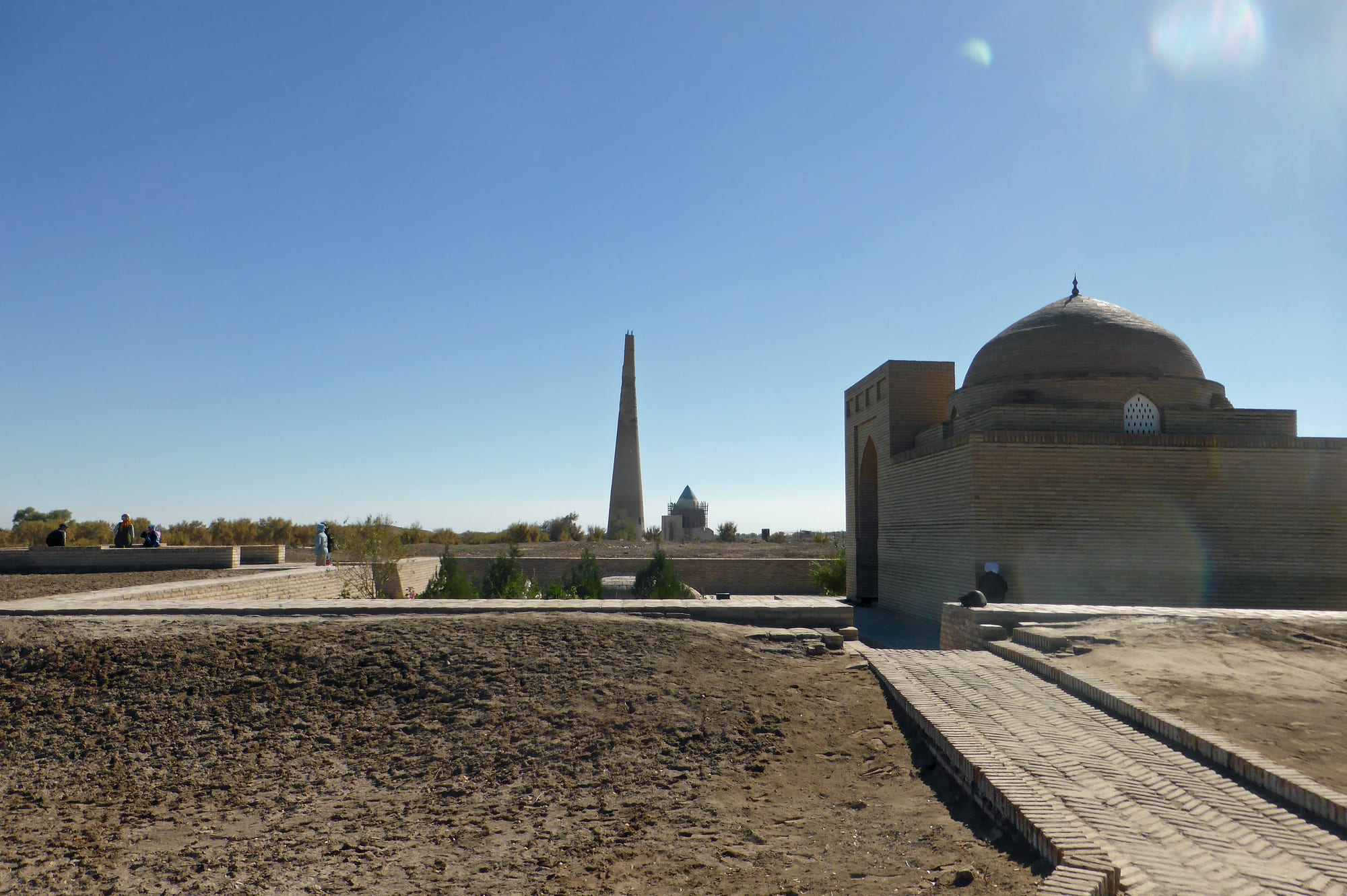
A domed brick building and paved paths on dry ground, with a tall slender minaret and a small conical-domed tomb in the distance under a clear sky

Turkmenistan

Ashgabat, Kunya-Urgench & the Karakum

The ruins of Konye-Urgench in Daşoguz province, with the Kutlug Timur minaret rising in the distance. (Hans Birger Nilsen / Wikimedia Commons · CC BY-SA 2.0)

The heart and north of Turkmenistan, running from the white-marble capital Ashgabat and the Ahal oasis under the Kopet Dag across the Karakum desert to the Daşoguz lowlands on the Amu Darya — home to Parthian Nisa, the burning Darvaza crater and the medieval Khwarazm capital of Kunya-Urgench.

Explore Ashgabat, Kunya-Urgench & the Karakum

History

The Ahal oasis along the northern foot of the Kopet Dag is one of the oldest farmed landscapes in Central Asia: Bronze Age settlements such as Anau and Namazga Tepe flourished here thousands of years before the Silk Road. In the third century BC the Parthians, a people from the steppe, made the foothills their early heartland, and Nisa, just west of modern Ashgabat, became one of their royal centres, with palaces, temples and a treasury whose ivory drinking horns are now among the best-known Parthian finds.

The north belonged to a different world. Kunya-Urgench, on an old channel of the Amu Darya, was the capital of Khwarazm, whose shahs built an empire across Central Asia and Iran around 1200 before provoking Genghis Khan; the Mongols sacked the city in 1221. It recovered under the Golden Horde, was destroyed again by Timur in the 1380s, and was largely abandoned after the river shifted its course, when the rulers of Khwarazm moved to Khiva.

In the 19th century the Teke Turkmen of Ahal resisted the Russian advance until 1881, when General Skobelev stormed the fortress of Geok Tepe and killed thousands of defenders and civilians. Ashgabat grew from a Russian garrison founded that year, became the Soviet republic's capital, and was flattened by the earthquake of 1948, which killed a large share of its people. After 1991 it was rebuilt again in white marble as the showcase of independent Turkmenistan.

Culture & Customs

Ahal is the homeland of the Ahal Teke Turkmen, and gives its name to the Akhal-Teke horse, bred in the oasis for speed and endurance over desert distances; the breed is honoured with its own holiday in late April, and horse racing at the Ashgabat hippodrome is a national passion. Teke carpets, with their rows of deep-red güls, are the best known of the Turkmen weaves and fill the national carpet museum in the capital.

Geok Tepe carries heavy meaning: the 1881 battle is remembered as a national tragedy, commemorated by a large mosque and memorial beside the old fortress. Gypjak, Saparmurat Niyazov's home village near Ashgabat, holds the vast mosque he built, with his mausoleum, and state ceremony, portraits and choreographed celebrations shape public life in the capital more than anywhere else.

Daşoguz and the north are part of historic Khwarazm and look towards Khiva as much as to Ashgabat. Many people there are ethnic Uzbeks, and the region shares the Khorezmian taste for song, dance and pilgrimage: the mausolea of Kunya-Urgench include the tomb of Najm ad-Din Kubra, founder of the Kubrawiya Sufi order.

Daily Life

Ashgabat, home to about a million people, is the centre of government, business and education, a city of ministries, apartment towers and parks kept immaculate by armies of cleaners. Life is orderly and closely watched: rules on car colours, dress and public behaviour change by decree, and the modern avenues are often empty while crowds gather in the bazaars, above all the sprawling Altyn Asyr market on the edge of the city. Near the capital the government has built Arkadag, a new planned city opened in 2023.

The Ahal oasis beyond grows wheat, cotton, grapes and melons on canal water from the Karakum Canal, which carries Amu Darya water across the south of the country; the desert itself is thinly peopled, with herders' settlements and gas fields. Daşoguz, the northern provincial capital, is a low-rise cotton town in irrigated land near the Uzbek border, and the villages around it depend on the river and the harvest. Water and salt in the soil are persistent problems in the north, which lies within the wider Aral Sea basin.

Days start early to beat the heat, family and weddings dominate social life, and the internet is slow and heavily filtered.

Food

Ahal eats the classic Turkmen table: palow for guests and holidays, dograma of torn bread, meat and onion in broth, and chorba soup. Round chorek bread from clay tandoor ovens appears at every meal, and in the bazaars stalls sell somsa, meat-filled tandoor pastries, and gutap, thin half-moon pastries filled with meat, pumpkin or greens and fried.

In the Karakum, chal — fermented camel's milk, sour and slightly fizzy — is the herders' drink, and on Darvaza trips guides grill skewered mutton over open fires beside the tents. In the Daşoguz region tea is sometimes drunk with milk, Kazakh-style, to soften the salty local water, and melons, a source of national pride, are celebrated with a national day in August.

Green tea, poured from small pots into bowls, is drunk all day, and grapes from the Kopet Dag foothills are eaten fresh and dried.

Attractions & Natural Wonders

Ashgabat is best seen as a monument to itself: the white-marble avenues and ministries, the Independence Monument and the Neutrality Monument, the gilded statues, the Alem cultural centre's enclosed Ferris wheel and the national museum and carpet museum, which hold the country's best collections. The Altyn Asyr bazaar is the liveliest place in town. A short drive west, the eroded mud-brick walls of Nisa rise over the plain, and to the north-west the Geok Tepe fortress and the Gypjak mosque recall two very different chapters of Turkmen history.

Further along the Kopet Dag foothills lies Kow Ata, a warm underground lake in a cave reached by a long stairway, where bathers float in mineral water. North of the capital the road crosses the Karakum's dunes and scrub to the Darvaza gas crater near the old settlement of Derweze, a burning pit best seen at dusk and after dark, with other craters nearby.

In the far north, Kunya-Urgench is a scattered field of ruins across the cemetery-dotted plain: the Kutlug Timur minaret, about 60 metres tall; the conical-roofed mausolea of Tekesh and Il-Arslan; the tiled dome of the Turabek Khanum mausoleum; and the mausoleum of Najm ad-Din Kubra.

Cities in Ashgabat, Kunya-Urgench & the Karakum

Planning basics

Budget

This is the part of Turkmenistan most tours cover, and costs follow the national pattern of guide, driver and state-priced hotels paid in advance. Ashgabat's hotels are the most expensive in the country; the Darvaza trip adds a 4x4 and a desert camp, and Kunya-Urgench is usually reached from Daşoguz or on the way to or from Uzbekistan. Local prices in TMT are low, but visitors pay mostly in US dollars cash.

Daily Budget Midrange
USD 180–300 (full guided tour, Ashgabat hotel, 4x4 to Darvaza, internal flight to Daşoguz)
Daily Budget Shoestring
USD 120–180 (short transit route with a guide, simple hotels, camping at Darvaza)

Bring enough clean, new US dollar notes for the whole trip; cards and cash machines cannot be relied on even in Ashgabat.

Safety

Crime against visitors is low, and guides accompany tours throughout. The real risks are heat and dehydration in the Karakum, the unfenced edge of the Darvaza crater at night, long desert roads, and the political climate: photographing government buildings, police or the presidential sites in Ashgabat can lead to questioning and deleted pictures.

Stay well back from the crater rim, carry plenty of water, and ask the guide before photographing anything official. Check current official travel advice before travelling.

Climate

Ashgabat and the Ahal oasis sit at the foot of the Kopet Dag and are slightly milder than the open desert, but summers are still very hot. The Karakum around Darvaza has the widest extremes, with blistering days and cold nights, and Daşoguz in the north has colder winters than the south, with regular frost.

Summer
very hot, often 38–45°C in the desert and in Ashgabat; nights cooler in the Karakum
Winter
cool in Ashgabat, around 0–10°C; colder in Daşoguz and the desert, with frost and occasional snow

Transportation

Ashgabat has the international airport and domestic flights to Daşoguz. The main road north runs across the Karakum from Ashgabat to Daşoguz, passing close to Darvaza, roughly four hours from the capital; the last stretch to the crater is sand track for 4x4s. Kunya-Urgench lies about two hours north-west of Daşoguz, which is close to the Uzbek border crossing used by many travellers heading for Khiva. Nisa is a short drive from central Ashgabat.

Let the agency route the trip north by road via Darvaza and back by domestic flight, or the reverse, to avoid driving the desert road twice.

Best Time to Visit

April to May and late September to October, when the desert is bearable by day and camping at Darvaza is comfortable at night. Spring brings a brief green flush to the Karakum and Turkmen Horse Day in late April, celebrated in Ashgabat. Midsummer is dangerously hot on the road north, and winter nights at the crater are bitterly cold.