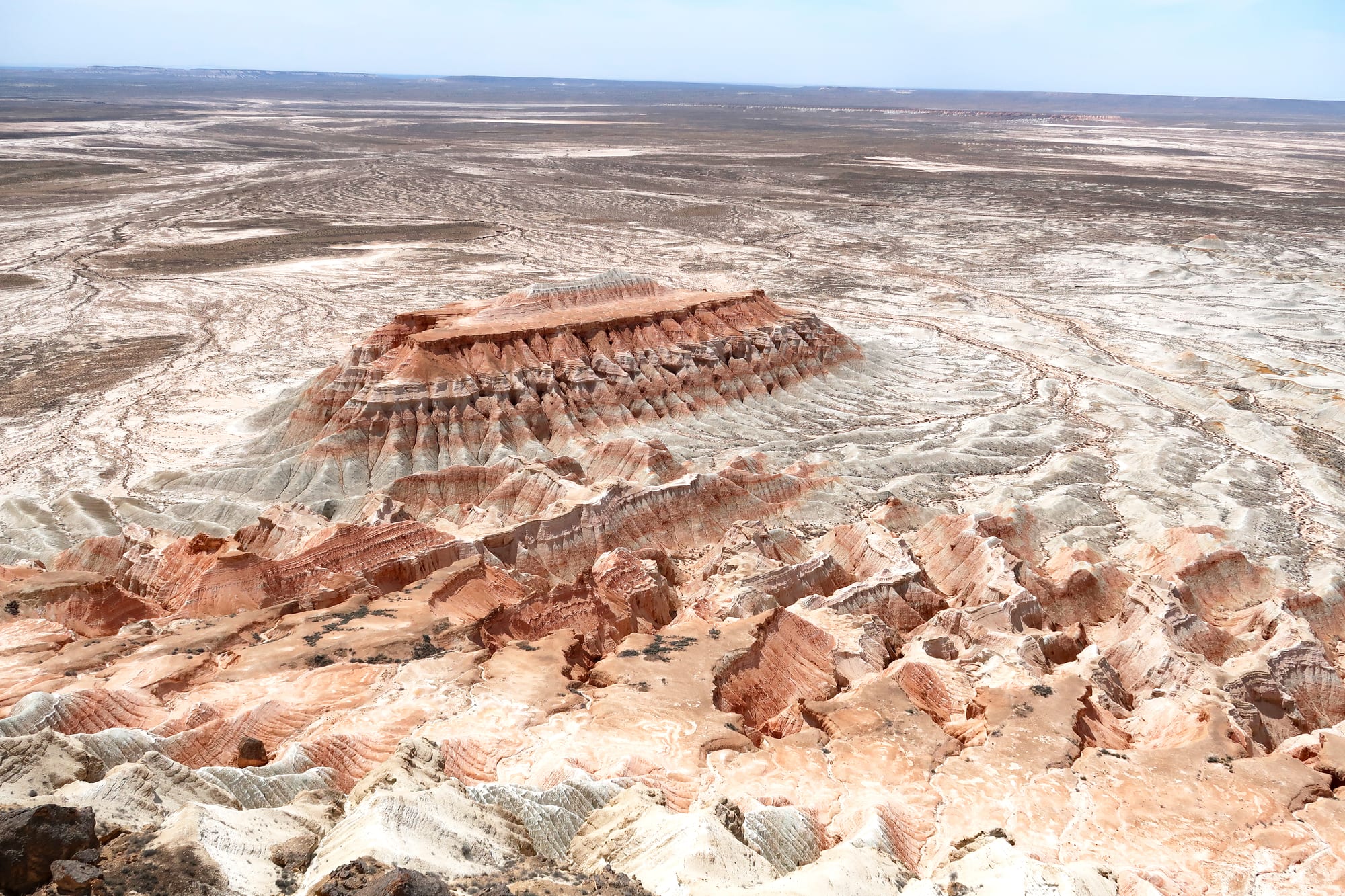
Eroded red, pink and white banded cliffs and a flat-topped mesa rising above a pale desert plain

Turkmenistan

Balkan & the Caspian

The striped cliffs and mesas of the Yangykala canyon in the desert of Balkan province. (John Pavelka / Wikimedia Commons · CC BY 2.0)

Turkmenistan's largest province, the desert west that runs down to the Caspian Sea — an oil and gas country of port towns and pipelines, home to Turkmenbashi, the Awaza resort and the provincial capital Balkanabat, and to the striped cliffs of the Yangykala canyon and the shrines of the Yomut Turkmen.

Explore Balkan & the Caspian

History

The west was a frontier between the settled lands of Iran and the steppe. In the south, near the Iranian border, the medieval city of Dehistan flourished from the 10th to the 14th centuries on a trade route of the Iranian world, leaving the ruins of a mosque and two minarets in the desert before it was abandoned around the 15th century. Further north the land was grazing ground for herders, and from the 14th century the Yomut Turkmen spread into the Balkan lands and along the Caspian coast.

Russia arrived by sea. In 1869 it founded the fortified port of Krasnovodsk on the Caspian as a base for the conquest of Central Asia, and from the coast the Trans-Caspian Railway was built eastwards from 1879, first for troops and then for cotton. Oil was found around Cheleken and in the desert near the Balkan mountains, and in Soviet times the oil town of Nebit Dag, today's Balkanabat, grew up beside the fields. In 1942 much of the Polish Anders' Army and many civilians were evacuated from the USSR through the port to Iran.

After independence Krasnovodsk was renamed Turkmenbashi after Saparmurat Niyazov, Nebit Dag became Balkanabat, and the province turned to offshore Caspian oil and gas. In 2009 the first new buildings of the Awaza resort west of Turkmenbashi were inaugurated.

Culture & Customs

The Yomut have long been the main people of the west, and their carpets, with gül motifs, hooked diamonds and colours from reddish brown to plum, are known to collectors worldwide. The coast was long home to Yomut fishermen as well as herders, a rare maritime strand in Turkmen culture.

Pilgrimage is a strong part of local life. Gozli Ata, one of the remotest shrines in Turkmenistan, is the tomb of a Sufi saint in the desert, and shrines like it are visited with quiet respect.

The port towns are more mixed than the rest of the country: Russians, Azerbaijanis and Armenians settled in Krasnovodsk and the oil towns in Soviet times, and Russian is still widely heard in Turkmenbashi. Beach holidays at Awaza, heavily promoted by the state, have become part of summer life for Turkmen families.

Daily Life

Balkan is the largest province by area but thinly peopled, with most people in a handful of towns along the railway and the coast. Balkanabat, the provincial capital, is an administrative and oil-industry town at the foot of the Big Balkan range. Turkmenbashi, the main port, has the country's largest oil refinery, a large international seaport and a ferry terminal, while Hazar on the Cheleken peninsula and Gyzylarbat in the east are the other main towns.

Oil and gas drive the economy, both onshore and offshore in the Caspian, along with salt and chemicals from the coast and the great lagoon of Garabogazköl. Farming is limited to small irrigated patches and herding in the desert. Work in the energy sector pays better than elsewhere, but jobs are controlled by the state and its partners.

Days follow the heat: early starts, a long break at midday, and evenings on the waterfront promenades in summer. Water supply and a shrinking fishery are local worries.

Food

The west shares the national taste for ishlekli, a round meat pie sealed in dough, cut into wedges to share. Mutton is the everyday meat, often stewed or cooked as palow, the rice dish of mutton, carrots and onions made in a large cast-iron cauldron and served at celebrations and to honoured guests. Shashlyk, skewered mutton or sometimes fish grilled over charcoal, is sold in the streets.

The Caspian adds fish, a traditional food of the Turkmen who live on the coast: carp and other fish are grilled or fried, and Caspian recipes serve them with sesame, rice, apricots, raisins or pomegranate juice. Tandoor-baked chorek accompanies every meal, and gutap, thin fried pastries, are sold in the bazaars of Balkanabat and Turkmenbashi.

Chal, fermented camel's milk, is the drink of the desert herders, and green tea is poured all day. Gatyk, a thick drinking yoghurt, is often served at breakfast.

Attractions & Natural Wonders

The Yangykala canyon is the west's great natural sight: a long escarpment on the edge of a desert plateau, carved into cliffs, mesas and gullies banded red, pink, ochre and white, which glow at sunrise and sunset. Trips usually combine it with the remote shrine of Gozli Ata, and many continue to camp on the rim overnight. Further north, the vast salt lagoon of Garabogazköl opens off the Caspian.

On the coast, Turkmenbashi climbs from its harbour into bare hills, with a Russian-era centre, a regional museum and views across the bay. The Awaza resort zone to the west has a promenade, beaches, large hotels and a yacht club on the open Caspian. The Hazar nature reserve protects a stretch of the south-east Caspian coast, including the island sanctuary of Ogurjaly.

Inland, Balkanabat is the base for the Big Balkan mountains and the desert beyond, while in the far south, towards the Iranian border, the ruined city of Dehistan and its minarets stand alone on the plain.

Cities in Balkan & the Caspian

Planning basics

Budget

The west is usually visited on a longer tour or by those arriving on the ferry from Baku, so costs follow the national guided-tour pattern. Awaza's large hotels are state-run and priced like Ashgabat's, and the Yangykala canyon and Gozli Ata need a full day by 4x4 with desert camping. Local prices in TMT are low, but visitors pay mostly in US dollars.

Daily Budget Midrange
USD 180–300 (Awaza hotel, 4x4 and camping trip to Yangykala and Gozli Ata)
Daily Budget Shoestring
USD 120–180 (transit route via Turkmenbashi with a guide, simple hotels)

Build spare days around the Caspian ferry, which has no reliable schedule, and let the agency hold hotel bookings.

Safety

Crime against visitors is low. The main risks are remoteness and heat on the desert routes, crumbling cliff edges at Yangykala, and sparse fuel, water and phone coverage away from the towns. The port, oil installations and border areas are sensitive, and photography there can draw attention.

Keep away from the cliff edges, travel in a well-equipped vehicle with a guide, and avoid photographing port and industrial sites. Check current official travel advice before travelling.

Climate

The Caspian coast is slightly milder than the interior, with humid heat in summer and cold winds in winter. Inland, around Balkanabat and Yangykala, the desert is extremely dry and very hot in summer, with cold, clear winter nights. Rain is rare everywhere.

Summer
hot and humid on the coast, 32–38°C; hotter and drier inland, often above 40°C
Winter
cool on the coast, around 3–10°C, with raw winds; colder inland with frost

Transportation

Turkmenbashi has an international airport with flights from Ashgabat, and the railway runs from the port east through Balkanabat and Gyzylarbat to the capital. Cargo ferries cross the Caspian between Turkmenbashi and Baku, taking passengers on an irregular basis. Yangykala lies about 160 km east of Turkmenbashi by 4x4, partly on desert tracks.

Expect a long, slow ferry crossing with unpredictable departure times; the flight from Ashgabat is the easier way in.

Best Time to Visit

April to May and late September to October for the canyon and desert trips, when the light is soft and camping is comfortable. Awaza fills with Turkmen holidaymakers in July and August, when the sea is warm but the interior is punishing; winter is quiet and grey on the coast.