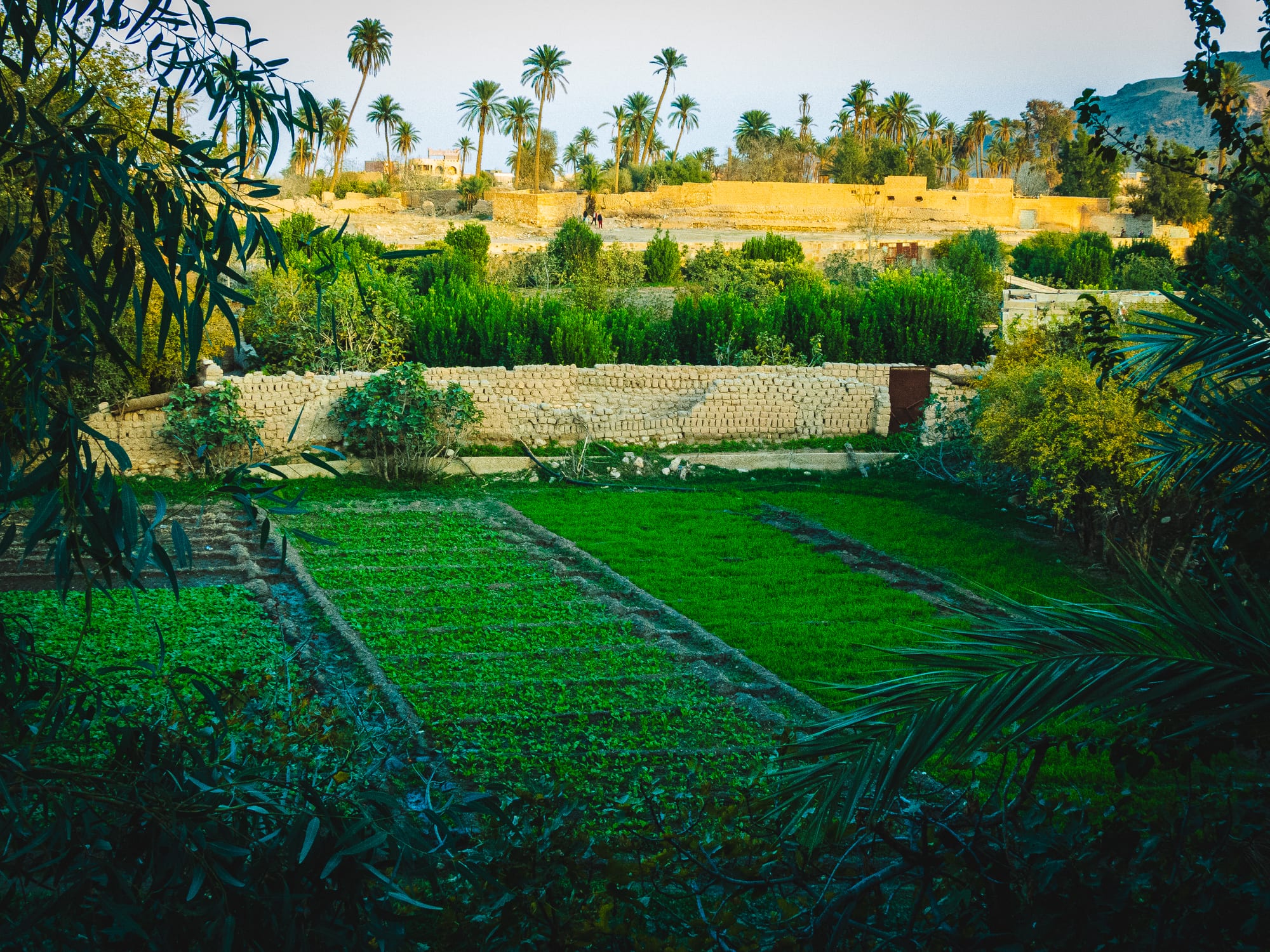
Green vegetable plots behind a low stone wall in an oasis garden, with date palms and sand-coloured houses on the slope beyond

The High Plateaus, Algeria

Bou Saâda

Irrigated garden plots and date palms in the oasis of Bou Saâda, with the old town on the rise behind. (BessenouciIslem / Wikimedia Commons · CC BY-SA 4.0)

An oasis town in the Hodna basin where the steppe of the High Plateaus meets the first sand of the Sahara. Its name means 'place of happiness', and its palm gardens, mud-brick old quarter and nearby dunes drew French Orientalist painters from the 1880s, above all Étienne Dinet, who converted to Islam, lived in the town and is buried there.

Neighbourhoods

  • The old ksar
    • Historic district
    • Photography

    The original town on the rise above the wadi, a dense block of mud-brick and stone houses, blind alleys and small mosques. Parts are decayed and parts still lived in, and the lanes open suddenly onto views of the palm gardens below.

    Open in Maps
  • The colonial centre
    • First-time visitors
    • Cafés and shops

    The quarter laid out under French rule around straight streets and a market square, where the hotels, banks, cafés and shops are. The museum devoted to the painter Étienne Dinet stands at its edge, near the old mill on the wadi.

    Open in Maps
  • The palm gardens along the wadi
    • Gardens
    • Quiet and residential

    Walled plots of date palms, pomegranates and vegetables watered from the Oued Bou Saâda, threaded by paths and irrigation channels. Families keep small houses among them, and the gardens stay several degrees cooler than the streets.

    Open in Maps
  • The newer districts and the dune road
    • Quiet and residential
    • Desert scenery

    Flats, schools and workshops spread north and east of the old town along the roads towards M'Sila and Biskra. Beyond the last houses the ground turns to stone desert and, a short way out, to the sand that marks the beginning of the Sahara.

    Open in Maps

Things to do

In the town

  • Nasreddine Dinet National Public Museummuseum

    The national museum in the house of the French painter Étienne Dinet, who took the name Nasreddine after converting to Islam and spent much of each year in the town from 1903; it opened to the public in 1993, and his domed tomb stands nearby.

    Open in Maps
  • The old ksarneighborhood

    The mud-brick old town above the wadi, a maze of covered lanes, courtyards and small mosques that was the whole of Bou Saâda before the French arrived.

    Open in Maps
  • The Ferrero milllandmark

    A 19th-century water mill on the Oued Bou Saâda built by a settler family, standing where the stream drops below the old town.

    Open in Maps
  • The palm grove and the wadipark

    Gardens of date palms and fruit trees along the watercourse below the town, cut by irrigation channels and small waterfalls after rain.

    Open in Maps

Desert and oasis around the town

  • El Hamelattraction

    A village about 12 kilometres south-west of Bou Saâda built around a large Rahmaniya Sufi zawiya founded in the 19th century by Sidi Mohammed Ben Belkacem, long a centre of religious teaching in the region.

    Open in Maps
  • The dunes east of the townviewpoint

    Low sand dunes a short drive out along the Biskra road, the nearest true Saharan landscape to the town and a traditional spot for sunset.

    Open in Maps

Short trips from the town

  • Kalâa of Beni Hammadlandmark

    The ruined first capital of the Hammadid dynasty, built in 1007 in the Hodna mountains north-east of M'Sila, where a 25-metre minaret is all that remains of its great mosque; a UNESCO World Heritage Site since 1980.

    Open in Maps
  • Chott El Hodnaattraction

    A large seasonal salt lake in the basin north-east of Bou Saâda, white and dry for much of the year and a feeding ground for waterbirds when it floods.

    Open in Maps
  • M'Silaattraction

    The provincial capital on the Hodna plain, a market and university town and the administrative centre for the region.

    Open in Maps
  • Djelfaattraction

    The largest town of the steppe to the south-west, surrounded by grazing land, the Senalba pine forests and prehistoric rock engraving sites.

    Open in Maps

Seasonal events

  • Spring on the steppeMarch and April

    Rain turns the steppe briefly green, and desert truffles dug on the plain are sold at the roadside and cooked with meat.

  • The weeks before Eid al-Adhavaries with the lunar calendar

    The livestock markets are at their busiest as herders bring sheep in from the surrounding steppe, and the town fills with buyers.

  • Ramadan eveningsvaries with the lunar calendar

    Cafés and restaurants stay shut through the day and the town comes to life after sunset, when the main street and the market are busy late.

Eat and drink

Long-standing places and food districts in Bou Saâda. Hours, ratings and directions come from your maps app, always current.

Bou Saâda classics

  • Grill-houses around the centrerestaurant

    Small restaurants serving skewers of lamb and liver, chorba, couscous with mutton and, in the right season, méchoui roasted over embers.

    Open in Maps
  • Zviti kitchensrestaurant

    Zviti, a fiery paste of roasted hot pepper and crumbled flatbread pounded in a wooden mortar and eaten with olive oil, is the dish the town is known for across Algeria.

    Open in Maps

Market and gardens

  • The town marketmarket

    Dates, olives, pomegranates and vegetables from the oasis gardens, alongside wool, rugs and the local bousaadi knives.

    Open in Maps
  • Café terraces on the main streetcafe

    Mint tea and strong coffee served on the pavement in the colonial-era centre, busiest in the cool hours after sunset.

    Open in Maps

Experience Bou Saâda

History

Bou Saâda grew where a permanent stream leaves the Ouled Naïl mountains and waters a palm grove at the edge of the Hodna basin, the last dependable water before the desert. A settlement of gardens and a fortified ksar had formed by the medieval period, and the town lived on the exchange between two worlds: grain, dates and fruit from the oasis against wool, meat and hides from the nomadic tribes of the steppe. Its name, understood as 'place of happiness', belongs to that role as a halt on the caravan roads between the Tell and the Sahara.

French forces occupied the town in 1849, during the campaign that pushed the army south through the plateaus, and Bou Saâda became a garrison post and the seat of a military administration overseeing the tribes of the Ouled Naïl. A new quarter of straight streets, barracks and a market square was laid out below the ksar, and a settler-built mill was put up on the wadi.

From the 1880s the town became a destination for European painters and writers drawn by the light, the gardens and the desert beginning just beyond. Étienne Dinet first came in 1884, bought a house in the town in 1903 and spent three quarters of each year there, converted to Islam, took the name Nasreddine and was buried in Bou Saâda after his death in 1929; his work made Bou Saâda one of the best-known names in Orientalist painting. Since independence the town has grown outwards with housing and light industry while the old ksar has been steadily emptied.

Culture & Customs

Bou Saâda sits in the country of the Ouled Naïl, a large Arab-Bedouin confederation whose name the mountains behind the town carry, and the culture is that of the steppe: unhurried greetings, strong obligations of hospitality, and poetry recited and sung to the gasba reed flute and the bendir drum. Saints'-day gatherings, the waadas, bring families in from the surrounding country for communal meals, and fantasia displays of charging horsemen firing powder rifles are staged at weddings and festivals.

The town's second identity is artistic. Dinet's paintings of Bou Saâda's streets, gardens and festivals hang in museums in France and Algeria, and the museum and tomb keep his memory locally; other painters followed him, and the town still appears in Algerian writing as shorthand for the oasis on the desert's edge. That reputation has always sat awkwardly beside the realities of colonial-era tourism, including the trade in images of Ouled Naïl women that circulated in Europe on postcards.

Craft is the other continuity. Bou Saâda is known across Algeria for the bousaadi, a slim, curved-handled knife made by local smiths, and for knotted woollen rugs, palm-fibre work and the white burnous cloaks worn by older men. Religion has a strong local focus in the Sufi zawiya at El Hamel, a few kilometres away, which has drawn students and pilgrims since the 19th century.

Daily Life

About 126,000 people lived in Bou Saâda at the 2008 census, which makes it the second most populous commune of M'Sila province after M'Sila itself. The population grew quickly through the later 20th century as families from the steppe settled, and the newer districts of flats and low villas now cover far more ground than the old ksar.

Work is in trade, administration, building, small workshops and the oasis gardens, which still produce dates, pomegranates, figs and vegetables from plots watered by channels from the wadi. Sheep matter as much: the surrounding steppe is grazing country, livestock markets serve herders from a wide area, and the weeks before Eid al-Adha are the busiest of the trading year. Knife-making, rug-weaving and leather work continue on a small scale, partly for visitors from elsewhere in Algeria.

Life is organised around the heat. Shops open early, close through the middle of the day in summer and reopen in the evening, when the main street and the café terraces fill and the gardens are watered. Water supply, drought and the slow advance of sand are constant worries, and the emptying of the old ksar — where mud-brick houses collapse when they are no longer maintained — is a recurring local issue. Young people leave for Algiers or the coast for study and work, and return for family occasions.

Food

The dish most associated with Bou Saâda is zviti: roasted hot green peppers, garlic and salt pounded in a wooden mortar with crumbled flatbread and olive oil into a fiery paste eaten straight from the bowl, usually with more bread and a glass of buttermilk to cool it. It is a herders' dish in origin, quick, cheap and hot enough to be a point of local pride.

Around it is the cooking of the steppe. Couscous, steamed and served with mutton and a thin vegetable stew, is the Friday and family dish; méchoui, a whole lamb roasted slowly over embers or in a pit, marks celebrations; chorba with cracked wheat and chakhchoukha, torn flatbread in a spiced mutton sauce, appear in homes and small restaurants. Bread is baked as flat rounds at home or in the neighbourhood ovens, and grilled skewers of lamb and liver are the standby of the town's eating places.

The oasis supplies the sweet side: dates eaten plain or with lben, the salted buttermilk, and worked into rfiss, a crumble of semolina or bread with dates and butter, and into makroud, the fried semolina cakes filled with date paste and dipped in honey. After the spring rains, desert truffles dug on the steppe, the terfas, are sold at the roadside and cooked in sauce with meat. Strong green tea with mint accompanies all of it.

Planning tools

Budget

Bou Saâda is cheap, but the choice of hotels is small and concentrated in the centre. Most costs are food, a room and the car or shared taxi needed to reach the sites around the Hodna. Algeria runs largely on cash and the gap between the official and unofficial exchange rates affects the total more than anything else.

Daily Budget Midrange
USD 75–150 (best hotel in town, restaurant meals, a car with driver between the oases)
Daily Budget Shoestring
USD 30–55 (basic hotel, café food, shared taxis)

Bring clean euro notes to change, and agree a day rate with a driver if visiting the Kalâa of Beni Hammad or the dunes.

Best Time to Visit

October to April. Autumn and spring are warm and dry, with the steppe briefly green after rain in March and April, and winter days are mild though nights are cold. Summer is punishing, with long, dusty afternoons when the town shuts down between about noon and five.

Suggested Number of Days

The oasis, the old town and the museum fill a day. Two or three allow the Hodna basin, the Hammadid ruins and the dunes as well, all of which need a car; the heat shortens what is comfortable in summer.

First Visit
1 day
With Surroundings
2–3 days

Transportation

Everything in the town is within walking distance or a short taxi ride, and shared taxis and small buses run to M'Sila, Sidi Aïssa and the surrounding villages. Sites out on the steppe are reached by hired car with a driver, arranged through a hotel.

Fix the fare before setting off, carry identification for checkpoints, and avoid driving on the steppe roads after dark.

Airport & Station Connections

There is a small airport north of the town, but no railway station, and almost everyone arrives by road. Coaches and shared long-distance taxis run from Algiers, which takes about four hours, and from M'Sila, Djelfa and Biskra; the busiest airports within reach are Biskra and those of the larger cities to the north.

Walkability

The town is small and flat in the centre, and the old ksar, the market and the gardens along the wadi can all be walked in a morning, though the lanes of the old quarter are steep and uneven in places. Walking is comfortable only early and late in the day from May to September, and shade outside the palm gardens is limited.

Safety

Bou Saâda is a quiet town where foreign visitors are rare and generally met with curiosity and hospitality. The practical risks are the heat, flash floods in the wadi after storms, road accidents on the steppe highways and occasional sandstorms. Police checkpoints are routine on the roads in and out, and photographing police or official buildings is not permitted.

Carry water and identification, travel between towns in daylight, and ask before photographing people, especially women. Most governments advise against all travel to the border regions with Mali, Niger, Libya, and Mauritania, and to parts of the Saharan interior, citing terrorism and kidnapping risk. Check current official travel advice before travelling.

Climate

A dry steppe climate on the edge of the desert, with a wide gap between day and night. Rain is scarce and usually arrives in short storms that can flood the wadi. Sand and dust blow in on the wind in spring.

Summer
hot and very dry, commonly 35–40°C in July and August, with cooler nights than in the towns further south
Winter
mild days of 14–18°C with cold nights that can fall to freezing

Local Customs

This is a conservative small town and dress that covers shoulders and knees is expected. Greetings are unhurried and hospitality is a duty: tea, coffee or dates are offered before anything is discussed. Friday is the day of communal prayer, and during Ramadan cafés and restaurants stay shut until sunset, after which the town is busy late into the night.

Ask before photographing people or the interior of the zawiya at El Hamel; tipping is not obligatory but small change is welcome; alcohol has no place in public life here.

Common Payment Methods

The currency is the Algerian dinar and nearly everything is paid in cash. Foreign cards are accepted in very few places and ATMs that take them are scarce, so travellers change euros or US dollars. Food prices in the market are fixed; rugs, knives and crafts are bargained.