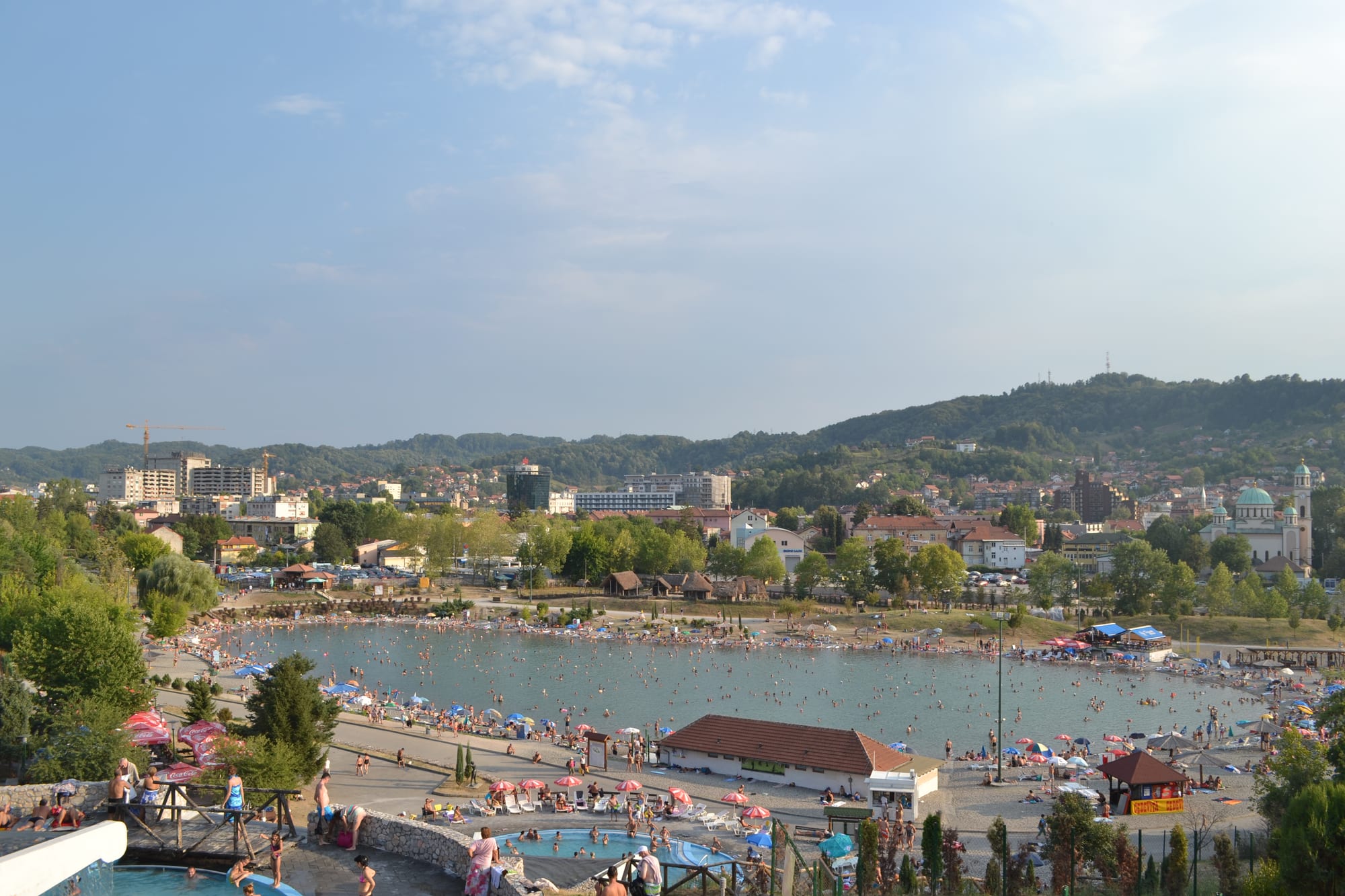
Crowds of swimmers and parasols around a large pale-blue lake, with city buildings, a domed church and green hills behind

Tuzla & the Northeast, Bosnia and Herzegovina

Tuzla

A summer day at Panonsko Lake, the first of the salt-water lakes in the centre of Tuzla. (Edinwiki / Wikimedia Commons · CC BY-SA 3.0)

The third-largest city in Bosnia and Herzegovina and the centre of the north-east, in the Jala valley below the Majevica hills. Built on salt — its name means salt mine in Ottoman Turkish — and later on coal, it is a working, university and industrial city known for keeping its mixed character through the war, with salt-water bathing lakes in its centre.

Neighbourhoods

  • Old town and Trg slobode
    • First-time visitors
    • Cafés
    • Historic district

    The pedestrian heart of the city around Trg slobode, the main square. Mosques, the Salt Square and the Kapija memorial lie within a few minutes' walk, in a centre where salt extraction has made parts of the ground sink.

    Open in Maps
  • The Pannonian Lakes
    • Swimming
    • Families
    • Summer

    The salt-water lakes, beaches, slides and replica Neolithic lake dwellings laid out in the centre since 2003, which fill with bathers in July and August. The area is a short walk from the old town.

    Open in Maps
  • Solina
    • Local life
    • Industrial heritage

    The north-eastern part of the city, named after the salt deposits that lie beneath it.

    Open in Maps
  • Ilinčica, Kicelj and Gradina
    • Quiet and residential
    • Views

    The hills to the north and south of the central plain, where most of the city's residential districts climb above the valley floor.

    Open in Maps
  • Gornja Tuzla
    • Quiet
    • Local life

    Upper Tuzla, a separate small town east of the city within the same municipality, near Simin Han.

    Open in Maps

Things to do

City landmarks

  • Trg slobodelandmark

    The main square of the pedestrian old town.

    Open in Maps
  • Kapija memoriallandmark

    The memorial at the Kapija promenade, where a shell killed 71 people, most of them young, on 25 May 1995; many of the victims are buried together in a nearby park.

    Open in Maps
  • Turalibeg Mosquelandmark

    One of the city's Ottoman mosques, also called the Polish mosque, listed as a national monument.

    Open in Maps
  • Šarena Mosquelandmark

    The Behram-beg or 'colourful' mosque, another of the Ottoman mosques the national heritage commission lists among the city's most important historic buildings.

    Open in Maps

Salt and museums

  • Pannonian Lakespark

    Salt-water lakes created in the city centre from 2003, with a second lake and artificial waterfalls added in 2008 and a third with water slides in 2012, fed from the brine beneath the city.

    Open in Maps
  • Salt Squaremuseum

    Solni trg, an open-air museum opened in 2004 that tells the story of salt production in the city.

    Open in Maps
  • Eastern Bosnia Museummuseum

    Archaeological, ethnological, historical and art collections from the whole north-east of the country.

    Open in Maps
  • Ismet Mujezinović Gallerymuseum

    A gallery mainly devoted to the work of the painter Ismet Mujezinović, who came from Tuzla.

    Open in Maps

Theatre and sport

  • Tuzla National Theatreattraction

    The oldest theatre in the country, founded in 1898 under Austro-Hungarian rule and working continuously since 1944.

    Open in Maps
  • Tušanj City Stadiumattraction

    The stadium shared by the city's two football clubs, FK Sloboda and FK Tuzla City.

    Open in Maps

Short trips from the city

  • Srebrenik Fortresslandmark

    A clifftop medieval fortress near the town of Srebrenik, a national monument of Bosnia and Herzegovina.

    Open in Maps
  • Modrac Lakepark

    A large artificial lake near Lukavac, popular with anglers, with a few lakeside restaurants; pollution makes it unsuitable for swimming.

    Open in Maps
  • Gradačac Castlelandmark

    A fortified complex on a hill above Gradačac, with curtain walls around 18 metres high and a three-storey tower built between 1765 and 1821, the seat of Husein-kapetan Gradaščević.

    Open in Maps
  • Konjuhpark

    A forested mountain averaging about 1,000 metres, rising above Kladanj.

    Open in Maps
  • Srebrenica–Potočari Memoriallandmark

    The memorial and cemetery for the victims of the July 1995 genocide, opposite the former UN base at Potočari; visitors come quietly and respectfully.

    Open in Maps

Seasonal events

  • TKT festlate March

    A festival run by the city's cabaret theatre, Teatar Kabare, held each year since 2003.

  • Kapija commemoration25 May

    The city remembers the 71 people killed by the shell at Kapija in 1995.

  • Book festival and Meša Selimović awardJuly

    An annual book festival at which the Meša Selimović award is given for the best novel written in the languages of Bosnia and Herzegovina, Croatia, Serbia and Montenegro.

Eat and drink

Long-standing places and food districts in Tuzla. Hours, ratings and directions come from your maps app, always current.

Tuzla classics

  • Ćevapi grillsrestaurant

    Traditional Bosnian fast-food grills across the city serve ćevapi, prepared here differently from Sarajevo's, along with pljeskavica.

    Open in Maps
  • Bakeries and pita shopsrestaurant

    Burek with meat, sirnica with cheese and zeljanica with spinach, the everyday meal.

    Open in Maps

Cafés and bars

  • Old town caféscafe

    The old town is full of cafés and bars, with terraces on Trg slobode and the pedestrian streets around it.

    Open in Maps

Experience Tuzla

History

Tuzla is among the oldest continuously inhabited places in Europe. A rich Neolithic settlement stood here, and people have lived on the site continuously for more than 6,000 years. The Illyrian Breuci held the area before Rome, and the Byzantine emperor Constantine VII recorded a fort called Salines in 950. In the Middle Ages it was Soli, "salts", in the Bosnian kingdom; the Ottomans took the villages of Upper and Lower Soli around 1512 and ruled the area from Zvornik for nearly 400 years, giving the town its present name, from tuz, salt.

Austria-Hungary, arriving in 1878, built new salt works and factories in and around the town, and in 1920 the Husino uprising broke out. In the Second World War the town lay inside the Independent State of Croatia until the partisans freed it on 2 October 1943, one of the first liberated towns in Europe. After the war it grew into a major industrial and cultural centre, but salt extraction made parts of the centre sink, and few buildings older than the 20th century survive.

In 1990 Tuzla was the only municipality in the country where non-nationalist parties won, and through the war it was the only municipality not governed by SDA-led authorities. A withdrawing Yugoslav army column was ambushed in the city in May 1992, killing 54 soldiers, and on 25 May 1995 a shell fired from Serb positions on Ozren killed 71 people at the Kapija promenade. After Dayton the city hosted the headquarters of the US-led peacekeeping division. In February 2014 protests that began here spread across the country, and the canton government building was set on fire.

Culture & Customs

Tuzla is known as one of the most multicultural cities in the country, and is proud of having kept its pluralist character through the war. The 2013 census counted about 73 per cent of its people as Bosniaks and 14 per cent as Croats, with smaller Serb and Jewish communities, and the Franciscan monastery of Saints Peter and Paul, an Orthodox cathedral that was untouched through the war and a renovated Jewish cemetery sit alongside many mosques.

The novelist Meša Selimović came from Tuzla, and a book festival each July presents an award in his name for the best novel in the region's shared language. The city's National Theatre, founded in 1898, is the oldest in the country, and Teatar Kabare runs its own festival every March. Kalesija, east of the city, is one of the homes of Bosnian roots music, sung to two violins and a šargija.

The Workers' Sports Society Sloboda, founded in 1927, was the city's first sporting organisation. The women's basketball team Jedinstvo Aida won the European Champions Cup with Razija Mujanović, later inducted into the FIBA Hall of Fame. Tuzla also likes records: in 2007 some 6,980 couples kissed at once in the city.

Daily Life

About 111,000 people lived in the municipality at the 2013 census, making Tuzla the third-largest city in the country. It is the seat of Tuzla Canton and the economic, educational and health centre of the north-east, with the public University of Tuzla, founded in 1958, and several private colleges. Most people live on the hills of Ilinčica, Kicelj and Gradina above the central plain, in suburbs spreading along the Jala valley, and in villages such as Husino and Simin Han.

The economy still rests on industry. Six coal mines operate in the city area, and most of their coal feeds the Tuzla Thermal Power Plant, the largest power station in the country; the salt works, chemicals at nearby Lukavac and a growing service sector, helped by salt-lake tourism, provide much of the rest.

The day runs from early shifts at the mines and plants to evening walks through the pedestrian old town and summer afternoons at the lakes. The canton government building burned in the 2014 protests was still under reconstruction in 2026, and the University of Tuzla, with about 16,500 students, keeps the centre lively in term time.

Food

The north-east eats like the Pannonian plain as well as like Bosnia. Grills turn out ćevapi and pljeskavica — the city's ćevapi are made differently from Sarajevo's — and bakeries sell burek and its cousins sirnica, with cheese, and zeljanica, with spinach. Restaurants serve sogan-dolma, onions stuffed with minced meat, and the classics found across Bosnia, from sarma to begova čorba, a "bey's soup" of chicken and vegetables.

Kajmak, a creamy dairy product similar to clotted cream, goes with the grilled meat and the flatbread, and stuffed peppers, grah, a bean soup, and ajvar are staples of Bosnian tables here as elsewhere. Sweets inspired by the Middle East, such as baklava and tufahija, a whole stewed apple stuffed with walnuts, finish the meal.

Salt, drawn from the deposits beneath the city since at least the Middle Ages, is a small point of local pride, and coffee is taken Bosnian-style everywhere, slowly, on the terraces of the old town.

Planning tools

Budget

Tuzla is cheaper than Sarajevo or Mostar, with few foreign tourists and prices set for local wages. Modest hotels and good cheap grills are the norm, the lakes charge only a small entry fee in summer, and the old town, museums and memorials cost little or nothing.

Daily Budget Midrange
USD 70–130 (mid-range hotel, restaurant meals, a hire car or taxis between towns)
Daily Budget Shoestring
USD 30–55 (guesthouse or hostel, bakery and grill meals, city buses)

Carry convertible marks for buses, bakeries and the lakes; card acceptance is patchy outside the main businesses.

Best Time to Visit

May, June and September are the most comfortable months. July and August are hot but are the season for the salt lakes, which draw more than 350,000 visitors a year. Winters are cold, with frost on many nights.

Suggested Number of Days

A day or two covers the city, longer in summer for the lakes. Allow three or four days to add the fortress towns of the north-east and a respectful visit to the Srebrenica memorial, which is best reached by car.

First Visit
1–2 days
With Surroundings
3–4 days

Transportation

The city has a well-organised, affordable network of buses and taxis, and the old town is pedestrian. There are no passenger trains; the nearest station with services is Doboj. Intercity buses run often to Sarajevo, in about three hours, and to Mostar, Belgrade, Croatia and beyond.

To travel to or from Banja Luka, change at Doboj.

Airport & Station Connections

Tuzla International Airport is at Dubrave, in the neighbouring municipality of Živinice, about 11 kilometres from the centre, with low-cost flights to Western Europe; local bus 11 links it to the city, and taxis are quicker. Most travellers arrive by bus from Sarajevo, Belgrade or Croatia.

Walkability

The old town, Trg slobode, the Salt Square, the Kapija memorial and the Pannonian Lakes are all close together on flat ground, and much of the centre is pedestrian. The residential districts climb the hills to either side.

Safety

Everyday crime is low and violent crime against tourists is rare; the main nuisances are pickpocketing in Sarajevo's tourist crowds and taxi overcharging — use marked, metered cabs or an app. The city itself is safe. Landmines laid in the war still remain in parts of the countryside, mainly near the lines between the country's two entities.

Stay on paved roads and well-used paths in the countryside, never enter ruined buildings or overgrown fields, and approach memorials quietly. Check current official travel advice before travelling.

Climate

A temperate climate with warm summers and cold winters. About 100 days a year pass 25°C, and thunderstorms are common in spring and summer.

Summer
warm, with about 36 days a year above 30°C; the record is 40.7°C
Winter
cold, with the temperature falling below 0°C on about 86 days a year, and about 15 days that stay below 0°C all day

Local Customs

Tuzla is regarded as one of the most multicultural cities in the country: most people are Bosniak, with a sizeable Croat Catholic community and smaller Serb and Jewish ones, and mosques, an Orthodox cathedral and a Franciscan monastery all serve the city. Coffee is taken slowly on café terraces. Dress modestly in places of worship.

Let locals raise the subject of the war rather than probing, and treat the Kapija memorial and cemeteries with obvious care.

Common Payment Methods

The currency is the convertible mark (KM, BAM), pegged to the euro. Cards work in hotels and larger shops and restaurants; cash is needed for buses, bakeries, grills and many cafés.