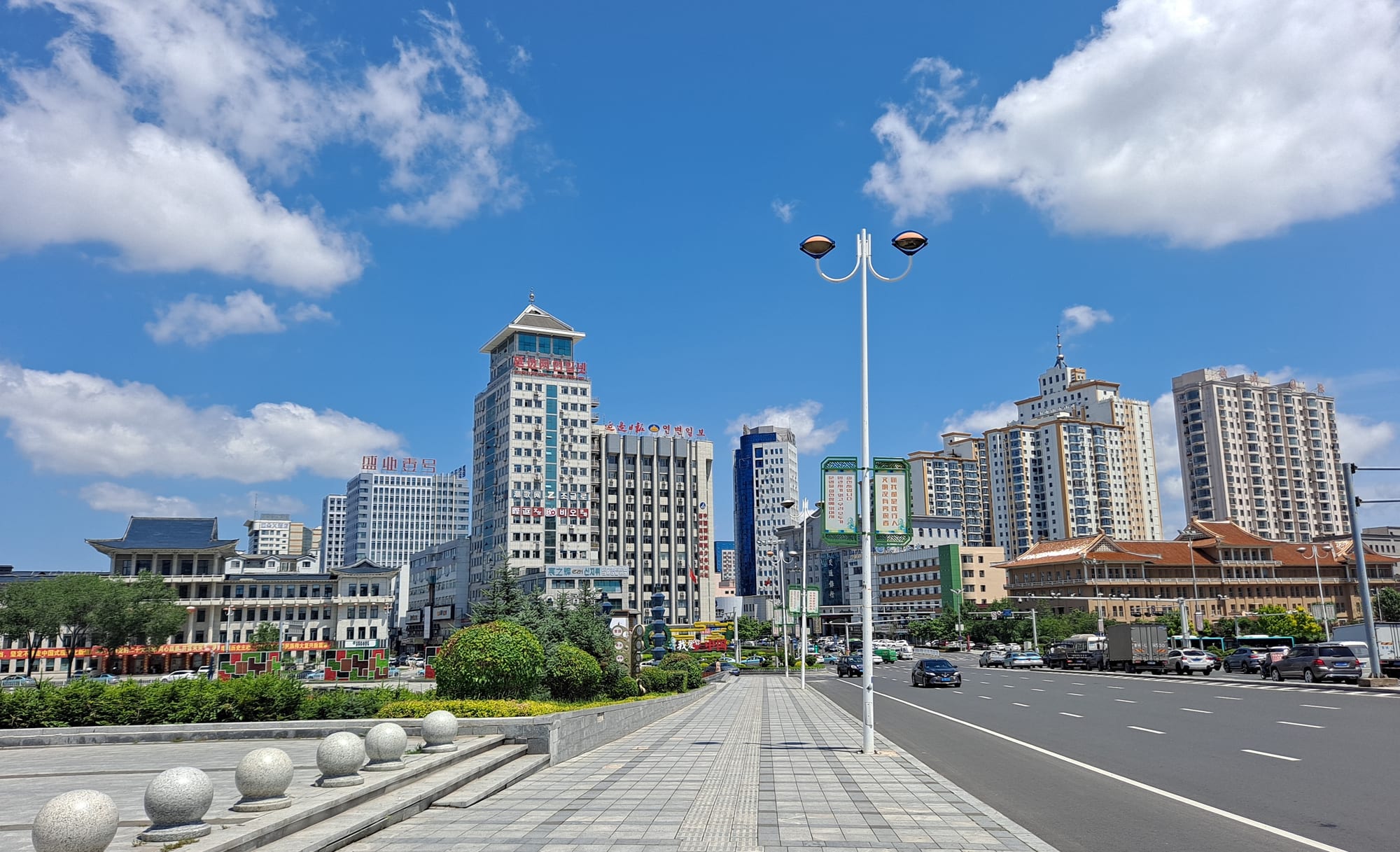
A wide city avenue in Yanji lined with mid-rise blocks and bilingual signs under a blue sky with white clouds

The Northeast (Dongbei), China

Yanji

A main avenue in central Yanji, the seat of the Yanbian Korean Autonomous Prefecture in Jilin province. (EditQ / Wikimedia Commons · CC BY-SA 4.0)

The seat of the Yanbian Korean Autonomous Prefecture in eastern Jilin, close to the borders with North Korea and Russia. Grown from a Korean farming settlement into a compact provincial city on the Buerhatong River, it keeps bilingual Korean and Chinese shop signs, Korean-language schools and a cold-noodle and barbecue culture, and serves as a common base for trips towards Changbai Mountain.

Neighbourhoods

  • The city centre
    • First-time visitors
    • Shopping
    • Close to public transport

    The commercial core north of the river, a grid of department stores, hotels, banks and restaurants along broad avenues. Almost every shopfront carries Korean script above or beside the Chinese, which is the first thing most visitors notice. Distances are short and buses and taxis are cheap.

    Open in Maps
  • The Buerhatong riverside
    • Walks
    • Evenings
    • Quiet and residential

    The river cuts through the middle of the city, with embankment paths, small parks and several bridges that are lit after dark. Residents walk, exercise and dance here on summer evenings, and the ice takes over in winter.

    Open in Maps
  • Around Yanbian University
    • Best for food
    • Students and nightlife
    • Local life

    The streets near the university in the north-west of the city are lined with cheap Korean and Chinese restaurants, barbecue houses, bakeries and bars. It is the busiest part of Yanji late in the evening during term.

    Open in Maps
  • The station and airport side
    • Close to public transport
    • Practical base

    Hotels cluster near the railway stations and along the roads towards the airport, a short ride from the centre. Convenient for early trains towards Changchun, Tumen and Hunchun, but plainer than the centre for eating and walking.

    Open in Maps

Things to do

In the city

  • Yanbian Universityattraction

    Founded in 1949, a comprehensive university teaching in both Korean and Chinese, with a campus in the north-west of the city that shapes the surrounding streets.

    Open in Maps
  • Yanji Chaoyangchuan International Airporttransit hub

    The prefecture's airport, a short drive west of the centre, with flights to Chinese cities and to South Korea.

    Open in Maps
  • Yanji West railway stationtransit hub

    The station west of the centre, on the railway that runs from Changchun and Jilin to Tumen and Hunchun, and the usual arrival point for visitors coming by rail.

    Open in Maps

Towns around Yanji

  • Longjingneighborhood

    A city just south-west of Yanji, on the Tumen opposite the North Korean town of Hoeryong, described as the birthplace of Korean-Chinese folk culture and home to a Korean folklore museum.

    Open in Maps
  • Helongneighborhood

    A quiet county-level city south-west of Yanji, in the farmland and hills of the upper Tumen valley below the Changbai range.

    Open in Maps

The border country

  • Tumenneighborhood

    A border town on the Tumen River east of Yanji, separated from Namyang in North Korea by the water, with a riverfront promenade whose restaurants look across the river.

    Open in Maps
  • Tumen Riverattraction

    The river that forms the boundary between China, North Korea and, at its mouth, Russia, running past a string of small towns east and south of Yanji.

    Open in Maps
  • Hunchunneighborhood

    A city of some 250,000 people near the junction of the Chinese, Russian and North Korean borders, with an observation platform at Fangchuan looking out over the meeting point.

    Open in Maps

Seasonal events

  • Spring Festival and Korean New Year customslate January or February

    The Lunar New Year is the main holiday, marked in Yanbian with Korean as well as Chinese customs, family meals and rice-cake dishes.

  • Prefecture founding anniversaryearly September

    The Yanbian Korean Autonomous Region was established on 3 September 1952 and redesignated a prefecture in 1955, and the date is marked locally with performances of Korean song and dance.

  • Autumn harvest and kimchi seasonOctober and November

    Households and restaurants put down cabbage for the winter, and markets fill with chillies, garlic and pickling jars.

Eat and drink

Long-standing places and food districts in Yanji. Hours, ratings and directions come from your maps app, always current.

Yanji classics

  • Yanji cold noodlesrestaurant

    Buckwheat noodles in chilled beef broth with slices of pear, cucumber, beef and half a boiled egg — a dish sold across China under the city's name and eaten here all year, not only in summer.

    Open in Maps
  • Korean barbecue housesrestaurant

    Tables with a grill in the middle, where beef, beef offal and marinated pork are cooked over charcoal and wrapped in lettuce leaves with garlic and bean paste.

    Open in Maps

Markets and food streets

  • The restaurant streets around Yanbian Universityneighborhood

    Small Korean and Chinese kitchens, barbecue places, bakeries and bars catering to students, and the easiest area to eat late.

    Open in Maps
  • Yanji's marketsmarket

    Covered and street markets sell kimchi and other pickles by weight, soybean paste, rice cakes, dried pollock and wild mushrooms and ginseng brought down from the mountains.

    Open in Maps

Experience Yanji

History

The land along the Tumen was long part of the Manchu homeland and was closed by the Qing to settlement, which left it thinly populated forest and farmland. From the 1860s famine and hardship in northern Korea pushed farmers across the river to clear fields on the Chinese bank, and the district they settled became known in Korean as Gando. The Qing eventually accepted the migrants and taxed them, and the Tumen was settled as the border while the Korean farmers stayed on the Chinese bank.

Yanji grew from one of those farming settlements into the administrative centre of the district, and Korean migration continued under Japanese colonial rule in Korea, so that the area came to hold the largest Korean population in China. The region was a centre of anti-Japanese guerrilla activity, and under the puppet state of Manchukuo Yanji became the seat of a province covering the border country.

After 1949 the new government recognised the Korean community as a national minority, and the Yanbian Korean Autonomous Region was established on 3 September 1952 with Yanji as its seat, becoming an autonomous prefecture in 1955; Yanbian University had opened three years earlier. Since China and South Korea established relations in 1992, a large share of Yanbian's Korean-Chinese have gone to South Korea or to southern Chinese cities to work, sending money home and leaving many villages emptied. Yanji, meanwhile, has grown, rebuilt its riverfront and gained a high-speed railway.

Culture & Customs

Yanji is the cultural capital of the Korean-Chinese, and bilingualism is written into daily life: by prefecture rules, signs carry Korean as well as Chinese, schools teach in Korean, and there are Korean-language newspapers, publishing and broadcasting. The result is a city that looks and sounds different from anywhere else in China, with Hangul over noodle shops and a hum of two languages in the markets.

The music and dance of the community are its most visible traditions. The farmers' dance of China's Korean ethnic group, performed with drums, gongs and the long ribbon twirled from a hat, is recognised by UNESCO as intangible cultural heritage, and the hourglass changgo drum, the gayageum zither and songs such as Arirang are taught and performed at festivals, weddings and anniversaries. Yanbian University and the prefecture's arts troupes keep the repertoire alive.

Everyday manners mix Korean and northern Chinese habits. Elders are deferred to and served first, meals are shared and noisy, and drinking is a social obligation at which refusing a toast needs an excuse. Football has an unusually strong following for a Chinese city of this size, and the prefecture has long fielded professional teams. South Korean television, pop music and fashion circulate here earlier and more freely than in much of the country, and the city's young people move easily between Korean and Mandarin pop culture.

Daily Life

Yanji is small by Chinese standards, a city of several hundred thousand people in a prefecture of about two million. Ethnic Koreans are a large share of both, though the proportion has fallen steadily as families move abroad for work or to bigger Chinese cities, and the population is ageing. Korean-Chinese, Han and Manchu residents live in the same blocks of flats rather than in separate quarters.

The economy is built on administration, education, health care, retail, transport and trade rather than heavy industry, with cross-border business through Hunchun and Tumen, a national cross-border e-commerce zone and a good deal of South Korean and Taiwanese investment. Tourism matters too, since Yanji is the transport hub for travellers heading towards the mountains and the border towns, and the city has hosted an annual travel fair since 1996. Remittances from relatives working in South Korea have paid for much of the city's new housing.

The rhythm of the year is set by the cold. Winter runs from November to March, with district heating on, thick coats, markets selling pickled cabbage by the tub, and evenings spent in barbecue restaurants and hot-stew houses. Summer turns the city outdoors: riverside squares fill with dancers and card players, and barbecue tables spill onto the pavements until late. Shrinking population and the pull of the coastal cities are the issues residents discuss most.

Food

Yanji's food is Korean cooking as it developed in north-east China, and the city's name travels with it. Yanji cold noodles — lengmian, the Korean naengmyeon — are buckwheat noodles in a chilled beef broth sharpened with vinegar, topped with pear, cucumber, thin beef and half an egg; restaurants across China advertise them as a Yanji dish, and here they are eaten in winter as well as summer.

Barbecue is the other pillar. Charcoal grills set into the table cook beef, marinated pork and, in the local style, beef offal, wrapped in lettuce with raw garlic and soybean paste. Around them come the pickles: kimchi in several forms, radish and cucumber versions, and salted greens, all sold loose by weight in the markets. Rice cakes, either pounded into chewy tteok or fried, appear as snacks and at New Year, and dishes of dried and shredded pollock are a regional favourite.

Northern Chinese food sits alongside it — dumplings, stews of pork and potato, and cumin-heavy skewers — and the two traditions meet in the beer-and-barbecue evenings that fill the streets in summer. Soju and rice wine are drunk with grilled meat, and Harbin beer is common. Breakfast may be soybean-paste soup with rice, or a bakery bun; markets also sell ginseng, wild mushrooms and pine nuts gathered in the forests towards Changbai.

Planning tools

Budget

Yanji is one of the cheaper cities in the north-east. Hotels, taxis and meals all cost less than in Shenyang or Dalian, and a bowl of cold noodles or a barbecue dinner is inexpensive. The costs that add up are excursions towards Changbai Mountain, which involve long transfers and park tickets, and rooms in the peak summer weeks.

Daily Budget Midrange
USD 80–140 (mid-range hotel, restaurant dinners, some taxis, day trips to the border towns)
Daily Budget Shoestring
USD 30–50 (guesthouse or budget hotel, noodle and canteen meals, buses and trains)

Barbecue and cold-noodle portions are large and meant to be shared, so a table of two rarely needs more than a few dishes.

Best Time to Visit

June to September is the comfortable season, with warm days, green hills and the easiest access to the mountains south-west of the city. September and early October bring clear air and autumn colour. Winter is long and severely cold, which suits travellers interested in snow, ice and hot Korean stews but makes sightseeing hard.

Suggested Number of Days

The city itself is small and a day or two covers it. Add two more days for the border country and for the long transfers involved in reaching the mountains, which are further away than the map suggests.

First Visit
1–2 days
With Surroundings
3–4 days

Transportation

Yanji is compact, with cheap city buses and taxis, and ride-hailing works as it does elsewhere in China. High-speed trains run west to Jilin, Changchun and on to Shenyang and Beijing, and east to Tumen and Hunchun; long-distance buses serve the smaller county towns. There is no metro.

Carry a passport for every train ticket and for hotel check-in, and allow extra time for station security.

Airport & Station Connections

Yanji Chaoyangchuan International Airport sits a few kilometres west of the centre and has flights to major Chinese cities and to South Korea. Most visitors arrive by high-speed train at Yanji West, roughly three to four hours from Shenyang and around two from Changchun; the older Yanji station handles slower services. Onward travel towards Changbai Mountain is by bus or hired car and takes several hours.

Walkability

The central grid is flat, wide and easy to walk, and the riverside paths link much of the city; most of what a visitor wants is within a couple of kilometres. Crossings on the main avenues are long, and pavements are icy for months in winter, when short taxi rides are the practical choice.

Safety

Crime is low and the city is quiet at night. The real hazards are the winter cold, icy pavements and heavy drinking at shared meals. The borders with North Korea and Russia are militarised and closely watched: the riverside towns are open to visitors, but approaching the boundary, crossing it or photographing guards and installations is not permitted.

Marked viewing areas are the only places to look across the river in the border towns, warm layers are essential from November to March, and a passport must be carried at all times. Check current official travel advice before travelling.

Climate

A cold continental climate with a short, warm, wet summer and a long, dry, very cold winter. Spring is brief and windy, autumn is the clearest season, and most rain falls in July and August.

Summer
warm and humid — August is the warmest month, averaging about 22°C, with most of the year's rain falling in July and August
Winter
severe — January averages about −13°C, with much colder nights and snow on the ground for months

Local Customs

Yanji is bilingual: shop signs, street names and public notices appear in Korean and Chinese, and Korean is widely spoken alongside Mandarin. Meals are shared from the middle of the table, and hosts are pressing with food and drink. Shoes come off in some Korean-style restaurants with floor seating. Tipping is not practised anywhere in China.

Politics and the situation across the border are sensitive subjects; avoid photographing soldiers, checkpoints and border installations, and ask before photographing people.

Common Payment Methods

The currency is the renminbi, its unit the yuan. Daily life runs on the mobile apps Alipay and WeChat Pay, which now allow foreign cards to be linked; foreign cards work in some hotels but rarely in small restaurants and markets, so setting up an app before arrival and carrying some cash is the safest combination. Bank ATMs in the centre accept international cards.