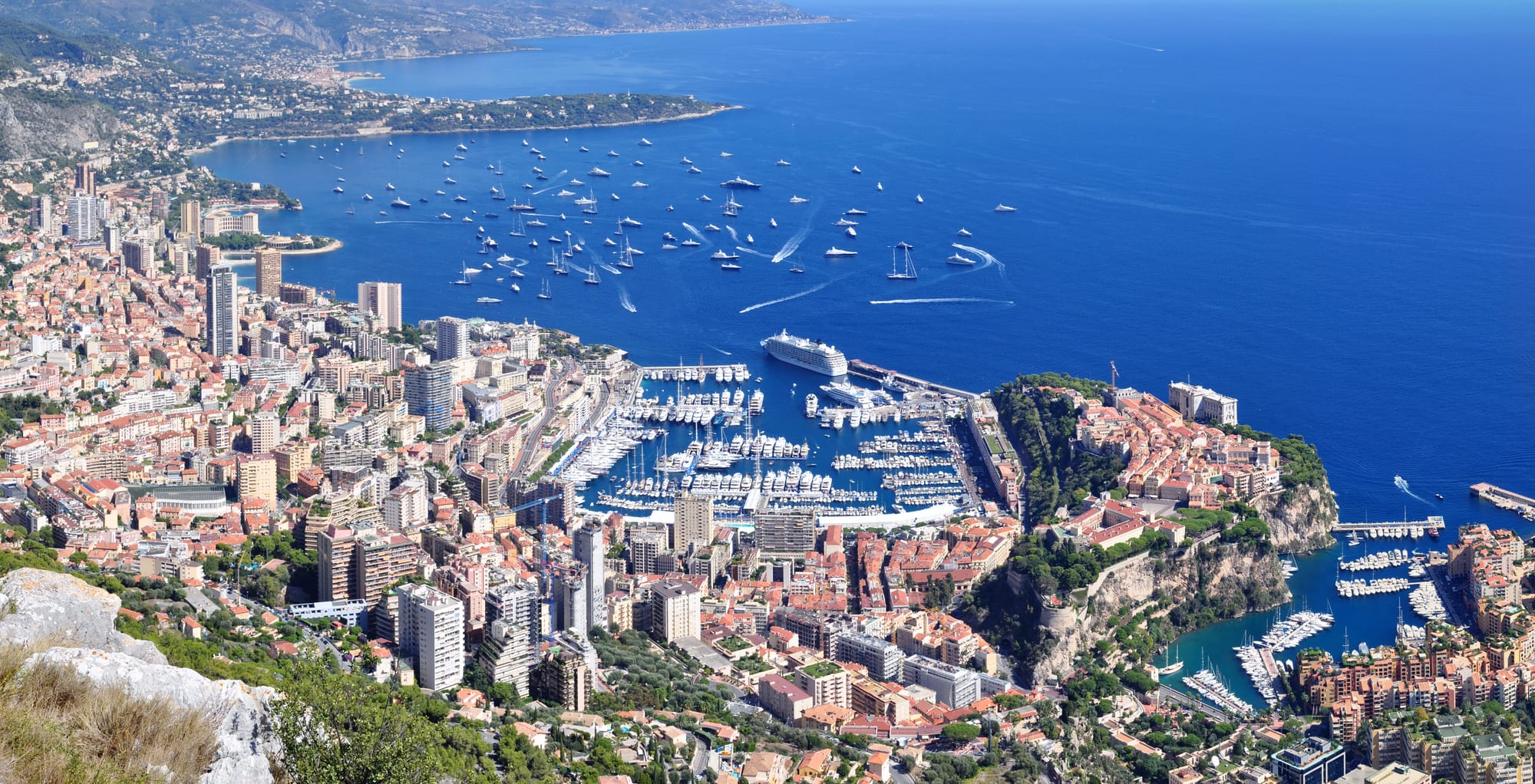
Monaco from the hills above: dense apartment blocks around a harbour full of yachts, the wooded rock of Monaco-Ville jutting into a deep blue sea

Monaco

Monaco

Monaco seen from the heights near La Turbie, with Port Hercules, the Rock and the Fontvieille harbour. (Tobi 87 / Wikimedia Commons · CC BY-SA 3.0)

A city-state of about two square kilometres on the French Riviera, packed between steep hills and the Mediterranean. The Grimaldi family has ruled the old fortress rock, with brief interruptions, since 1297; the casino opened at Monte Carlo in the 1860s turned a debt-laden principality into a tax haven of high-rise apartments, yacht harbours and a Grand Prix run through its streets.

Neighbourhoods

  • Monaco-Ville (the Rock)
    • First-time visitors
    • Historic district
    • Views

    The old city and seat of government on a rocky promontory jutting into the sea. Narrow lanes lead between the Prince's Palace, the cathedral and the Oceanographic Museum, and only local vehicles are allowed up to the Rock.

    Open in Maps
  • Monte Carlo
    • Nightlife
    • Casino and opera
    • Shopping

    The principal residential and resort quarter in the east and north-east, built around the casino and its gardens. It is the most populated quarter, with the opera house, the casino gardens and dense apartment towers on the hillside.

    Open in Maps
  • La Condamine
    • Best for food
    • Close to public transport
    • Harbour life

    The port quarter between the Rock and Monte Carlo, around Port Hercules, with the Rainier III Nautical Stadium and the Princess Antoinette Park. Its streets around the harbour form part of the Grand Prix circuit, and the Condamine Market has been held on the Place d'Armes since 1880.

    Open in Maps
  • Fontvieille
    • Quiet and residential
    • Parks
    • Families

    A district reclaimed from the sea in the 1970s on the far side of the Rock, with a second harbour for smaller boats, the Fontvieille Park and Princess Grace Rose Garden, and some light industry.

    Open in Maps
  • Larvotto and Le Portier
    • Beaches
    • Promenades

    The easternmost ward and the most populated, with Monaco's public beach, a new seafront esplanade, the Japanese Garden and the Grimaldi Forum. Le Portier, reclaimed from the sea and opened in 2024, has extended it.

    Open in Maps

Things to do

The Rock

  • Prince's Palace of Monacolandmark

    Built in 1191 as a Genoese fortress and home of the Grimaldis since the late 13th century, the official residence of the Sovereign Prince — a palace that had to stay fortified long after others turned to Renaissance and Baroque luxury.

    Open in Maps
  • Cathedral of Our Lady Immaculatelandmark

    Monaco's Catholic cathedral in Monaco-Ville, built on the site of the Cathedral of Saint Nicholas, which was demolished in 1874.

    Open in Maps
  • Oceanographic Museummuseum

    The museum of marine sciences of the Institut océanographique, inaugurated in 1910 by Prince Albert I, with collections of sea creatures, model ships and the laboratory from L'Hirondelle, the first of his research yachts.

    Open in Maps

Monte Carlo

  • Monte Carlo Casinolandmark

    The gambling and entertainment complex completed in 1863 and enlarged in 1878–79 to designs by Jules Dutrou and Charles Garnier, architect of the Paris opera; Monaco's own citizens are forbidden to enter its gaming rooms.

    Open in Maps
  • Opéra de Monte-Carloattraction

    The Salle Garnier, the opera house built into the casino and opened in 1879.

    Open in Maps
  • Japanese Gardenpark

    A small municipal garden commissioned by Prince Rainier III in 1994, beside the Grimaldi Forum, with a stylised mountain, waterfall, brook and Zen garden designed by Yasuo Beppu.

    Open in Maps
  • Larvotto beachbeach

    Monaco's main public beach in its easternmost ward, with a new esplanade added in recent works.

    Open in Maps
  • Villa Sauber and Villa Palomamuseum

    The two villas of the New National Museum of Monaco, showing two contemporary art exhibitions a year and holding a large collection relating to the painter Kees van Dongen.

    Open in Maps

The harbour and Fontvieille

  • Port Herculesattraction

    Monaco's only deep-water port, used since ancient times; the modern harbour, completed in 1926, can berth up to 700 vessels.

    Open in Maps
  • Sainte-Dévote Chapellandmark

    The chapel of Monaco's patron saint, first recorded in 1070, where princely brides lay their bouquets; its name is given to the first corner of the Grand Prix circuit.

    Open in Maps
  • Princess Grace Rose Gardenpark

    Two municipal parks with a combined area of 4 hectares in Fontvieille.

    Open in Maps

Short trips from the city

  • Èzeneighborhood

    A French seaside commune about 4.5 kilometres west of Monaco, on the way to Nice.

    Open in Maps
  • Trophy of Augustuslandmark

    A Roman victory monument of 7–6 BC at La Turbie, above Monaco, built to mark the subjection of the Alpine peoples under Augustus.

    Open in Maps
  • Mentonneighborhood

    The French town east of Monaco, acquired by the Grimaldis in 1346 and an exclave of the principality until 1860, reached by the coastal train or the 600 bus.

    Open in Maps

Seasonal events

  • International Circus Festival of Monte-CarloJanuary

    A circus competition created by Prince Rainier III in 1974, presided over by Princess Stéphanie, which awards the Golden Clown to the best acts.

  • Monte Carlo RallyJanuary

    The rally named after Monaco's motorsport association, run in the French Alps.

  • Monaco Grand Prixfirst weekend of June

    The Formula One race on the Circuit de Monaco through the principality's streets, held in late May until 2025 and on the first weekend of June from 2026.

  • Bread festival17 September

    An annual festival of bread held every year on 17 September.

  • Monaco Yacht ShowSeptember

    A superyacht show held every September at Port Hercules, with around 130 boats on display.

  • National Day19 November

    Monaco's national day, when barbagiuans are especially eaten.

Eat and drink

Long-standing places and food districts in Monaco. Hours, ratings and directions come from your maps app, always current.

Monaco classics

  • Barbagiuansrestaurant

    Fritters stuffed with Swiss chard, rice and ricotta among other fillings; the traditional Lenten dish of Monaco, now eaten all year round and especially on the national day, 19 November.

    Open in Maps
  • Stocafirestaurant

    The traditional Friday lunch of Monégasque families, the dernā.

    Open in Maps

Food districts and markets

  • La Condamineneighborhood

    The port quarter, with places to eat around the harbour and its streets.

    Open in Maps
  • Monaco-Villeneighborhood

    The old town on the Rock, with restaurants around the cathedral square.

    Open in Maps

Experience Monaco

History

Ancient writers knew the harbour here as Monoikos, a name linked to a temple of Heracles, which survives in Port Hercules. The rock above it became a Genoese fortress in 1191, and in 1297 Francesco Grimaldi, known as Malizia, captured it — according to legend by entering the fortress at night disguised as a Franciscan monk. The family was soon driven out, and the struggle for the Rock went on for another century. Between 1346 and 1355 Monaco took in Menton and Roquebrune, multiplying its territory almost tenfold, and from the 1640s the princes lived under French protection.

Revolutionary France annexed Monaco in 1793; after Napoleon's defeat it was placed under the Kingdom of Sardinia. Menton and Roquebrune, weary of Grimaldi taxation, broke away, and Charles III gave up his claim to them — some 95 per cent of his territory — with the Franco-Monégasque Treaty of 1861 recognising the principality's sovereignty. A casino was the answer to the lost revenue. A first gaming house opened in 1856, a new building on the Spelugues plateau was completed in 1863, François Blanc took over the business, and the district was renamed Monte Carlo. Profits were such that in 1869 Monaco stopped collecting income tax.

In the Second World War Monaco was occupied by Italy and then Germany, and Jews and resistance fighters were deported; in 2015 Albert II apologised for Monaco's part in this. Rainier III reigned from 1949 to 2005, married the actress Grace Kelly in 1956, amended the constitution in 1962 and faced Charles de Gaulle's blockade of 1963; Monaco joined the United Nations in 1993. Land reclaimed from the sea created Fontvieille in the 1970s and Le Portier, opened in 2024.

Culture & Customs

The principality's identity is bound up with the Grimaldis, whose home has been the palace on the Rock since the end of the 13th century, and with the Church: Saint Devota is the patron saint, and by tradition princely brides lay their bouquets at her chapel in the ravine below the Rock. The Cathedral of Our Lady Immaculate stands on the site of the old Saint Nicholas cathedral.

High culture arrived with the casino. The Salle Garnier opened inside it in 1879, and Les Ballets de Monte-Carlo and the Monte-Carlo Philharmonic Orchestra also perform at the Grimaldi Forum. Prince Rainier III founded the International Circus Festival in 1974, and Princess Stéphanie has presided over it since 2006. The sea is a princely tradition too: the Oceanographic Museum, the International Atomic Energy Agency's marine laboratories and one of the world's first protected marine habitats make Monaco a centre of marine research.

Sport is followed closely. The Grand Prix through the streets is the year's great spectacle, the Monte Carlo Rally carries the name of the local motorsports association, AS Monaco plays in the French Ligue 1 and has been French champion several times, and the basketball team plays in the EuroLeague. The principality also keeps an annual bread festival on 17 September.

Daily Life

About 38,400 people live in Monaco, on about 2.08 square kilometres since Le Portier was added in 2024 — the most densely populated country in the world and the second smallest after Vatican City. Fewer than 10,000 residents are Monégasque nationals; Larvotto is the most populated ward and Monte Carlo the most populated quarter.

Monaco is a tax haven, with no personal income tax except for French citizens and low business taxes, which shapes who lives here and why. It also faces scrutiny: in June 2024 the Financial Action Task Force placed Monaco under increased monitoring over money laundering and terrorist financing. The prince shares his veto power with the National Council; since the 2023 election all 24 seats on the National Council are held by the Monegasque National Union, and Christophe Mirmand has served as Minister of State since July 2025. Pope Leo XIV visited Monaco on 28 March 2026.

Many jobs require a solid knowledge of Italian as well as French, and English, German and Russian are also commonly heard. Everyday food shopping is done at open-air markets and at the supermarket in the Fontvieille shopping centre.

Food

Monégasque cooking emphasises fresh ingredients — seafood, vegetables and olive oil — and grew from a coast where the ancient Greeks introduced grapes and olives to a region already known for its lemons. Olive, lemon and orange trees are central to the traditional kitchen, along with almonds, chestnuts, anise, honey and orange blossom, and seasonal vegetables: asparagus in spring, courgettes and aubergines in summer, pumpkin in autumn. Raw vegetables may be served as crudités with a dip of anchovy paste mixed with garlic and olive oil.

Family meals keep old rules. Every Friday the traditional Monégasque lunch, the dernā, is stocafi. Barbagiuans were the traditional dish of Lent and are now eaten all year round, and on special days dishes such as roast kid and pasqualina, a chard pie, appear. Fougasse, a flatbread, was singled out by the writer Notari as an authentic national food, made in its traditional version with orange blossom, light brandy and local almonds. Freshly squeezed orange juice and coffee are popular drinks with a meal at home.

Planning tools

Budget

Monaco is among the most expensive places in Europe to stay, and most visitors come for the day from Nice or elsewhere on the Riviera by train or bus. Walking the Rock, the harbour and the public gardens costs nothing; the museums charge for entry.

Daily Budget Midrange
USD 400–950 to stay overnight (four-star hotel, restaurant meals, a drink by the harbour)
Daily Budget Shoestring
USD 30–70 as a day visitor (train or bus from Nice, a museum, a simple lunch, walking)

Staying in Nice or Menton and arriving by the coastal train or bus is far cheaper than a room in the principality.

Best Time to Visit

The climate is mild all year, with afternoons kept moderate by sea breezes. Late spring and early autumn are warm without the summer peak; the Grand Prix weekend, now the first weekend of June, fills the principality and raises prices sharply. January has the circus festival.

Suggested Number of Days

The principality is so small that one or two days cover it. Allow three or four to include the nearby Riviera towns and hill villages, which are a short train or bus ride away.

First Visit
1–2 days
With Surroundings
3–4 days

Transportation

Monaco is small enough to cross on foot, though it is steep, and city buses link the quarters, with real-time displays at most stops. The railway runs underground through the principality, and the regional 600 bus runs along the coast to Nice and Menton.

Ride-hailing apps work from nearby French towns; within Monaco, walking and the buses are the simplest ways around.

Airport & Station Connections

Nice Côte d'Azur Airport, the nearest airport, serves Monaco, linked by the express bus route 80 and by helicopter to the Monaco Heliport. SNCF trains on the coastal line between Cannes and Ventimiglia stop at the underground Monaco–Monte-Carlo station, with occasional high-speed services to Paris. Borders with France are open.

Walkability

Very walkable but hilly: the city climbs from the harbour up steep slopes, and walks between the Rock, the harbour and Monte Carlo involve stairs and climbs. A seaside path of about 3 kilometres from Cap d'Ail in France is a pleasant way to arrive on foot, though it can be closed in bad weather.

Safety

Monaco is among the safest places in the world, with a very large police presence and near-total CCTV coverage. The main risks for visitors are crowds during the Grand Prix and other big events, and steep streets and stairs.

Watch bags in event crowds and expect closed roads during the Grand Prix. Check current official travel advice before travelling.

Climate

A hot-summer Mediterranean climate with strong sea influence. Summer afternoons rarely pass 30°C thanks to constant sea breezes, but nights can be warm and humid; winters are mild, and snow is rare, though it fell in February 2018.

Summer
warm — August averages about 24°C across day and night, and summer temperatures generally stay above 20°C
Winter
mild — January averages about 10°C across day and night

Local Customs

French is the official language, and Italian and Monégasque are also widely spoken and understood; English is widely understood because of the many international visitors. Monaco is Catholic by tradition, with Saint Devota as its patron saint. Monégasque citizens, fewer than 10,000 of the residents, are barred from the casino's gaming rooms.

Dress modestly in the cathedral and chapels, and keep voices down during services.

Common Payment Methods

The currency is the euro. Bus tickets can be bought on board or from machines at the stops.