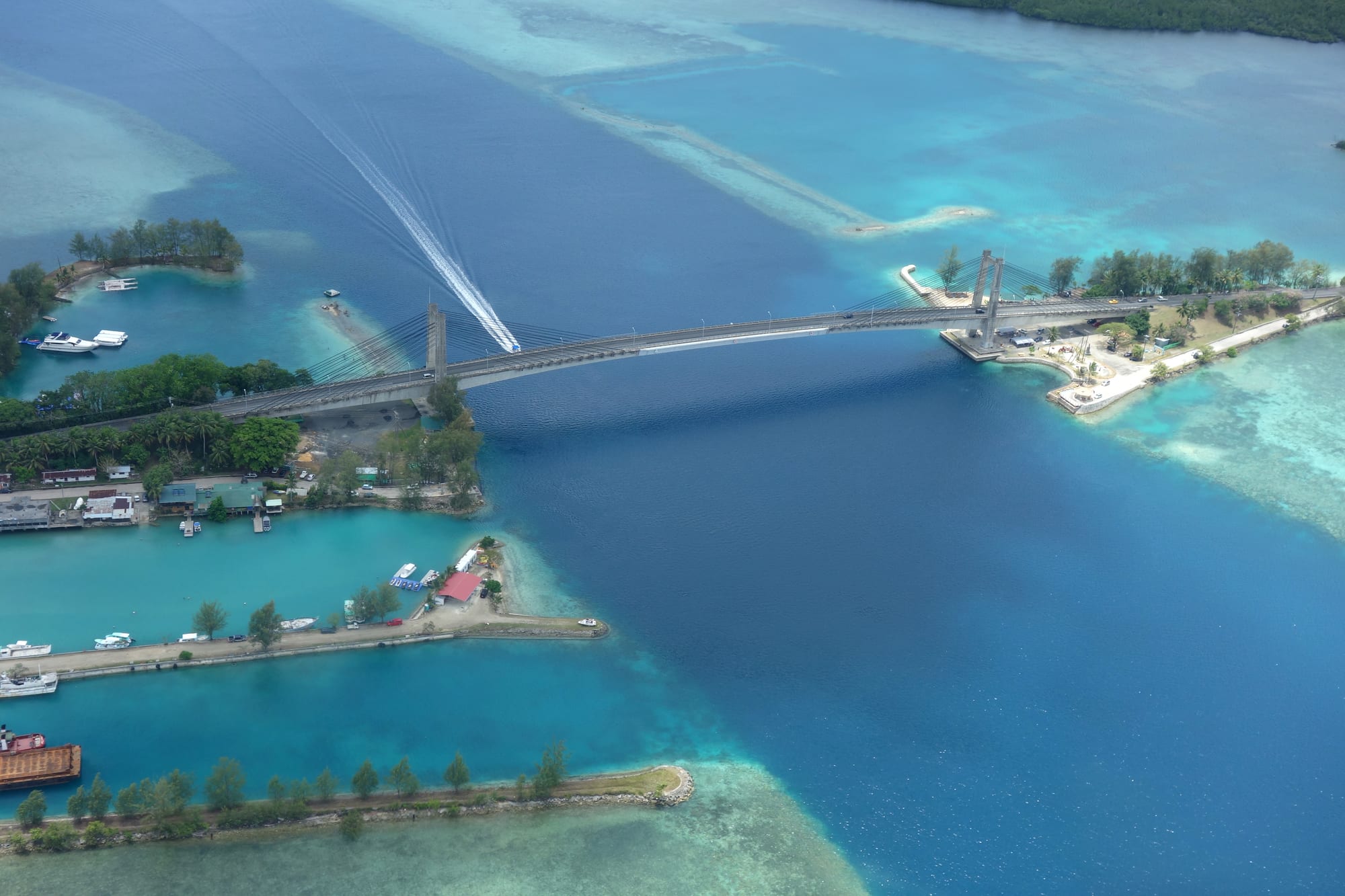
Aerial view of a long cable-stayed bridge crossing a deep blue channel between two green islands, with jetties, boats and pale reef flats on either side

Palau

Koror

The Koror–Babeldaob Bridge crossing the channel from Koror to Babeldaob, above the reefs and boat jetties of the town's waterfront. (Luka Peternel / Wikimedia Commons · CC BY-SA 4.0)

Palau's largest town and its commercial centre, spread over Koror Island and the islands linked to it by causeways and a bridge. Capital of Japan's South Seas Mandate before 1944 and of Palau until 2006, it is now a low-rise town of shops, dive operators and government offices at the edge of the Rock Islands lagoon.

Neighbourhoods

  • Central Koror
    • First-time visitors
    • Best for food
    • Shops

    The main street and the blocks around it hold the shops, banks, government offices, hotels and most of the restaurants, in low concrete buildings along a ridge above the water. Nearly everything a visitor needs is within a mile, and the Belau National Museum stands at the western end.

    Open in Maps
  • Malakal Island
    • Diving
    • Close to the harbour

    The working end of town, joined to Koror by a causeway — the commercial port, fuel tanks, boatyards, dive shops and liveaboard berths, along with a cluster of waterfront restaurants. Most boats to the Rock Islands leave from here.

    Open in Maps
  • Ngerekebesang and Meyuns
    • Quiet and residential
    • Local life

    A hilly island north-west of central Koror, reached by causeway, with the village of Meyuns, residential lanes, a school and a hospital, and quiet shoreline roads.

    Open in Maps
  • Ngerbeched and the eastern hamlets
    • Quiet and residential

    Residential hamlets strung along the road east towards the bridge to Babeldaob, with family houses on garden plots, churches, small shops and views over the lagoon — the part of Koror where most people actually live.

    Open in Maps

Things to do

Museums and the town

  • Belau National Museummuseum

    Palau's national museum, founded in 1955 and the oldest in Micronesia, with collections on clan society, navigation, the colonial eras and the war, and a full-size painted bai, or chiefs' meeting house, in its grounds.

    Open in Maps
  • Palau International Coral Reef Centermuseum

    A coral reef research centre in Koror with a public aquarium showing the country's reef and lagoon habitats.

    Open in Maps
  • Etpison Museummuseum

    A privately founded museum in Koror holding Palauan and wider Micronesian artefacts, traditional money, historical photographs and a large collection of model bai.

    Open in Maps

The lagoon and the Rock Islands

  • Rock Islands Southern Lagoonattraction

    The UNESCO World Heritage Site of hundreds of undercut limestone islets, marine lakes, sandbars and coral gardens that begins a short boat ride south of the town.

    Open in Maps
  • Jellyfish Lakeattraction

    A marine lake on the island of Eil Malk where snorkellers can swim among golden jellyfish that have lost most of their sting; numbers fluctuate with drought cycles and a permit is required.

    Open in Maps
  • Ngerekebesang shorelineneighborhood

    The causeway and coast roads around the island give easy walking or cycling beside the water, with jetties, mangrove edges and views of the reef.

    Open in Maps

Diving and snorkelling

  • Blue Cornerattraction

    A current-swept corner of the barrier reef close to German Channel, described as the most requested dive in Palau, where divers hold position in the current to watch sharks and schooling fish pass.

    Open in Maps
  • German Channelattraction

    A channel dug through the barrier reef by the German administration around the end of 1908, to shorten the route from the phosphate mines on Angaur, and now one of Palau's best-known dive sites.

    Open in Maps

Short trips from the town

  • Peleliuattraction

    The island about 30 miles south, reached by boat or a short flight, where the 1944 battlefield of bunkers, guns and tanks lies in regrown jungle.

    Open in Maps
  • Ngerulmudlandmark

    Palau's purpose-built capital in the hills of Babeldaob, a domed capitol complex standing almost alone about 15 miles from Koror.

    Open in Maps
  • Ngardmau Waterfallattraction

    A large waterfall in the hills of Ngardmau, on the north-west side of Babeldaob, reached by a jungle track through country once strip-mined.

    Open in Maps
  • The Ngarchelong stone monolithslandmark

    Rows of ancient stone monoliths on a grassy hillside in Ngarchelong, at the northern end of Babeldaob, raised long before European contact and mysterious in origin.

    Open in Maps

Seasonal events

  • Independence DayOctober

    Palau's national day, marking the Compact of Free Association taking effect in 1994, with ceremonies, sport, dancing and food in Koror.

  • Constitution Dayannually

    A public holiday for the adoption of Palau's constitution, the world's first to be nuclear-free, marked with official events and family gatherings.

  • Customary celebrationsthrough the year

    First-birthday ceremonies, house-warmings, funerals and title ceremonies bring clans together with large exchanges of food, cash and traditional money; visitors may see processions and gatherings but these are family occasions.

Eat and drink

Long-standing places and food districts in Koror. Hours, ratings and directions come from your maps app, always current.

Koror classics

  • Central Koror restaurantsneighborhood

    The town's main street and side roads carry Palauan, Japanese, Filipino, Chinese, Korean and American kitchens, from sashimi counters to rice-and-fish plate lunches, within walking distance of the hotels.

    Open in Maps
  • Malakal waterfront eateriesneighborhood

    Restaurants and bars beside the port and the dive docks, where boat crews and divers eat grilled reef fish, sashimi and mangrove crab at the end of the day.

    Open in Maps

Markets and local food

  • Koror food markets and shopsmarket

    Shops and roadside stalls selling taro and cassava, bananas, coconuts, reef fish and betel nut, alongside the imported groceries that fill most of the shelves.

    Open in Maps
  • Fish and crab from the boatsmarket

    Fishermen and small dealers sell the day's reef and pelagic catch and live mangrove crab near the harbours, the freshest food in town.

    Open in Maps

Experience Koror

History

Koror was a powerful village long before it was a town. Its high chief, the Ibedul, was among the most powerful of Palau's traditional chiefs, and the island's position among the reefs made it a centre of canoe traffic and exchange. British ships began calling in the late eighteenth century after the East India Company packet Antelope was wrecked on Ulong in 1783; the Ibedul's son Lee Boo sailed to England with the survivors and died there of smallpox soon after arriving.

Spain claimed Palau and sold it to Germany in 1899, and Japan took the islands in the First World War. Koror was then rebuilt as the administrative capital of the whole South Seas Mandate, an ordered colonial town with offices, schools, a hospital, shops, a shrine and thousands of Japanese and Okinawan residents who outnumbered Palauans. American bombing in 1944 destroyed much of it, and the Japanese garrison was left isolated until the surrender.

After the war the United States administered Palau from Koror as part of the Trust Territory of the Pacific Islands, and the town remained the capital through the long, contested negotiations that led to the Compact of Free Association in 1994. The bridge to Babeldaob, first built in the 1970s, collapsed in September 1996, cutting the town off from the airport and its water supply; a replacement funded by Japan opened in 2002. The capital moved to Ngerulmud on Babeldaob in 2006, but Koror kept the population, the port, the shops and the dive industry that now underpins it.

Culture & Customs

Koror is where Palau's customary order meets its modern state. Clans are matrilineal: land, titles and the beads and bars of traditional money pass through women, and senior women choose and can remove the chiefs who speak for a village. The Ibedul's standing is still recognised, and the bai — the meeting house whose painted gable carries legends and histories — remains the emblem of that order.

Customary obligation is expensive and inescapable. A first-birthday ceremony, a funeral or the conferring of a title draws clans from across the country and involves large exchanges of food, cash and traditional money, and a family may spend heavily on one in a month when money is short. Christianity is the majority faith, with Catholic and Protestant churches through the town, while the syncretic Modekngei religion still has followers.

Japanese rule left loanwords, a taste for sashimi and a strong local following for baseball, which Palauans play with unusual seriousness; the town also hosted the Pacific Mini Games in 2025. Conservation is close to a civic identity — the Palau Pledge, the national marine sanctuary and the shark sanctuary are matters of pride — and evenings are spent on porches and waterfronts chewing betel nut and talking, in a town small enough that most people are related or at least known.

Daily Life

Roughly twelve and a half thousand people live in Koror, about half the population of Palau, in houses spread along ridges and shorelines rather than in dense blocks. The working day starts early and government, tourism and retail provide most of the formal jobs, with diving and boat operations the best known of them. A large share of the workforce comes from abroad, chiefly the Philippines and Bangladesh, staffing shops, restaurants, construction and domestic work.

Almost everything is imported through the port at Malakal, which makes shop prices high and shipping delays a constant subject of conversation. Power is generated from imported fuel, water comes from Babeldaob, and both are vulnerable to storms and drought. Tourism has been unstable — the loss of Chinese group tours and then the closure of the borders left empty hotels and half-finished buildings around the town — and the economy also depends on Compact funding from the United States, fishing licences and, increasingly, defence construction linked to American installations on Babeldaob.

Daily rhythms revolve around the sea and the family. Fishing after work, gardens of taro and cassava, church on Sunday, basketball and baseball in the evening, and the run of customary ceremonies that require attendance and contribution. Diabetes and heart disease have risen with a diet of imported food, and rising seas, coral bleaching and stronger storms are practical worries rather than distant ones.

Food

Palauan cooking in Koror rests on the reef and the taro patch. Reef and pelagic fish are eaten grilled, in soup, or raw as sashimi, a Japanese habit fully absorbed into local eating, and mangrove crab is prized, steamed and pulled apart by hand. Taro, grown in freshwater patches tended by women, is the staple that carries ceremonial weight, alongside cassava, yam, sweet potato and breadfruit. A thick soup of taro leaves cooked with coconut milk, often with crab or fish in it, is the dish visitors are most often offered. Fruit bat soup is a Palauan delicacy that some restaurants still prepare.

The town's restaurants reflect its history and its workforce. Japanese kitchens serve sashimi, bento and noodles; Filipino cooks make adobo, pancit and lumpia; Chinese, Korean, Indian and American places fill the rest of the main street, and hotel restaurants cook reef fish for visitors.

Coconut water, calamansi and tropical fruit juices are the everyday drinks, with imported beer and a locally brewed beer in bars, and coffee shops in the centre. Betel nut, chewed with lime and pepper leaf, is sold everywhere and functions as the town's real social habit, while supermarket shelves of rice, tinned meat and frozen goods show how much of the diet arrives by ship.

Planning tools

Budget

Koror is expensive by regional standards: it is a remote island town where almost everything is imported and the economy is built on dive tourism. Rooms range from small guesthouses to lagoon-front hotels, and local plate lunches are cheap, but boat trips, dives and the required permits for the Rock Islands and Jellyfish Lake are the real expense.

Daily Budget Midrange
USD 220–450 (mid-range hotel, restaurants, two-tank boat dives, the Rock Islands and Jellyfish Lake permits)
Daily Budget Shoestring
USD 90–150 (guesthouse, local eateries, a shared Rock Islands day trip)

Permits are sold for several days at once, so a multi-day permit works out cheaper for anyone taking more than one boat trip.

Best Time to Visit

December to April is drier and breezier, with the calmest seas and the best underwater visibility, and it is the peak dive season. June to November is wetter, with heavy showers between sunny spells and cheaper rooms. Big fish and manta action continues for much of the year, and temperatures barely change.

Suggested Number of Days

Four or five days suits a first visit, allowing for boat trips and weather. Divers and anyone travelling further through the islands should plan a week or more. Flight schedules are limited, so arrival and departure days are often fixed by the airline rather than by choice.

First Visit
4–5 days
With Surroundings
7–10 days

Transportation

Most visitors get around by hotel shuttle, taxi ordered by phone, or a hire car; driving is on the right and the speed limit is low throughout the town. Causeways and a bridge connect Koror with Malakal, Ngerekebesang and Babeldaob, and traffic along the single main road can be slow at the start and end of the working day. Boats, not roads, reach everything in the lagoon.

Distances in town are short, so a car is mainly useful for trips onto Babeldaob; dive operators normally collect guests from their hotels.

Airport & Station Connections

Roman Tmetuchl International Airport is at Airai on Babeldaob, about four miles from central Koror and a short drive over the bridge. Flights are few and change often, with services from Manila, Taipei, Guam and at times Australia and Japan. Most arrivals come in late at night, and hotels meet guests at the terminal.

Walkability

Central Koror can be walked, and the shops, offices and many restaurants lie within about a mile of each other, but pavements are patchy, verges are narrow and the ridge is hilly. Heat, humidity and midday sun shorten most walks, and Malakal and Ngerekebesang are better reached by vehicle.

Safety

Koror is a safe town with little serious crime; petty theft and alcohol-related trouble late on weekend nights are the main concerns. The real risks are in the water — strong currents on the channel dives, boat safety, sun and dehydration, and saltwater crocodiles in some mangrove channels. Medical facilities are limited, and serious cases are flown to the Philippines, Guam or Taiwan.

Dive the current sites only with an established operator and the right equipment, avoid swimming in mangrove channels, and carry insurance that covers medical evacuation. Check current official travel advice before travelling.

Climate

Tropical, hot and humid every month, with rain in all of them and temperatures in the low to high 80s°F. A drier, breezier trade-wind season runs from about December to April and a wetter one from June to November. Palau lies outside the main typhoon belt but is occasionally affected by storms passing to the north.

Summer
hot and wet — days in the high 80s°F, heavy afternoon and night showers, lighter winds and warm, flat seas
Winter
warm and drier — days in the mid-80s°F, steadier trade winds, the clearest water and the busiest dive months

Local Customs

Palauan society is matrilineal, and senior women hold the land, the titles and the traditional money while chiefs speak in public; deference to elders and to the Ibedul, Koror's high chief, runs deep. Every arriving visitor signs the Palau Pledge, stamped in the passport, undertaking to protect the environment. Betel nut, wrapped in a leaf with lime, is chewed widely.

Modest dress is expected away from the beach and in villages, permission should be asked before photographing people or ceremonies, nothing should be taken from the reef, and tipping is welcomed but not required.

Common Payment Methods

The currency is the US dollar. Hotels, dive shops and larger stores take cards, though connections fail from time to time, and small restaurants, taxis and market stalls work in cash. ATMs are in Koror and effectively nowhere else in the country, so cash is drawn before leaving town.