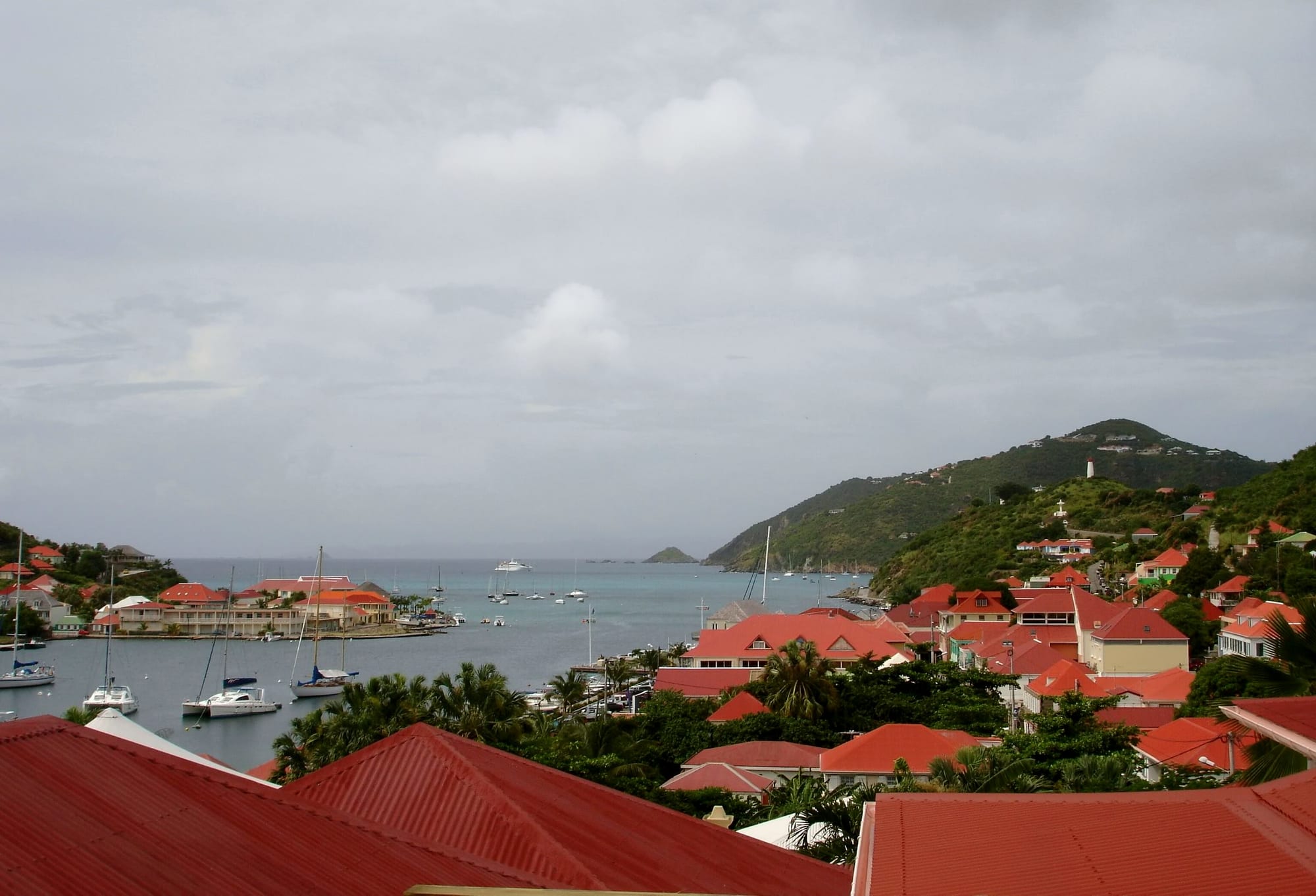
Red-roofed houses on green hills around a harbour full of moored yachts, with a lighthouse on the far hillside

Saint Barthélemy

Gustavia

Gustavia's red roofs and yacht-filled harbour. (MARELBU / Wikimedia Commons · CC BY 3.0)

The capital and main harbour of Saint Barthélemy, set around a sheltered harbour. Named for King Gustav III when Sweden held the island, it grew rich as a free port; today its red-roofed streets, Swedish forts and yacht-filled harbour are lined with restaurants and luxury boutiques.

Neighbourhoods

  • The harbour and town centre
    • First-time visitors
    • Shopping
    • Best for food

    The streets wrapped around the harbour, where yachts tie up along the quays and the old warehouses and houses now hold restaurants, gift shops and designer boutiques. The Catholic church, the Anglican church on the harbour front and the Swedish bell tower are all a few minutes apart on foot.

    Open in Maps
  • La Pointe
    • Historic district
    • Museums
    • Quiet and residential

    The peninsula on the far side of the harbour, quieter than the shopping streets. The Wall House museum stands at its end, and Fort Oscar, now the gendarmerie, sits at its tip with views over the harbour mouth and the regatta courses.

    Open in Maps
  • Shell Beach and Fort Karl
    • Beaches
    • Walks and viewpoints

    The south-western edge of town, an easy walk from the centre. Shell Beach, a strip of sand and shells about a kilometre long, lies below the ruins of Fort Karl, whose site is a favourite short climb for walkers.

    Open in Maps

Things to do

Forts and landmarks

  • Fort Karllandmark

    The remains of a fort the Swedes built in 1789 and named for Karl XIII, on a protected hill above Shell Beach managed by the Conservatoire du littoral.

    Open in Maps
  • Fort Gustav and Gustavia Lighthouseviewpoint

    A Swedish battery of 1787 on the hill north of the harbour, now a listed historic monument, with a white lighthouse built on its grounds in 1961 — a site popular with hikers.

    Open in Maps
  • Fort Oscarlandmark

    Originally named Gustav Adolf, one of the three Swedish forts that guarded the harbour, at the tip of the peninsula; it now houses the gendarmerie and is a viewing point for the big regattas.

    Open in Maps
  • Church of Our Lady of the Assumptionlandmark

    The town's Catholic church, finished in 1829, badly damaged by a cyclone in 1837 and reopened in 1842, with a sober interior and a partly marble floor.

    Open in Maps
  • Swedish bell towerlandmark

    A stone-and-wood bell tower in the town, housing a bell cast in Stockholm in 1799 — one of the clearest traces of the Swedish period.

    Open in Maps

Museums and old houses

  • Wall Housemuseum

    The island's territorial museum and library, in a stone building at the far end of La Pointe, telling the story of Saint Barthélemy from its French settlers through the Swedish century.

    Open in Maps
  • Le Brigantinlandmark

    The Maison Dinzey, a house in the town listed as a French historic monument.

    Open in Maps

Beaches

  • Shell Beachbeach

    The town beach, also called Anse de Grand Galet, made in the 1960s and 1970s from sand and shells dredged out of the harbour; jumping into the sea from the rocks is the local sport.

    Open in Maps
  • Saint-Jeanbeach

    The bay and quartier on the north side of the island beside the airport, where departing aircraft pass low over the end of the beach.

    Open in Maps
  • Anse des Flamandsbeach

    A quartier on the north-west coast with a very wide sandy beach.

    Open in Maps
  • Anse du Gouverneurbeach

    A quartier and beach on the leeward side, in the south of the island.

    Open in Maps

Getting around the island

  • Gustaf III Airporttransit hub

    The island airfield at Saint-Jean, also called Rémy de Haenen Airport, whose short runway ends on the beach after a steep approach over a hilltop roundabout; pilots need special certification to land.

    Open in Maps

Seasonal events

  • St Barts Music FestivalJanuary

    An international performing-arts festival held every year, usually in the second and third weeks of January.

  • CarnivalFebruary or March, before Ash Wednesday

    Two weeks of French Caribbean Carnival ending on Ash Wednesday with a black-and-white parade at Shell Beach and the burning of Vaval, the Carnival King.

  • St Barths Bucket RegattaMarch

    Three days of racing for large invited yachts, first held on the island in 1995 and often watched from Fort Oscar.

  • Les Voiles de Saint-BarthApril

    One of the spring regattas that fill the harbour with racing and classic yachts.

  • Festival of GustaviaAugust

    The town's own festival, with dragnet fishing and partying.

  • GustavialoppetDecember

    The Swedish Marathon Race, a running event that keeps up the island's link with Sweden.

Eat and drink

Long-standing places and food districts in Gustavia. Hours, ratings and directions come from your maps app, always current.

Food districts

  • Harbour-front restaurantsneighborhood

    The streets around the harbour hold restaurants serving French, Italian, American and Swedish food, with seafood the one thing not imported; a service charge is usually added to the bill.

    Open in Maps
  • Bakeries in Gustaviacafe

    French bakeries supply the daily baguettes and pastries that are part of island routine.

    Open in Maps

Experience Gustavia

History

The cove where Gustavia stands was first known as Le Carénage, probably because damaged ships were brought there to be careened. Saint Barthélemy was too dry, steep and rocky for sugar, so the island had little value to the plantation powers — but the harbour was a good one. In 1784 France gave the island to Sweden in exchange for trade rights in Gothenburg, and the name Gustavia, for King Gustav III, appears in the records between December 1786 and February 1787.

As a Swedish free port, Gustavia became a supply and trading centre for the warring powers of the Caribbean: captains sold captured prizes and booty here, and the harbour filled with ships of many nations. Slavery was practised on the island under Swedish rule. Three forts guarded the anchorage — Gustav, Karl and Oscar, first called Gustav Adolf — and the town prospered during the Napoleonic Wars, but declined afterwards. A treaty of 10 August 1877, approved by the islanders in a referendum, returned the island to France in 1878, and it has kept its free-port status.

The Swedish legacy survives in the street plan, the forts, the bell tower and the town's very name. In the second half of the 20th century tourism turned Gustavia into a harbour for yachts and luxury shops. Hurricane Irma damaged the island in September 2017, but by early 2018 transport and electricity were largely working again.

Culture & Customs

Gustavia is French in language and manners and Caribbean in its calendar. The town's year turns on the harbour: the Bucket Regatta in March, Les Voiles de Saint-Barth in April and other races bring large yachts into port, and Fort Oscar is a favourite place to watch them. Carnival fills the streets in the weeks before Lent and ends on Ash Wednesday with a black-and-white parade at Shell Beach, where Vaval, the Carnival King, is burned. January brings an international music festival, and the August Festival of Gustavia is the town's own celebration.

The Swedish century remains a point of pride. The Gustavialoppet, a running race held each December, keeps up the link with Sweden, Sweden keeps a consulate in the town, and the island's coat of arms carries the Three Crowns of the Swedish arms. La Pointe is an English-speaking quarter, and the town has an Anglican church, built in 1855 of stone brought from Sint Eustatius, as well as the Catholic church of 1829.

Visitors notice the understated style of the place: boutiques and long lunches rather than nightlife spectacle. Courtesy follows French habits, from greeting shopkeepers to a measured pace at the table.

Daily Life

The whole island had a population of 10,660 at the January 2023 census, and Gustavia is its administrative centre and main port. The territorial government, the sub-prefecture, the gendarmerie at Fort Oscar and the small Hôpital de Bruyn are all here, along with the town's nursery and primary schools.

The economy rests on luxury tourism and duty-free retail. High-end boutiques are an essential source of revenue, and restaurants depend on imported food, since almost nothing except seafood is produced locally. Tap water comes from desalinated seawater. The harbour is the town's working heart, busy with yachts, ferries from Saint Martin and the tenders of visiting cruise ships.

The rhythm follows the seasons. From December to April the quays are crowded and parking is scarce; early autumn is so quiet that many businesses close for a few weeks. Outside the high season the town feels like the small French village it is.

Food

Gustavia's restaurants serve French, Italian, American and Swedish cooking, and fine dining sets the tone. Fish is the one local product, while cheese, wine and almost everything else is imported, mostly from the United States or France, which shows in the prices. Most restaurants add a service charge of 10–15 per cent to the bill, and the island hosts gastronomic events through the year.

Creole cooking appears alongside the French menus: accras (salt-cod fritters), boudin (a spiced blood sausage) and colombo, a curry made with chicken or goat. Fresh baguettes and pastries from the town's bakeries are a daily fixture of island life for residents and visitors alike.

The classic French Caribbean aperitif is ti-punch — white rum with cane syrup and lime. There is no real budget dining scene in the town; eating more cheaply means the bakeries, the supermarkets and a picnic on the sand at Shell Beach, a short walk from the harbour.

Planning tools

Budget

Gustavia is one of the most expensive towns in the Caribbean. Rooms, villas and restaurant meals are priced for a wealthy clientele, even souvenirs carry premium prices, and the December–April high season costs far more than the rest of the year. Day-tripping by ferry from Saint Martin is the cheapest way to see the town.

Daily Budget Midrange
USD 500+ per day, far more in the December–April high season
Daily Budget Shoestring
USD 500+ — there is no realistic shoestring option on the island; day-tripping by ferry from Saint Martin is the cheapest way to visit

Visit in May–June or November for lower prices, or come for the day by ferry from Saint Martin; Shell Beach, the forts and the lighthouse cost nothing.

Best Time to Visit

December to April is the drier, breezier and busiest season, with the January music festival, Carnival and the spring regattas. May–June and November are quieter and cheaper. Early autumn is the quietest time, when many businesses close for a few weeks and the hurricane season is at its height.

Suggested Number of Days

The town itself is small and can be seen in a day or two, or on a day trip by ferry. Four to six days allows time for the island's beaches as well; the cost of staying is usually what decides the number.

First Visit
1–2 days
With Surroundings
4–6 days

Transportation

Taxis are available, and most visitors hire a small car or a scooter to reach the beaches. The island's roads are steep, narrow and winding, with blind bends, and driving is on the right. Parking in Gustavia is very limited.

Reserve a small car well ahead in the high season, and drive slowly on the hill roads.

Airport & Station Connections

Gustaf III Airport at Saint-Jean takes only small aircraft, mostly carrying fewer than twenty passengers, on short flights from Princess Juliana International Airport and Grand Case on Saint Martin, about 30 kilometres away, and from other nearby islands. Ferries run regularly from Marigot and Philipsburg, and crossings can be rough in any wind. Small and medium cruise ships anchor outside the harbour and bring passengers ashore by tender.

Walkability

The town is small and walkable, though not always easy for wheelchair users. Shell Beach is a short walk from the centre, and the climbs to Fort Karl and to the lighthouse are popular with walkers. The other beaches need a car, scooter or taxi.

Safety

Very safe, with very little crime. The practical risks are the steep, narrow roads, where scooter accidents are frequent, strong surf on the Atlantic-facing beaches, the sun and the hurricane season. The town has a small hospital, but serious cases may need evacuation off the island.

Take extra care on a scooter, swim on sheltered beaches when the sea is rough, and carry good travel insurance. Check current official travel advice before travelling.

Climate

A tropical climate with little change in temperature through the year, cooled by the trade winds. Average temperatures are around 27°C; the dry season is known locally as Carême (Lent), and the more humid season from May to November brings short showers and overlaps the Atlantic hurricane season.

Summer
warm and more humid — across the island July highs are about 30°C, with brief showers
Winter
dry and breezy — across the island January highs are about 28°C

Local Customs

The culture is French Caribbean, and a greeting of 'bonjour' on entering a shop is expected. French is the language of daily life, and English is widely spoken in tourism. Many restaurants add a service charge of 10–15 per cent to the bill. The island is Catholic, and churches should be visited quietly and decently dressed.

The legal age for buying alcohol is 18, as in France; ask before photographing residents.

Common Payment Methods

The currency is the euro. US dollars are accepted in many places at a variable rate, and cards are standard almost everywhere, including in the boutiques and restaurants.