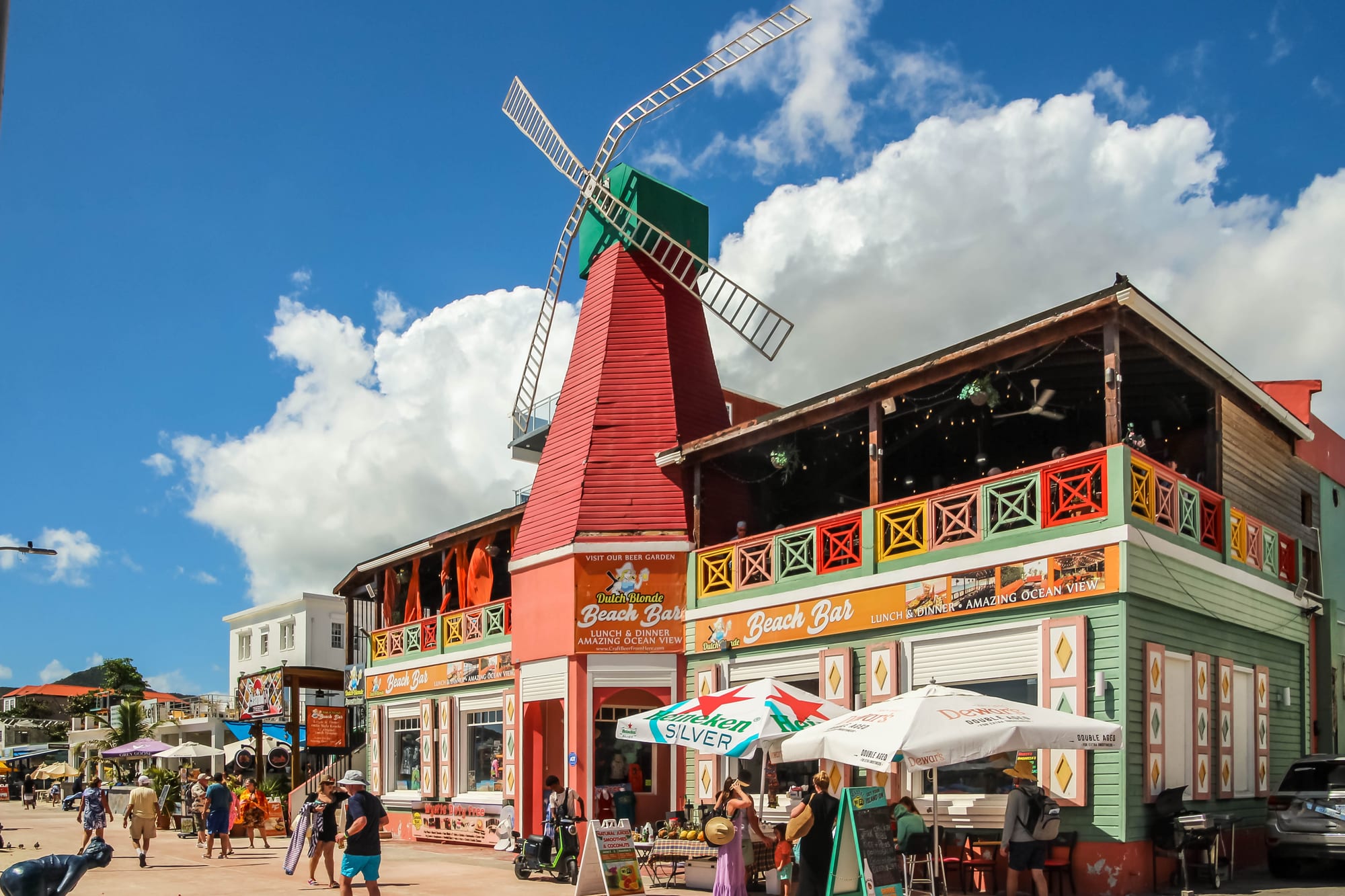
A red wooden windmill-shaped building and a colourful two-storey beach bar on a sunny boardwalk with people walking past

Sint Maarten

Philipsburg

Bars and restaurants along the Great Bay boardwalk in Philipsburg. (Dr. Thomas Liptak / Wikimedia Commons · CC BY-SA 4.0)

The capital of Sint Maarten, on a narrow strip of land between Great Bay and the Great Salt Pond on the island's south coast. Named after the Scot John Philips, a vice-commander in Dutch service, it is now the island's cruise port and duty-free shopping town, with a beachfront boardwalk, Front Street's shops and two old forts.

Neighbourhoods

  • Front Street and the boardwalk
    • First-time visitors
    • Shopping
    • Beaches

    The heart of town, where the beach, the boardwalk and Front Street run side by side. Front Street is known for its jewellery, electronics and souvenir shops, the boardwalk for its restaurants and bars, and Great Bay Beach runs the full length of the town.

    Open in Maps
  • Back Street
    • Local life
    • Quiet and residential

    The street parallel to Front Street, catering more to residents' daily needs than to cruise passengers; Old Street, an often-photographed alley, links the two.

    Open in Maps
  • The cruise port and the marinas
    • Boats and ferries
    • Close to public transport

    The eastern end of town, with the A.C. Wathey cruise terminal about ten minutes' walk away, Bobby's Marina and Dock Maarten, where ferries and day-trip boats leave for nearby islands, and the main bus terminal at Emmaplein.

    Open in Maps

Things to do

Forts and landmarks

  • Fort Amsterdamlandmark

    A triangular stone fort of 1631 on the peninsula between Great Bay and Little Bay, where Peter Stuyvesant lost his leg in a failed attack on the Spanish garrison in 1644; its ruins, rusting cannon and harbour view sit in an Important Bird Area with a brown pelican colony.

    Open in Maps
  • Fort Willemlandmark

    The second of the town's colonial forts, built in the 18th century.

    Open in Maps
  • The Courthouselandmark

    The old courthouse, one of the principal historic sights and official buildings of the town.

    Open in Maps
  • St. Martin of Tours Churchlandmark

    The town's Catholic church, one of its historic monuments.

    Open in Maps

Shopping streets and the waterfront

  • Front Streetneighborhood

    The main street, lined with duty-free jewellery, electronics and souvenir shops, the Methodist church and the Guavaberry Emporium.

    Open in Maps
  • Great Bay Beach and the boardwalkbeach

    The large, busy beach that runs along the whole town, with the boardwalk — built for the cruise trade and now the town's liveliest place — between the sand and Front Street.

    Open in Maps
  • Sint Maarten Museummuseum

    A small volunteer-run museum in a side alley between Front Street and the boardwalk, covering the island's history.

    Open in Maps

Short trips from the town

  • Little Baypark

    A small coastal pond near the capital, recognised as an Important Bird Area for species such as the green-throated carib.

    Open in Maps
  • Maho Beachbeach

    The beach beside the end of the airport runway where aircraft land just above the sand; jet blast from departing planes is dangerous, and a tourist holding the fence was killed by it in 2017.

    Open in Maps
  • Simpson Bay Lagoonpark

    One of the largest inland lagoons in the West Indies, shared by the Dutch and French sides, a centre for yachts and marinas.

    Open in Maps
  • Marigotneighborhood

    The capital of the French side, reached by bus from Emmaplein, with its waterfront market and Fort Louis.

    Open in Maps

Seasonal events

  • Sint Maarten CarnivalApril to May

    The Dutch side's Carnival, whose Grand Carnival parade is the largest of the island's two carnivals, with calypso and soca competitions and street jump-ups.

  • Heineken RegattaMarch

    The island's big sailing regatta, held each spring.

  • Sint Maarten Day11 November

    The island's day, celebrated on both the Dutch and French sides.

Eat and drink

Long-standing places and food districts in Philipsburg. Hours, ratings and directions come from your maps app, always current.

Food districts

  • Boardwalk restaurants and barsneighborhood

    Restaurants for lunch and bars along the Great Bay boardwalk; several stay open after the cruise ships leave, and Friday evenings are the busiest.

    Open in Maps
  • Guavaberry Emporiumcafe

    A shop on Front Street devoted to guavaberry liqueur, the rum-based Christmas drink closely associated with the island.

    Open in Maps
  • Back Streetneighborhood

    The everyday shopping street behind Front Street, used by residents as well as visitors.

    Open in Maps

Experience Philipsburg

History

Philipsburg stands on a narrow strip of land with the sea on one side and a salt lake, the Great Salt Pond, on the other. The Dutch built Fort Amsterdam on the headland in 1631 to guard their outpost; the Spanish captured it two years later and held it until 1648, beating off a Dutch attack in 1644 in which Peter Stuyvesant, later governor of New Amsterdam, lost his leg. After the island's partition in 1648 the fort changed hands several times between the Dutch, English and French, but stayed mostly Dutch.

People had settled on the strip by about 1631, and around 1733 the town was founded under John Philips, a Scot from Arbroath serving the Dutch as vice-commander, to centralise the island's trade. His name for it first appears in a letter he wrote to the West India Company in 1738. Under Philips many English planters settled on the Dutch side, bringing English-speaking enslaved people with them. In 1768 Philipsburg became the island's chief town and a trading centre, and Fort Willem was added in the 18th century.

Tourism transformed it from the 1950s and 1960s, with duty-free shopping, the cruise port and the boardwalk built for the cruise trade. In 2010 Sint Maarten became a self-governing country within the Kingdom of the Netherlands, with Philipsburg as its capital. In September 2017 Hurricane Irma, a Category 5 storm, hit the island head-on, wrecking the airport and much of the building stock; a Dutch-funded reconstruction programme has driven a slow recovery.

Culture & Customs

Philipsburg's culture is the island's Caribbean mix. English is the first language of about seven in ten people in Sint Maarten, followed by Spanish, Haitian Creole and Dutch, and the population brings together long-established families with communities from the Dominican Republic, Haiti, Dominica, Jamaica, Guyana, India and elsewhere. Methodism was historically the dominant church on the Dutch side, unlike the mainly Catholic French side, and the Methodist church on Front Street is one of the town's landmarks, alongside the Catholic church of St. Martin of Tours.

Carnival is the biggest event of the year. The Dutch side's season runs from April into May, after Easter, and its Grand Carnival parade is the larger of the island's two, with calypso and soca competitions, costumed troupes and street jump-ups. Music festivals such as Soul Beach are promoted to draw visitors, and the March regatta fills the bay with yachts.

Older traditions include string bands, ponum dance and guavaberry liqueur, which features in island Christmas songs. Sint Maarten Day on 11 November celebrates the island's shared identity on both sides of the border.

Daily Life

The town had 1,894 inhabitants in 2017; Sint Maarten as a whole had 58,477 people in June 2023. Philipsburg is the seat of government and the main port of entry, with schools, the courthouse and public offices among the shops.

The economy is tourism. Around four-fifths of the country's workforce is employed in the sector, and Philipsburg is its centre: the deep-water port can take six cruise ships at once, and on busy days thousands of passengers fill Front Street, the boardwalk and Great Bay Beach. Several boardwalk bars stay open after the ships leave and are popular in the evening, especially on Fridays.

Residents shop on Back Street, the everyday street behind Front Street, and travel by the minibuses that leave from Emmaplein. Life is shaped by the cruise schedule, by the long recovery from Hurricane Irma, and by the island's exposure to shocks such as the pandemic, which showed how heavily it depends on visitors.

Food

Sint Maarten's food mixes Creole, French and West Indian cooking with Dutch and Indian touches. Conch broth with dumplings is often called the island's national dish, and seafood and stews form the Creole base. In Philipsburg, the menu runs from Dutch bar snacks — bitterballen, crisp fried meat-ragout balls, and frikandel, a skinless sausage — to Indian roti shops and international restaurants along the boardwalk.

Guavaberry is the town's signature flavour: a tart wild fruit made into a rum-based liqueur closely associated with the island and drunk especially at Christmas. It is sold in most bars, and the Guavaberry Emporium on Front Street is devoted to it.

Local rums, Carib and Presidente beers and fresh tropical juices are the usual drinks, and some beach bars on the boardwalk sell local craft beer. The roadside lolos and restaurant street of Grand Case, on the French side, are a short drive away for Creole grills.

Planning tools

Budget

Philipsburg is geared to cruise passengers and is not cheap: restaurants on the boardwalk and shops on Front Street are priced for visitors, though duty-free goods are often cheaper than on surrounding islands. Self-catering, buses and eating away from the cruise crowds keep costs down.

Daily Budget Midrange
USD 200–420 (hotel, restaurants, car hire, a boat or island tour)
Daily Budget Shoestring
USD 70–120 (guesthouse or apartment, supermarket and roti-shop food, buses)

Check which cruise ships are in port; on busy days the town is crowded, while quiet days are better for wandering Front Street.

Best Time to Visit

December to April is the dry, sunny and busy peak, with the highest prices around the winter holidays and the regatta in March. Carnival takes over the town in April and May. May and November are quieter shoulder months. Hurricane risk is highest from August to October.

Suggested Number of Days

The town can be seen in a day, which is how most cruise passengers see it. A week allows time for the beaches, the lagoon and the French side, and the number of boat trips to neighbouring islands decides how much longer.

First Visit
1–2 days
With Surroundings
5–7 days

Transportation

Philipsburg is easy to explore on foot. The Emmaplein bus terminal is the island's main bus station, with minibuses to Marigot, Maho and the airport, and other parts of the island. Taxis serve the cruise port, and a hire car is the easiest way to see the whole island; there is no checkpoint between the Dutch and French sides. Traffic can be heavy.

Park at the marinas on the eastern edge of town rather than in the centre.

Airport & Station Connections

Princess Juliana International Airport, the island's main airport, lies to the west of the town near Simpson Bay Lagoon. Its terminal was badly damaged by Hurricane Irma in 2017; the rebuilt check-in area opened in January 2024 and a new arrivals hall in October 2024. Cruise ships dock at the deep-water port, about ten minutes' walk from the town, and ferries leave Bobby's Marina for Saint Barthélemy, Saba, Sint Eustatius and Saint Kitts.

Walkability

The beach, the boardwalk and Front Street run parallel, so the centre is simple to walk, and the cruise terminal is about ten minutes on foot. Traffic is heavy, pavements are narrow or missing in places, and the midday sun is strong.

Safety

Sint Maarten has a higher crime rate than many Caribbean islands, with robberies, break-ins to cars and villas, and some violent crime, concentrated away from the main tourist strips and worse after dark. In Philipsburg the daytime centre is busy with visitors; petty theft on the beach is common.

Keep valuables out of sight on the sand and in cars, avoid unlit streets at night, use repellent and watch the forecast in hurricane season. Check current official travel advice before travelling.

Climate

A tropical savanna climate, drier than most of the north-eastern Caribbean because the island's hills cast a rain shadow over the town. The drier season runs from December to April; June to November is wetter and hotter and is the Atlantic hurricane season.

Summer
hot, humid and wetter — across the island temperatures are around 28–31°C, with the hurricane risk at its peak from August to October
Winter
dry, sunny and breezy, still around 28°C by day across the island

Local Customs

English is the everyday language of nearly everyone; Dutch is official alongside it, and Spanish, Haitian Creole and Papiamento are common. Most people are Christian, and Methodism has deep roots on the Dutch side. Family, church and Carnival groups organise social life. The capital is known locally simply as 'Town'.

Ask before photographing people, and dress modestly when visiting churches.

Common Payment Methods

The official currency is the Caribbean guilder, introduced on 31 March 2025 and pegged to the US dollar, but almost everything is priced in US dollars, which are accepted everywhere; the euro is the currency of the French side. Cards are standard; carry some cash for small shops and buses.