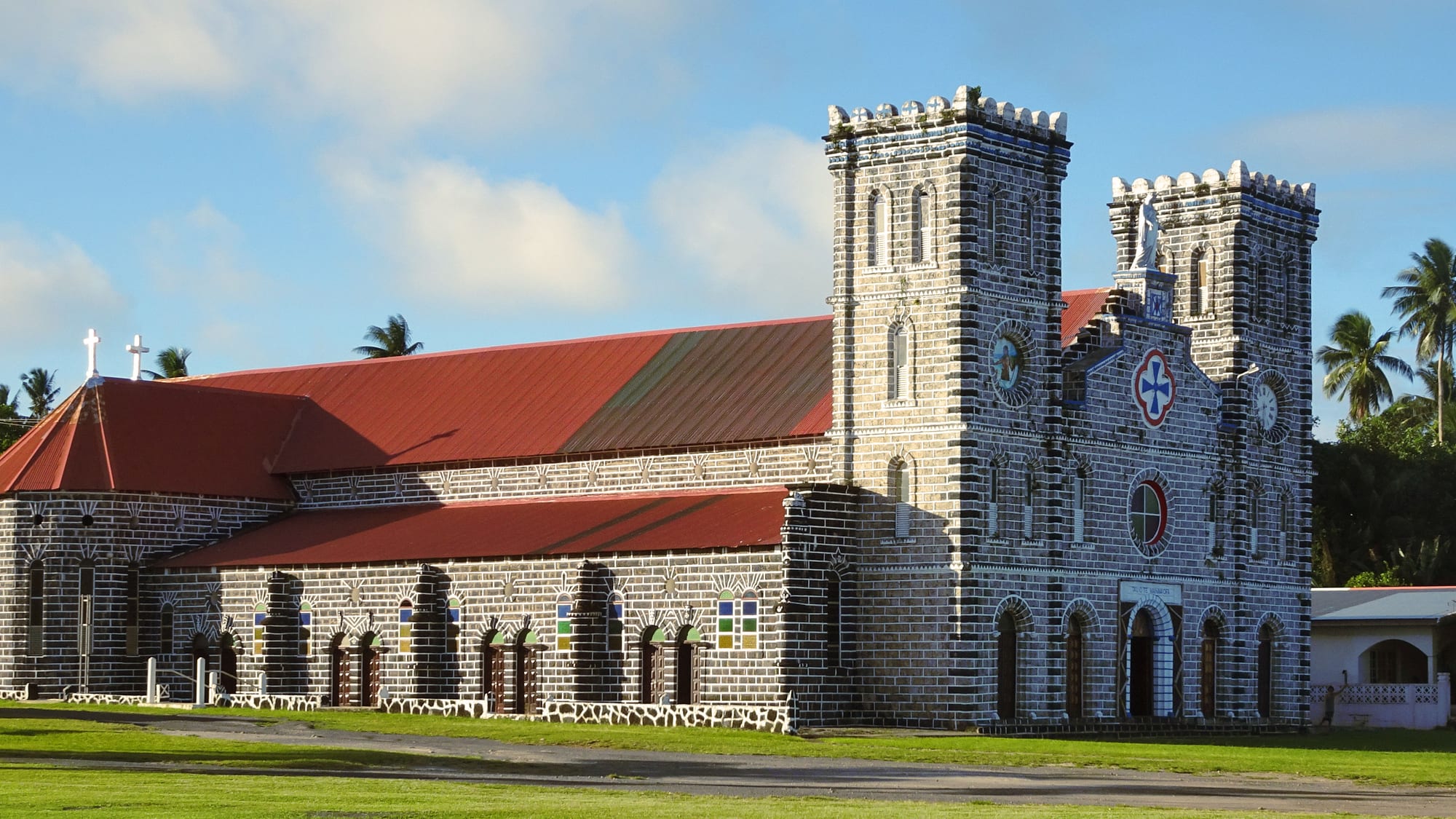
A long church of grey stone blocks with two battlemented towers, a dark red metal roof and palms behind it under a blue sky

Wallis and Futuna

Mata Utu

The cathedral of Our Lady of the Assumption in Mata Utu, seen from the side. (Brigitte & Heinz / Wikimedia Commons · CC BY-SA 2.0)

The capital of Wallis and Futuna, a village of about a thousand people on the east coast of Wallis island in the western Pacific. It holds the stone cathedral of Our Lady of the Assumption, the residence of the Lavelua, king of ʻUvea, and the offices of the French administration, and it remains a quiet place ordered by church bells, custom and the lagoon.

Neighbourhoods

  • The cathedral and palace green
    • First-time visitors
    • Historic centre

    The heart of the capital, where the twin-towered stone cathedral stands beside the royal palace of the Lavelua and the open ground used for customary gatherings. The territory's administrative offices, the post office and a handful of shops are within a few minutes' walk, and the lagoon is just across the road.

    Open in Maps
  • The seafront and wharf
    • Walks
    • Local life

    A low coastal strip facing the reef-sheltered lagoon, with a wharf, fishing boats, a war memorial and views out to the small islands offshore. Early morning and late afternoon are when people gather here, and the coast road running north and south is the main street of the whole district.

    Open in Maps
  • Sia and the edges of the village
    • Quiet and residential
    • Practical services

    The residential ground behind the seafront, where houses with gardens of taro and banana spread inland and the island's hospital, schools and sports ground sit among them. There is nothing to see, but this is where most of the capital's daily business happens.

    Open in Maps
  • The Hahake coast villages
    • Local life
    • Churches

    Mata Utu is only the largest settlement in Hahake, the eastern district of Wallis, and neighbouring villages run into it along the coast road. Each has its own church and its own place in the island's customary order, and the walk or drive between them takes in gardens, chapels and lagoon views.

    Open in Maps
  • Mu'a and the south of the island
    • Archaeology
    • Quiet

    The southern district, about 9 km down the coast, holds the Talietumu archaeological site and a coast of coral flats and small islets. It is the quietest part of Wallis and the part with the most obvious pre-European remains.

    Open in Maps

Things to do

Landmarks in the capital

  • Cathedral of Our Lady of the Assumptionlandmark

    The seat of the Diocese of Wallis and Futuna, 60 metres long and built of cut volcanic stone, some of it quarried from the cliffs around Lake Lalolalo; a first church stood here from 1857, and the present building dates from a reconstruction in the 1950s.

    Open in Maps
  • Palace of the Lavelualandmark

    The official residence of the king of ʻUvea, standing beside the cathedral on the green where customary ceremonies and the presentation of gifts take place.

    Open in Maps
  • Mata Utu wharf and seafrontviewpoint

    The working waterfront of the capital, looking across the lagoon to the reef and the low islets beyond it.

    Open in Maps

Short trips on Wallis island

  • Talietumulandmark

    A fortified Tongan settlement about 9 km south-west of the capital, near Halalo, built around 1450 during the expansion of the Tu'i Tonga and the last Tongan stronghold on ʻUvea, with basalt walls, platforms and a ceremonial ground cleared among the trees.

    Open in Maps
  • Lake Lalolaloattraction

    A circular crater lake of very dark water, about 88 metres deep and the largest body of water in Wallis and Futuna, ringed by cliffs 40 to 50 metres high; its surroundings were long a strictly regulated sacred area under the Lavelua.

    Open in Maps
  • Lake Lanutavakeattraction

    A second, smaller crater lake in the south-west of the island, near Fineveke, surrounded by bush and popular with islanders for a day out.

    Open in Maps
  • Wallis Islandattraction

    The whole island can be driven around in a morning, past roadside chapels, plantations, volcanic craters and the lagoon that surrounds it.

    Open in Maps

The lagoon

  • Nukuhifalabeach

    A small islet in the lagoon off the east coast, belonging to Mata Utu village, one of several reached by boat for a beach and a swim.

    Open in Maps
  • Faioabeach

    An islet at the southern end of the lagoon, by the pass that ships use on their way to Mata Utu, with sand and shallow water on the sheltered side.

    Open in Maps

Seasonal events

  • Feast of the Assumptionmid-August

    The patronal feast of the cathedral and of the Hahake district, when the church is hung with coloured cloth and the Mass is followed by customary dancing and a shared meal.

  • Territory Daylate July

    The territory's own holiday, marking the law of 29 July 1961 that made the islands a French overseas territory, with official ceremonies, Mass, dance and a katoaga, the customary feast and gift exchange.

  • Feast of Saint Pierre Chanellate April

    The feast day of the Marist missionary killed on Futuna in 1841 and later canonised; the main pilgrimage is on Futuna, but Mata Utu keeps the day as well.

  • Katoaga and parish feaststhroughout the year

    Customary feasts held for church and chiefly occasions, with mats, tapa cloth, pigs and root crops presented in front of the palace or the church.

Eat and drink

Long-standing places and food districts in Mata Utu. Hours, ratings and directions come from your maps app, always current.

Eating in the capital

  • Shops and snack bars in Mata Utuneighborhood

    A small number of eating places and general stores sit along the coast road near the cathedral, serving French and Chinese-influenced plates alongside local fish and root crops. Choice is limited, and many guesthouses cook for their guests.

    Open in Maps
  • Bakeries and grocery storesneighborhood

    Bread baked in the French manner is a daily staple, sold with imported groceries in the village shops; roadside sellers sometimes offer fruit, fish and coconuts.

    Open in Maps

Experience Mata Utu

History

Mata Utu has been the seat of the kings of ʻUvea for centuries, and its importance has always come from that rather than from trade or size. Stone platforms and fortifications elsewhere on the island, above all the walled site of Talietumu in the south, record a long period of Tongan influence over ʻUvea before the island's own chiefly line consolidated its authority. The village on the east coast, sheltered by the lagoon and reef, was the place where that authority was exercised and where the paramount chief, the Lavelua, lived.

French Marist missionaries reached the island in 1837 and converted it within a few years, and Mata Utu became a mission centre as well as a royal one. The stone cathedral of Our Lady of the Assumption was raised beside the palace, and priests built chapels through the surrounding villages, so that church and kingship came to share the same ground. Queen Amelia signed the treaty that made ʻUvea a French protectorate, ratified by France in 1887, and a French resident was installed on the island; proposals to annex the islands outright, raised in 1913, were dropped as too costly.

The Second World War brought American forces to the island from 1942, and the roads and the airfield in the north date from that period. When Wallis and Futuna became a French overseas territory in 1961, Mata Utu was confirmed as its administrative capital, gaining the offices, hospital, secondary schools and wharf that still make it the centre of island life. The kings and the French administrator have sat side by side here ever since, an arrangement that has sometimes produced open disputes over the succession.

Culture & Customs

Life in the capital is shaped by two authorities that occupy the same few hundred metres of ground: the cathedral and the royal palace. Sunday Mass fills the church, sung in Wallisian by large choirs, and the religious calendar sets the year's rhythm, with the feast of the Assumption in August the parish's own great day. Custom, coutume, governs the rest: rank, land, marriage and the obligations between families are settled by chiefly authority rather than by the administration.

The katoaga, a customary feast and ceremonial gift exchange, is the most visible expression of that order. Mats woven from pandanus, lengths of tapa cloth, whole pigs, taro and yams are stacked and presented in front of the church or the palace, then redistributed, while dancers perform in ranks and the kava ceremony proceeds according to strict precedence. Wallisian dance, sung and drummed, has many named forms, and groups from each village rehearse for weeks before the big feast days.

Wallisian, Faka'uvea, is the language of the street and the home; French is the language of school, paperwork and the administration, and most people move between them. The community is small and closely related, and news travels quickly. Visitors are treated with courtesy and considerable curiosity, and are expected to reciprocate with modest dress, a greeting in passing and patience with the slow pace at which arrangements are made.

Daily Life

About a thousand people live in Mata Utu itself, out of roughly 11,000 in the whole territory, and the capital feels less like a town than a string of houses, churches and offices along a coast road. Its economy is largely public: the territorial administration, the French state services, the hospital at Sia, the schools, the church and the wharf provide most of the salaried work on the island. Around that, families keep gardens of taro, yam, banana and breadfruit, raise pigs, and fish inside the lagoon.

The day starts early, before the heat, with gardening, fishing and the school run, and slows in the middle of the day. Shops and offices open in the morning and late afternoon, and by dusk the village is quiet. Sunday is set aside almost entirely for church and family. Houses are single-storey, spread among plantations rather than packed together, and extended families live close to one another on customary land that cannot be bought or sold.

The overriding issue is departure. Far more Wallisians now live in New Caledonia and mainland France than on the island, drawn by work and study, and the territory's population has fallen steadily for two decades. That leaves an ageing community, schools with shrinking rolls and a heavy reliance on remittances and French transfers. Electricity, water and communications all reach the capital, but almost everything material arrives by ship or plane.

Food

Everyday eating in Mata Utu combines the produce of the island's gardens and lagoon with imported staples. Taro, yam, breadfruit, cassava and banana are the base, boiled or baked; reef fish and tuna are grilled or served raw in lime and coconut cream; and rice, tinned meat and fish, and freshly baked French bread fill out the rest. Coconut cream, made from grated flesh squeezed by hand, goes into almost everything, including taro leaves slow-baked until soft.

Feast food is different in scale and method. It comes from the umu, an earth oven of hot stones covered with leaves and soil, in which whole pigs, root crops and parcels of fish and leaves cook slowly together. The pig is the prestige food and the standard unit of ceremonial giving, and a large katoaga can account for many of them. Sweet dishes lean on starch and coconut, among them puddings of baked breadfruit or papaya in coconut milk.

Kava, pounded from the root of the pepper plant and mixed with water, is drunk ceremonially rather than casually, and the order in which the cup is passed matters as much as the drink. French wine and beer are imported and available in the village shops, along with coffee and soft drinks. Eating out barely exists: a few small restaurants and snack bars near the cathedral serve French and Chinese-influenced dishes, and most meals are taken at home or as a guest.

Planning tools

Budget

Costs are high for a small Pacific island, because almost everything is imported and carries French overseas prices, and because the only flights come from Nouméa. Accommodation in and near the capital means a small hotel or a family guesthouse rather than a resort, and there is very little organised tourism to spend money on once on the island.

Daily Budget Midrange
USD 180–300 (small hotel, meals out or half board, a hire car)
Daily Budget Shoestring
USD 90–140 (guesthouse room, food from shops and bakeries, lifts or a shared car)

Book a room before arriving, as there are only a few, and carry enough cash for the whole stay; the sights themselves, from the cathedral to the crater lakes, cost nothing.

Best Time to Visit

May to October is drier, a little less humid and outside the cyclone season. Late July and mid-August bring Territory Day and the cathedral's patronal feast, the liveliest days in the capital, with dancing and customary feasts. The wet months from November to April are hotter, with heavy rain and a risk of tropical cyclones.

Suggested Number of Days

Two or three days are enough for the capital and a circuit of the island at an unhurried pace. Four or five suit anyone adding boat trips, and more again if the flight on to Futuna is included, since that service is easily disrupted.

First Visit
2–3 days
With Surroundings
4–5 days

Transportation

There is no public transport. Visitors get around by hire car, by taxi arranged through a guesthouse, or by lifts from residents, which are readily offered. A sealed road runs the length of the east coast through the capital and a loop covers most of the island, so distances are short and traffic is light. Driving is on the right. Boats for the lagoon islets are arranged locally.

Confirm a car or a lift in advance, since vehicles for hire are few and nothing runs to a timetable.

Airport & Station Connections

Wallis's airport lies in the Hihifo district about 6 km north-west of Mata Utu, on a runway the United States Army built for bombers in 1942 and reopened for civil use in 1957. Aircalin flies from Nouméa in New Caledonia, the only scheduled international link, and also runs the short hop to Futuna. Most arrivals are residents, officials and family visitors, and guesthouses usually meet the plane.

Walkability

The capital is easily walked from end to end in half an hour, and the cathedral, palace, administrative offices and wharf are all within a few minutes of each other. Pavements are limited outside the centre, so walking often means the edge of the coast road, and the heat and humidity make the middle of the day hard going. Anything beyond the neighbouring villages needs a vehicle.

Safety

Mata Utu is a very safe place with almost no crime, and the real hazards are natural and medical rather than criminal: strong currents and coral in the lagoon, cyclones in the wet season, mosquito-borne illness, and the island's isolation. The hospital handles routine care, and serious cases are flown to New Caledonia.

Ask before entering village land, plantations or ceremonial ground, take local advice on where to swim, and carry insurance that covers medical evacuation. Check current official travel advice before travelling.

Climate

Tropical and humid all year, with temperatures usually between about 25 and 31°C and little seasonal variation in heat. The wetter season runs from November to April and the drier one from May to October, and rain can be heavy at any time of year.

Summer
December to February is the southern summer here — hottest and wettest, around 27–31°C by day, with high humidity, frequent downpours and the peak of the cyclone season
Winter
June to August is a little cooler and drier, with temperatures still around 25–29°C and steadier sunshine

Local Customs

Custom, or coutume, and the Catholic Church govern daily behaviour more than the French administration does. Modest dress is expected, especially near the cathedral and the palace, and shoulders and knees are best covered; Sunday is kept quiet, with Mass in the morning and little open. Land is held under custom, so permission is asked before crossing gardens or entering ceremonial ground. Kava is drunk socially and as a customary offering, with strict protocol at formal occasions, and visitors take part only when invited.

Greet people in passing, ask before photographing anyone, a ceremony or the interior of a church, and accept food or kava graciously if offered. Tipping is not a local practice.

Common Payment Methods

The currency is the CFP franc (XPF), shared with New Caledonia and French Polynesia and fixed against the euro. Cash is essential: card acceptance is very limited and cash machines are few, with the bank and post office in the capital the practical places to draw or change money. Bring enough for the whole visit, especially before travelling on to Futuna.