Attractions & Natural Wonders
Does water really swirl the other way south of the equator?
Hurricanes do spin the opposite way in each hemisphere, but sinks, baths and toilets do not; the force behind it is far too weak at that size.
By Globeway Editorial · 2 November 2026
The short answer
Not in a sink, a bath or a toilet. The idea comes from a real force, the Coriolis effect, which is caused by the Earth's rotation and does make enormous weather systems turn in opposite directions on either side of the equator. But in anything as small and quick as a draining basin, that force is negligible. The shape of the bowl, the angle of the tap and the faint swirl left over from filling it are many times stronger, and they decide which way the water turns. Identical toilets flushed in the two hemispheres drain the same way, because the direction is set mostly by the shape of the bowl.
The effect can be detected in water, but only in a laboratory. Scientists have filled wide tanks, left the water perfectly still for a day, and drained it slowly. Under those conditions water in the Northern Hemisphere does turn anticlockwise, seen from above, and water in the Southern Hemisphere turns clockwise. The famous demonstrations performed for tourists on the equator are engaging diversions, not physics.
A force that only works at scale
The Coriolis effect is not a push in the usual sense. It appears because the ground beneath a moving object is itself rotating. Anything travelling over the Earth's surface for a long distance or a long time drifts off a straight line relative to the ground: to the right of its direction of travel north of the equator, and to the left south of it. The deflection is strongest near the poles, weakens towards the tropics and falls to zero at the equator itself.
Physicists judge whether the effect matters by a figure called the Rossby number, which compares a system's speed with its size and with the strength of the Coriolis effect at that latitude. A small Rossby number means rotation dominates. A weather system moving at 10 metres per second (22 mph) across 1,000 kilometres (621 miles) scores about 0.1, so the Earth's spin shapes it strongly. A tornado scores very high: its winds are violent, but the Coriolis force on it is, for practical purposes, negligible. A bathroom sink, smaller and quicker still, is even further from the range where the Earth's rotation matters.
The force was understood long before anyone worried about plugholes. The mathematics appeared in an 1835 paper by the French scientist Gaspard-Gustave de Coriolis, who was studying the energy of machines with rotating parts such as waterwheels. Later in the 19th century meteorologists grasped how it combines with differences in air pressure to steer the winds.
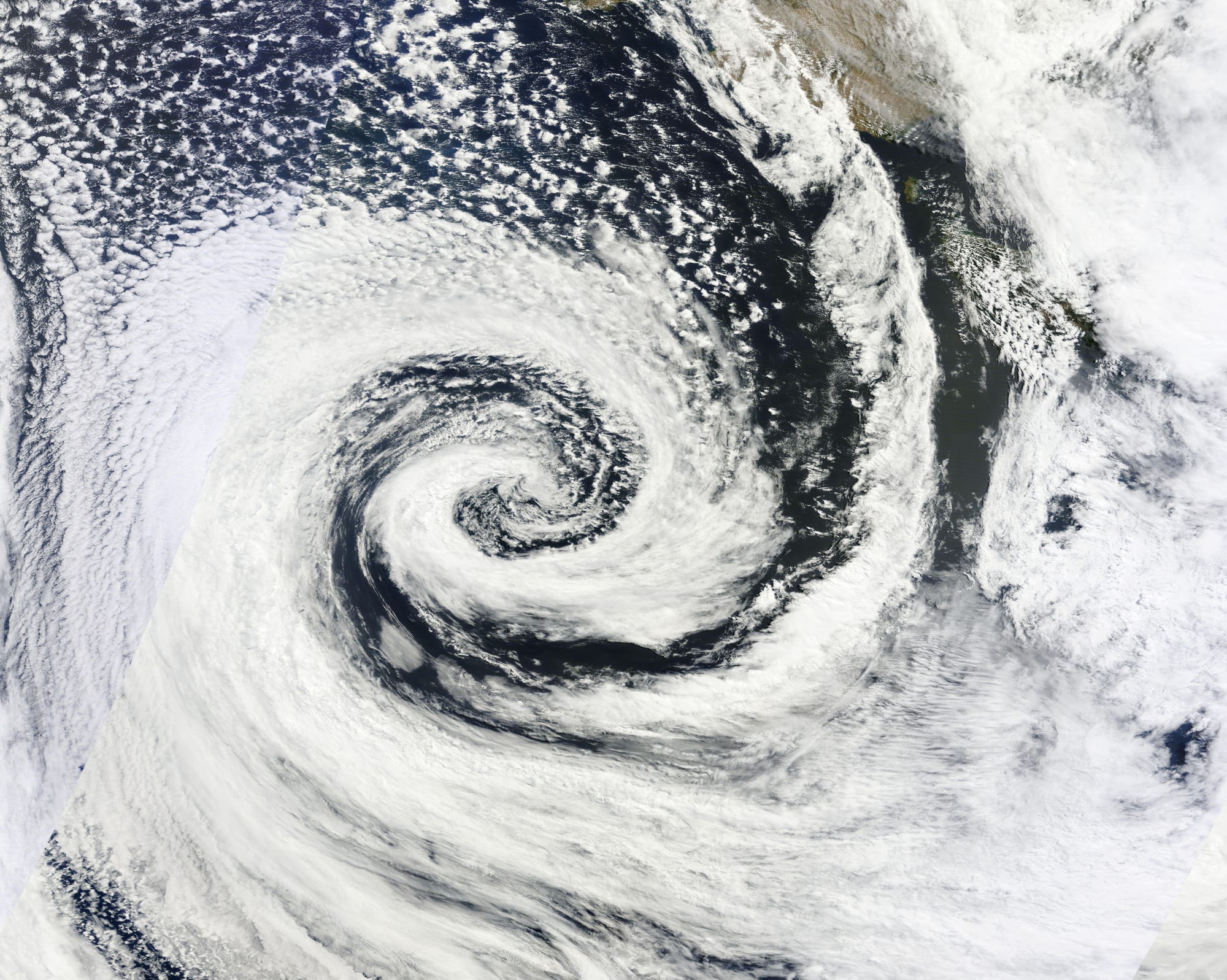
At this size the Earth's rotation is one of the main forces in play, which is why the direction of the spiral depends on the hemisphere.
Where the rule really holds: storms
The hemispheres genuinely differ in their weather. Air flows towards an area of low pressure, but the Coriolis effect bends it sideways, so instead of rushing straight to the centre it circles around it. Tropical cyclones, called hurricanes or typhoons in some oceans, have surface winds that blow anticlockwise in the Northern Hemisphere and clockwise in the Southern Hemisphere. Winds and ocean currents in general tend to flow to the right of their path north of the equator and to the left of it to the south.
The equator itself is where this breaks down. Because the deflecting force fades to nothing there, a developing storm lacks the spin it needs to organise, and tropical cyclones rarely form within 5 degrees of the equator. This is also why a Foucault pendulum, the classic museum demonstration of the Earth's turning, behaves differently by latitude. At the poles its line of swing appears to rotate a full circle in a day; at lower latitudes it turns more slowly; and on the equator it does not turn at all.
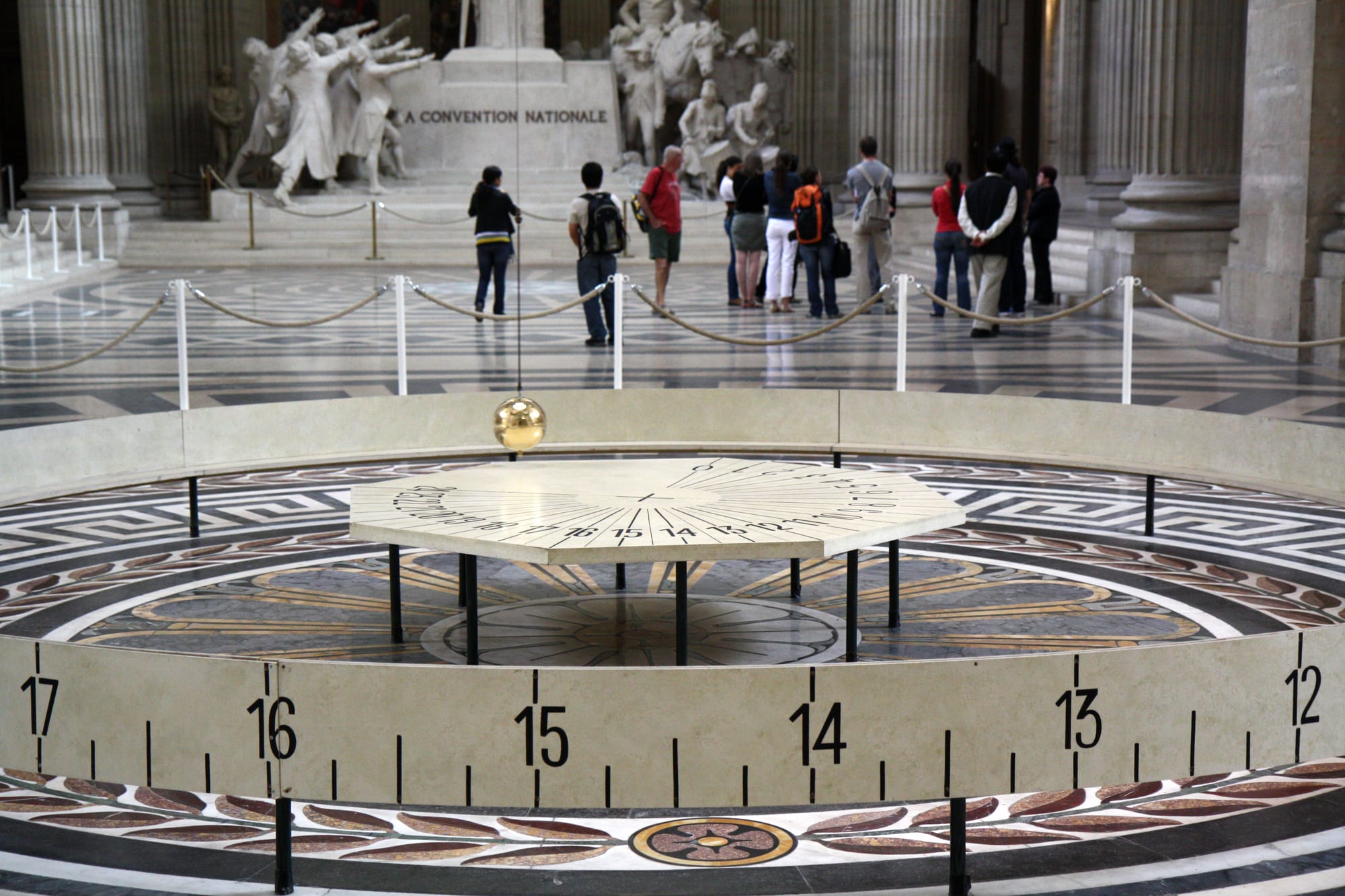
Foucault's pendulum had a 28-kilogram (62 lb) bob on a 67-metre (220 ft) wire. In Paris its swing turns clockwise by about 11.3 degrees an hour.
The bathtub experiments
In 1962 Ascher Shapiro, a professor of mechanical engineering at the Massachusetts Institute of Technology, set out to catch the Earth's rotation in a bath. His basin, in Massachusetts at about 42 degrees north, was 2 metres (6 ft 7 in) across. He filled it, covered it and let the water stand for at least 24 hours so that every trace of motion from the filling died away. Over the plughole he fixed a small cross made of two slivers of wood to show any rotation.
The tank took 20 minutes to drain, and for about the first 15 the cross did not move. Then it began to turn anticlockwise, and by the end it was rotating once every 3 to 4 seconds. The test was later repeated in the Southern Hemisphere, at the University of Sydney, where the researcher Trefethen reported clockwise rotation in five runs, each after the water had settled for 18 hours or more.
Those results confirmed both halves of the story at once. Under extremely careful conditions the Earth's rotation does decide the direction of a draining vortex. In everyday sinks and baths, though, the direction varies unpredictably from day to day and from house to house, because any leftover swirl or quirk of the basin overwhelms a force that small.
The tricks on the line
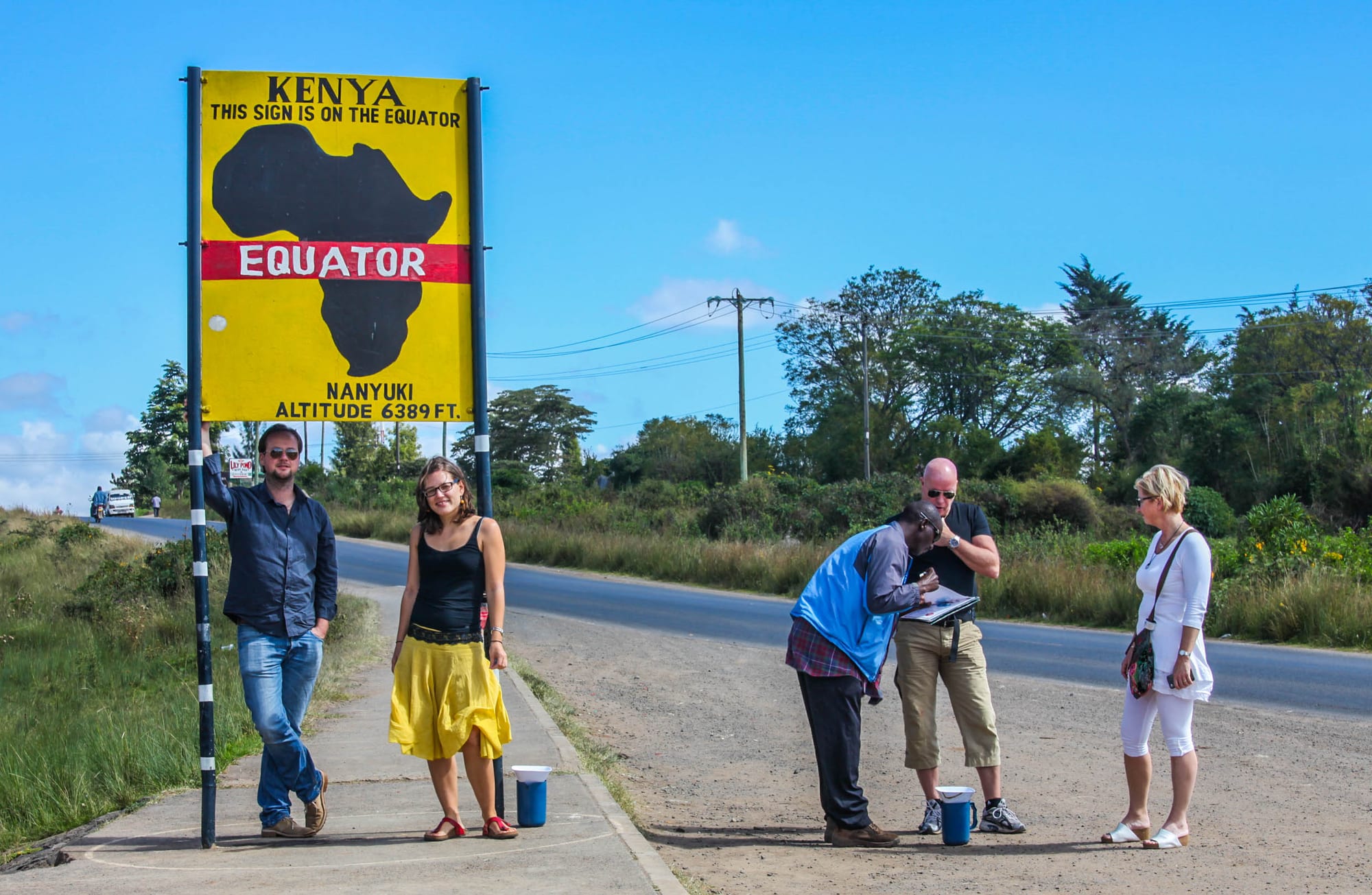
On the equator the myth has become a small industry. Beside the A2 road at Nanyuki in Kenya, which sits just north of the line, a government sign marks the equator, and people are usually at hand to show visitors water draining one way on one side and the other way a few steps away. Near Quito in Ecuador, guides at the private Intiñan Solar Museum perform similar demonstrations, along with balancing eggs on their ends, tricks said to be possible only on the line.
None of it depends on latitude. Eggs balance just as well anywhere on Earth, and the Coriolis effect has no influence on the direction of a household drain anywhere. A basin carried a few steps along a roadside drains in whatever direction its filling, its shape and any leftover movement in the water dictate, exactly as it would at home. The demonstrations are best enjoyed as theatre in a place that is genuinely worth standing on.
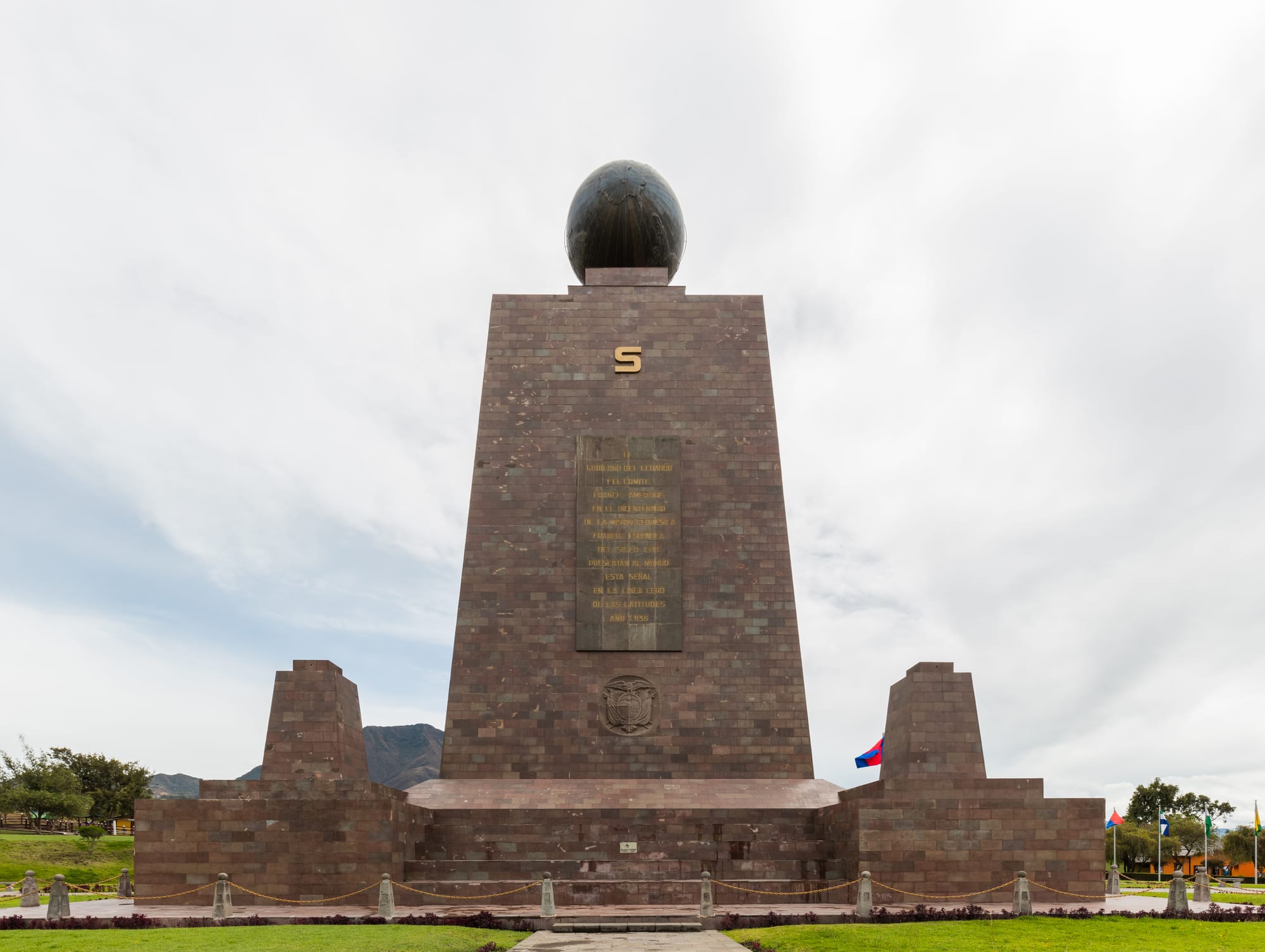
The monument, built between 1979 and 1982, honours the French expedition that fixed the equator's position here in the 1730s. Their line was out by about 240 metres (790 ft).
Seeing the real effect
The honest place to watch the Coriolis effect at work is the sky, not the sink. Satellite images of any large storm show the hemisphere's signature plainly: an anticlockwise spiral north of the equator, a clockwise one south of it. On the ground, a Foucault pendulum in a science museum shows the Earth's rotation turning a swinging weight through the day, a little faster the further the museum lies from the equator. And at the markers on the line itself, from Kenya to Ecuador, the drain demonstrations remain a cheerful illusion, an entertaining show rather than proof of a turning planet.