Daily Life
How do cruise ships stay upright when they look so top-heavy?
The tall decks are light and the heavy machinery sits at the bottom, while a very wide hull pushes back against every roll.
By Globeway Editorial · 2 November 2026
The short answer
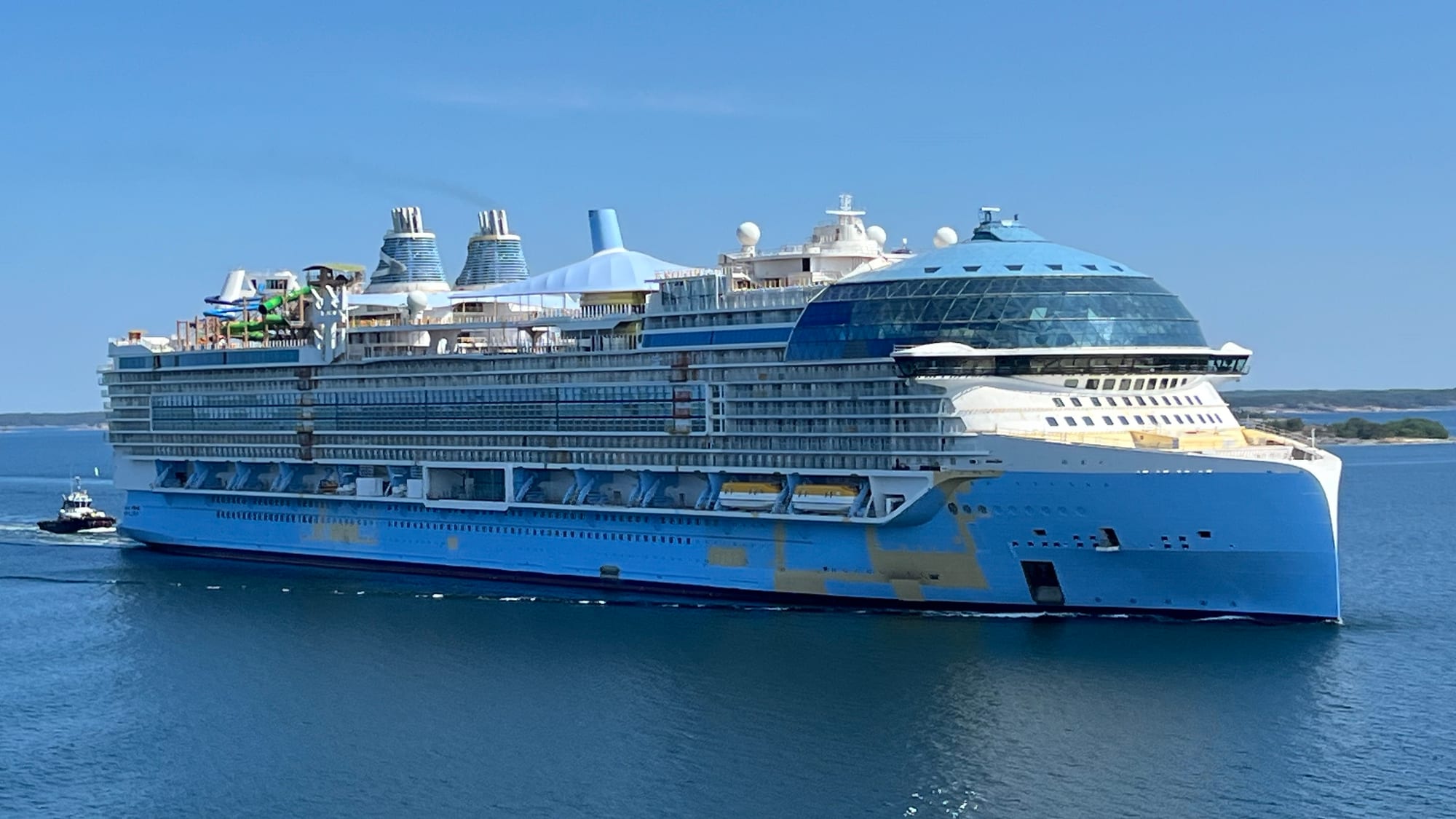
A cruise ship only looks top-heavy. The towering decks of cabins, theatres and pools are mostly open space, built from aluminium, high-strength steel and other lightweight materials. The heaviest parts of the ship, its engines, propellers and fuel tanks, sit at the very bottom of the hull, below the waterline. Weighed as a whole, the ship's centre of gravity is far lower than its silhouette suggests.
The second half of the answer is width. Large cruise ships are very broad, and a broad hull fights back hard when it is tipped: as the ship leans, the side going down pushes more water out of the way and is lifted more strongly, which shoves the ship back upright. Naval architects measure that tendency precisely, test it on every new ship and keep checking it at sea, so that the giant can lean in wind and waves and always come back.
Weight low, volume high
Every ship has two key points. The centre of gravity is the average position of all its weight. The centre of buoyancy is the centre of the underwater part of the hull, where the upward push of the water effectively acts. It seems natural to assume that a ship is safe only if its weight sits below that upward push, but this is not so. In most ships, cruise ships included, the centre of gravity lies well above the centre of buoyancy, and they are perfectly stable.
What matters is what happens when the ship leans, or heels. One side of the hull rises out of the water and the other side sinks deeper, so the shape of the underwater hull changes and the centre of buoyancy slides towards the lower side. If it moves out beyond the centre of gravity, the upward push of the water and the downward pull of the ship's weight form a twisting pair that rolls the ship back. Making sure the centre of buoyancy shifts outboard of the centre of gravity as the ship heels is the core of a naval architect's job.
That is why low weight matters so much. So modern cruise ships carry their machinery and fuel deep in the hull and build the many floors above from the lightest materials that will do the job.
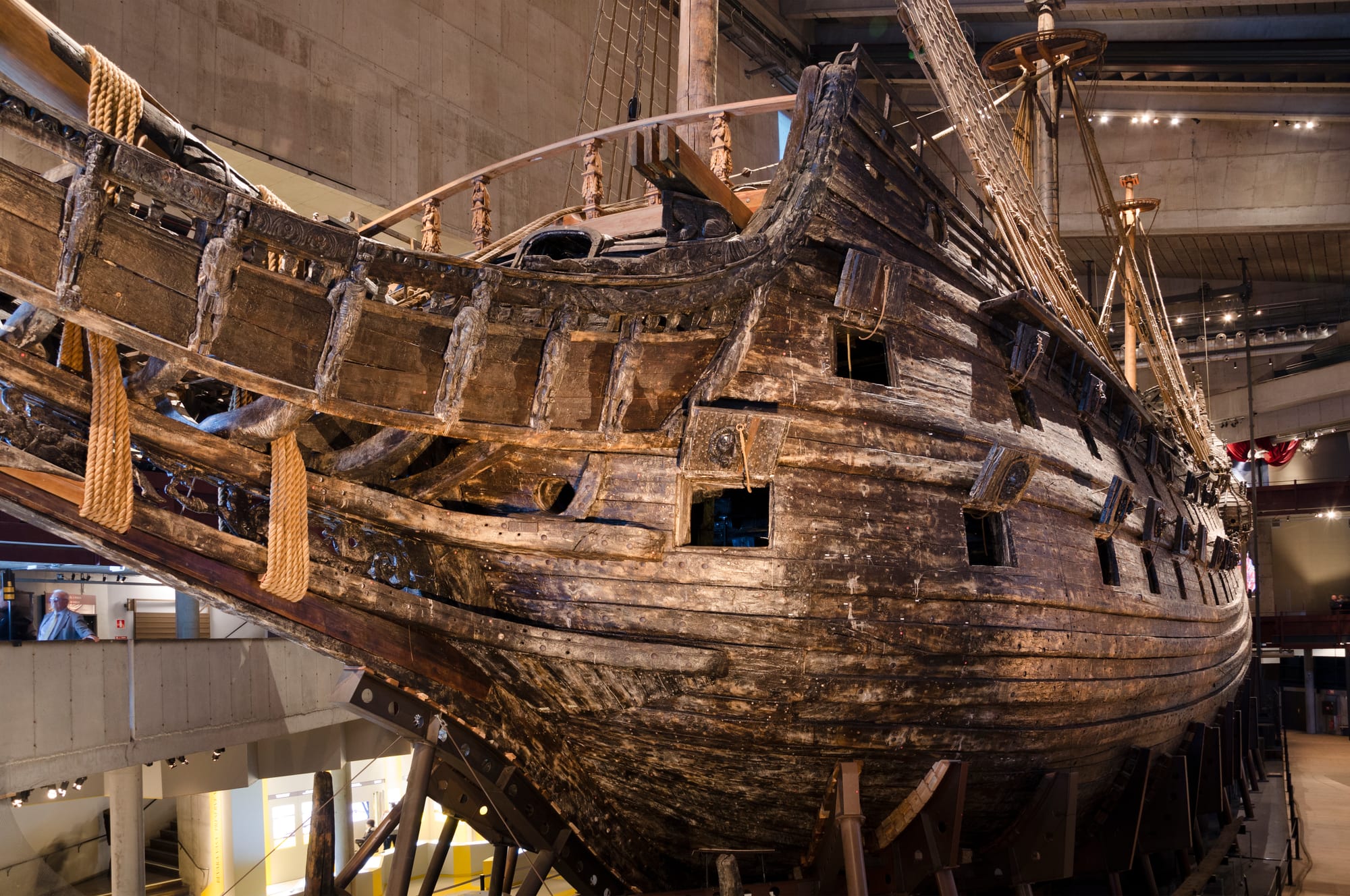
Vasa is what a truly top-heavy ship looks like. Her centre of gravity was too high, and she sank on her maiden voyage on 10 August 1628, a few minutes after meeting a wind stronger than a breeze, about 1,300 metres into the journey.
The metacentre, and why width helps
Engineers capture all this in one measurement. Draw a vertical line up from the centre of buoyancy of a slightly tilted ship, and it crosses the ship's centreline at a point called the metacentre. As long as the metacentre lies above the centre of gravity, the ship will right itself. The distance between the two, the metacentric height, is the single figure that dominates a ship's initial stability. The idea dates from the 1740s, when the French scientist Pierre Bouguer introduced the metacentre and made it possible to calculate stability rather than guess at it.
Width raises the metacentre. A wide, shallow hull has a high metacentre; a narrow, deep one has a low metacentre. In two decades, from 1988 to 2009, the largest class of cruise ship roughly doubled in width while growing only a third longer, and that breadth considerably increases their initial stability.
Too stable is a problem too
A ship can also be too stiff. The metacentric height acts like the stiffness of a spring: the larger it is, the faster the ship snaps back after each roll. A very large metacentric height gives a short, jerky roll with high accelerations on deck, which is uncomfortable for passengers and crew. A very small one gives a slow, gentle roll, comfortable but closer to the danger of capsizing. For passenger ships the ideal is a metacentric height that is sufficient but not excessive, so designers deliberately aim for the middle.
They also fight the roll itself. Cruise ships frequently use stabiliser fins, wing-like blades that stick out from the hull below the waterline. A gyroscope senses the ship beginning to roll and swivels the fins so that the water flowing past lifts one side and presses the other down, against the roll. All medium and large cruise ships can fold their fins away inside the hull when they are not needed, saving fuel. Because the fins work by the ship's forward movement, they are most effective at speed and lose their grip when the ship slows. The fin stabiliser was patented in Japan in 1922, and a Japanese cruise liner was the first ship to use one, in 1933.
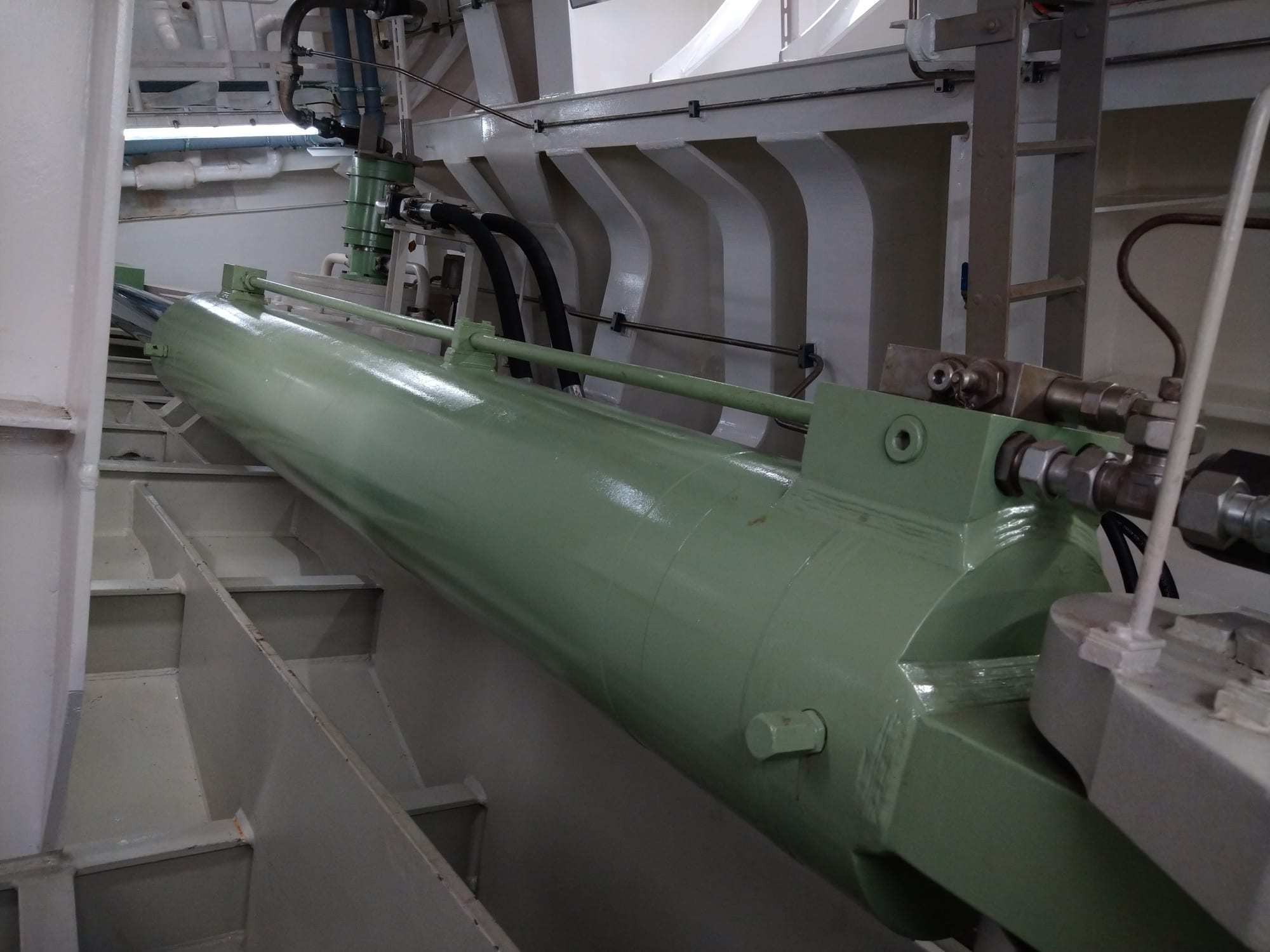
The fin itself sits outside the hull, under water.
Measured, tested and checked at sea
Stability is not left to the drawing board. Newly built ships longer than 24 metres (79 feet) undergo an inclining test, usually in calm, still water. Known weights are moved across the deck to tilt the ship by between 1 and 4 degrees, and from the measured angle engineers calculate the true metacentric height and the real position of the centre of gravity. The International Maritime Organization sets the standards a ship's stability must meet, in its International Code on Intact Stability.
The figure changes whenever the load on board changes, so most ships now carry stability computers that work out the metacentric height on the fly from the current loading. Ballast tanks, compartments that can be filled with water, let the crew adjust the ship's stability, correct a lean to one side and even out the load along the hull.
Liquid aboard brings its own risk, called the free surface effect. In a tank that is only partly full, the liquid stays level as the ship tilts and rushes to the low side, like water on a tipped tray, which pushes the ship further over. The effect grows with the cube of the tank's width, so dividing a tank with two baffles reduces it by a factor of nine. It matters most in fuel and ballast tanks, and in flooded compartments of a damaged ship.
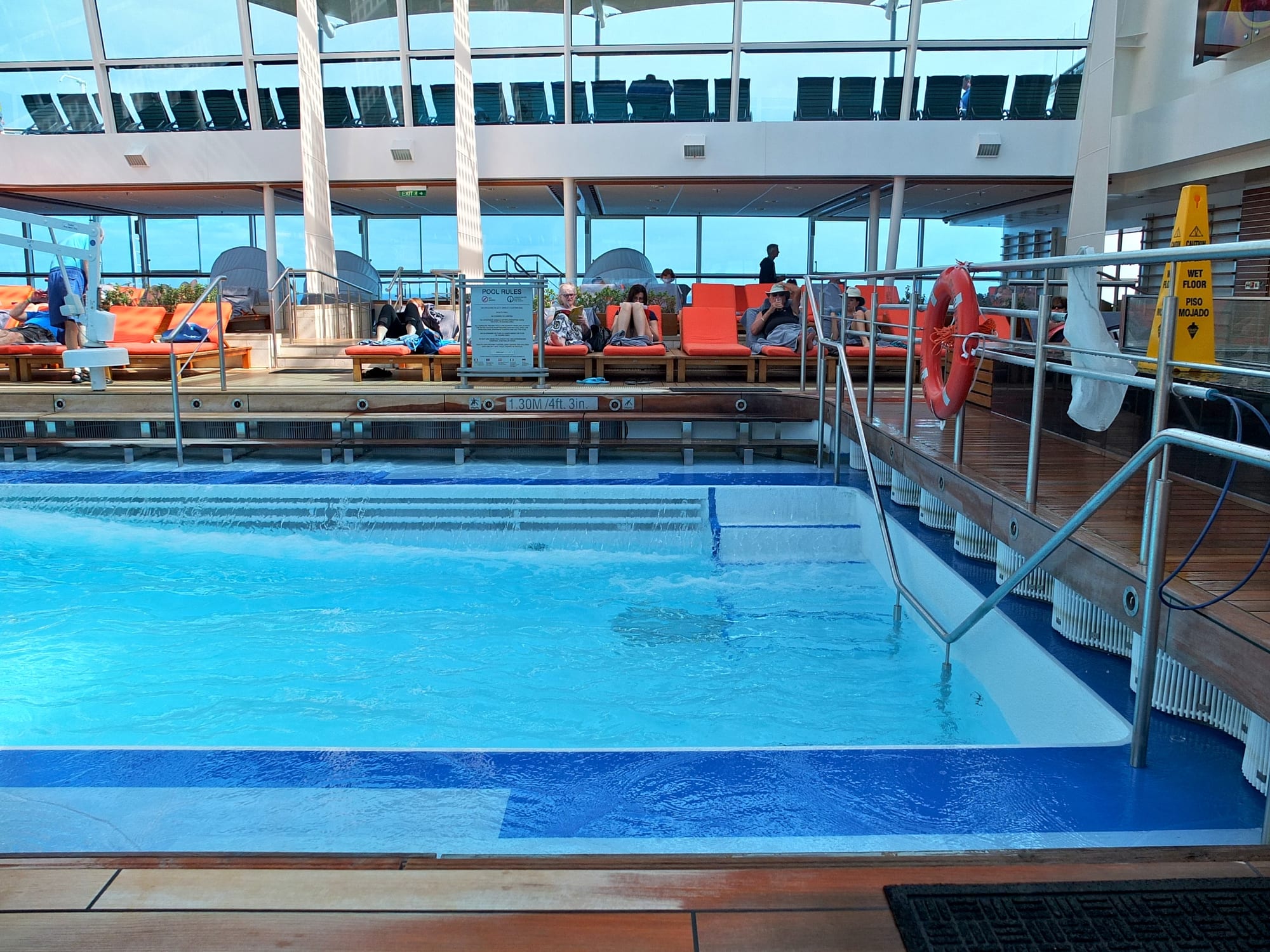
A pool is a small, visible example of the free surface effect.
What actually sinks ships
In the best-known modern cruise ship disaster, height was not the cause; water inside the hull was. On 13 January 2012 the Costa Concordia struck a rock off the Italian island of Giglio, which tore a 35-metre (115-foot) gash in her side below the waterline. Seawater flooded the engine spaces, and the ship later capsized; 32 people died. Flooding lowers a ship's metacentric height, and water moving freely inside the hull adds the free surface effect on top, which is why designers calculate stability for the damaged ship as well as the intact one.
Feeling it on board
On a large cruise ship in open water, the result of all this design is a slow, gentle lean rather than a sharp rock. In rough seas the ship rolls more, the stabilisers work hard, and the swimming pools slop over their edges, but the ship always comes back: not because its weight sits below the waterline, but because a wide, carefully loaded hull is built to push itself upright every time it tilts.