Attractions & Natural Wonders · French Polynesia
Why are Bora Bora's famous bungalows built over a sunken volcano?
Bora Bora's extinct volcano is slowly sinking, and the shallow, reef-sheltered lagoon that formed over its drowned slopes is the perfect place for houses on stilts.
By Globeway Editorial · 2 November 2026
The short answer
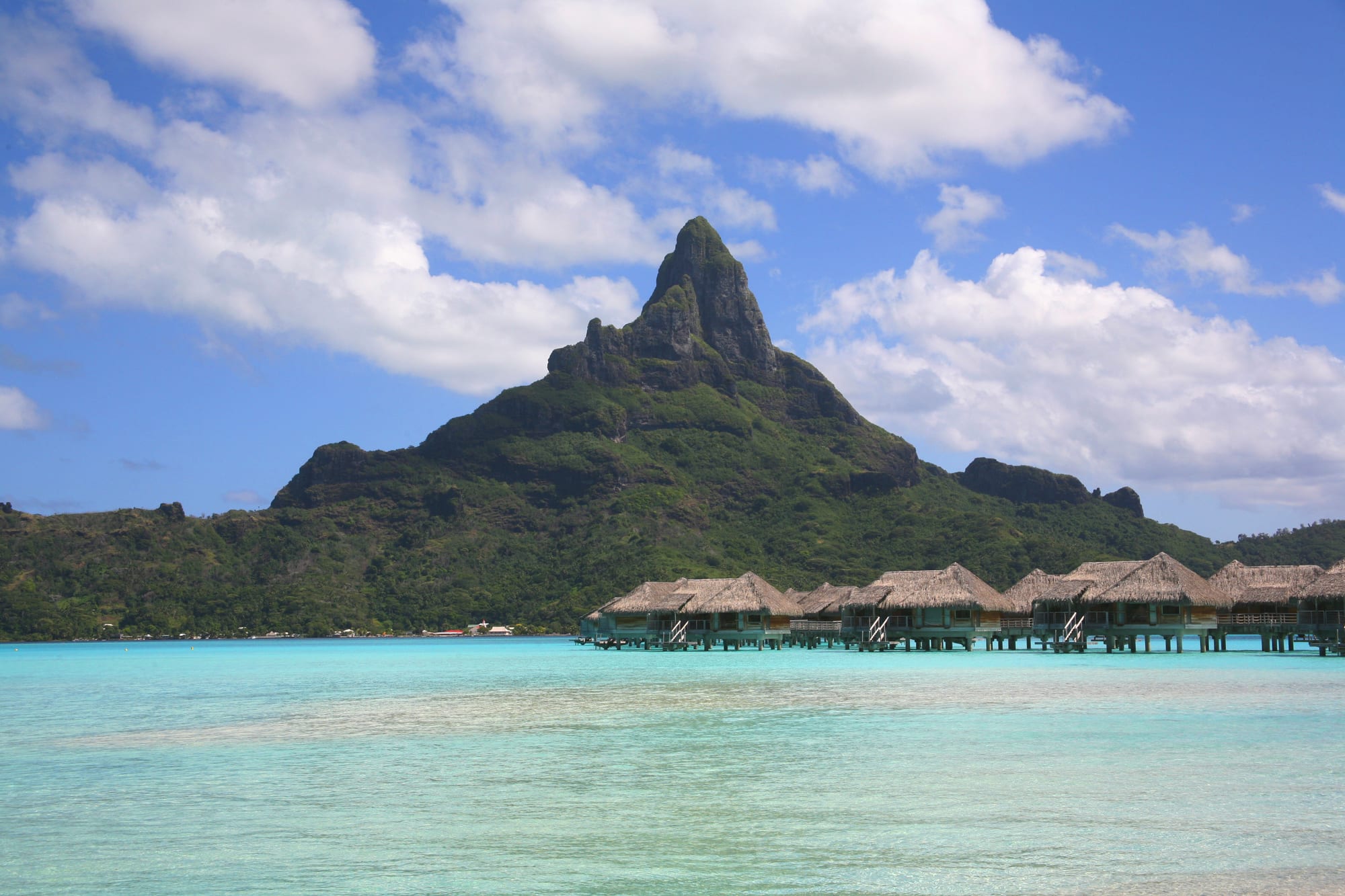
Bora Bora's bungalows stand in a lagoon, and that lagoon exists because the island is an extinct volcano, last active more than three million years ago, that has partly sunk since. As the volcano went quiet and slowly subsided, a coral reef that had grown around its shore kept building upwards towards the light. The island shrank away from the reef, leaving a ring of coral out at sea and a broad, shallow, sheltered lagoon of water between the two, lying over the volcano's drowned lower slopes.
That lagoon is the reason the bungalows are there. The barrier reef breaks the force of the open ocean and much of the water inside is shallow, so cabins can be built on stilts with the sea beneath them. Hotels began doing exactly that in 1970, and overwater bungalows are now a standard feature of most resorts on the island. The volcano itself has not fully disappeared: its peaks still rise from the middle of the lagoon.
A volcano on a moving plate
Bora Bora belongs to the Society Islands of French Polynesia, a chain of volcanic islands and atolls created by a hotspot, a place where hot material rises from deep in the Earth and punches through the crust. The Pacific Plate moves north-west over this hotspot, so each volcano is carried away from its source in turn, goes extinct and starts to sink, while a new one forms behind it.
The islands therefore get older towards the north-west. Mehetia, at the south-eastern end of the chain, is thought to sit over the hotspot today; Tahiti's lavas date from about 1.67 million to 250,000 years ago; and Bora Bora's volcano was active in the Upper Pliocene, about 3.45 to 3.1 million years ago. Since then it has subsided at least partly and been deeply eroded by heavy tropical rain. What remains is a main island only about 8 kilometres long and 5 kilometres wide, crowned by Mount Otemanu at 727 metres and Mount Pahia at 661 metres.
Darwin's sinking islands
The explanation for islands like this goes back to Charles Darwin. He had already worked out the essentials of his theory before he ever saw a coral island. Sailing on HMS Beagle, he reached Tahiti in November 1835 and saw it encircled by a coral reef with still water inside. From its hills he looked across to the island now called Moorea and noted that if its central mountains were removed, a lagoon island would remain.
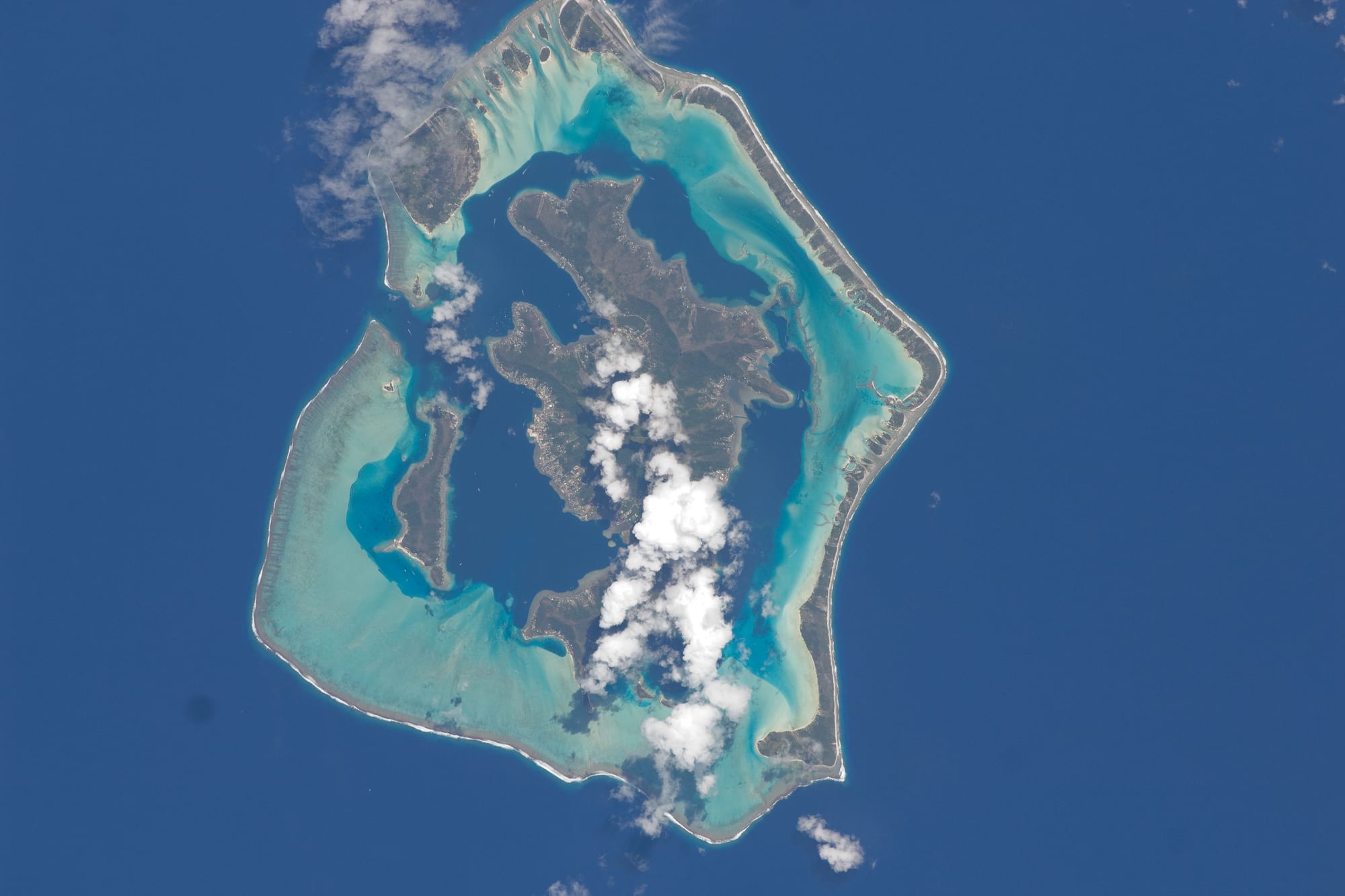
The reef rises close to the surface all the way around, broken by a single main pass on the western side.
In The Structure and Distribution of Coral Reefs, published in 1842, Darwin set out three stages. Corals first grow along the coast of a volcanic island as a fringing reef. Corals can only live within a limited depth below low tide, so as the island and the sea floor sink, the reef grows upwards to stay near the surface and becomes a barrier reef, separated from the shore by a lagoon. In the end the volcano disappears altogether, leaving an atoll, a ring of reef and coral islets around an open lagoon. In his model, the remains of a sunken island lie beneath every atoll's lagoon. His view that reefs formed as islands sank has been supported by later investigations and is no longer disputed.
Bora Bora is caught in the middle stage. Its lagoon is not a flooded crater: it occupies the sunken slopes between the old volcano and the reef. The volcano's real crater survives as Tuuraapuo Bay on the west side, whose collapsed south-western rim now pokes out of the water as the islets of Toopua and Toopua-iti.
A lagoon made for stilts
The reef surrounds the island like a sea wall. It has only one opening to the ocean, the Teavanui Pass, used by cargo and cruise ships, which must keep to the channel because much of the lagoon outside it is shallow. In places, especially to the south-west, the reef is more than 2 kilometres wide. To the north and east it carries a string of motu, low islets of coral rubble and sand, and one of them, Motu Mute, holds the island's airport.
The colours that make the lagoon famous come from that shallowness: the water turns dark indigo in the deep pass and bays, and pale shades of blue and green over the sand and coral elsewhere. Calm, clear, shallow water, sheltered from ocean swells, is just what a builder of houses on stilts needs.
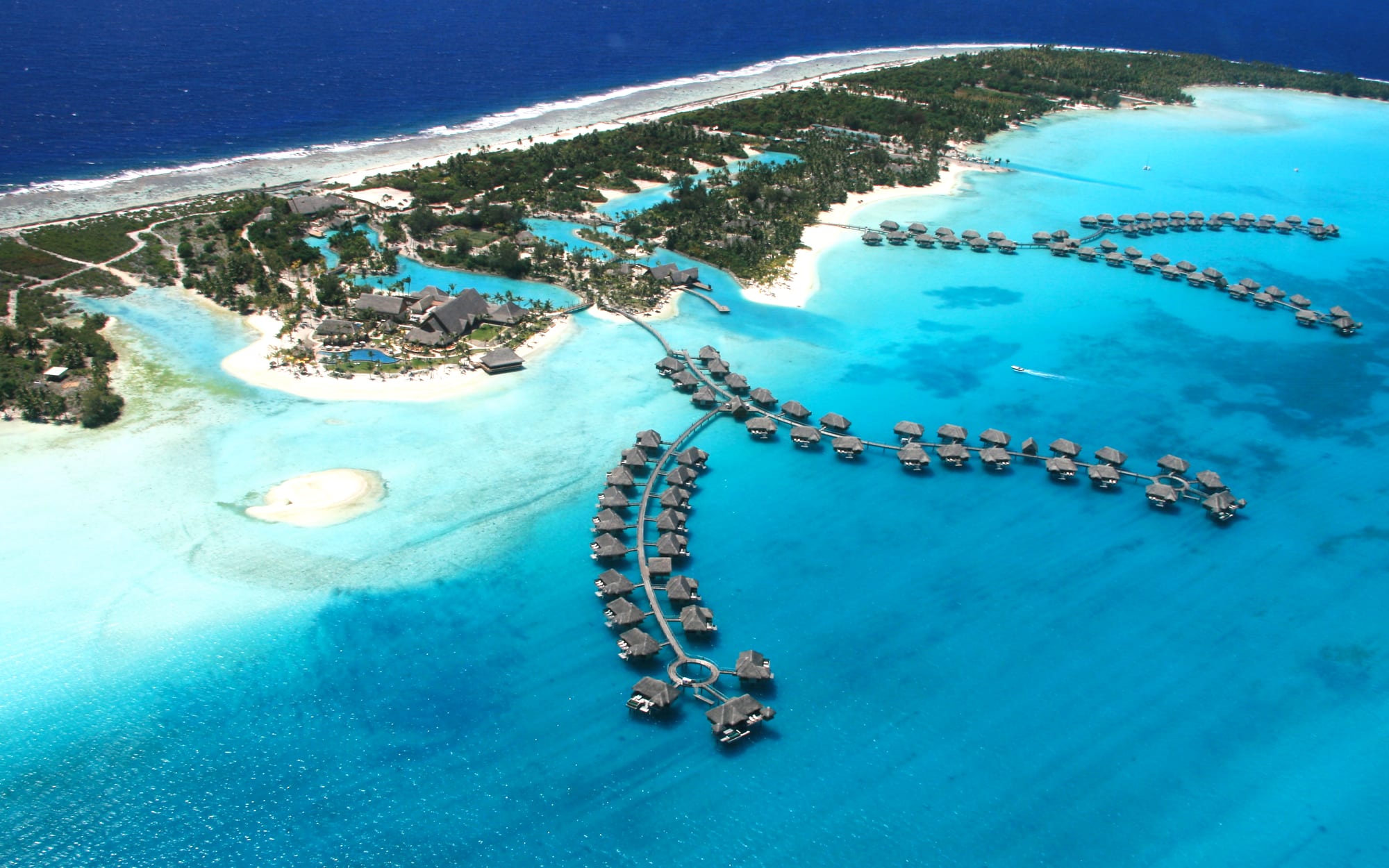
Several of Bora Bora's resorts are built on the motu that line the reef, facing the lagoon.
From Raiatea to the world
The overwater bungalow is a modern invention, inspired by the traditional stilt houses of South Asia and the Pacific. The first were built in 1967 on Raiatea, Bora Bora's larger neighbour in the Society Islands, by three American hotel owners, Jay Carlisle, Donald McCallum and Hugh Kelley, and they were an immediate success.
On Bora Bora, the Hotel Bora Bora had opened in 1961, and nine years later, in 1970, the island's first overwater bungalows were built on stilts over the lagoon. Through the 1970s tourism to French Polynesia boomed, and the bungalows became synonymous with the region, especially for honeymoons. The idea spread across Asia, most famously to the Maldives, and later to the Caribbean. Today the economy of Bora Bora, home to an estimated 10,605 people in 2017, is driven almost entirely by tourism, and its bungalows range from fairly basic to extremely expensive.
The volcano's slow future
If Darwin's model holds, Bora Bora is a snapshot of a process still under way. Maupiti, the oldest island in the chain at around 5 million years, lies at its north-western end and shows a later stage: a smaller central island inside a wide lagoon and a ring of low islets. Over geological time Bora Bora's peaks should wear down and sink further, and if the reef keeps pace with any change in sea level, the island will eventually become an atoll, a ring of coral around a lagoon where the volcano used to be.
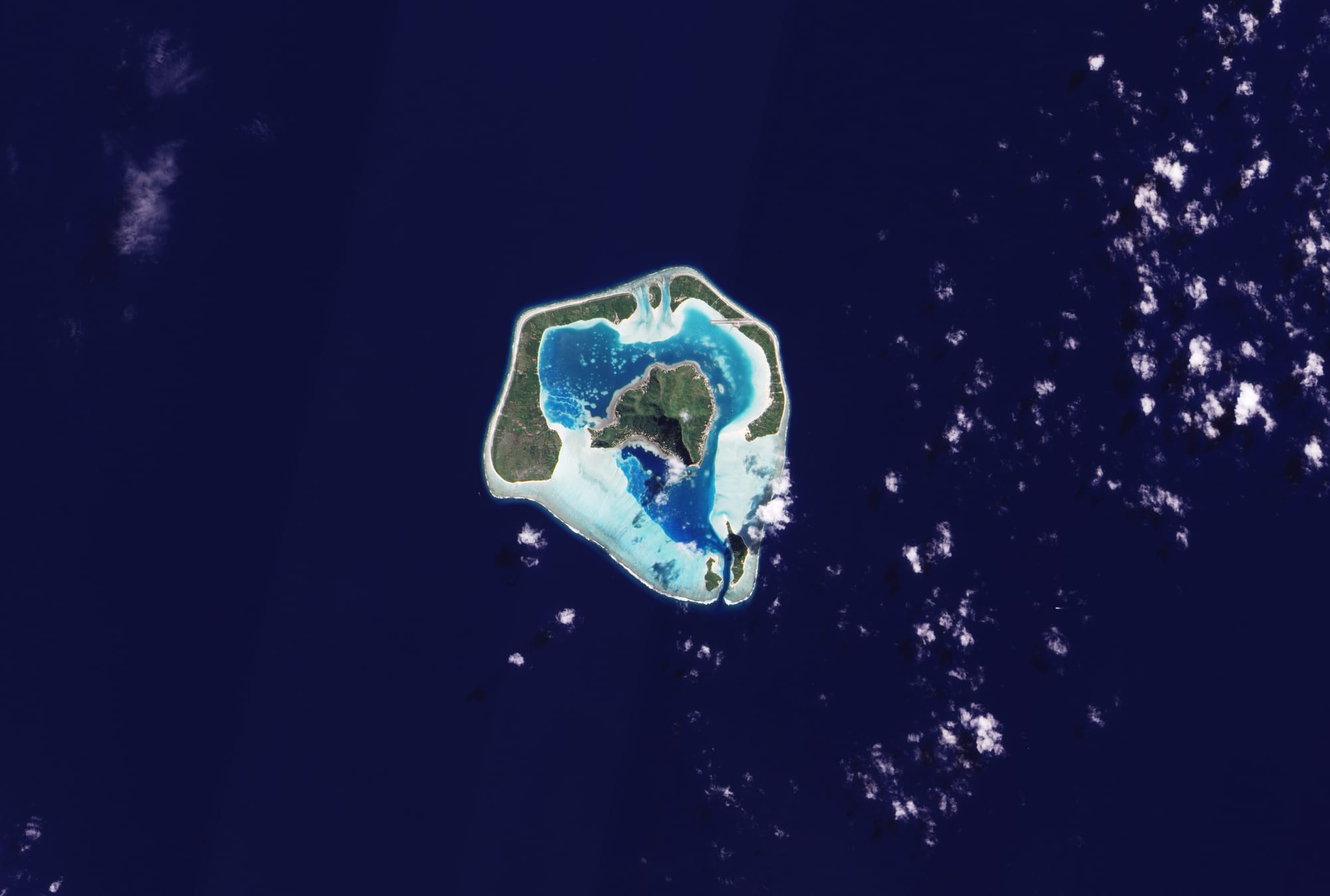
Maupiti's volcano, a highly eroded shield volcano, built up between about 4.8 and 4 million years ago.
For visitors, the lagoon is the main attraction, explored by glass-bottomed boat, snorkelling and diving. Shark fishing has been banned since 2012, and sharks, manta rays and other rays are common in the surrounding waters. The dry season runs from about June to October, while November to April is wetter, with heavy downpours and occasional violent storms.