History · Northern Mariana Islands
Why did the atomic bombers take off from the tiny island of Tinian?
Tinian lay within bomber range of Japan, held what became the world's largest airfield, and was quieter and closer than crowded Guam.
By Globeway Editorial · 2 November 2026
The short answer
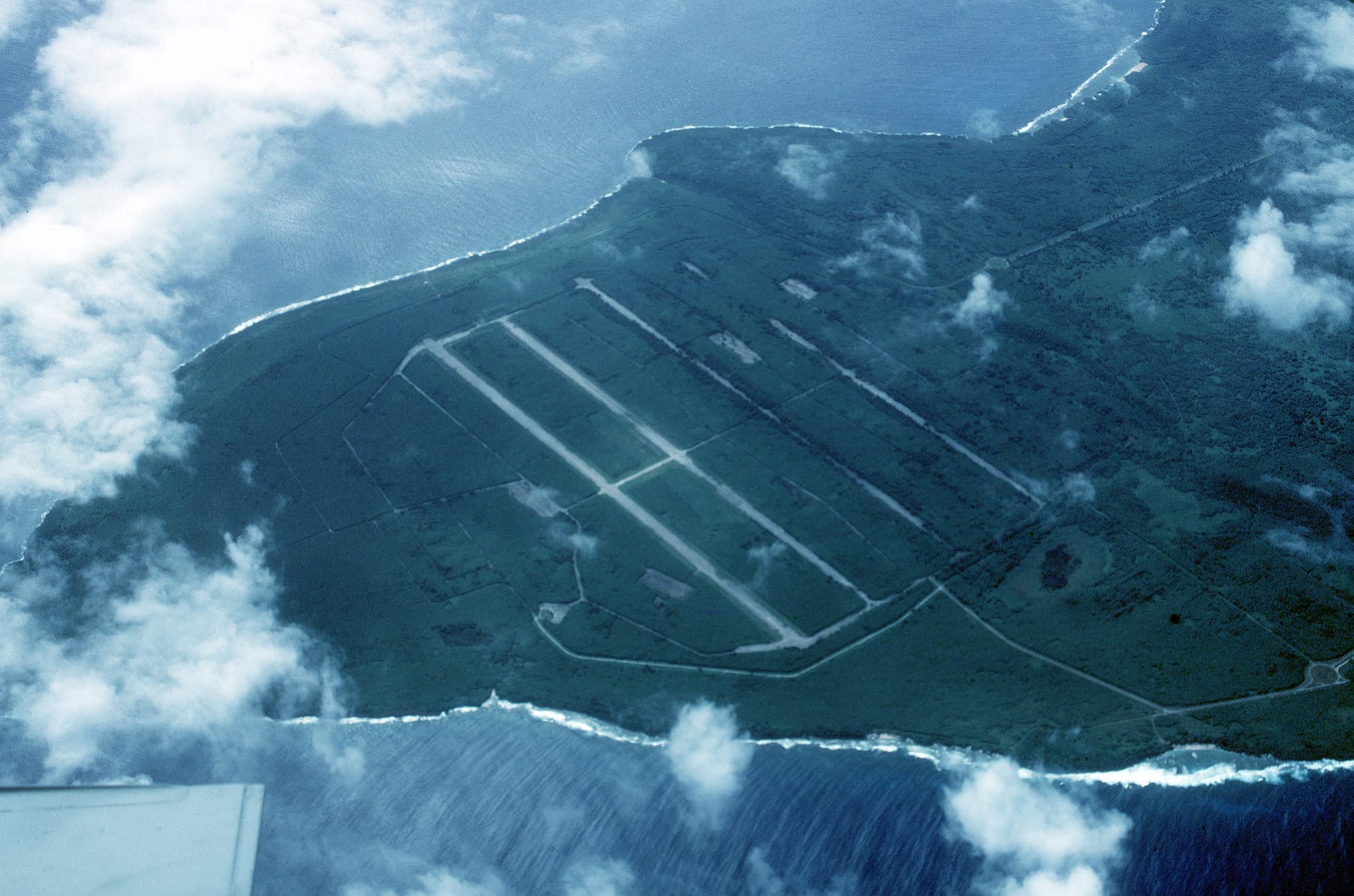
The bombers that dropped the atomic bombs on Hiroshima and Nagasaki in August 1945 took off from Tinian because it was close enough to Japan and big enough to hold an enormous airfield. Tinian lies about 1,500 miles from mainland Japan, within reach of the new B-29 Superfortress bomber, and after United States forces captured it in the summer of 1944, navy construction crews turned its flat northern end into North Field, which on completion was the largest airfield in the world.
When the planners of the atomic missions went looking for a base in early 1945, they expected to use Guam. They found its harbour congested and building crews in short supply. Tinian had two good airfields and sat 125 miles further north, an important difference for aircraft that might be carrying a dangerously heavy load. Its northern tip also gave room to keep a secret unit apart from everyone else. So the 509th Composite Group, the unit trained to deliver the bombs, moved to North Field, and the Enola Gay and Bockscar flew from there.
Why the Marianas mattered
Tinian is one of the three main islands of what is now the Commonwealth of the Northern Mariana Islands, just south of Saipan. It covers about 39 square miles, and its highest point is only 614 feet above the sea. Spain and then Germany had ruled it, and after the First World War Japan took over and made it largely a sugar plantation.
For the United States, the attraction was range. In early 1944 its B-29 bombers were operating from bases in China, where they were ineffective. From the Marianas, Japan's home islands lay within their effective range, and supplies could come straight across the Pacific from ports on the American west coast. Marines landed on Tinian on 24 July 1944, two weeks after the battle for neighbouring Saipan ended, and the fighting was over by 1 August. Of a Japanese garrison of about 8,000, only a few hundred were taken prisoner. An estimated 2,610 civilians also died, most in the fighting, others in mass suicides or at the hands of Japanese soldiers.
The world's largest airfield
Even before the fighting ended, 1,500 Seabees, the navy's construction battalions, were repairing the small Japanese runway at Ushi Point. Working day and night, often under fire, they extended it and added more. North Field grew to four parallel runways, each 8,000 feet long, with miles of taxiways and hardstands, or parking pads, for 265 B-29s. Building it meant moving nearly a million cubic yards of earth and coral. Nearly the whole northern end of the island became airfield.
The Seabees laid out the base like New York City's Manhattan, naming its roads after New York streets such as Broadway and Riverside Drive, and calling the open area between North and West Fields Central Park. Accommodation was built for more than 45,000 service personnel. From early 1945 North Field's B-29s flew raids against Japan, including the firebombing of Tokyo on 9 to 10 March, which killed more than 90,000 people in a single night.
Choosing Destination O
Manhattan Project and Army Air Forces officials agreed in December 1944 that the atomic missions would fly from the Marianas. In February 1945 Commander Frederick Ashworth travelled to Guam, but the crowded harbour and lack of builders there turned him towards Tinian, which air force officers suggested he look at. Tinian was given the code name Destination O, and supplies were shipped to it directly rather than through Guam, as was usual.
Secrecy shaped everything. The 509th Composite Group, about 1,800 men, began arriving in May 1945 and was given its own base area on the island's northern tip, several miles from the other bomber groups. Its B-29s were painted with the tail markings of other units, because it was feared that Japanese survivors still hiding on Tinian were reporting by clandestine radio to Tokyo. Seabees built air-conditioned assembly buildings for the bombs and two loading pits with hydraulic lifts. The bombs were too large to load in the usual way, so each B-29 was manoeuvred over a pit with its bomb doors open.
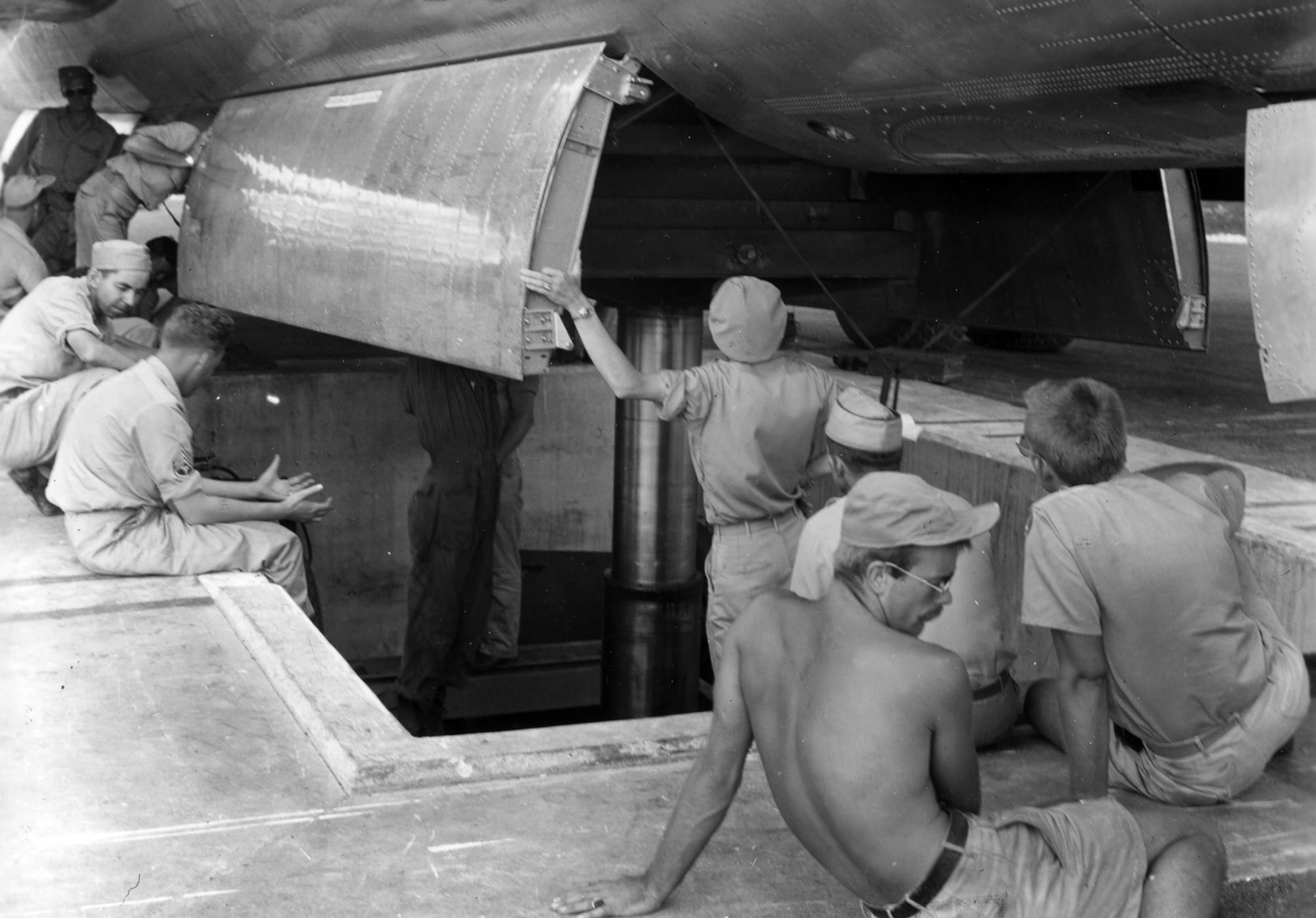
Each bomb was lifted into the aircraft from below, using a hydraulic hoist in the pit.
August 1945
The components arrived by sea and air. The heavy cruiser USS Indianapolis delivered parts for the uranium bomb, Little Boy, on 26 July. Four days later, on her way onward, she was torpedoed by a Japanese submarine and sank in 12 minutes; no US warship sunk at sea has lost more sailors.
Safety worried the scientists. In a single week four B-29s crashed and burned on Tinian's runways, and the planners considered evacuating the 20,000 people on the island in case a loaded bomber did the same. Instead they decided the Hiroshima bomb would be armed in flight, after take-off.
- 24 July 1944
US Marines land on Tinian.
- 1 August 1944
The Battle of Tinian ends.
- February 1945
Tinian is chosen over Guam as the atomic base.
- May 1945
The 509th Composite Group begins arriving at North Field.
- 26 July 1945
USS Indianapolis delivers Little Boy's components.
- 6 August 1945
Enola Gay takes off at 2.45 a.m. for Hiroshima.
- 9 August 1945
Bockscar takes off at 3.49 a.m.; the bomb falls on Nagasaki.
The Enola Gay took off from North Field at 2.45 a.m. local time on 6 August, about six hours' flight from Japan, and returned that afternoon. Three days later Bockscar left with the plutonium bomb, Fat Man; its primary target, Kokura, was obscured by cloud and smoke, and the bomb fell on Nagasaki. The two bombings killed between 150,000 and 246,000 people, most of them civilians, and remain the only uses of nuclear weapons in war.
The pits today
After the war the airfield emptied quickly. The last bomber group left in June 1946, the base closed in 1947, and the jungle crept back over the runways. North Field and the nearby landing beaches now form a National Historic Landmark District. Both atomic bomb loading pits were reopened for the 60th anniversary of the battles of Saipan and Tinian, and they are now covered by glass roofs on metal frames so visitors can look inside.
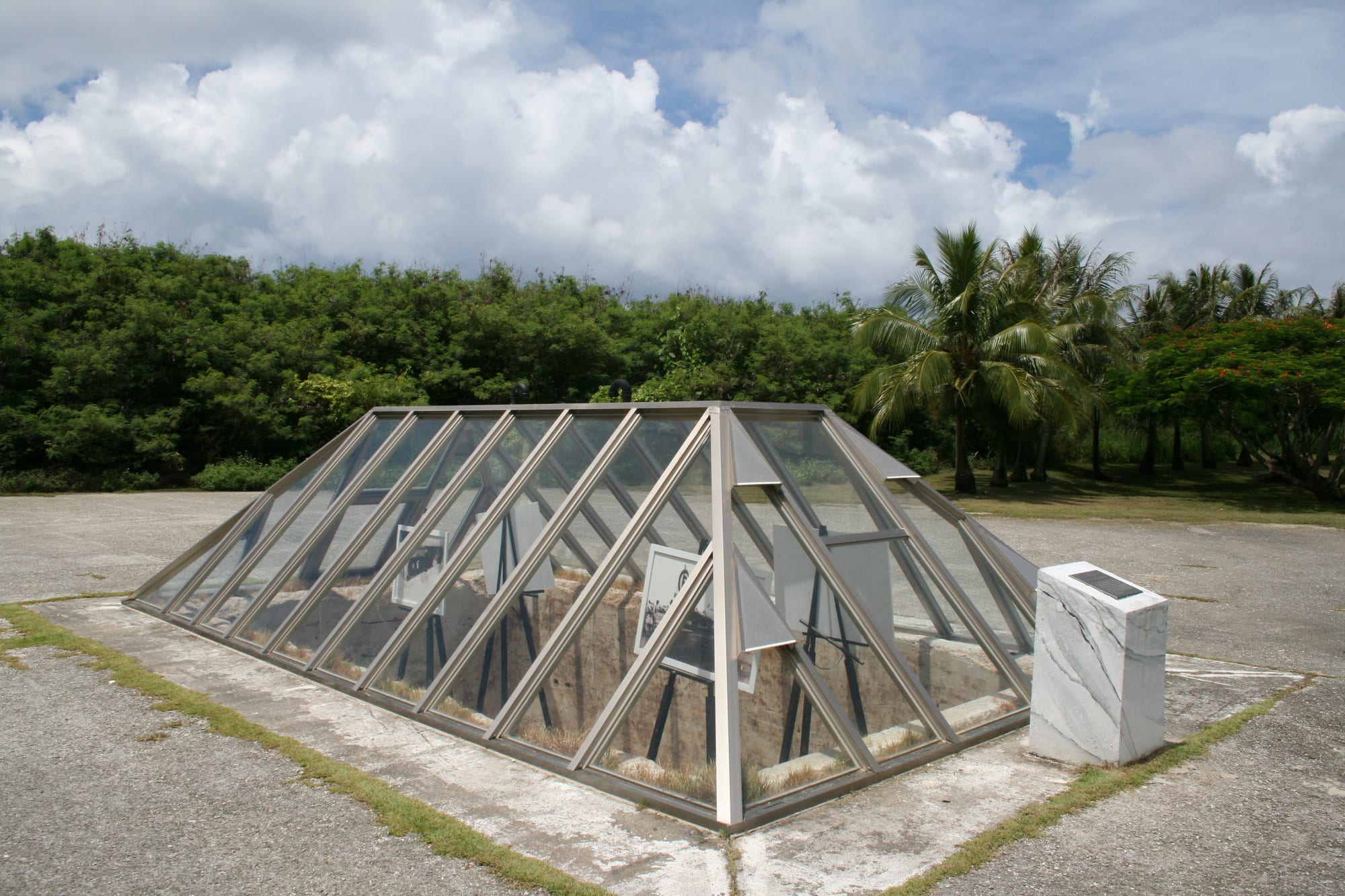
The pits sit beside the old runways a few miles north of San Jose, Tinian's largest village.
The airfield's story is not over. In 2024 the US Air Force awarded a $409 million, five-year contract to restore North Field as a place to disperse aircraft in a crisis, initial operations began there on 31 May 2026, and two of the four runways are scheduled for completion by 2027. Some of the island's roughly 2,000 residents have voiced concern that renewed military use could make Tinian a target in a future conflict.