Attractions & Natural Wonders
Why do glaciers look blue?
Ice quietly absorbs red light, and in the thick, bubble-free ice of a glacier light travels far enough for only the blue to survive.
By Globeway Editorial · 2 November 2026
The short answer
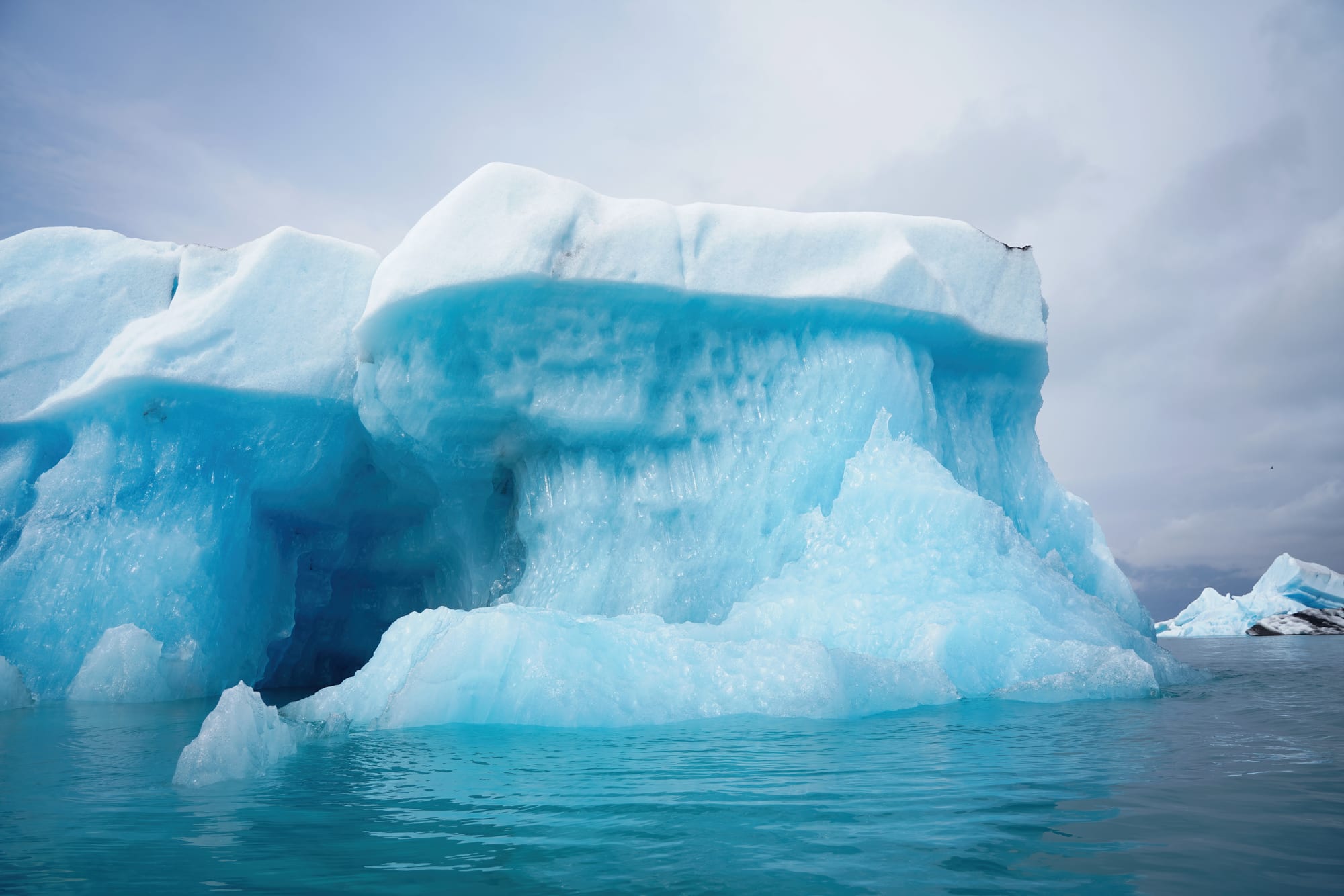
Ice is not truly colourless. Like liquid water, it absorbs a little light at the red end of the spectrum and lets blue light through. In an ice cube the effect is far too weak to notice, but glacier ice is thick, dense and almost free of air bubbles, so light can travel a long way through it. By the time it comes back out, much of the red has been absorbed, and what reaches the eye is blue.
Ordinary ice and snow look white because they are full of air bubbles and crystal surfaces that bounce all colours of light straight back before much can be absorbed. Glaciers are made of snow that has been squeezed for years under its own weight until most of that air has been pressed out. The blue is not the same effect that makes the sky blue, though that explanation is often given.
A colour that belongs to water itself
Small amounts of water look colourless, but pure water has a faint blue tint that deepens as the thickness grows. The cause lies in the water molecule. Its two bonds between oxygen and hydrogen vibrate, and they mostly absorb infrared light, which is invisible. Higher harmonics of those vibrations, called overtones, reach into the visible spectrum and absorb red light. In liquid water at 20 °C (68 °F) these absorptions sit at wavelengths of about 740 and 660 nanometres, both red.
Because the overtones are weak, the effect only builds up over distance. Water owes its blueness to this selective absorption of red light, and it shows after light has passed through more than about 3 metres (10 feet) of it. Ice behaves in the same way, with its absorption shifted to slightly lower energies, so ice appears blue with a slightly greener tint than liquid water. Since absorption is cumulative, the colour gets stronger the thicker the ice is, or the more times light reflects around inside it.
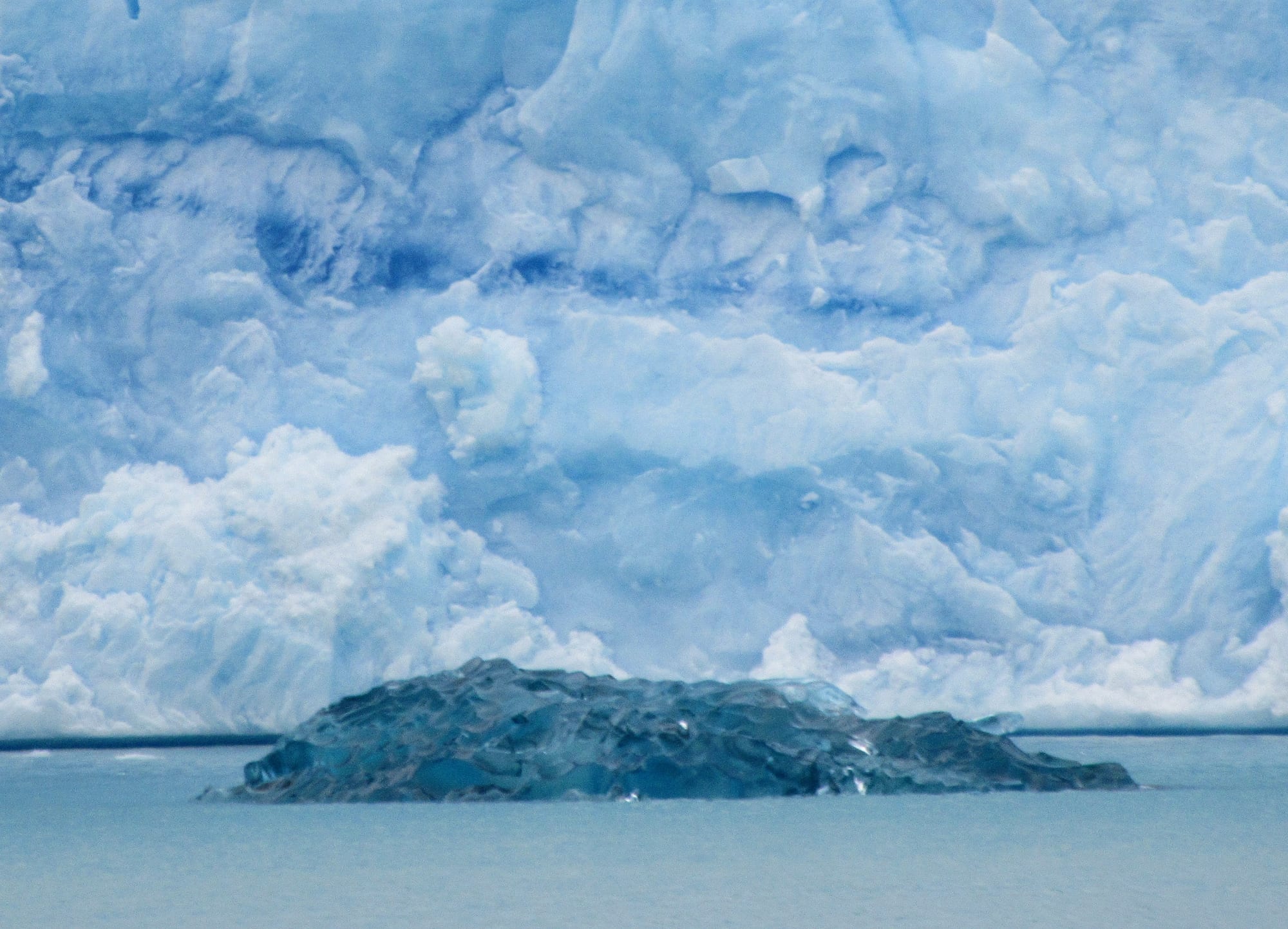
Glacier ice looks deepest blue up close and where it is shaded from direct light, because light has bounced a long way through it before escaping.
From snowflake to blue ice
A glacier forms where more snow falls than melts, year after year, often for centuries. As the snow piles up it refreezes into granular snow called névé. Under the weight of the layers above, the grains are crushed together into firn, from a Swiss German word meaning "last year's". Firn looks like wet sugar but is hard enough to resist a shovel, and its density ranges from 0.35 to 0.9 grams per cubic centimetre. Where its crystals touch they bond, squeezing the air between them out towards the surface or into bubbles.
Over a period of years the firn is compacted further into glacial ice. The pressure drives out most of the remaining air, which is why glacier ice is slightly denser than ice made by freezing water. It also enlarges the ice crystals, lengthening the path that light travels through each one and increasing the absorption of red light.
Why the surface is usually white
Snow-covered glaciers look white from a distance. Even exposed blue ice does not stay blue for long. Once it meets warmer air, cracks and fissures open in the surface layers and break up the large crystals. Within hours these air-filled fissures cloud the surface and make it look white again. The blue returns only when the ice breaks or rolls over to reveal ice that air could not reach.
That is why the brightest blues appear in crevasses, at freshly broken ice fronts and on icebergs that have just turned over. In January 2011 visitors at Tasman Glacier in New Zealand watched an iceberg roll over to reveal startling blue ice that had stayed underwater for months since it broke off the glacier.
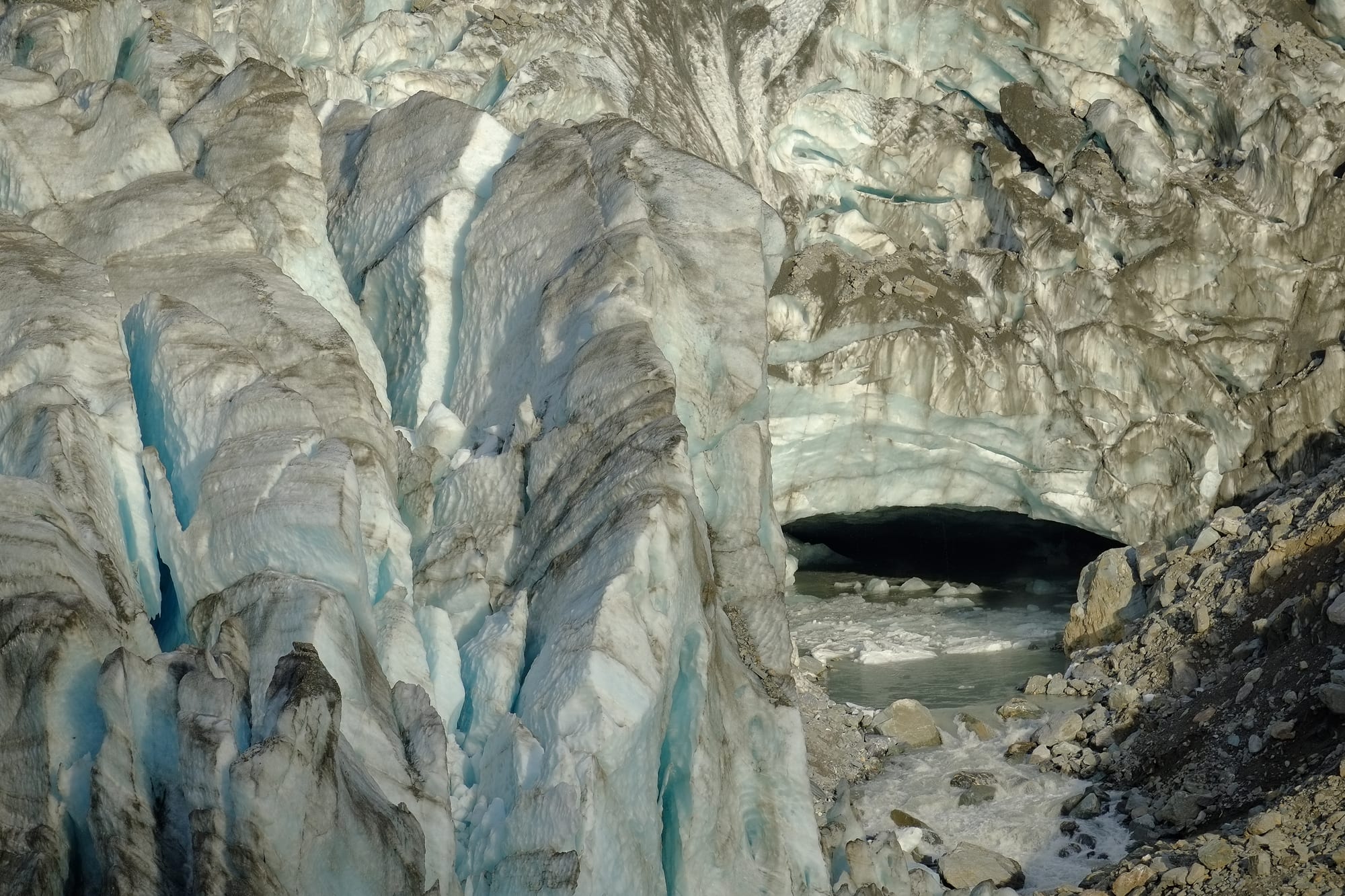
Fox Glacier is one of the most accessible glaciers in the world, with its end as low as 300 metres above sea level.
Colour can also come from what the ice carries. Icebergs are generally white because of their snow cover, but sediment, algae, seawater and the lack of bubbles can make them green, blue, yellow, black or striped.
Not the sky's kind of blue
The sky is blue because of Rayleigh scattering: molecules in the air, far smaller than a wavelength of light, scatter blue light much more than red. The blue of glacier ice is sometimes put down to the same process acting on the bubbles in the ice, but that is a misconception. Glacier ice is blue for the same reason that a deep swimming pool with white walls looks blue: water molecules absorb red light. Scattering from bubbles would make the ice whiter, not bluer, which is exactly why bubbly ice looks white.
Where the blue is easiest to see
Jökulsárlón, a lagoon at the foot of the Breiðamerkurjökull glacier in southern Iceland, has been described as a ghostly procession of luminous blue icebergs. The icebergs come in two shades, milky white and bright blue, depending on how much air is trapped inside. The lagoon formed after the glacier began retreating in the late 19th century, and in 2009 it was reported to be the deepest lake in Iceland, at more than 284 metres.
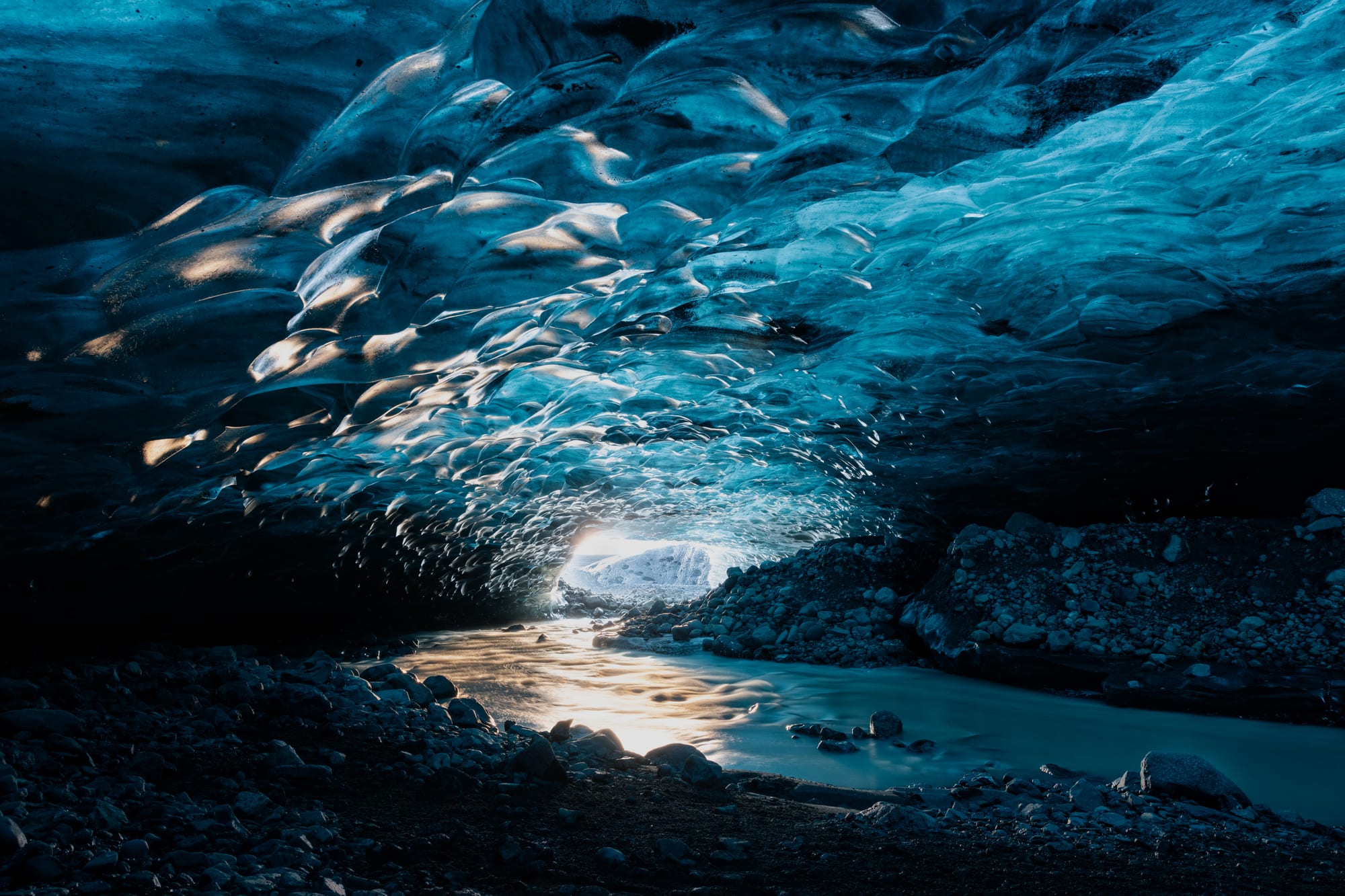
Glacier caves change constantly. The Paradise Ice Caves on Mount Rainier in the United States had disappeared by the 1990s as the glacier retreated.
The calving front of Perito Moreno Glacier in Argentine Patagonia and the crevassed end of Fox Glacier in New Zealand also show the colour well. In Antarctica, winds strip the snow from about 1 percent of the ice sheet, exposing blue-ice areas that collect meteorites, have yielded ice up to 2.7 million years old and are hard enough to serve as runways for aircraft on wheels.