Attractions & Natural Wonders
Why does hot weather feel so much worse when it's humid?
The body sheds heat by evaporating sweat, and damp air slows that evaporation, so the same temperature feels far hotter and becomes more dangerous.
By Globeway Editorial · 2 November 2026

The short answer
The human body keeps cool in hot weather mainly by sweating, but sweat only cools the skin when it evaporates. Evaporation carries heat away from the body. Humid air already holds a lot of water vapour, so sweat evaporates more slowly, or not at all. It sits on the skin without doing its job, and body heat builds up.
That is why 32 °C (90 °F) with 70 percent relative humidity feels, according to the US National Weather Service's heat index, as hot as 41 °C (106 °F) in dry air. In very humid heat the body can lose the ability to cool itself altogether, which makes muggy heatwaves not just uncomfortable but dangerous.
Sweat works only when it evaporates
A body at rest loses heat in four ways: by evaporation, convection (warm air carried away from the skin), conduction (direct contact) and radiation. When the skin is warmer than the surrounding air, convection and conduction can carry heat away. When the air is hotter than the skin, the only way left for the body to get rid of heat is evaporation.
Sweating is the main means of doing it. The eccrine glands, spread over most of the body, release a watery, slightly salty fluid. As the most energetic water molecules escape from the skin into the air, they take with them energy absorbed from the body, and the skin and the blood vessels just beneath it cool down. An adult can sweat at up to 2 to 4 litres an hour.
The cooling depends directly on how fast the sweat evaporates, and that depends on the air. The body keeps producing sweat to hold its normal temperature of around 37 °C even when it is sweating faster than the sweat can evaporate, which is why people end up drenched on humid days without exercising. Comfort falls as unevaporated sweat builds up.
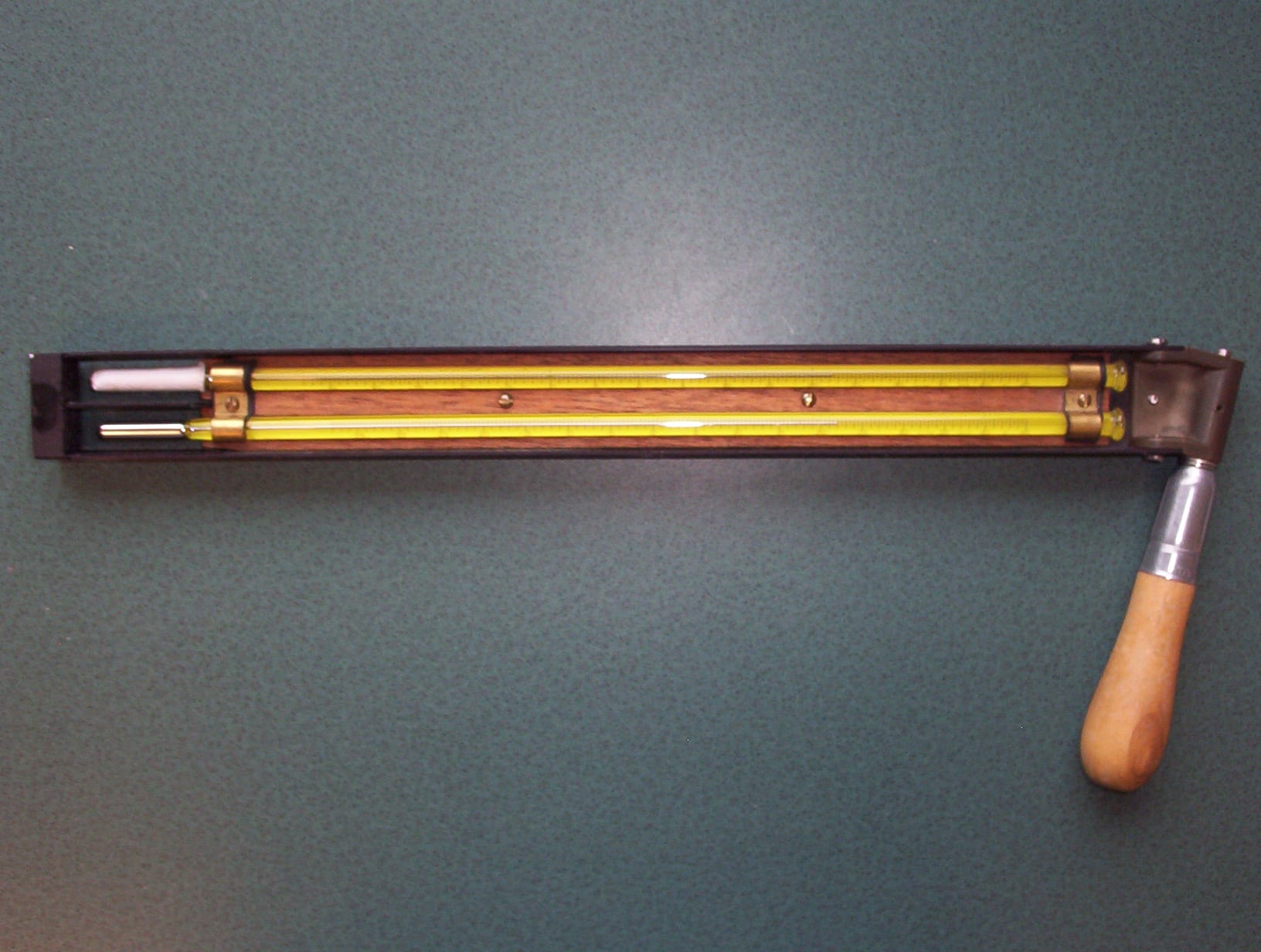
The wet thermometer behaves like sweaty skin. In dry air it reads below the air temperature; at 100 percent humidity nothing can evaporate and it reads the same as the dry one.
What humidity actually measures
Humidity is the amount of water vapour in the air. Warm air can hold more vapour than cold air before it becomes saturated, so weather reports usually give relative humidity: how close the air is to saturation at its current temperature. The same amount of vapour gives a higher relative humidity in cool air than in warm air.
Another measure is the dew point, the temperature to which the air would have to cool for its vapour to start condensing. Because it reflects the actual amount of moisture, it is a useful guide to comfort. People used to temperate climates often begin to feel uncomfortable when the dew point rises above 15 °C (59 °F); at 20 °C almost everyone feels sticky; and most of them consider a dew point above 21 °C oppressive. Experience shifts the threshold, so someone from Singapore or Miami may tolerate muggy air that a visitor from London or Chicago finds hard to bear.
Humidity matters little in cold weather, a little more at moderate temperatures and a great deal in the heat. A given relative humidity also pushes the heat index up more steeply the hotter it gets.
Putting a number on the feeling
The heat index was worked out in 1979 by the researcher Robert G. Steadman, using assumptions about a typical person's size, clothing and activity. It gives the temperature that would feel the same at a fixed, moderate level of humidity. On the US National Weather Service's table, 36 °C (96 °F) with 65 percent humidity has a heat index of 49 °C (121 °F). The figures assume shade and a light breeze; full sunshine can add up to 8 °C. Canada uses a similar measure, the humidex, introduced in 1965.
At the extremes, the numbers become startling. On 8 July 2003 Dhahran in Saudi Arabia recorded a temperature of 42 °C (108 °F) with a dew point of 35 °C, giving a heat index of 81 °C (178 °F), the highest on record. A reading of 82.2 °C from a weather station in southern Iran in August 2024 would beat it if confirmed.
The point where the body cannot cope
Scientists measure the cooling power of the air with the wet-bulb temperature: the reading of a thermometer whose bulb is wrapped in a wet cloth, which is the lowest temperature that evaporation can reach in those conditions. In dry air the wet bulb reads far below the air temperature. In saturated air the two are the same.
Because the body must keep its core near 37 °C, a sustained wet-bulb temperature above 35 °C (95 °F), equivalent to a heat index of about 71 °C, is likely to be fatal even to fit, healthy people resting in the shade in front of a fan. At that point the body stops shedding heat to its surroundings and starts gaining it. A 2022 study found that the real limit for young, healthy adults going about everyday activities was 5 to 10 °C lower than that theoretical figure. A 2020 study reported that wet-bulb temperatures of 35 °C had already occurred, though too briefly and in too small an area to cause deaths.
Dry heat and wet heat compared
Death Valley in California holds the record for the highest air temperature measured on Earth, 56.7 °C (134 °F) at Furnace Creek on 10 July 1913, though some meteorologists now dispute that reading. Its air is extremely dry, and in dry air sweat evaporates quickly and cools the skin faster.

The valley is so dry because it lies in the rain shadow of four mountain ranges, including the Sierra Nevada.
The muggiest heat is found in places such as Kolkata, Chennai and Kochi in India and Lahore in Pakistan, where warm, wet monsoon seasons feel like a lukewarm sauna. Sukkur, on the Indus River in Pakistan, often has dew points above 30 °C during the monsoon. In such conditions, anything that helps sweat evaporate helps the body: a breeze or a fan speeds evaporation, and light, loose clothing lets perspiration escape and cool the skin.