Daily Life
Why are eastbound flights often shorter than westbound ones?
It is not about going home but about going east. A river of fast wind high in the sky pushes eastbound planes along and holds westbound ones back.
By Globeway Editorial · 2 November 2026
The short answer
The flight home is only shorter when home lies to the east. What really matters is direction. High above the middle latitudes of both hemispheres, narrow rivers of fast wind called jet streams blow from west to east around the planet. A plane flying east rides them like a swimmer going with the current; a plane flying west has to push against them. The engines and the airspeed are the same both ways, but the speed over the ground is not.
So a traveller from Europe who visits New York has a slower flight out and a quicker flight home. A New Yorker visiting Europe gets the opposite: a quick night flight east and a longer daytime flight back. On routes that run mostly north to south, the effect is much smaller.
A river of air at cruising height
Jet streams are fast, narrow currents of air near the tropopause, the boundary between the lowest layer of the atmosphere, where weather happens, and the calmer layer above it. Each hemisphere has a polar jet at around 9 kilometres (30,000 feet) above sea level, flowing at about 180 km/h (110 mph) and often much faster. Speeds of 400 km/h have been measured. A weaker subtropical jet runs closer to the equator and a little higher.
That height matters because it is where airliners fly. On the busy routes between North America and Europe, aircraft cruise between about 8,800 and 12,500 metres, right in the band where the polar jet blows hardest. In the Northern Hemisphere it flows over the middle and northern latitudes of North America, Europe and Asia and the oceans in between, most often between 30 and 60 degrees north: latitudes crossed by many of the world's busiest long-haul routes.

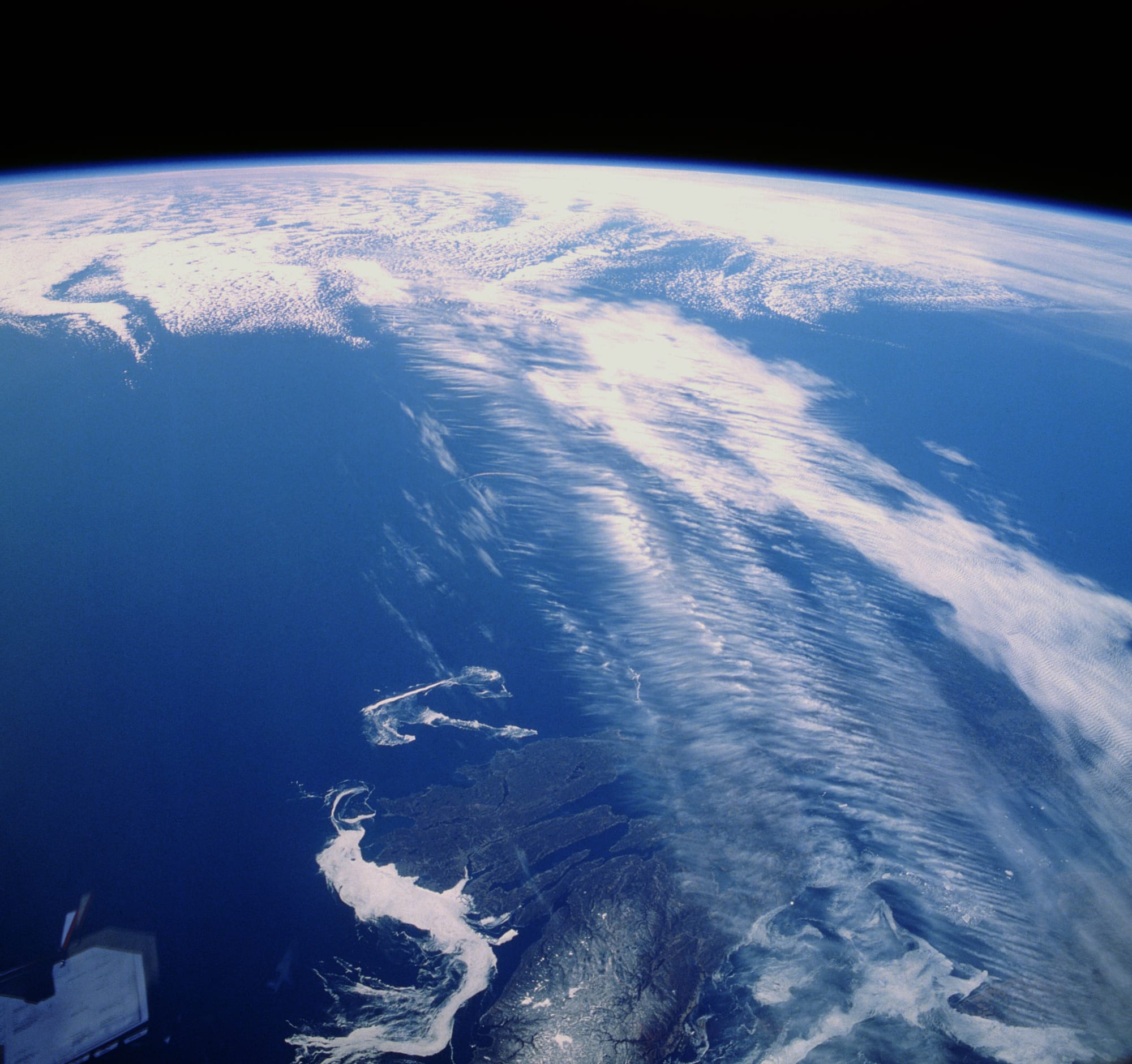
On some days the jet stream draws its own map in the sky, combing cloud into long streaks that race eastwards.
Why the wind blows east
The jet streams exist because the equator is warmer than the poles. Warm air spreading towards the poles is deflected by the Coriolis effect, the apparent sideways push created by the Earth spinning on its axis. Air moving towards either pole is turned towards the east, and the wind grows stronger with height, peaking just below the tropopause. The result is a ring of westerly wind, meaning wind blowing from the west, around each hemisphere.
The wind is strongest where warm and cold air masses meet most sharply, because the speed depends on the difference in temperature between them. That is why the jet does not run in a neat circle: it meanders north and south in great loops, splits, rejoins and shifts from day to day. A flight's time therefore changes from one day to the next, even on the same route.
The physics behind the time saved is simple. An aircraft's speed over the ground is its speed through the air plus the wind: a tailwind adds to it, a headwind subtracts from it. Flying through a 200 km/h tailwind is like stepping onto a moving walkway; flying into it is like walking the wrong way along one.
Airlines chase the wind every day
Over the North Atlantic, the effect is built into the system. The North Atlantic Tracks, a set of parallel routes between North America and Europe, are drawn up afresh twice a day by air traffic controllers at Shanwick, run from Prestwick in Scotland, and Gander in Canada. Airlines tell them in advance which routes they would like, and the tracks are laid out to catch as much tailwind and dodge as much headwind as possible. Even so, because of the difference in ground speed, westbound flights tend to take longer.
The timetable follows the same pattern. Eastbound flights cross the ocean mostly at night, reaching Europe in the early morning, while westbound flights leave Europe during the day. One aircraft can fly to Europe overnight and come back the following afternoon.
When computer flight planning replaced planning by hand for eastbound Atlantic crossings, average flight times fell by about 5 minutes and each flight burned about 450 kilograms less fuel. Small gains on one flight add up across thousands of crossings.
Record days and stormy skies
When the jet stream is unusually strong, eastbound flights can break records. On 9 February 2020 a British Airways flight from New York to London took 4 hours 56 minutes, the fastest crossing by a subsonic passenger plane on that route. At its quickest it reached 1,328 km/h (825 mph) over the ground, helped by a tailwind of about 320 km/h (200 mph). In late February 2024 another burst of unusually fast wind pushed airliners past 1,300 km/h relative to the ground.
The same winds bring a hazard. The jet stream can produce clear-air turbulence, sudden jolts in cloudless sky that can make an aircraft drop without warning; it is met most often near jet streams, where the wind changes speed sharply over short distances. That is one reason pilots and dispatchers study the wind forecast so closely before every long flight.
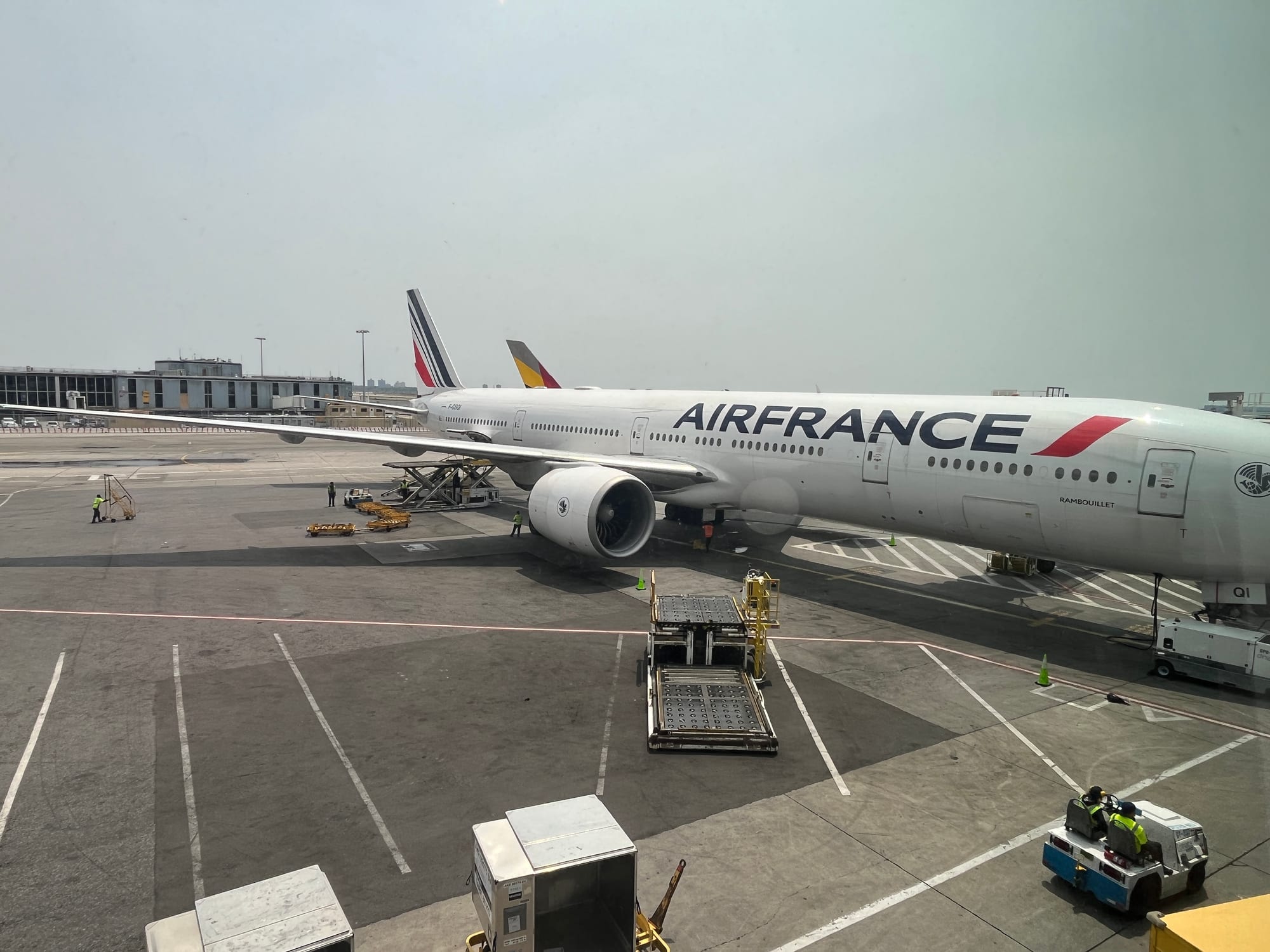
Flights between New York and Europe are planned around the jet stream every single day.
Discovered by balloon, used for war, then for airlines
In the 1920s the Japanese meteorologist Wasaburo Oishi tracked small weather balloons rising from a site near Mount Fuji and found fast winds high above Japan. His work went largely unnoticed abroad. In the mid-1930s the American pilot Wiley Post, flying high in a pressure suit of his own invention, noticed that his speed over the ground sometimes far exceeded his speed through the air. During the Second World War, crews flying from the United States to Britain kept meeting westerly tailwinds of more than 160 km/h.
Japan put the discovery to grim use. Between November 1944 and April 1945 the Imperial Japanese Army launched about 9,300 paper balloons carrying bombs, which the high winds carried across the Pacific to North America. Peaceful use followed: on 18 November 1952 Pan Am flew from Tokyo to Honolulu riding the jet stream, the first commercial flight to exploit it.
The same pattern holds south of the equator, where a polar jet circles Antarctica and strong westerly winds blow between 40 and 50 degrees south, in the latitudes known as the Roaring Forties. And the gap may be growing. A study by Paul Williams of the University of Reading suggests that as the climate warms, the North Atlantic jet stream will speed up eastbound flights and slow down westbound ones.