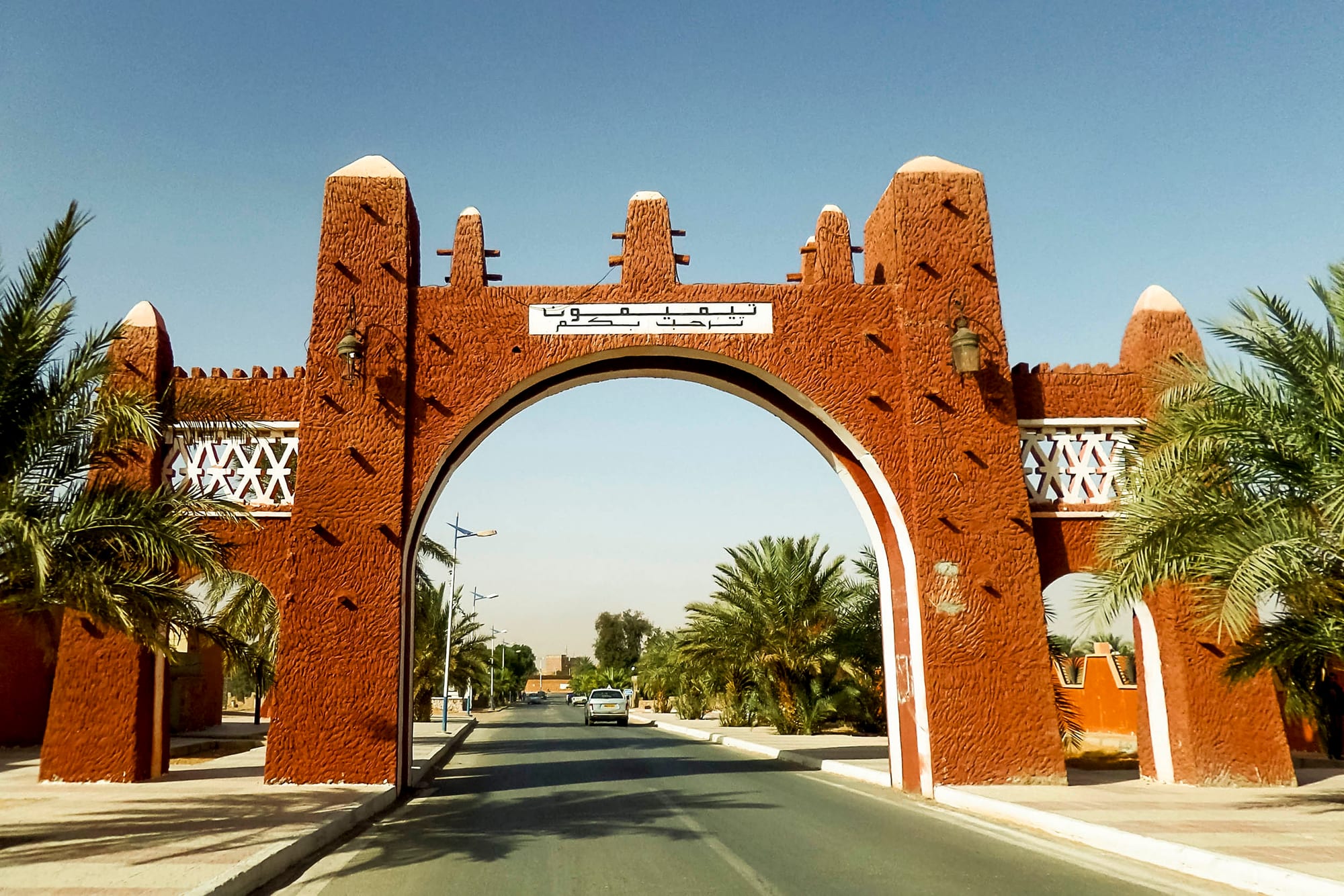
A large red earthen gateway with pointed towers and a wide arch spanning a road, flanked by date palms under a clear blue sky

The Southwest Sahara, Algeria

Timimoun

The red earthen gateway on the road into Timimoun, in the Gourara oases. (Habib kaki / Wikimedia Commons · CC BY-SA 4.0)

The main town of the Gourara, in the western Algerian Sahara, built in red earth above a salt flat and the edge of the Grand Erg Occidental. Its palm gardens are fed by foggaras, underground channels dug by hand over centuries, and the surrounding oases are Zenata Berber country with a distinctive sung poetry, the ahellil.

Neighbourhoods

  • The main street and the red town
    • First-time visitors
    • Architecture
    • Cafés

    The central avenue, lined with arcades, shops and cafés, where the red ochre rendering and the pointed buttresses of the local building style are at their most theatrical. The administrative buildings, the hotels and the bus stop are all within a few minutes' walk of each other.

    Open in Maps
  • The old ksar and the palm groves
    • Historic district
    • Walks
    • Palm gardens

    Below the town the ground drops away into date gardens watered by foggaras, with the mud-brick lanes and ruined walls of the older quarters between them. Paths run down among the palms, past irrigation channels and small vegetable plots divided by earth banks.

    Open in Maps
  • The edge above the Sebkha
    • Viewpoints
    • Sunsets

    The town sits on an escarpment looking out over a wide salt flat, the Sebkha, with the dunes of the Grand Erg Occidental beyond it. The terraces and open ground along this edge are where people come out in the late afternoon for the view and the cooler air.

    Open in Maps

Things to do

The oasis and the desert

  • Grand Erg Occidentallandmark

    The great sand sea of western Algeria, whose dunes rise beyond the salt flat below Timimoun and run for hundreds of kilometres north and east.

    Open in Maps

Ksour and oases of the Gourara

  • Charouineneighborhood

    A small oasis town west of Timimoun, on the road east to the town, with old earthen ksour strung along its palm belt.

    Open in Maps
  • Aougroutneighborhood

    A group of oasis villages in the southern part of the Gourara, in the palm belt that runs on towards the Touat.

    Open in Maps
  • Talmineneighborhood

    An oasis settlement in the Gourara surrounded by date gardens and the remains of mud-brick ksour.

    Open in Maps
  • Tinerkoukneighborhood

    An oasis district north of Timimoun set against the dunes of the Grand Erg Occidental.

    Open in Maps

Seasonal events

  • Sbouâthe week after the Prophet's birthday, which shifts each year

    The Gourara's great pilgrimage and festival, when processions carrying banners come in from the surrounding ksour and converge on the mausoleum of Sidi El Hadj Belkacem, with drumming, singing and crowds filling the town.

  • Ahellil gatheringswinter, around festivals and family celebrations

    The Gourara's sung poetry, performed through the night by a chorus with flute and drum, recognised by UNESCO as intangible cultural heritage and heard around weddings and religious festivals.

Eat and drink

Long-standing places and food districts in Timimoun. Hours, ratings and directions come from your maps app, always current.

Markets and food streets

  • The town marketmarket

    A small daily market for dates, vegetables from the oasis gardens, semolina, spices and mutton, with traders coming in from the surrounding ksour.

    Open in Maps
  • Date sellers of the Gouraramarket

    Dates from the Gourara groves in many varieties, sold loose, on the branch or pressed into blocks of paste for the kitchen.

    Open in Maps

Cafés and simple kitchens

  • Cafés along the main streetcafe

    Arcaded cafés serving strong coffee and sweet mint tea, busiest in the late afternoon once the heat has gone out of the day.

    Open in Maps
  • Grills and couscous housesrestaurant

    Plain eating houses near the centre doing grilled mutton, chorba soup and couscous; hotel dining rooms cook the same food for guests.

    Open in Maps

Experience Timimoun

History

Timimoun grew where water could be brought to the surface. The Gourara sits on a sandstone basin whose groundwater lies slightly higher than the oasis floor, and generations of diggers exploited that difference with the foggara: a gently sloping tunnel, sunk from a line of shafts, that draws water out of the aquifer and runs it by gravity to the palm gardens. The technique belongs to a family of systems found from Iran to Morocco, and in the Gourara and the neighbouring Touat it made settled life possible in one of the driest places on earth. Around each foggara a ksar was built, a fortified village of mud brick, and Timimoun grew into the main one.

The oases lived on dates, on their gardens and on the trans-Saharan caravan trade that crossed this corner of the desert between the Niger and the Maghreb, carrying gold, salt, cloth and enslaved people northwards. Their populations reflected that traffic: Zenata Berbers, Arabs, and Haratin families whose ancestors worked the gardens. The distribution of foggara water, measured out in shares to the hour, was the central institution of the community and is still governed by inherited rights.

French forces took the Touat and Gourara around 1900, after a long dispute with Morocco over the oases, and Timimoun became a military and administrative post. Colonial builders adopted an ochre-red neo-Sudanese style, inspired by the mud architecture of the Sahel, and gave the town the walls, gateways and pointed buttresses that define it today. Since independence the town has become an administrative centre and, in winter, one of Algeria's best-known domestic tourist destinations.

Culture & Customs

This is Zenata Berber country. Taznatit is spoken alongside Arabic in the ksour of the Gourara, and the oases keep a strong sense of their own identity within the wider Sahara. The best-known expression of it is the ahellil, a long sung poetry performed at night by a chorus of men who answer a lead singer, with a reed flute and a drum, hands clapped in complex patterns and the group moving in a slow circle. It is religious and social at once, and it has been recognised by UNESCO as intangible cultural heritage.

The year turns on the Sbouâ, the great pilgrimage held the week after the Prophet's birthday, when delegations from the surrounding ksour walk into town behind their banners and converge on the mausoleum of Sidi El Hadj Belkacem. It is the one time the whole Gourara gathers in one place, and the town fills with drumming, processions and visitors. Sufi devotion, saints' shrines and the authority of religious families run deep in the oases.

Water is a cultural as much as a technical matter. Shares in a foggara are inherited, traded and measured with a notched comb at a distribution basin, and the maintenance of the tunnels — dangerous, filthy work — has always been a collective duty. Manners are those of a conservative desert town: unhurried greetings, immediate hospitality, modest dress, and a reserve between men and women in public that visitors are expected to respect.

Daily Life

Timimoun is small — the commune counted around 33,000 people at the 2008 census, with more in the scattered ksour of the surrounding district — and it functions as the service centre for a wide area of oases. Administration, schools, the hospital, the market and the transport connections are all here, which is why people come in from the villages.

The economy rests on dates above all, with vegetables and cereals grown in the garden plots beneath the palms, and on government employment, trade and winter tourism. The town's hotels and drivers do most of their business between November and March, and the year-end holidays are the peak. Away from the oasis, the wider region's money comes from public works and from the irrigated farms developed around Adrar with deep boreholes.

The long-running local worry is water. Many foggaras have silted up or dried altogether as the water table has fallen, drawn down by modern pumping, and keeping the remaining channels flowing is both a livelihood and a cause; some have been restored with state support. Daily rhythm follows the heat and the calendar of prayer: activity early, a long shuttered pause in the middle of the day, then streets, cafés and market stalls coming back to life in the evening, with Friday given over to prayers and family.

Food

Dates are the foundation. The Gourara grows many varieties, and they are eaten fresh at the harvest, dried through the year, stoned and pounded into a paste for pastries and travel food, and taken with a bowl of milk or buttermilk, which is the classic Saharan combination and the usual thing pressed on a guest. Date syrup and date-stuffed sweets appear at every celebration.

Everyday cooking is simple and cereal-based. Couscous steamed over a stew of mutton and oasis vegetables — carrots, turnips, pumpkin, chickpeas — is the Friday and festival dish; chorba, a soup thickened with vermicelli or crushed wheat, is eaten most evenings, especially in Ramadan. Semolina also becomes thick flatbreads and the layered, pan-cooked breads found across Algeria, and the old desert method of baking a round of dough in hot sand under a fire is still understood here. Goat and mutton are the common meats, and camel meat turns up in the butchers.

To drink there is sweet mint tea, poured from a height into small glasses and taken in rounds, and strong black coffee in the cafés; buttermilk is the local answer to the heat. Alcohol is absent from public life. Meals in town are straightforward — grilled meat, soup, couscous — and the more interesting eating usually happens in somebody's house or at a camp out among the dunes.

Planning tools

Budget

Timimoun is one of the cheaper Saharan bases in Algeria, far less costly than an expedition to the Tassili or the Hoggar. Hotels are few, simple and fill up at the year-end holidays, and the main extra cost is a 4x4 with a driver for the dunes and the outlying ksour. Algeria runs largely on cash, and foreign cards are rarely accepted, so money has to be brought in and changed.

Daily Budget Midrange
USD 110–220 (a hotel in town, meals, a 4x4 with a driver for day trips)
Daily Budget Shoestring
USD 35–60 (basic hotel or guesthouse, café food, coaches between the oases)

Book well ahead for late December, when Algerian families fill the town's hotels; carry enough cash for the whole stay.

Best Time to Visit

November to March, when days are warm rather than punishing and the dunes can be walked. The Sbouâ pilgrimage, which follows the Islamic calendar, is the busiest and most interesting week of the year, and late December is crowded with Algerian holidaymakers. Sandstorms blow in spring, and summer heat makes daytime movement outside unwise.

Suggested Number of Days

The town is small and a couple of days covers it comfortably. Allow several more for excursions into the surrounding oases and the dunes, which take most of a day each and depend on arranging a vehicle. Travel time between Saharan towns is long, so add a day for each leg.

First Visit
2 days
With Surroundings
3–5 days

Transportation

Distances in the Gourara are long, and there is no local public transport to speak of. Coaches and shared taxis run between the oasis towns, but the practical way to reach the ksour, the foggaras and the dunes is a hired 4x4 with a driver, arranged through a hotel or a licensed agency. Within Timimoun itself everything is close enough to walk to.

Agree the route and the price for a day's driving before setting out, and take water for everyone in the vehicle.

Airport & Station Connections

Timimoun Airport has flights to Algiers and other Algerian cities, and flying is much the quickest way in; the overland alternatives are long desert roads, from Adrar to the south, from Béchar to the north-west, which takes most of a day, and from El Menia and Ghardaïa to the east. Coaches cover these routes. Travellers on a tour run by an approved Algerian agency may be able to obtain a visa on arrival for up to 30 days, since Timimoun is on the list of southern provinces that scheme covers; everyone else applies at an embassy in advance.

Walkability

The centre is small and entirely walkable, and the paths down into the palm gardens below the town are the best walking here. Beyond that, sand, heat and distance take over: the neighbouring ksour are kilometres apart along open desert roads. From late spring to early autumn walking is only sensible in the early morning and the evening.

Safety

Timimoun is a small, calm town that receives Algerian and foreign visitors through the winter season, with frequent police checkpoints on the roads between oases. The real hazards are environmental — heat, dehydration, and the ease of losing direction in the dunes — along with night driving on desert roads. Desert excursions are expected to be made with a licensed operator.

Carry the passport for checkpoints, take far more water than seems necessary, and do not go into the erg without a guide. Most governments advise against all travel to the border regions with Mali, Niger, Libya, and Mauritania, and to parts of the Saharan interior, citing terrorism and kidnapping risk. Check current official travel advice before travelling.

Climate

One of the hottest and driest parts of Algeria. Rain is negligible, the sky is clear almost all year, and the gap between day and night temperatures is wide. Spring brings sand-laden winds.

Summer
extreme heat, often 42–48°C by day, with hot nights
Winter
sunny days of about 18–24°C and cold nights, sometimes close to freezing

Local Customs

The Gourara is Zenata Berber country: Taznatit is still spoken alongside Arabic, and French is understood by many. The town is religious and conservative, and modest dress covering shoulders and knees is expected of visitors of both sexes. Hospitality is taken seriously — tea and dates are offered quickly and refusing is awkward — and greetings are long and unhurried.

Ask before photographing people, particularly women and the interiors of ksour; avoid photographing officials or military sites; alcohol has no place in public life here.

Common Payment Methods

The currency is the Algerian dinar. Timimoun is a cash economy: foreign cards are effectively unusable, and ATMs that accept them are scarce, so travellers bring euros or US dollars to change. The dinar is hard to get hold of outside Algeria, and the official and unofficial exchange rates differ sharply.