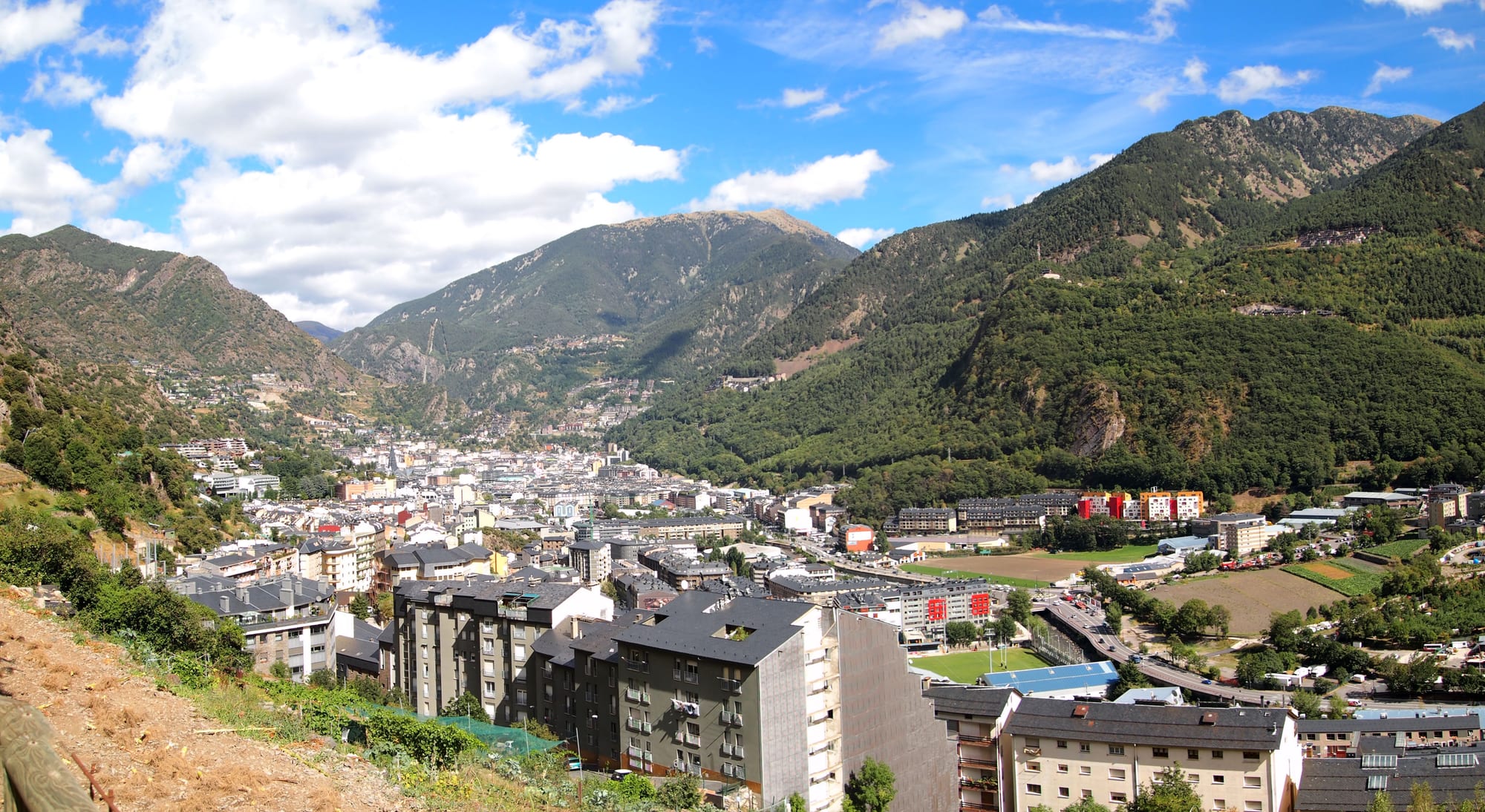
Apartment blocks filling a narrow valley floor between steep green and rocky mountains under a blue sky

Andorra

Andorra la Vella

Andorra la Vella spread along its valley, seen from a hillside path on the western side of the town. (Tiia Monto / Wikimedia Commons · CC BY-SA 3.0)

Andorra's capital and largest town, at the meeting of the Valira rivers in the eastern Pyrenees and, at about 1,023 metres, the highest capital in Europe. The principal settlement of the valleys since 1278, it keeps a small stone old town and the Casa de la Vall, but today it is above all a commercial centre of tax-free shops and banks running into Escaldes–Engordany.

Neighbourhoods

  • Barri Antic (old town)
    • Historic district
    • First-time visitors

    The original settlement, a small knot of old stone streets and houses around the Romanesque church of Sant Esteve and the Casa de la Vall, the old parliament house. It is quiet compared with the shopping streets just below.

    Open in Maps
  • Avinguda Meritxell and the commercial centre
    • Shopping
    • Close to public transport

    The newer, northern part of town, built up during the 20th century and lined with tax-free shops, department stores and banks. It is the busiest part of the capital, and the main street carries on into the shopping avenue of neighbouring Escaldes–Engordany.

    Open in Maps
  • Escaldes–Engordany
    • Spa and thermal water
    • Shopping
    • Quieter evenings

    The neighbouring parish, separated from Andorra la Vella in 1978 but continuous with it on the ground. Its pedestrian Avinguda Carlemany is packed with tax-free stores, and it holds the Caldea spa, a riverside art installation of giant taps and pipes, and a hot-spring fountain.

    Open in Maps
  • Santa Coloma and La Margineda
    • Romanesque heritage
    • Quiet and residential

    Villages of the parish downstream to the south-west, towards the Spanish border. Santa Coloma has the country's oldest church, with its round bell tower, and La Margineda the largest and best preserved of Andorra's medieval bridges over the Gran Valira.

    Open in Maps

Things to do

Old town landmarks

  • Casa de la Valllandmark

    A fortified manor built in 1580 by the Busquets family and bought by the Consell de la Terra in 1702; it was the seat of the General Council until 2011 and holds the 'closet of the seven keys', with one lock for each parish.

    Open in Maps
  • Església de Sant Estevelandmark

    A Romanesque church of the 11th–12th century with the largest semicircular apse in the principality, its bell tower remodelled in the 1940s by Josep Puig i Cadafalch; its original frescoes are now in Barcelona's Museu Nacional d'Art de Catalunya.

    Open in Maps
  • New Parliament of Andorralandmark

    The seat of the General Council since 2011, near the government headquarters; visitors can walk up behind it onto a roof with a small park and a view south over the valley.

    Open in Maps
  • Antiga Vegueria Francesalandmark

    A house of 1941 on Avinguda Meritxell, registered as part of Andorra's cultural heritage, standing among the shops of the main street.

    Open in Maps

Romanesque churches and bridges

  • Església de Sant Miquel d'Engolasterslandmark

    A small church first built in the 11th–12th century at Engolasters, in the parish of Escaldes–Engordany above the capital.

    Open in Maps
  • Church of Santa Coloma d'Andorralandmark

    Andorra's oldest church, with a nave of the 8th or 9th century and a 12th-century tower, dedicated to Columba of Sens.

    Open in Maps
  • Pont de la Marginedalandmark

    A medieval bridge of the 14th–15th century across the Gran Valira, built with pumice archstones to keep it light and granite walls.

    Open in Maps

Spa, walks and the mountains

  • Caldeaattraction

    A spa resort in Escaldes–Engordany, finished in 1994 in a glass spire 80 metres high — one of Europe's largest spas and Andorra's tallest building.

    Open in Maps
  • Rec del Solàtrail

    A paved walking path about 2.5 km long, with handrails and lighting at night, marked with green signs.

    Open in Maps
  • Parc Centralpark

    The town's central park, with a small pond — a green break between the shopping streets.

    Open in Maps
  • Madriu-Perafita-Claror Valleytrail

    A roadless glacial valley covering about 9% of Andorra, listed by UNESCO as a cultural landscape; one entrance is a short bus ride or about an hour's walk from the old town.

    Open in Maps

Seasonal events

  • Festa major d'Andorra la Vellafirst weekend of August

    The capital's main annual festival, held over the first weekend of August.

  • Fira de Santa Llúcia10–12 December

    A December fair held each year from 10 to 12 December.

Eat and drink

Long-standing places and food districts in Andorra la Vella. Hours, ratings and directions come from your maps app, always current.

Andorra la Vella classics

  • Traditional mountain restaurantsrestaurant

    Many of Andorra's traditional restaurants are housed in former rustic huts, and this is where trinxat and other mountain dishes are served.

    Open in Maps
  • Old-town restaurantsneighborhood

    The streets around Sant Esteve and the Casa de la Vall, the oldest part of the capital, with places to eat among the shops.

    Open in Maps

Food shops

  • Pyrénées department storemarket

    A department store of several floors on the main shopping street, whose supermarket is known for Andorran and Spanish specialty foods and red wines.

    Open in Maps

Experience Andorra la Vella

History

The valley floor where the Valira del Nord and the Valira de l'Orient meet has been settled since before the Christian era — by the Andosins, a people living here from the late Neolithic. In the Middle Ages the area belonged to the County of Urgell, one of the Catalan counties of the Marca Hispanica, and Andorra la Vella — the name means "the town of Andorra", from the Latin villa, not "old" — became the principal settlement of the valleys in 1278, when the French and episcopal co-princes agreed to share sovereignty. The Barri Antic, its old quarter, keeps streets and buildings from those centuries.

Its best-known building began as a private house: the Casa de la Vall was built in 1580 as a fortified manor by the Busquets family and bought in 1702 by the Consell de la Terra, after which it housed the country's General Council for more than three centuries, until the move to a new parliament building nearby in 2011; traditional sessions are still held in the old house. For most of that time the capital was a small, isolated place, and well into the twentieth century the area remained largely forgotten.

The modern town was mostly built in the 20th century. After political turmoil in the 1930s, including an attempted coup by Boris Skossyreff, an informal democracy developed, and the 1993 constitution set up a parliamentary state with all three branches of government based in the capital. Modern banking offices were built as Andorra became a tax haven, and ski areas grew up around the town. Andorra la Vella hosted the Games of the Small States of Europe in 1991 and 2005, and put itself forward for the 2010 Winter Olympics, though it was not selected as a candidate city. In 1978 Escaldes–Engordany was separated from it as a parish of its own.

Culture & Customs

The capital is the country's cultural centre, and it is thoroughly Catalan in language and tradition: Catalan is the only official language, while Spanish, Portuguese and French are heard constantly in the shops. Native Andorrans make up only about a third of the population; Spaniards are the largest group, with sizeable Portuguese and French minorities, and families can choose between Catalan-, Spanish- and French-based public schools.

Its heritage is Romanesque and Catholic. Sant Esteve, in the old town, keeps its 12th-century altarpiece and Baroque altarpieces of Saint John the Baptist and Saint Lucy, though most of its frescoes were removed in the early 20th century and are now in Barcelona and in the Espai Columba. Santa Coloma, a village of the parish, has the oldest church in the country. Modern art turns up in the streets: a Salvador Dalí sculpture of a melting clock, Noblesse du Temps, stands in the Plaça de la Rotonda.

The square outside the old parliament house is used for public events, the town holds a music festival every winter, and the Government Exhibition Hall serves as a main theatre and museum. The parish celebrates its festa major on the first weekend of August, and the Fira de Santa Llúcia comes in December. FC Andorra, based in the capital, plays in Spain's Segunda División, while UE Santa Coloma comes from the village of the same name.

Daily Life

About 24,000 people lived in the town in 2023, and the wider urban area, which takes in Escaldes–Engordany and outlying villages, has more than 40,000 — a large share of the whole country. The parish of Andorra la Vella also includes the villages of La Margineda and Santa Coloma downstream. Life expectancy is over 80, and most residents are Roman Catholic.

Andorra la Vella is the country's commercial centre and the base of the many banks and businesses that have grown on its tax-haven status. Tourism is the principal industry: around ten million visitors a year come to Andorra, almost all of them passing through the capital, and much of the town is given over to shops selling spirits, perfume, tobacco, electronics, jewellery and ski gear to visitors.

The town is squeezed into a narrow valley, and the daily round revolves around it: blocks of flats climbing the slopes, traffic on the main roads, buses connecting every parish and paid car parks in the centre. Children can go through the whole of their schooling within the parish, in one of three national systems. In winter the town fills with skiers heading up to the resorts by bus; in summer residents take to the paved paths at the edge of town and the trails into the side valleys.

Food

The food of the capital is Catalan mountain cooking, shared with the neighbouring Alt Urgell and Cerdanya. The best-known dish is trinxat — the name means "chopped" — made with potatoes, cabbage and pork, something like bubble and squeak; many of the traditional restaurants that serve it are housed in former rustic huts. Escudella is a meat and vegetable soup built around a pilota, a very large meatball spiced with garlic and parsley, with vegetables such as cabbage, celery and carrots and sometimes botifarra sausage.

Pork is central: embotits, the general name for cured pork meats such as fuet and llonganissa, and botifarra sausage, eaten with beans as mongetes amb botifarra. Wild mushrooms are prized, and caragols a la llauna are cooked snails. Pa amb tomàquet, bread rubbed with tomato and oil and sometimes garlic, comes with many meals. For dessert there is crema catalana, a set cream of egg yolk, milk and sugar, and mel i mató, fresh mató cheese with honey.

Away from the traditional kitchens, many of the town's reasonably priced restaurants serve Italian pizza and pasta, and few are open late in the evening. Spirits and wine are good value in the supermarkets, and the department stores on the main street sell Andorran and Spanish specialty foods and wines to take home.

Planning tools

Budget

Prices are broadly European, but low taxes make spirits, tobacco, perfume, electronics and jewellery cheaper than in France or Spain, which is why the shopping streets are so busy. Accommodation is the main cost, and in winter many visitors base themselves in the capital and ride buses up to the slopes.

Daily Budget Midrange
USD 125–220 (hotel, restaurant meals, a spa session or a ski pass)
Daily Budget Shoestring
USD 70–110 (budget room or apartment, supermarket food, local buses)

Many of the best things — the old town, the Romanesque churches, the valley paths — are free; supermarkets sell drink and spirits at low prices.

Best Time to Visit

June to September for walking, when the trails into the side valleys are open and the evenings are long, and December to March for skiing, with the resorts reached by bus from town. The shops are busy all year.

Suggested Number of Days

The capital itself fills a day or two. Most visitors use it as a base for longer, and the number of days depends mainly on how much skiing, walking or time at the spa is planned.

First Visit
1–2 days
With Surroundings
4–5 days

Transportation

Andorra has no railway and no airport of its own. The national bus lines all start in or stop at Andorra la Vella, linking it with the other parishes and, in winter, the ski areas, and three communal bus lines serve the town's own districts. Traffic and parking are the main problems on the narrow valley floor, and car parks are paid.

Taxis in Andorra take payment in cash; return bus tickets bought from the driver are also paid in cash.

Airport & Station Connections

Most people arrive by road. Direct buses link the national bus station with Barcelona and Toulouse in about three to four hours, and other services run from Girona and Lleida. Andorra–La Seu d'Urgell Airport, in Spain about 12 km south of the border, has a few domestic Spanish flights, and the railway station at L'Hospitalet-près-l'Andorre in France is linked by bus. From La Seu d'Urgell the road north is about 20 km.

Walkability

The town falls into two halves — the commercial north and the older part across the river to the south and west — and each is easily covered on foot, though walking from one end to the other takes half an hour or more, so the cheap local bus is useful. Two easy, paved paths at the edge of town, the Rec del Solà and the Rec de l'Obac, give longer walks with views.

Safety

Andorra is one of the safest countries in the world, with very little crime. In the capital the practical concerns are busy traffic on the narrow main roads, icy pavements in winter and fast-changing weather on the paths above the town.

Check the forecast before walking into the side valleys, carry warm layers even in summer and allow extra time on the roads in snow. Check current official travel advice before travelling.

Climate

An oceanic mountain climate, with warm days and cool nights in summer and chilly to cold, snowy winters. Temperatures below zero are very common in winter, and summer highs seldom pass 30°C. Average annual precipitation is about 810 mm.

Summer
warm days and cool nights — in neighbouring Escaldes–Engordany July averages around 17°C
Winter
cold and snowy — in neighbouring Escaldes–Engordany January averages around 2°C, and frosts are frequent

Local Customs

Catalan is the official language, and Spanish, Portuguese and French are widely spoken as well; native Andorrans are only about a third of the population, with Spaniards the largest group. Most residents are Roman Catholic. Andorra is outside the EU, and everyone entering goes through customs controls, with duty-free allowances on what can be taken out.

A few words of Catalan are appreciated; churches are places of worship as well as monuments, so visits are made outside mass times.

Common Payment Methods

The currency is the euro, which Andorra uses although it is not in the European Union. Taxis are paid in cash, and so are return bus tickets bought on board, so some cash is useful alongside cards; the fee for the Envalira road tunnel on the approach from France is paid by card.