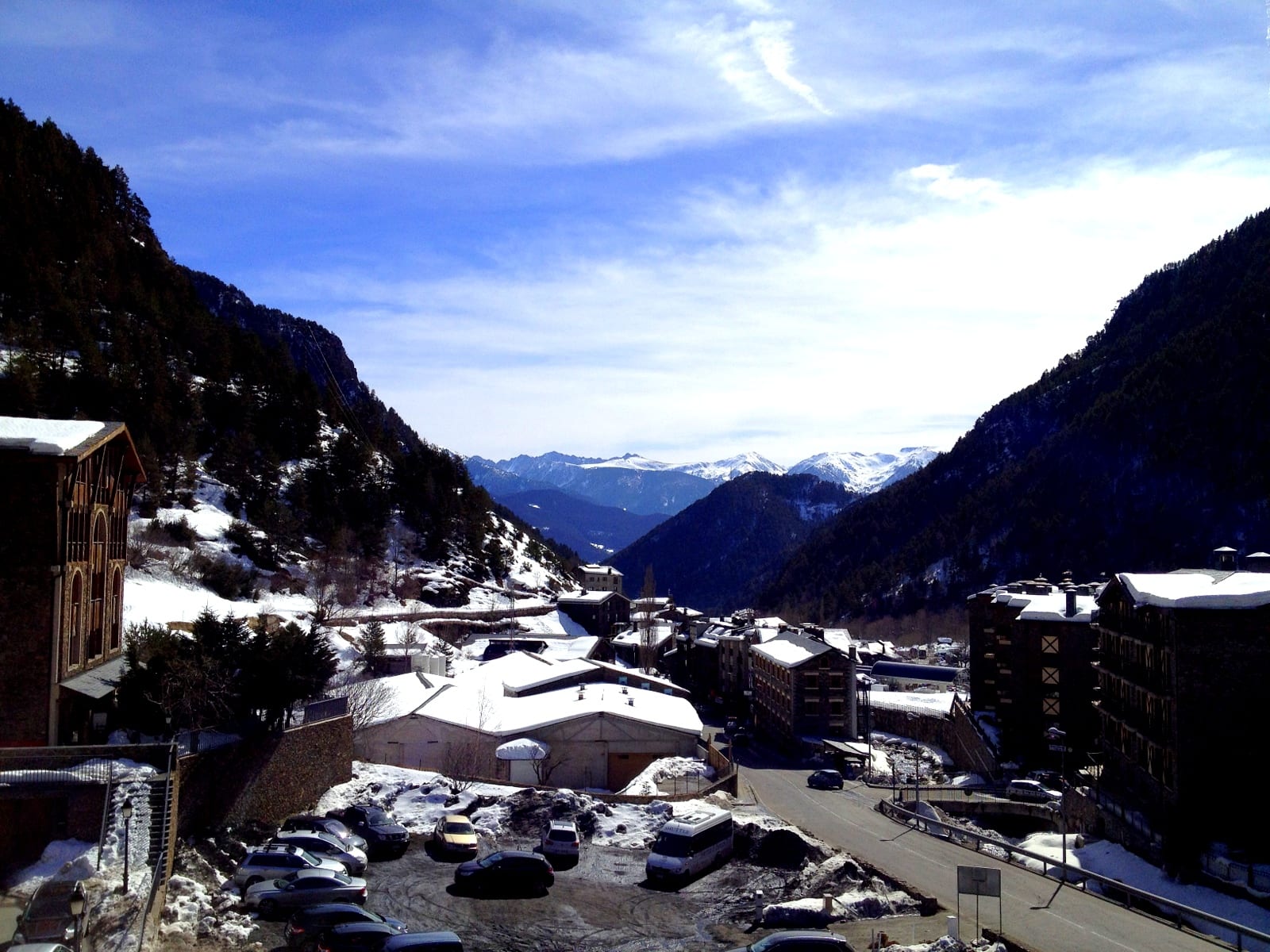
Snowy rooftops and stone apartment buildings along a road in a narrow wooded valley, with snow-capped peaks beyond

Andorra

Arinsal

Arinsal in late winter, looking down its valley towards the mountains of the Pyrenees. (Ainars Brūvelis / Wikimedia Commons · CC BY-SA 3.0)

A mountain village in the parish of La Massana, at the head of the Arinsal valley near the Spanish border and below Coma Pedrosa, Andorra's highest peak. Recorded since the 12th century, it grew into a ski resort after its first lifts in 1973 and is now linked with Pal; in summer the slopes become a mountain-bike park and a base for walkers.

Neighbourhoods

  • The old village
    • Historic village
    • Quiet and residential

    The original stone village, still clearly visible beside the newer buildings, with the 17th-century church of Sant Andreu. Arinsal has a sizeable year-round population, unlike Andorra's more seasonal resorts.

    Open in Maps
  • The resort centre
    • Skiing
    • Families
    • Nightlife

    The newer part of the village that grew around the gondola up to the slopes, with hotels, apartments and chalets, ski and snowboard shops, a couple of supermarkets and many bars. Outside the ski season much of it closes.

    Open in Maps

Things to do

Skiing, biking and the mountains

  • Vallnordattraction

    The ski area that joined the linked Pal and Arinsal sectors with Ordino-Arcalís in 2004; in summer the Arinsal slopes become a large bike park of cross-country and downhill trails, used for UCI Mountain Bike World Cup events.

    Open in Maps
  • Coma Pedrosatrail

    Andorra's highest mountain, at about 2,943 metres, climbed from Arinsal: the walk to the mountain refuge is rated moderate and the final climb difficult, past several mountain lakes and tarns.

    Open in Maps
  • Parc Natural Comunal de les Valls del Comapedrosapark

    The protected natural park established in 2003 around the valleys of Coma Pedrosa, in the western corner of Andorra above Arinsal.

    Open in Maps

Churches and villages

  • Església de Sant Andreu d'Arinsallandmark

    The village church, built in the 17th century and registered as part of Andorra's cultural heritage, with a 17th-century altarpiece of the Virgin Mary.

    Open in Maps
  • Església de Sant Climent de Pallandmark

    The church of the neighbouring mountain village of Pal, of unknown date but first mentioned in 1312.

    Open in Maps
  • Farga Rossellmuseum

    In La Massana, a forge built in the mid-19th century, now a museum with demonstrations of iron working.

    Open in Maps
  • Casa Rullmuseum

    The ethnographic museum in the village of Sispony, in the parish of La Massana.

    Open in Maps

Short trips from the village

  • Casa d'Areny-Plandolitmuseum

    In Ordino, the next parish, a mansion built in 1633 and registered as part of Andorra's cultural heritage.

    Open in Maps

Seasonal events

  • Rosary festivalsecond Sunday of July

    One of the parish of La Massana's traditional celebrations.

  • Festa major of La Massana15 August

    The main summer festival of the parish to which Arinsal belongs.

  • Festa patronal of La Massana17 November

    The parish's patronal feast day in late autumn.

Eat and drink

Long-standing places and food districts in Arinsal. Hours, ratings and directions come from your maps app, always current.

Arinsal classics

  • Village restaurantsneighborhood

    A good range for a small village, from local Catalan cooking to steak houses, Mexican food, pizza and pub dishes for the ski crowd.

    Open in Maps
  • Village barsneighborhood

    Many bars, most of them family-friendly, with après-ski and live music in the winter season.

    Open in Maps

Experience Arinsal

History

The name Arinsal is thought to be Basque in origin, from arantze, "thorn" or "hawthorn" — the same root as the nearby villages of Arans and Ransol — and the village appears in documents of the 12th and 13th centuries as Arensau. For centuries it was a small settlement in the valley of the Arinsal river, in the parish of La Massana, at the foot of the highest mountains in Andorra: Coma Pedrosa, Medacorba and the Pic del Pla de l'Estany all stand within its territory, and historically Coma Pedrosa gave Andorra protection from invasion on this side. The village church of Sant Andreu was built in the 17th century.

The ski era began in 1973, when Josep Serra installed the first lifts in the Comallémpia valley above the village. The parish council, the Comú of La Massana, soon took the ski area over, and over the following years the neighbouring ski areas of Pal and Ordino-Arcalís were developed. Arinsal and Pal were then linked by cable car, and in 2004 the three areas were brought together as Vallnord, on a single lift pass.

As a result the village has grown a great deal, with hotels, apartments and chalets around the old core, which is still clearly visible. Summer brought a second season: the ski slopes became the Vallnord Bike Park, and the area has hosted rounds of the UCI Mountain Bike World Cup.

Culture & Customs

Arinsal's culture is shaped by two seasons. In winter it is a resort very popular with English-speaking skiers, and the slopes of Arinsal and Pal are known as good terrain for beginners and intermediates — many skiers start here before moving on to Soldeu or Pas de la Casa. The bars are numerous and mostly family-friendly, with après-ski and live music. In summer the same slopes fill with mountain bikers on the cross-country and downhill circuits, and walkers set out for Coma Pedrosa and the lakes.

Unlike Andorra's more seasonal resorts, Arinsal has quite a few full-time residents, and the old village keeps its parish life. The church of Sant Andreu holds a 17th-century altarpiece of the Virgin Mary, and the wider parish of La Massana keeps its calendar of celebrations: the Rosary festival on the second Sunday of July, the festa major on 15 August and the patronal feast on 17 November.

The parish's past is kept in two museums: the ethnographic Casa Rull in Sispony, and the Farga Rossell, a mid-19th-century forge where iron working is demonstrated.

Daily Life

Arinsal had about 1,600 inhabitants in 2009. The village sits at about 1,470 metres in the Arinsal valley, close to the border with Spain at Tor, in the Pallars.

Work follows the seasons. From around December to March the economy is skiing — the gondola, ski schools, equipment shops, hotels, apartments, bars and restaurants. In summer the bike park, walking and adventure activities such as via ferrata and horse riding keep part of the village busy, but outside the ski season much of the resort, including some bars and restaurants, closes.

For more than daily needs, residents go down the valley: a bus links Arinsal with La Massana and Andorra la Vella, though not very often, and the capital is the place for serious shopping. Above the village the road continues for a short way, and a semi-private road winds up the mountain to the top station of the lift. Arinsal also has its own heliport, one of two in the parish, with commercial helicopter services — though no scheduled passenger flights.

Food

The local food is Catalan mountain cooking. Trinxat, a dish of the Pyrenees made with potatoes, cabbage and pork and sometimes served with salt herring, is one of Andorra's typical dishes; escudella is a meat and vegetable soup built around a pilota, a very large meatball spiced with garlic and parsley, with vegetables such as cabbage, celery and carrots and sometimes botifarra sausage.

Cured pork — the embotits, such as fuet and llonganissa — and botifarra are staples, often eaten with beans as mongetes amb botifarra; wild mushrooms are prized, and caragols a la llauna are cooked snails. Desserts include crema catalana, a set cream of egg yolk, milk and sugar, and mel i mató, fresh cheese with honey.

Because Arinsal lives from visitors, its restaurants cover a wide range for a small village: several serve local Catalan dishes, and others offer Argentinian-style steak, Mexican food, pizza and pasta, and pub food. Evenings in winter centre on the bars, and self-catering is common, with a couple of supermarkets in the village.

Planning tools

Budget

Arinsal and Pal are known as places for a first or second ski holiday, and much of the accommodation is self-catering apartments and chalets within walking distance of the lifts. Lift passes, equipment hire and lessons are the main winter costs. Supermarket food keeps costs down; for wider shopping, Andorra la Vella is the place to go.

Daily Budget Midrange
USD 125–220 (hotel or chalet, restaurant meals, ski pass or bike park)
Daily Budget Shoestring
USD 70–110 (shared apartment, self-catering, local bus)

Outside the ski season many bars and restaurants close, so check what is open before an off-season stay.

Best Time to Visit

The ski season runs approximately from December to March, with slopes suited to beginners and intermediates and a freestyle area for snowboarders. In summer the walking trails to the lakes and refuges open and the bike park runs. Between the seasons the village is very quiet.

Suggested Number of Days

A ski holiday here usually means a week. Walkers and mountain bikers can do well with a few days, and more time allows the rest of Andorra to be seen by bus from the capital.

First Visit
3–4 days
With Surroundings
6–7 days

Transportation

The main road climbs to Arinsal from La Massana, itself up the valley from Andorra la Vella. A bus runs between Arinsal and the capital through La Massana, though not very frequently, so the timetable is worth checking. In winter the gondola from the village centre serves the slopes, and a cable car links the Arinsal and Pal ski sectors.

Above the village a semi-private road winds several kilometres up the mountain to the top station of the lift.

Airport & Station Connections

Andorra has no airport or railway. Visitors arrive by road from Barcelona or Toulouse, changing in Andorra la Vella for the bus up the valley. The nearest airport, Andorra–La Seu d'Urgell in Spain, is about 12 km from the border, and there are heliports in Arinsal and La Massana with commercial helicopter services and bookable taxi flights from Barcelona, Lleida, Perpignan or Toulouse airports.

Walkability

The village is small and easily walked, with the gondola in its centre and most accommodation a short walk away. Many walks and treks start straight from the village, with three mountain huts and seven mountain lakes within about two hours on foot. Paths and pavements are snowy and icy in winter.

Safety

Andorra is one of the safest countries in the world, with very little crime. In Arinsal the real hazards are in the mountains: changeable weather, avalanches off-piste, and the strenuous upper slopes of Coma Pedrosa, whose final climb is considered difficult.

Check avalanche bulletins before skiing off-piste, leave word of the planned route when walking and turn back if the weather turns. Check current official travel advice before travelling.

Climate

A high-mountain climate with snowy winters and mild summers. The village lies at about 1,470 metres, and conditions are much colder on the upper slopes, which reach about 2,560 metres.

Summer
mild in the valley and cool on the peaks — lower down, in Escaldes–Engordany beside the capital, July averages around 17°C
Winter
cold and snowy — in Escaldes–Engordany, far lower down, January averages around 2°C, and La Massana's annual average is about 8°C

Local Customs

Catalan is the language of Andorra, but Arinsal is very popular with English-speaking skiers and English is widely used in the resort. The village has more year-round residents than Andorra's other big ski resorts, and the bars are mostly family-friendly.

Churches are places of worship as well as heritage buildings; visits are made respectfully and outside services.

Common Payment Methods

The currency is the euro. Taxis in Andorra take cash, and so do return bus tickets bought on board, so some cash is useful.