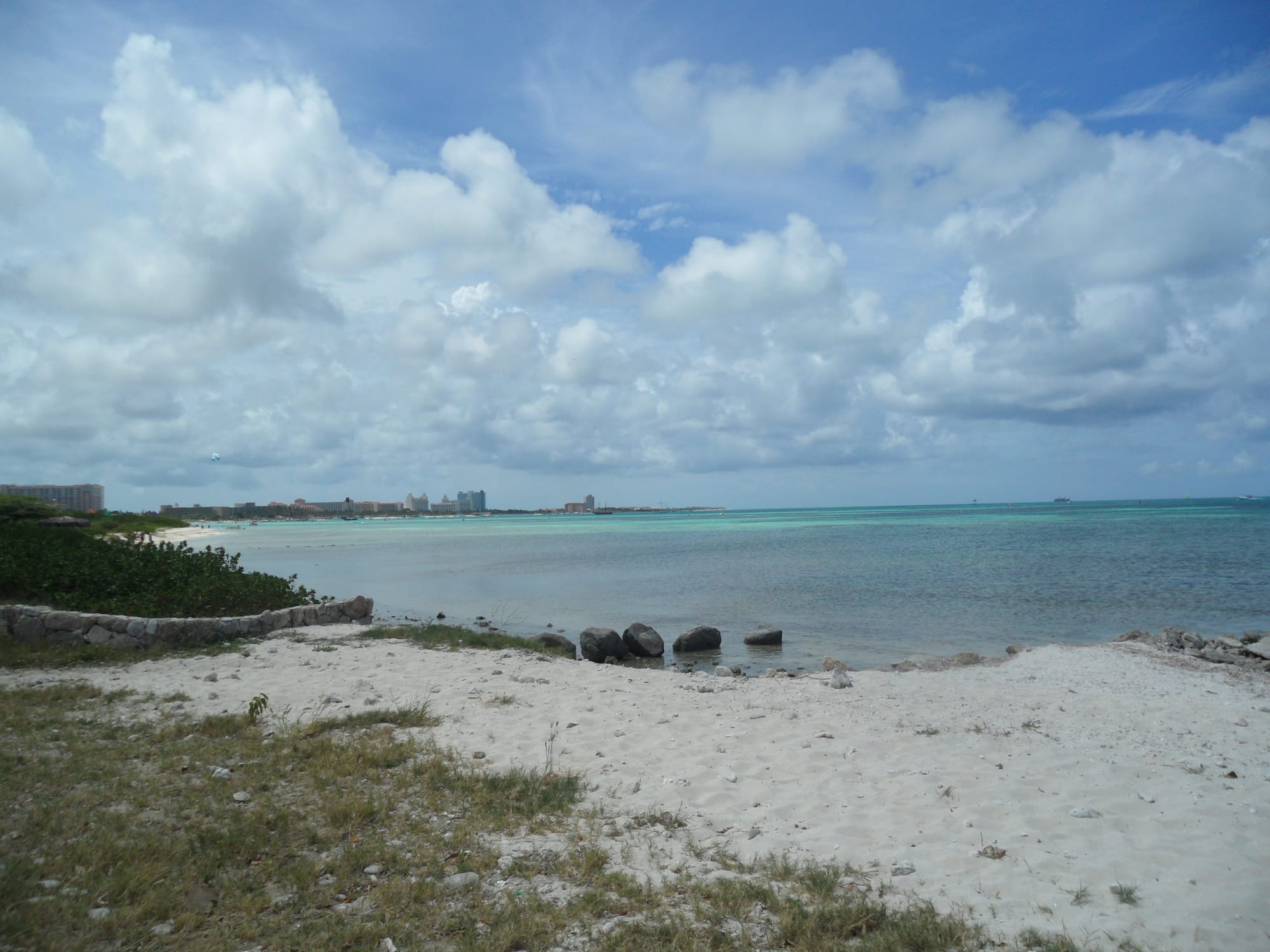
A pale sandy shore with rocks and shrubs beside calm turquoise water, with distant hotel towers along the bay

Aruba

Noord

Hadicurari Beach in Noord, looking along the bay towards the hotels of Palm Beach. (EgorovaSvetlana / Wikimedia Commons · CC BY-SA 4.0)

The town and region covering Aruba's north-west, from the old village around St Ann's Church to Palm Beach and the California Lighthouse. Once a rural district of cunucu houses, it now holds the high-rise hotels of Palm Beach, malls and restaurants, alongside quiet residential streets, a bird sanctuary and the calm beaches of the leeward coast.

Neighbourhoods

  • Palm Beach
    • Beaches
    • Nightlife
    • First-time visitors

    The tourism district about 6 km north-west of Oranjestad, where high-rise hotels line a long stretch of calm leeward beach. A shopping district with two large malls was finished beside the hotels in 2009, and restaurants and bars line the strip.

    Open in Maps
  • Malmok and Arashi
    • Quiet and residential
    • Snorkelling
    • Beaches

    North of Palm Beach a dead-end boulevard runs past smaller apartment complexes and large holiday homes to the island's northern tip. The coast here has a small sandy strip, the Antilla wreck offshore and Arashi Beach near the lighthouse.

    Open in Maps
  • Noord village and Tanki Flip
    • Local life
    • Best for food

    The inland town behind the hotel strip, spreading out around St Ann's Church. Supermarkets and grocery shops line Noord Road, local restaurants are scattered through the district, and older cunucu houses survive among newer suburban streets where many residents, including many migrants from the Netherlands, live.

    Open in Maps

Things to do

Beaches and the sea

  • Palm Beachbeach

    The island's main resort beach, lined by high-rise hotels and named after a coconut plantation that took its name from Palm Beach, Florida.

    Open in Maps
  • Arashi Beachbeach

    A white-sand beach on the north-western tip of the island, near Malmok and the lighthouse, whose calm water is popular for swimming and snorkelling.

    Open in Maps
  • Eagle Beachbeach

    The widest beach on Aruba, just south of Palm Beach, with low-rise hotels set back behind a broad public beach of soft white sand.

    Open in Maps
  • Antilla wreckattraction

    A German cargo ship scuttled off Malmok in May 1940, now lying on its side in up to 18 metres of water — one of the largest shipwrecks in the Caribbean and a popular dive site.

    Open in Maps

Landmarks and nature

  • California Lighthouselandmark

    A 30-metre lighthouse on the Hudishibana plateau at the island's north-western tip, finished around 1916 and named after a steamship wrecked nearby in 1891; it is the tallest structure on Aruba.

    Open in Maps
  • Alto Vista Chapellandmark

    A small bright yellow Catholic chapel on the hills above the north coast, completed in 1952 on the site of the island's first chapel, built in 1750, where the conversion of Aruba's Indigenous people began.

    Open in Maps
  • St Ann's Churchlandmark

    The parish church at the heart of Noord, tracing its history to 1776 and rebuilt several times, with a hand-carved neo-Gothic oak altar.

    Open in Maps
  • Bubali Bird Sanctuarypark

    A 20-hectare wetland near the Palm Beach hotels, an Important Bird Area for migratory waders and other birds, with an observation tower.

    Open in Maps

Short trips from the town

  • Bushiribanalandmark

    The stone ruin of a gold mill built in 1825 on the wild north coast, which processed ore from the nearby hills for ten years.

    Open in Maps
  • Arikok National Parkpark

    The national park covering about a fifth of the island, established in 2000 — cactus desert, caves with rock art and the rugged windward coast.

    Open in Maps

Seasonal events

  • Children's Carnival Paradeusually February

    Children's groups in costume parade through the streets during the carnival season.

  • Dande Festivallast week of December

    One of the island's biggest musical events, with more than fifty singers performing new and traditional dande songs for the new year.

Eat and drink

Long-standing places and food districts in Noord. Hours, ratings and directions come from your maps app, always current.

Noord classics

  • The Old Cunucu Houserestaurant

    A restaurant serving Aruban food in a traditional countryside cottage, close to the hotel strip.

    Open in Maps

Food districts

  • Palm Beach restaurant stripneighborhood

    Seafood grills, beach bars and international restaurants along the hotel strip and in the malls beside it.

    Open in Maps
  • Noord Roadneighborhood

    The inland main road through Noord, with the grocery shops and supermarkets used by residents and self-caterers.

    Open in Maps

Experience Noord

History

People lived in what is now Noord long before Europeans arrived. Radiocarbon dating places habitation at Malmok between about 450 BC and AD 240, and a cemetery there held some forty skeletons from around AD 300, a tenth of them laid on sea-turtle shells. Later, between about 1000 and 1500, the Caquetío built a fenced village at Tanki Flip, with longhouses and smaller round houses around a central plaza. On the hills to the north-east, the Venezuelan missionary Domingo Silvestre built the island's first chapel at Alto Vista in 1750, where the conversion of Aruba's Indigenous people to Christianity began.

Until 1754 only the commanders and staff of the Dutch West India Company were allowed on Aruba, and one of their cemeteries survives on the dirt road between Sero Patrishi and Shiribana. Noord's parish church, St Ann's, dates back to 1776. In 1825 a gold mill was built at Bushiribana, on the north coast in neighbouring Paradera, and after the steamship California was wrecked in 1891, a lighthouse named after it was built on the north-west tip and finished around 1916.

The coast changed in the 20th century. In May 1940, as Germany invaded the Netherlands, the crew of the German freighter Antilla scuttled her off Malmok, where the wreck still lies; an open-air memorial was completed in 2024. The government land of a coconut plantation at Palm Beach was taken back for hotel development in 1958, the first hotel, a group of bungalows on the sand, opened in the 1950s, and Malmok was developed with new homes in the 1960s. High-rise hotels followed, and a large shopping district opened beside them in 2009.

Culture & Customs

Noord keeps more of rural Aruba than its hotel strip suggests. The cunucu house, the traditional rural home, survives among the newer streets; Cas Tan Tin, built in the early 20th century by a couple who raised nine children and grew fruit and vegetables there, was bought by the Monuments Fund Aruba in 2019 and opened to the public that year as a house kept with its original furniture. The district has also produced the writer and storyteller Olga Orman and professional baseball players, among them the pitcher Sidney Ponson.

Religion has deep roots here. Alto Vista Chapel, rebuilt in 1952 on the site of the 1750 original, is a place of quiet visits on its hill above the north coast, and St Ann's Church, rebuilt in 1831, 1886 and 1916, is known for its hand-carved neo-Gothic oak altar. Carnival reaches Noord too, with a children's parade usually held in February.

The hotel district has a culture of its own, built around the beach, water sports and nightlife. Around it, Noord is a mixed community of long-established Aruban families and many newer residents, among them many migrants from the Netherlands.

Daily Life

Noord is both a residential town and the centre of Aruba's tourist industry. No single population figure is given for the whole region, but its settlements are substantial: Malmok alone had 5,105 people in 2010, of whom 2,480 were employed and 260 unemployed, and Papiamento was its most spoken household language, followed by Spanish, Dutch and English. The district is divided into neighbourhoods including Alto Vista, Malmok, Moko, Palm Beach, Tanki Flip, Tanki Leendert and Washington, and has its own supermarkets, restaurants and police station.

Work revolves around the hotels, restaurants, malls, tour operators and the trades that serve them. Suburban sprawl has spread across the old countryside, so that farmhouses like Cas Tan Tin now stand among modern homes. Life is car-based, with grocery shopping on Noord Road and weekends spent on the calmer beaches and with family.

Along the coast the rhythm follows the visitors: busy beaches by day and restaurants and bars on the strip in the evening.

Food

Noord offers both sides of Aruban eating. On the hotel strip there are seafood grills, beach bars and international restaurants; inland there are local restaurants, including one in a traditional countryside cottage, serving island food. The national dish is keshi yena, a hollowed Edam or Gouda cheese stuffed with spiced meat, often chicken, with olives and raisins, then baked. Stoba is a slow stew of goat, beef or chicken, eaten with funchi, a cornmeal dish like polenta, or pan bati, a slightly sweet griddle bread.

Fish is central: red snapper, wahoo and mahi-mahi, often served criollo style, and conch, called kalko. Pastechi, fried pastry turnovers, are the classic snack, alongside Dutch bitterballen and kroket and the Venezuelan arepa, now common street food.

Balashi, the beer brewed on the island since 1999, is the local drink, and at Christmas families make ponche crema. The tap water, desalinated from the sea, is safe and good to drink.

Planning tools

Budget

Noord holds both the most expensive and some of the cheaper beds on the island. The high-rise hotels of Palm Beach command the highest prices, especially from December to April; apartments and guesthouses inland or around Malmok cost less, and self-catering from the supermarkets on Noord Road keeps food costs down.

Daily Budget Midrange
USD 220–400 (Palm Beach hotel, restaurant dinners, a snorkel trip, car hire)
Daily Budget Shoestring
USD 70–120 (apartment or guesthouse inland, supermarket and snack-bar meals, buses)

Staying a short way back from the beach in Noord itself costs much less than a beachfront room, and the beaches themselves are open to everyone.

Best Time to Visit

Any time of year. December to April is the dry, busy and most expensive season on the hotel strip; May to November is quieter and cheaper. Short showers fall mostly between September and January, and the trade wind keeps the heat bearable.

Suggested Number of Days

Noord is where most visitors base a beach holiday, so stays are usually measured in days on the sand. A long weekend covers the beaches and the north-west tip; a week allows time for diving and for exploring the rest of the island.

First Visit
3–5 days
With Surroundings
6–8 days

Transportation

Several Arubus routes run between Oranjestad, Eagle Beach, Palm Beach and Noord, and taxis wait at the hotels. The north-western tip, the chapel and the north coast are easiest by hire car, scooter or bicycle.

Hire a car or 4x4 for at least a day to reach the north coast and the national park.

Airport & Station Connections

Queen Beatrix International Airport is just outside Oranjestad, with flights from the United States, Canada, the Netherlands, the Caribbean and northern South America. Palm Beach is about 6 km north-west of the capital, and most visitors reach it by taxi, hotel transfer or hire car.

Walkability

The Palm Beach strip is easy on foot, with hotels, malls, restaurants and the beach side by side. Beyond it Noord is spread out and suburban, with few pavements on some roads, and the heat makes long walks tiring by day; the lighthouse and the chapel are better reached by car or bike.

Safety

Aruba is one of the safer Caribbean islands, with tourism-focused policing. In Noord the main risks are theft from hire cars, hotel rooms and bags left on the beach, strong currents on the wild north coast, and the sun.

Swim on the calm leeward side rather than the north coast, leave nothing in parked cars at beaches and viewpoints, and drink plenty of water. Check current official travel advice before travelling.

Climate

Hot and semi-arid, with little change through the year and a steady north-east trade wind that keeps the beaches breezy. Rainfall is low; the short rainy season runs from September to January.

Summer
hot, dry and breezy — across the island, days stay around 28–32°C
Winter
barely cooler — September to January brings brief showers, and across the island days still average around 28°C

Local Customs

Papiamento is the everyday language, with Dutch, English and Spanish all widely spoken. Manners are relaxed and polite. Beachwear belongs on the beach and at the pool rather than in supermarkets, shops and churches such as St Ann's and Alto Vista.

The legal drinking age is 18. Check whether service is already included on a restaurant bill before adding a tip.

Common Payment Methods

The currency is the Aruban florin, pegged to the US dollar; dollars are accepted almost everywhere on the hotel strip and prices are often shown in both. Cards are widely used, and small change is useful for buses and snack bars.