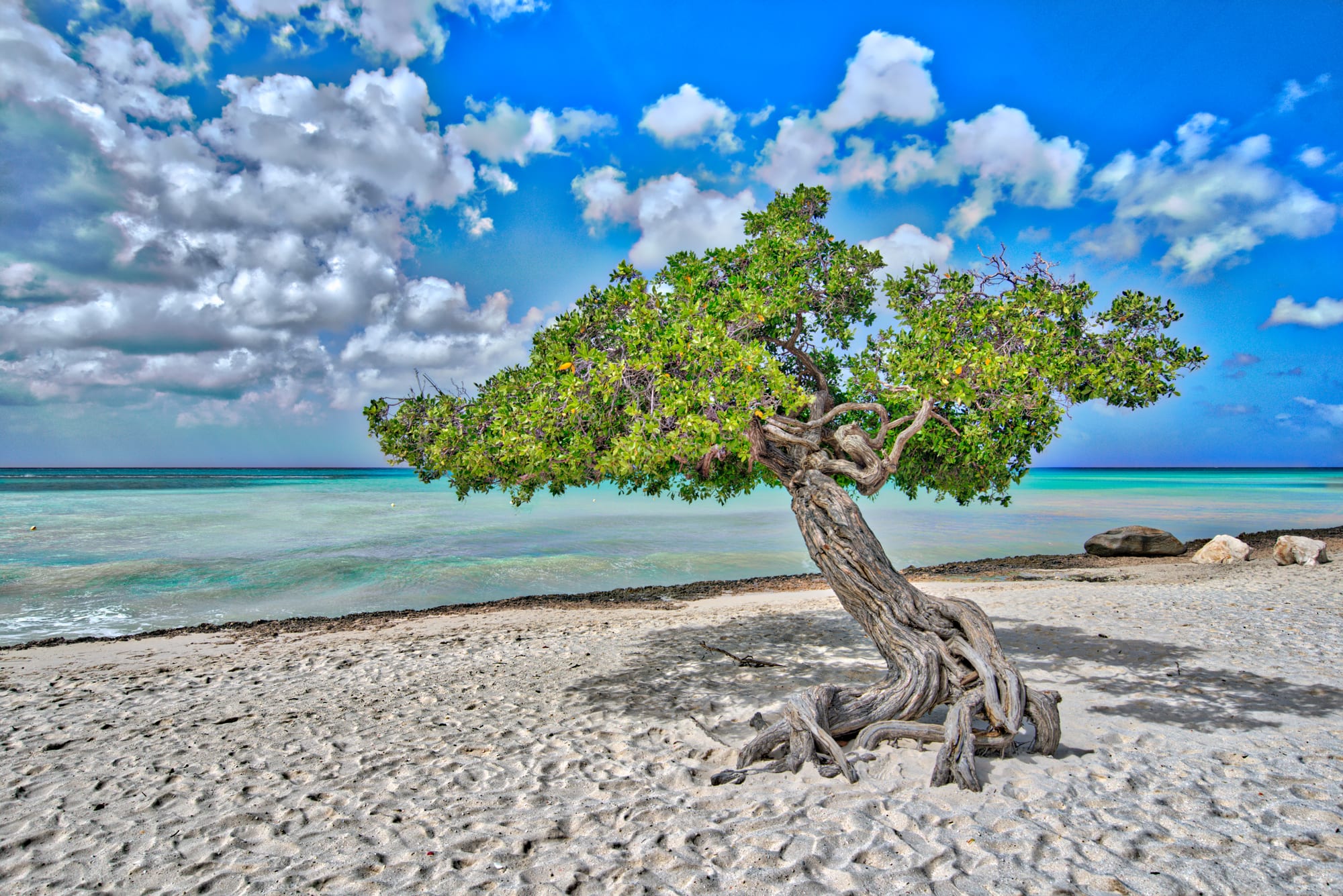
A lone divi-divi tree bent almost sideways by the wind, standing on white sand above a calm turquoise sea

Aruba

A wind-sculpted divi-divi tree, Aruba's unofficial emblem, permanently angled by the constant northeast trade winds. (sbmeaper1 / Wikimedia Commons · CC0)

A dry, flat, cactus-strewn island off the coast of Venezuela — a self-governing country within the Kingdom of the Netherlands, outside the hurricane belt, that turned an oil-refining economy into one of the Caribbean's most tourism-dependent.

Explore Aruba

History

Aruba's first inhabitants were the Caquetío, an Arawak people related to those of the Venezuelan mainland, whose rock paintings survive in the island's caves. Spain claimed Aruba in 1499 but, finding no gold and little water, declared it an "islas inútiles" (useless islands) and in 1513–1515 deported most of the Caquetío to Hispaniola as forced labourers, using the island mainly for ranching.

The Dutch took Aruba in 1636 during their war with Spain, and it became part of the Dutch colonial Caribbean. Unusually, plantation agriculture was limited here because the land was too dry; the island lived from herding, salt, the export of aloe (Aruba was once a leading producer), and a nineteenth-century gold rush. In the 1920s the Lago refinery, built to process Venezuelan crude, transformed the economy and drew workers from across the Caribbean, making English and a refinery-town culture part of the island, especially in San Nicolas.

Within the Netherlands Antilles, Aruba pushed for its own status, and in 1986 it achieved status aparte — becoming a separate, self-governing country within the Kingdom of the Netherlands, with its own parliament, government, and flag, while the Kingdom retains defence and foreign affairs. The Lago refinery's closure in 1985 forced a pivot, and Aruba built one of the most tourism-dependent economies in the world, with visitors — overwhelmingly from the United States — outnumbering residents many times over each year.

  • Aruba: Gold, Oil, and Status Aparte — An arid island the plantation system passed over — home to the Caquetío, a Dutch livestock reserve, an oil-refinery boomtown, and a country that won its own status and then declined independence

Culture & Customs

Aruban culture is a Caribbean-Latin-Dutch blend, and its clearest expression is Papiamento, spoken with pride and used in local media, literature, and politics alongside official Dutch. The island's motto, "One Happy Island", is a tourism slogan that locals also use half-seriously about a generally easy-going, tolerant society.

Carnival is the cultural high point — months of jump-ups, tumba and road march music competitions, lavish costumes, the Lighting Parade, and the Grand Parade — a tradition that took root partly through Caribbean migrants who came for the refinery. Folkloric music and dance, including the dande serenade at New Year and the Dera Gai rooster festival on St John's Day, mark the calendar.

Most Arubans are Roman Catholic, with Protestant and other communities, and the island has small but long-established Jewish, Chinese, and, more recently, Venezuelan populations. Family, the neighbourhood, Carnival groups, and the beach organise social life.

  • Aruba: Sweet Land, Many Tongues — A Catholic island with a creole language all its own, a New Year sung from door to door, and a Carnival season that runs for months

Daily Life

About 109,000 people live on Aruba, most along the developed western and central strip from Oranjestad through Noord to the beaches, with San Nicolas the "second city" in the south. As Dutch nationals, Arubans can move to the Netherlands to study and work, and many do, though the island itself sits outside the EU as one of its overseas countries and territories.

The economy is dominated by tourism and the businesses that serve it — hospitality, retail, construction, transport — which makes the island highly exposed to downturns and shocks, as the pandemic showed. Tourism's success has also brought pressure on water (all of it desalinated), electricity, housing, and the coastline. A large influx of Venezuelans fleeing their country's collapse has added to the population and to political debate.

Daily life is relaxed, bilingual or trilingual, car-dependent, and oriented to the calm leeward beaches, with Carnival the fixed point of the year.

  • Aruba: Papiamento at Home, Tourists at Work — A household language different from the main language of the classroom, an economy that depends almost entirely on visitors, and a beach life shaped as much by flight schedules as by the trade winds

Food

Aruban cooking mixes Caribbean, Latin American, and Dutch elements. Keshi yena — a whole Edam or Gouda rind stuffed with spiced meat (often chicken), olives, and raisins and baked — is the signature dish, a creative use of the Dutch cheese trade. Stoba (a hearty goat, beef, or chicken stew), pastechi (fried pastry turnovers), and pan bati (a flat, slightly sweet griddle bread often eaten like a pancake) are everyday staples.

Fresh fish and seafood are central — red snapper, wahoo, mahi-mahi, conch (kalko) — often served criollo style with funchi (polenta) and pan bati. Dutch bar snacks like bitterballen and kroket appear alongside, and the Venezuelan arepa has become common street food.

The local Balashi beer, brewed on the island since 1999, ponche crema at Christmas, and aloe-based products are the island's own, and the tap water — desalinated from the sea — is famously good.

  • Aruba: Food and the National Dish — A cheese rind turned into a feast, fried turnovers sold on every corner, and a Dutch-Caribbean-Venezuelan kitchen shaped by a dry desert island

Attractions & Natural Wonders

The west coast is the resort side: Eagle Beach, a broad sweep of white sand regularly rated among the world's best and the widest beach on the island, backed by the wind-bent trees that appear in countless photographs, and the high-rise strip of Palm Beach with its water sports, piers, and nightlife. Snorkelling and diving centre on the wreck of the Antilla, a scuttled German freighter, and the calm reefs off the leeward shore.

Arikok National Park covers about a fifth of the island's rugged interior and windward coast — a desert landscape of divi-divi and cactus, wind-carved boulders, Caquetío rock art in Fontein Cave, the Quadirikiri cave, and the natural rock pool known as Conchi or the "Natural Pool", reached on foot, by 4x4, or on horseback. The Natural Bridge on the same coast, an arch of coral limestone about 30 metres long, collapsed in 2005.

Oranjestad, the capital, has pastel Dutch colonial buildings, a tram line, Fort Zoutman — the oldest building on the island, put up in 1798 — with the Willem III Tower beside it, and several small museums. The California Lighthouse marks the island's northwest tip at Hudishibana, and San Nicolas, the old refinery town in the south, has become an open-air gallery with more than fifty hand-painted murals.

Planning basics

Budget

Aruba is one of the pricier Caribbean islands, geared to North American resort tourism. The Palm Beach and Eagle Beach hotel strips are expensive; costs fall with guesthouses and apartments in Oranjestad, Noord, and San Nicolas, self-catering, and eating at food trucks and local snèk bars.

Daily Budget Midrange
USD 200–400 (beach-strip hotel, restaurants, car hire, a snorkel or 4x4 tour)
Daily Budget Shoestring
USD 70–120 (guesthouse or apartment, supermarket and food-truck meals, bus or shared car)

Stay away from the Palm Beach high-rise strip for lower prices, hire a small car or a UTV to see Arikok, and use the cheap Arubus service along the coast.

Visa Requirements

Aruba is a country within the Kingdom of the Netherlands but is not part of the EU or the Schengen area, and entry is governed by the Kingdom's separate Caribbean visa system. Citizens of the EU, UK, US, Canada, and many other countries enter visa-free for stays of up to 90 days; others need the Dutch Caribbean visa, which also covers Curaçao, Sint Maarten, Bonaire, Sint Eustatius, and Saba but is not valid for the Netherlands itself.

Typical Stay
Up to 90 days visa-free for most Western passports

Check the official entry requirements shortly before you fly, including any online arrival form, and carry proof of onward travel and accommodation.

Safety

Aruba is one of the safer Caribbean islands, with tourism-focused policing. The main risks are petty theft from cars, hotel rooms, and beaches, occasional after-dark robberies away from the resort areas, strong currents and undertow on the wild north and east coasts, and heat and sun exposure.

Health
Tap water — desalinated — is safe and good; dengue occurs occasionally; the main hazards are the sun, dehydration, and rough water on the windward coast

Swim on the calm leeward (west) side and heed warnings on the north coast, don't leave valuables in cars or on the sand, and drink plenty of water in the heat.

Climate

Hot, dry, and remarkably stable, around 28–32°C year-round, cooled by a near-constant northeast trade wind. Rainfall is low and mostly falls in short showers between September and January. Aruba lies south of the main hurricane belt and is rarely directly hit.

All Year
Hot, dry, breezy; little seasonal change
Wetter Months
September–January (brief showers)

Transportation

Queen Beatrix International Airport near Oranjestad has frequent flights from the US, the Netherlands, and other Caribbean and South American cities, with US pre-clearance for travel to the States. A hire car, UTV, or scooter is best for exploring; the Arubus service runs along the developed west coast, and a tram line loops through central Oranjestad.

Hire a car or 4x4/UTV for at least a day to reach Arikok's rugged east coast, and use Arubus for cheap trips along the hotel strip.

Best Time to Visit

Any time of year works. December to April is the peak, dry and busy, with the highest prices around Christmas and Carnival. May to November is quieter and cheaper, with a slightly higher (still low) chance of a passing storm and some October–November showers.

Events
Carnival — a weeks-long season culminating before Lent, with the Lighting Parade and the Grand Parade; Dera Gai (Dia di San Juan, 24 June); Dande serenades at New Year

Currency

The currency is the Aruban florin, pegged to the US dollar, but US dollars are accepted almost everywhere and often quoted alongside florin prices. Cards are widely used; carry small change for buses and food trucks.

Symbol
Afl / ƒ
Currency Code
AWG — Aruban florin (US dollars widely accepted)

Language

Papiamento — a creole blending Portuguese, Spanish, Dutch, African languages, and English — is the everyday language and, with Dutch, co-official. Dutch is the language of government and schooling. English and Spanish are very widely spoken, so visitors rarely have any difficulty.

Co Official
Papiamento and Dutch
Also Widespread
English and Spanish