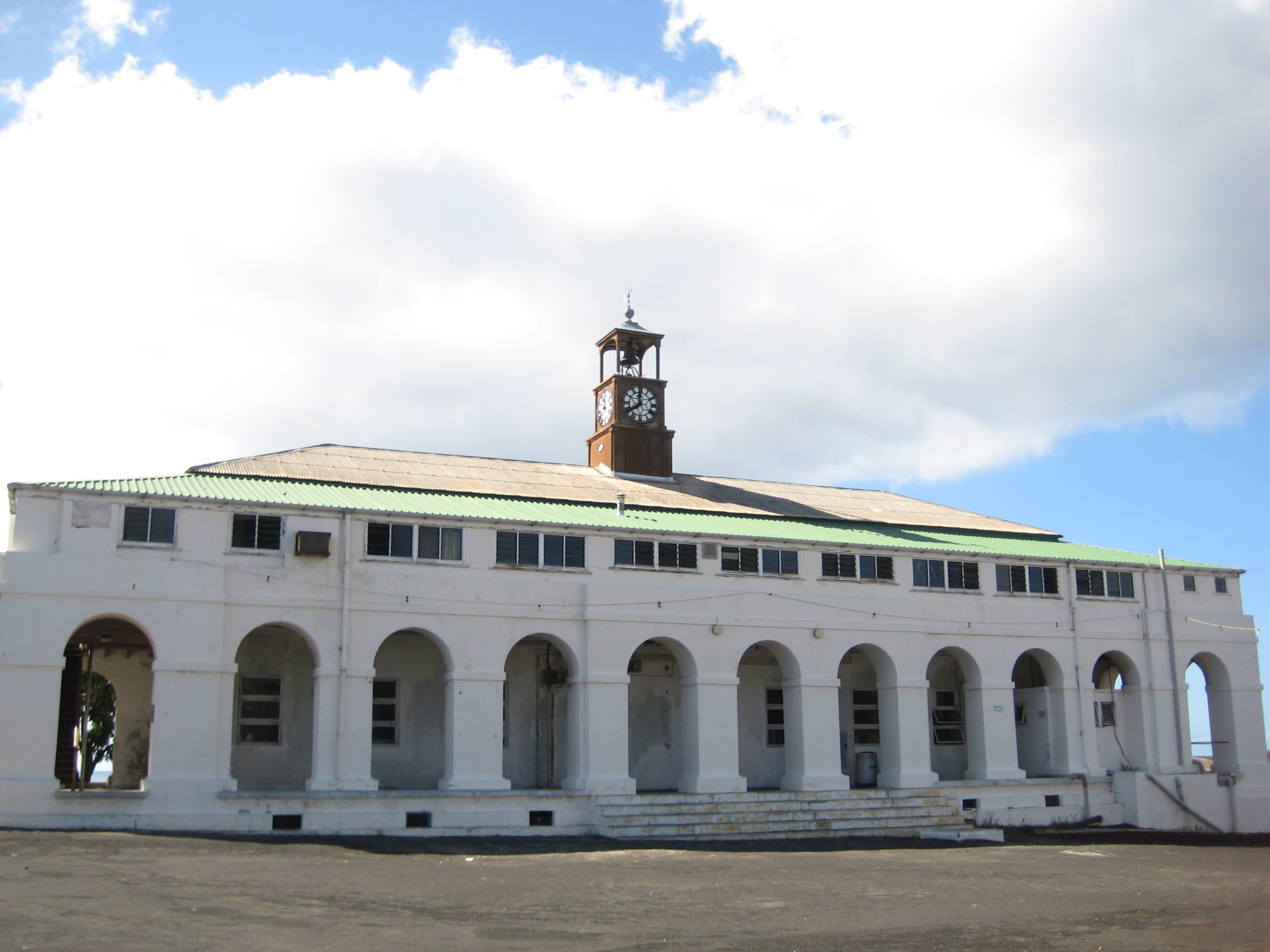
A long white colonial barracks building with an arcade of arches and a small clock tower, under a bright cloudy sky

Ascension Island

Georgetown

The old marine barracks in Georgetown, built for the garrison and still one of the settlement's main buildings. (LordHarris / Wikimedia Commons · CC BY-SA 3.0)

The main settlement of Ascension Island, a line of low buildings on the bare lava of the leeward coast, laid out around the pier where the Royal Navy garrison landed from 1815. It holds the island's administration, hospital, shop, post office and church, and looks out on a shore of green turtles, swell and volcanic cinder cones.

Neighbourhoods

  • Georgetown
    • First-time visitors
    • Historic district
    • Local life

    The settlement itself is a few streets of nineteenth-century garrison buildings, government offices, the hospital, the supermarket, the post office and the church, set between the pier and the lava plain. Everything official on the island is transacted here.

    Open in Maps
  • Two Boats
    • Quiet and residential
    • Cooler air

    The other village, about three miles inland at the foot of Green Mountain, with the island's only school.

    Open in Maps
  • The base areas
    • Working island
    • Viewpoints

    The airfield, the communications sites and the military and American facilities spread across the plain south and east of Georgetown. They dominate the landscape and employ most of the island's residents; large parts are restricted and must not be photographed.

    Open in Maps

Things to do

In and around the settlement

  • Long Beachbeach

    The beach beside Georgetown, an important nesting ground for green turtles, which come ashore to lay their eggs from November to May.

    Open in Maps

Inland and the mountain

  • Green Mountainpark

    The island's green summit, a national park opened in 2005, covering a peak that rises to about 859 metres and carries a cloud forest planted from the 1850s on what had been barren rock.

    Open in Maps
  • Two Boats Villageattraction

    The inland village about three miles from Georgetown at the foot of the mountain, home to the island's only school.

    Open in Maps

Wildlife and the coast

  • Boatswain Bird Islandattraction

    A steep islet off the north-east coast that holds most of the breeding population of the endemic Ascension frigatebird.

    Open in Maps
  • Comfortless Covebeach

    A sheltered cove with a beach where it is safe to swim, one of the coves, along with English Bay, used for sea bathing.

    Open in Maps
  • Wideawake Airfieldtransit hub

    The airfield about three miles from Georgetown, built by the United States in 1942 and named after the noisy sooty terns, called wideawakes, that nest in colonies nearby.

    Open in Maps

Seasonal events

  • Turtle nesting seasonNovember to May

    Green turtles haul out on the beaches beside Georgetown to lay, with hatchlings emerging later in the season; guided night walks are the way the island sees it.

  • Sooty tern breedingbreeding season

    Sooty terns, called wideawake birds locally for their constant calling, nest in great colonies on the lava near the airfield that is named after them.

  • The club calendaryear-round

    Sports days, quizzes, darts and social evenings at the island's clubs structure the year for a population that is here on work contracts.

Eat and drink

Long-standing places and food districts in Georgetown. Hours, ratings and directions come from your maps app, always current.

Eating on Ascension

  • Fresh tuna and wahoorestaurant

    The fishing off the island is exceptional, and yellowfin tuna and wahoo, grilled or curried, are the one genuinely local food on the table.

    Open in Maps
  • Saint Helenian home cookingrestaurant

    Most residents are Saint Helenians, and plo, fishcakes and curry are cooked at home and served at the island's small eateries and club bars.

    Open in Maps

Where to shop and drink

  • The Georgetown supermarketmarket

    The island's main shop, stocked by ship and plane, is where almost all food is bought; what is available depends on when the last delivery arrived.

    Open in Maps
  • The club barscafe

    The social clubs run the bars that stand in for pubs and restaurants, and are the centre of evening life for residents and visitors alike.

    Open in Maps

Experience Georgetown

History

Georgetown exists because of Napoleon. Ascension had been an uninhabited, waterless rock since Portuguese ships sighted it in 1501, visited only for turtles and by the occasional marooned sailor, when the Royal Navy garrisoned it in 1815 to deny it to anyone planning to rescue the emperor from Saint Helena, 800 miles to the south-east. The landing place on the leeward coast became the settlement, named after King George III, and the island was run as a stone frigate, HMS Ascension, until 1922.

The garrison built in stone: barracks, a hospital, stores, a church, and a line of forts on the shore and the hills above it. Water was the constant problem, met by carefully managing the springs on the high ground inland, and it lay behind the planting scheme, proposed by the botanist Joseph Hooker after his 1843 visit, that created the cloud forest on Green Mountain from the 1850s.

Cable and radio changed the town's purpose. The Eastern Telegraph Company landed a submarine telegraph cable in 1899, and in 1942 the United States built Wideawake airfield inland, which was used again as a staging post during the 1982 Falklands War. The BBC opened an Atlantic Relay Station in 1966, and satellite tracking and signals facilities followed. Georgetown remained the administrative centre throughout, and since 1964 the seat of the Administrator who represents the Governor of Saint Helena, with an elected Island Council, while the working population lived wherever their employer housed them.

Culture & Customs

There is no indigenous culture on Ascension and nobody is from here: everyone present holds a contract, and there is no right of abode. About 800 people live on the island, most of them Saint Helenians working for the government, the airfield or the communications operators, alongside British and American staff. English is the only language, and the Saint Helenian accent is the one most often heard in Georgetown.

Social life is organised rather than spontaneous, because the population is small and turns over steadily. The clubs are the centre of it — bars, darts, quizzes, film nights, sports days — and St Mary's, the Anglican church, holds the other half of the calendar. Newcomers are absorbed quickly and departures are frequent, which gives the place a friendly, slightly transient character.

A strong conservation ethic has grown up around the island's wildlife. The turtle nesting season is watched closely and guided, the seabird colonies are protected, and the eradication of feral cats in the early 2000s allowed frigatebirds to return to the main island. Visitors are expected to take that seriously, along with the rules around the bases: large areas are restricted, and photographing them is not allowed. Fishing, walking on the mountain and the beach fill most free time.

Daily Life

Georgetown holds the island's institutions rather than most of its people: the Administrator's offices, the hospital, the supermarket, the post office famous for its stamps, the bank and St Mary's church stand within a few hundred metres of the pier. Two Boats village, three miles inland, has the island's only school, and further housing sits near the airfield and the bases.

The economy is the bases and government services, plus income from fishing licences in Ascension's waters. By law, accommodation, medical cover and food, or an allowance for it, come with the job. The supermarket's stock rises and falls with the arrival of the ship and the plane. The population itself rises and falls with the contracts.

Days are structured by work shifts and the heat: early starts, a quiet afternoon on the exposed plain, and evenings at the club or on the shore. The pier head is still where the island's fuel comes ashore, piped in by floating hose from a tanker at anchor. Anyone needing advanced medical care leaves the island by air, which is the single fact that shapes how people live here.

Food

Almost everything eaten on Ascension arrives frozen or tinned by ship or plane, and the supermarket in Georgetown is where most of it is bought. Self-catering is the norm, and what is on the shelves depends on how long ago the last delivery came in, which islanders plan around.

The exception is fish. The waters off Ascension hold outstanding yellowfin tuna and wahoo, and shore and boat fishing are both a hobby and a supply: grilled tuna steaks, wahoo in curry, and fish cooked simply with lemon are the island's real local food. Turtle was historically taken here and harvested regularly until 1930, when the practice was banned; the animals are now protected and closely watched.

Saint Helenian home cooking shapes the rest, since most residents come from the neighbouring island: plo, the spiced pilau, tuna fishcakes, curries and Sunday roasts. The rest of the diet is heavily imported. Eating out means the island's few small eateries and the club bars, which serve straightforward hot food and are also where people drink.

Planning tools

Budget

Ascension is not a leisure destination and costs are high and inflexible, set by the airfare and the very limited accommodation — a small guesthouse or hotel and a few self-catering units. There is little to spend money on once there beyond food, fuel and a hire car.

Daily Budget Midrange
USD 180–300 (guesthouse or hotel room, meals at the clubs, a hire car and fuel)
Daily Budget Shoestring
USD 90–140 (self-catering unit, groceries from the island shop, shared transport)

Arrange the entry permit, accommodation and transport well in advance; casual, unplanned visits are effectively not possible, and prices are fixed rather than negotiable.

Best Time to Visit

Season matters little on an island that is warm and dry all year. Green turtle nesting runs roughly November to May, with hatchlings later in that period, and the fishing is good throughout. Access depends on the flight and the permit rather than the weather.

Suggested Number of Days

Transport schedules set the length of a stay rather than the amount to see: visitors generally come and go with the aircraft or the ship. Under a week covers the island comfortably; longer stays suit fishing, walking or work.

First Visit
4–7 days
With Surroundings
7–10 days

Transportation

A hire car is close to essential, as the settlements are far apart across open lava and there is no public transport. Driving is on the left, on a mixture of sealed and rough roads, and fuel is limited. The military and communications areas are off-limits, and the roads through them are signed accordingly.

Carry water and a spare tyre on the lava roads, and never drive onto or photograph a restricted site.

Airport & Station Connections

There is no scheduled commercial airline. The South Atlantic Air Bridge from RAF Brize Norton to the Falklands, flown for the Ministry of Defence, stops at Wideawake airfield about three miles from Georgetown and sells a limited number of civilian seats; a monthly charter links the island with Saint Helena, and the cargo ship that serves the territory carries a few passengers between Cape Town, Saint Helena and Ascension. An entry permit must be obtained in advance from the Ascension Island Government, and nobody may land without permission.

Walkability

Georgetown is small enough to walk from end to end in a few minutes, and the pier, the shop, the church and the offices are all within a short stroll. Beyond it there is no shade, no pavement and a long stretch of black lava between settlements, so walking outside the town means a planned hike with water rather than a casual stroll.

Safety

Crime is negligible and the settlement is very safe. The hazards are environmental: powerful Atlantic swell and undertow, including the heavy waves known as rollers, sharp lava, strong equatorial sun on an exposed plain, and long distances between help. Medical care is a small hospital, and serious cases are evacuated off the island.

Respect all restricted-area signage and photography bans, swim only at supervised or advised spots, and carry water and sun protection on the open lava. Check current official travel advice before travelling.

Climate

A hot desert climate at sea level, warm and dry all year and tempered by the trade winds, with little seasonal variation and no cyclone risk. Green Mountain is five or six degrees cooler, wetter and often in cloud, so the island has two climates within a few miles.

Summer
warm and dry, averaging about 23–28°C in Georgetown with little monthly change
Winter
barely different at about 22–26°C, with the trade wind constant and the mountain damp

Local Customs

English is the only language and there is no indigenous population: everyone is on a work contract, most of them Saint Helenians alongside British and American staff, and there is no right of abode. Social life runs through the clubs, and newcomers are noticed and welcomed. Dress is practical and informal.

Do not photograph the military and communications installations or their signage, keep to marked routes near turtle beaches and seabird colonies, and follow the conservation rules the island takes seriously.

Common Payment Methods

The Saint Helena pound is used at parity with sterling, and British notes and coins circulate alongside it. It is largely a cash economy, served by a branch of the Bank of St Helena in Georgetown, with very limited card acceptance, so sterling cash is the practical way to pay.