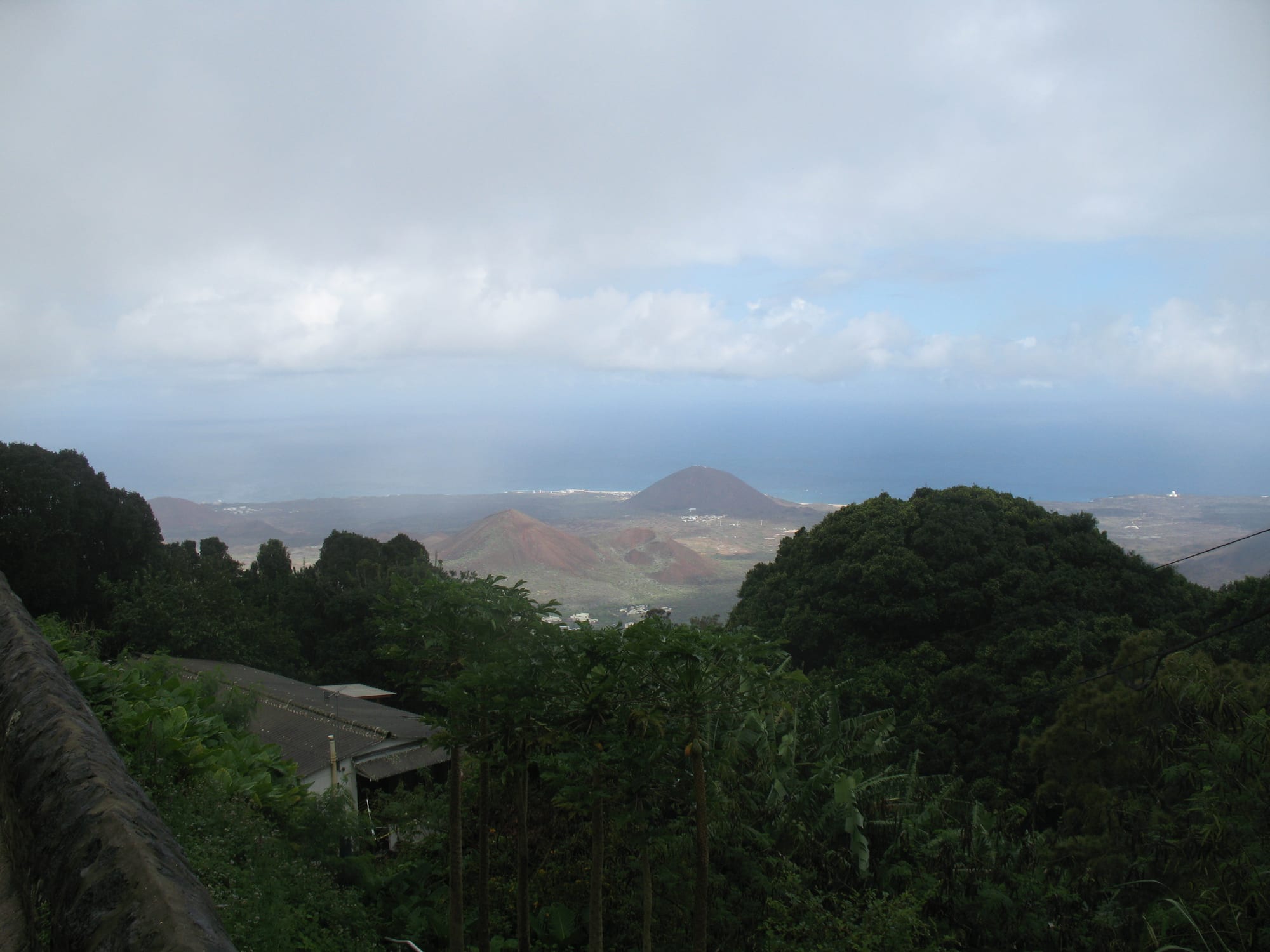
A small settlement of low buildings on a bare, reddish-brown volcanic plain running down to the sea, cinder cones on the skyline

Ascension Island

Georgetown, the main settlement, on the arid lava plain of Ascension Island's leeward coast. (Ben Tullis / Wikimedia Commons · CC BY 2.0)

A barren volcanic island in the equatorial South Atlantic, part of the British Overseas Territory of Saint Helena, Ascension and Tristan da Cunha — never a settled colony but a working base for the military, satellite trackers, seabirds, and turtles, with no right of abode and a population that comes and goes with the jobs.

Explore Ascension Island

History

Ascension was an uninhabited, waterless rock when the Portuguese navigator João da Nova sighted it in 1501; Afonso de Albuquerque is said to have renamed it Ascension in 1503, on Ascension Day. For three centuries ships used it only for turtles and the odd marooned sailor. The Royal Navy garrisoned it in 1815 to help guard Napoleon on Saint Helena and stayed, running the island as a stone frigate, HMS Ascension, until 1922. Charles Darwin called in 1836, and the botanist Joseph Hooker later devised a scheme to "green" the barren summit by planting species from around the world, creating the unique man-made cloud forest of Green Mountain.

The Eastern Telegraph Company, later Cable & Wireless, landed the island's first submarine telegraph cable in 1899. In 1942 the United States built Wideawake airfield, which was used again as a staging post for the 1982 Falklands War and remains active; its worn runway was closed to most traffic in 2016 and the repairs were finished in 2023. The BBC World Service opened its Atlantic Relay Station here in 1966 for short-wave broadcasts to Africa and South America, and a European Space Agency tracking station, a British-American signals-intelligence site, and one of the four ground antennas of the GPS system followed. Ascension has its own Administrator, representing the Governor of Saint Helena, and an elected Island Council; it was a dependency of Saint Helena from 1922 until the territory was reorganised in 2009. There is no permanent population and no right of abode — everyone is present on a contract for the airfield, the American facilities, the government, or the communications operators.

Culture & Customs

About 800 people live on Ascension, most of them Saint Helenians on work contracts, alongside British and American service and civilian staff. English is the only language. Life revolves around the employers, the two civilian settlements of Georgetown and Two Boats, the social club, fishing, and the beach. There is no indigenous culture, and nobody is "from" Ascension.

A strong conservation ethos has grown up around the turtles and seabirds, and the turtle-nesting season and the club's sports-and-social calendar shape the year. Contracts end and families move on, so the community turns over steadily.

Daily Life

The population rises and falls with the contracts. Georgetown, the tiny capital, sits by the pierhead; Two Boats village lies inland at the foot of Green Mountain. The economy is entirely the bases and government services, and since 2019 all of Ascension's waters have been a marine protected area closed to large-scale commercial fishing. Housing comes with the job, as there is no right to buy property. There is a school at Two Boats, a hospital and a small supermarket in Georgetown, and little else, while Wideawake airfield and the bases dominate the flat lava plain. Broadband is limited and costly.

  • Ascension Island: A Population That Never Stays — Everyone present on a work contract, a small supermarket and a single school shared between two small settlements, and a community that turns over as steadily as the ships and flights that bring it

Food

Food is whatever comes in on the ship or the plane. There is a shop, a couple of small eateries, and the club bars. Fresh fish is the local bounty — the yellowfin tuna and wahoo fishing off Ascension is exceptional — and Saint Helenian home cooking (plo, fishcakes, curry) is common in that community. Otherwise the diet is largely self-catered from imported and frozen goods.

Attractions & Natural Wonders

Green Mountain National Park, opened in 2005, is the surprise: an artificially created cloud forest of bamboo, Norfolk pine, eucalyptus, and banana, planted from the 1850s on a barren summit that rises to 859 metres, with paths through it. The green turtles that nest on Long Beach and other sands from November to May — the most important nesting ground in the South Atlantic — are watched on guided night walks.

Boatswain Bird Island, an islet a few hundred metres off the northeast coast, holds the bulk of the endemic Ascension frigatebird's breeding population, and since feral cats were eradicated between 2002 and 2004 the frigatebirds have started nesting on the main island again and other seabirds have recolonised it. The lava fields and their walking routes, the sandy coves of the leeward coast, Cross Hill with its old gun battery, Fort Bedford, and the Royal Marines barracks in Georgetown, and the shore and boat fishing round out a short but distinctive list. The wartime and space-tracking installations are visible landmarks, though the sites themselves are closed.

Planning basics

Budget

Ascension is not a leisure destination. Visitor accommodation is very limited — a small guesthouse or hotel and some self-catering units — and you need an approved entry visa and confirmed accommodation before you travel. Costs are high and set by the flight.

Daily Budget Note
High and inflexible; dominated by the airfare and the scarce accommodation

Arrange your e-visa, accommodation, and transport well in advance; casual, unplanned visits are effectively not possible.

Visa Requirements

An entry visa must be obtained in advance through the Ascension Island Government's online e-visa portal, at least 14 days before travel: nobody may land without permission, there is no visa on arrival and no tourism on spec, and there is no right of abode. Applicants are normally expected to show accommodation, onward travel, funds, and medical cover, and stays are time-limited.

Typical Stay
As specified on your e-visa (short, and tied to your onward transport)

Apply for the e-visa early, at least 14 days before travel, and have a confirmed way off the island before you arrive.

Safety

Very safe, with negligible crime. The hazards are environmental — powerful Atlantic swell and undertow (swim only where advised, and beware the "rollers"), sharp lava, heat and strong sun on the exposed plain, and long distances between help. The military and communications areas are off-limits and must not be photographed. Medical care is a small hospital; serious cases are evacuated.

Health
No tropical disease risk; the concern is access to advanced care and the sea conditions

Respect all restricted-area signage and photography bans, swim only at supervised or advised spots, and carry water and sun protection on the open lava.

Climate

A hot desert climate: warm and dry at sea level all year, averaging about 23–28°C and tempered by the trade winds. Green Mountain, the high point, is five or six degrees cooler, wetter, and often in cloud. There is little seasonal variation and no cyclone risk.

Lowland
Warm and dry, averaging about 23–28°C
Green Mountain
Cooler, wetter, often clouded

Transportation

The South Atlantic Air Bridge from RAF Brize Norton to the Falklands, flown for the Ministry of Defence, stops at Wideawake airfield and sells a limited number of civilian seats; there is also a monthly charter link with Saint Helena, and the cargo ship MV Helena takes a few passengers between Cape Town, Saint Helena, and Ascension. There is no scheduled commercial airline service. On the island a hire car is close to essential — driving is on the left — as the settlements are far apart across the lava.

Confirm your seat on the air bridge, the Saint Helena charter or a berth on the ship before committing, and arrange a vehicle on arrival.

Best Time to Visit

Green turtle nesting runs roughly November to May, with hatchlings emerging later in the season, and guided night walks to see it are a highlight. The fishing is good all year. Otherwise the season barely matters, and access depends on the flight and the permit.

Events
Turtle-nesting season (November–May); the sports-and-social-club calendar that structures island life

Currency

The Saint Helena pound is fixed at parity with sterling and both circulate, so British money is straightforward. It is largely a cash economy, served by a branch of the Bank of St Helena in Georgetown and little else — bring sterling.

Symbol
£
Currency Code
SHP / GBP — Saint Helena pound and sterling, at par

Language

English is the language of the island. There is no indigenous population and no local language; residents are on work contracts, most of them Saint Helenians, along with British and American staff.

Language
English