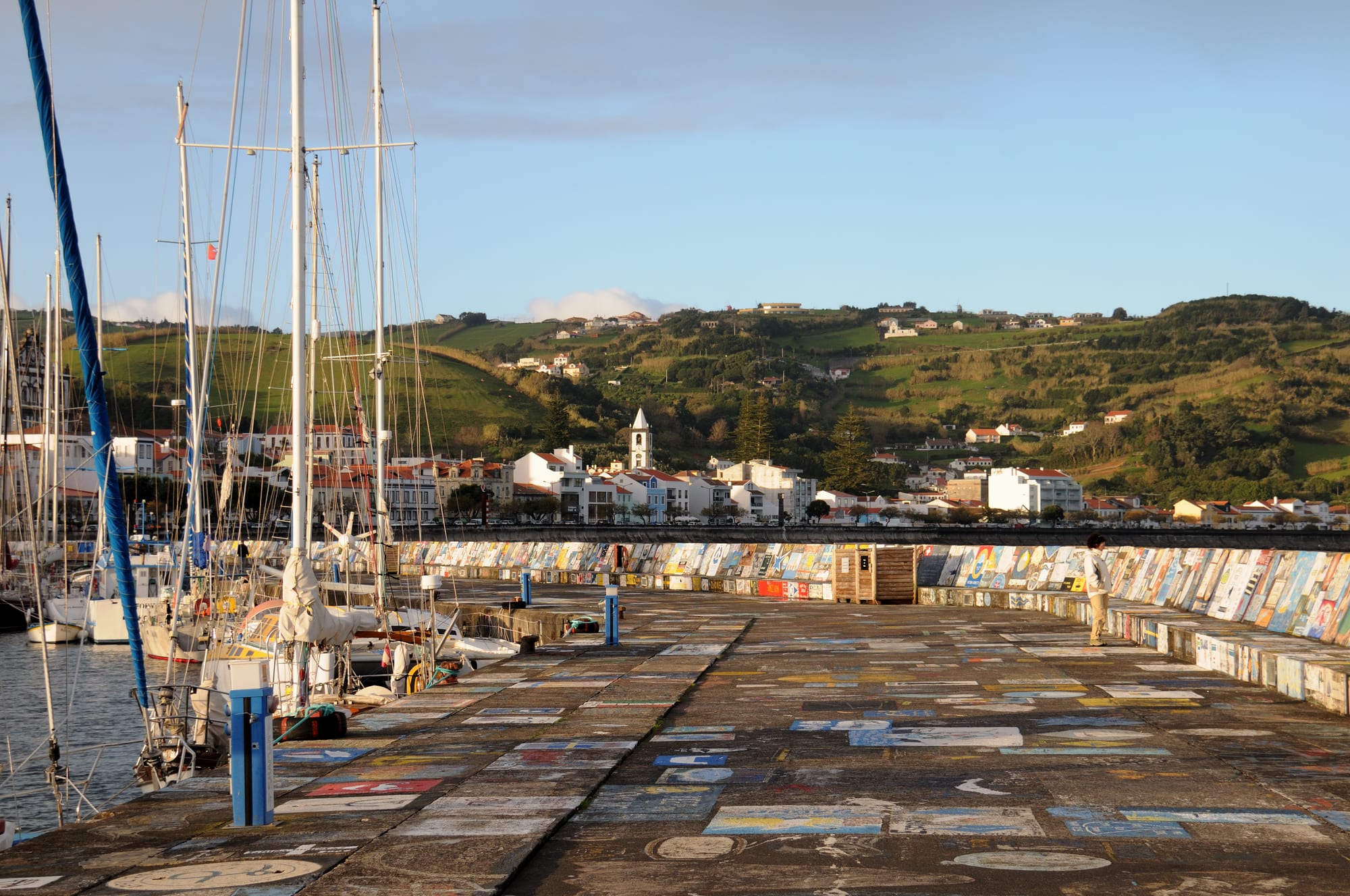
Sailing yachts moored beside a long quay whose wall and paving are covered in colourful painted panels, with white houses and green hills behind

The Azores

Horta

Moored yachts and sailors' paintings on the quay of Horta Marina, Faial. (Josep M. Gracia / Wikimedia Commons · CC BY-SA 4.0)

The harbour town of Faial, facing the volcano of Pico across a narrow channel, and the seat of the Azores' regional parliament. Founded by Flemish settlers in the 15th century, it grew rich on oranges, Pico wine, whalers and transatlantic cables; today its marina, with quays painted by passing crews, is a classic stop for yachts crossing the Atlantic.

Neighbourhoods

  • Matriz and the marina
    • First-time visitors
    • Waterfront

    The smallest and most populous parish of the island, at the core of the town, around the old main church and the tower clock, where most of the town's commercial and administrative life, including the Regional Assembly, is concentrated. The marina and its painted quay lie along the waterfront nearby.

    Open in Maps
  • Angústias and Porto Pim
    • Beaches
    • Museums

    The commercial south-western part of the town, running to the sheltered bay of Porto Pim with its black-sand beach, the old whaling factory and the volcanic cone of Monte da Guia.

    Open in Maps
  • Conceição
    • Quiet and residential
    • Beaches

    One of the areas where the first settlers gathered, now a parish of the town with one of the island's few natural sand beaches.

    Open in Maps

Things to do

The harbour and the town

  • Horta Marinaattraction

    The 300-berth marina opened in 1986, a primary stop for yachts crossing the Atlantic, whose walls and walkways are covered with paintings by visiting crews recording their boats and the year they passed.

    Open in Maps
  • Peter Café Sportattraction

    The café facing the marina that has long been a meeting place for transatlantic sailors, with Faial's scrimshaw museum of carved whale tooth and jawbone upstairs.

    Open in Maps
  • Horta Museummuseum

    The town's local history museum, with a photographic exhibition on the Capelinhos eruption and models of buildings, ships and people carved from fig-tree pith by Euclides Rosa.

    Open in Maps
  • Porto Pim Whale Factory Museummuseum

    A whaling museum in the abandoned factory that rendered whale blubber into oil until 1975 and processed 1,940 sperm whales.

    Open in Maps

Beaches and viewpoints

  • Porto Pim beachbeach

    A black-sand beach in a sheltered bay on the south side of town.

    Open in Maps
  • Monte da Guiaviewpoint

    A volcanic tuff cone on the southern edge of the town, rising above Porto Pim, with views over the town and its bay.

    Open in Maps
  • Porto Pim bartizanlandmark

    A simple watchtower that guarded the south-west entrance to the bay, part of the fortifications that once ringed Porto Pim.

    Open in Maps

Short trips on Faial and Pico

  • The Caldeirapark

    The large crater at the centre of Faial, part of the island's nature park, with the island's highest point, Cabeço Gordo, at 1,043 m on its southern rim.

    Open in Maps
  • Capelinhosattraction

    The volcano on the western coast of Faial whose 13-month eruption of 1957–58 enlarged the island by 2.4 km² and destroyed 300 houses; an underground museum explains the eruption.

    Open in Maps
  • Mount Picotrail

    The dormant volcano across the channel on Pico, at 2,351 m the highest mountain in Portugal, reached by the short ferry crossing to Madalena.

    Open in Maps

Seasonal events

  • Semana do Marearly August

    The Week of the Sea, the town's big summer festival, with bands and traditional and contemporary musicians on several stages.

  • Holy Spirit festivalsMay to September

    Festivals of the Holy Spirit, held across the Azores, with processions and shared meals in the parishes.

Eat and drink

Long-standing places and food districts in Horta. Hours, ratings and directions come from your maps app, always current.

Horta classics

  • Peter Café Sportcafe

    The sailors' café on the harbour front, popular among transatlantic sailors.

    Open in Maps
  • The marina waterfrontneighborhood

    The cafés, bars and restaurants along the harbour road facing the marina and Pico.

    Open in Maps

Wine from across the channel

  • Pico wineneighborhood

    Verdelho, one of the traditional grapes of Pico, was once exported through Horta to mainland Europe and is being planted again on the neighbouring island.

    Open in Maps

Experience Horta

History

The Flemish nobleman Josse van Huerter first landed on Faial around 1465, and in 1467 returned on a second expedition, coming ashore on the bay where the town now stands; the next year he was granted the first captaincy of the island. The settlers gathered around Conceição and Porto Pim, forming the Vila de Orta — a name taken from Huerter's own surname. A second wave of Flemish settlers followed under Willem van der Haegen, and the town grew between the old main church and the bay, with new parishes created in 1568 and 1684.

For a long period Horta was a centre of commerce and travel: the gateway for Azorean oranges and for Verdelho wine from Pico, a regular stop for North American whalers, and later a coaling port for steamships. The American Dabney family dominated the island's trade for 83 years. A commercial port was built in 1876, and on 23 August 1893 the first telegraph cables linked Horta with Lisbon, making the town a relay in transatlantic communication; foreign cable companies brought money, sport and a cosmopolitan society.

The eruption of Capelinhos in 1957–58 and the decline of whaling ended Faial's prosperity, and many islanders emigrated to North America. Yachts had begun using the harbour by 1960, the airport opened in 1971, and the marina followed in 1986. When the Azores gained autonomy, Horta became the seat of the regional Legislative Assembly.

Culture & Customs

Horta's culture is the culture of a harbour. The marina is one of the great meeting points of Atlantic sailing, and the custom of painting the quay — a crew's name, the boat, the year — has turned its walls and walkways into a vast, constantly renewed collage. Peter Café Sport, facing the yachts, is part of the same lore: a gathering place for sailors that also houses the island's scrimshaw museum, with whale teeth and jawbones engraved and carved.

Whaling is remembered rather than practised. Open-boat hunting of sperm whales once sustained the island, and the factory at Porto Pim that rendered blubber into oil until 1975 is now a museum; the whales themselves are now the object of watching trips that leave from the harbour.

The town's calendar peaks in early August with the Semana do Mar, the Week of the Sea, with bands and musicians on several stages. As elsewhere in the Azores, the Holy Spirit festivals bring processions and shared meals to the parishes, and the parliament gives the small town a political life out of proportion to its size.

Daily Life

About 14,300 people lived on Faial, a single municipality, at the 2021 census, and about 7,000 in the town itself. The island counted about 15,000 people in 2011, so numbers have slipped slightly since.

Horta has been the staging point for each of Faial's economic cycles — dyes, oranges, whale oil, wine and cable traffic — and today depends on public administration, including the regional parliament, on the port and on tourism: sightseeing and whale-watching trips, cruise ships in summer and the steady traffic of yachts. The harbour is also the base of the ferry lines that link the central islands, with a new passenger dock opened in 2012, and the airport in the parish of Castelo Branco, opened in 1971, was designated an international airport after major renovations in 2001.

Life follows the harbour and the weather. Crews from across the world pass through each summer, ferries cross to Pico through the day, and the town keeps the close, unhurried rhythm of a place where most people know one another.

Food

Faial's cooking follows the wider Azorean table, built on the sea and on island farming. Lapas grelhadas — limpets grilled with butter and garlic — are a delicacy of the islands. Bolo lêvedo, the sweet sourdough muffin of the Azores, is eaten across the islands, and Queijo São Jorge, a slightly spicy cow's-milk cheese, is made on the neighbouring island of São Jorge.

Wine links Horta with Pico across the channel. Verdelho is one of Pico's three traditional grape varieties, and the wine was shipped out through Horta to mainland Europe, reaching even the cellars of Tsar Nicholas II, before the phylloxera plague all but wiped the vines out. The grape is being planted again and made into fortified wines.

The town's best-known address for food and drink is Peter Café Sport, on the harbour front, long popular among transatlantic sailors, and the cafés and restaurants along the marina look across the water to Pico.

Planning tools

Budget

Horta is moderately priced by Western European standards. The main extras are a hire car or tour for the Caldeira and Capelinhos, boat trips from the harbour, and the ferry to Pico.

Daily Budget Midrange
USD 115–235 (hotel, restaurant meals, a hire car, a whale-watching trip)
Daily Budget Shoestring
USD 50–95 (guesthouse, cafés and bakeries, island buses)

Island buses do not run on Sundays, so plan a car or taxi for trips out of town that day.

Best Time to Visit

The climate is mild all year, with an average annual temperature of around 18°C. Summer is the busiest season, when the marina fills with yachts and the Semana do Mar takes over the harbour in early August. Rain is plentiful, especially in winter.

Suggested Number of Days

The town itself takes a day or two. Allow three or four days to see the rest of Faial as well, and more to cross to Pico, since weather and sea conditions often change plans.

First Visit
1–2 days
With Surroundings
3–4 days

Transportation

The town is small enough to walk. Island buses run up to six times a day on weekdays, four on Saturdays and not at all on Sundays, so most visitors hire a car or take tours to the Caldeira and Capelinhos. Passenger ferries cross to Madalena on Pico in about half an hour, and other ferries link Horta with São Jorge, Terceira and Graciosa.

Check the ferry and weather forecast before planning a day on Pico; crossings depend on the sea.

Airport & Station Connections

Horta Airport is in the parish of Castelo Branco, about 9.5 km south-west of the town centre, with flights to the other islands and mainland Portugal; no foreign airlines fly there. Ferries arrive from Pico and the central islands, and yachts and summer cruise ships call at the harbour.

Walkability

The town is a crescent along the bay, and the marina, the centre and Porto Pim are all within walking distance of each other. Monte da Guia is a steeper walk. Beyond the town the island needs wheels.

Safety

The Azores are very safe, with little crime. The practical risks are the weather and the sea: fog on the Caldeira rim, rough water on boat trips and ferry crossings, and loose volcanic ground around Capelinhos.

Take a local guide to descend into the Caldeira, and check the forecast before walks and boat trips. Check current official travel advice before travelling.

Climate

A mild oceanic climate, warmed by the Gulf Stream, with an average annual temperature of about 18°C. Days average around 20°C and nights around 15°C, and rain is plentiful, especially in the winter months.

Summer
the warmest season — days across the year average around 20°C and nights around 15°C
Winter
mild and wet — the coldest month, February, averages about 14°C, and frost occurs only on high ground

Local Customs

Portuguese is the language, and sailing crews from many countries meet on the waterfront. The marina tradition is that crews leave a painting on the quay to mark their crossing.

Leave existing paintings on the marina walls untouched, and ask before photographing people at religious ceremonies.

Common Payment Methods

The currency is the euro. Many restaurants and shops do not accept international credit cards, but cash machines are widely available, so carrying some euros is sensible.