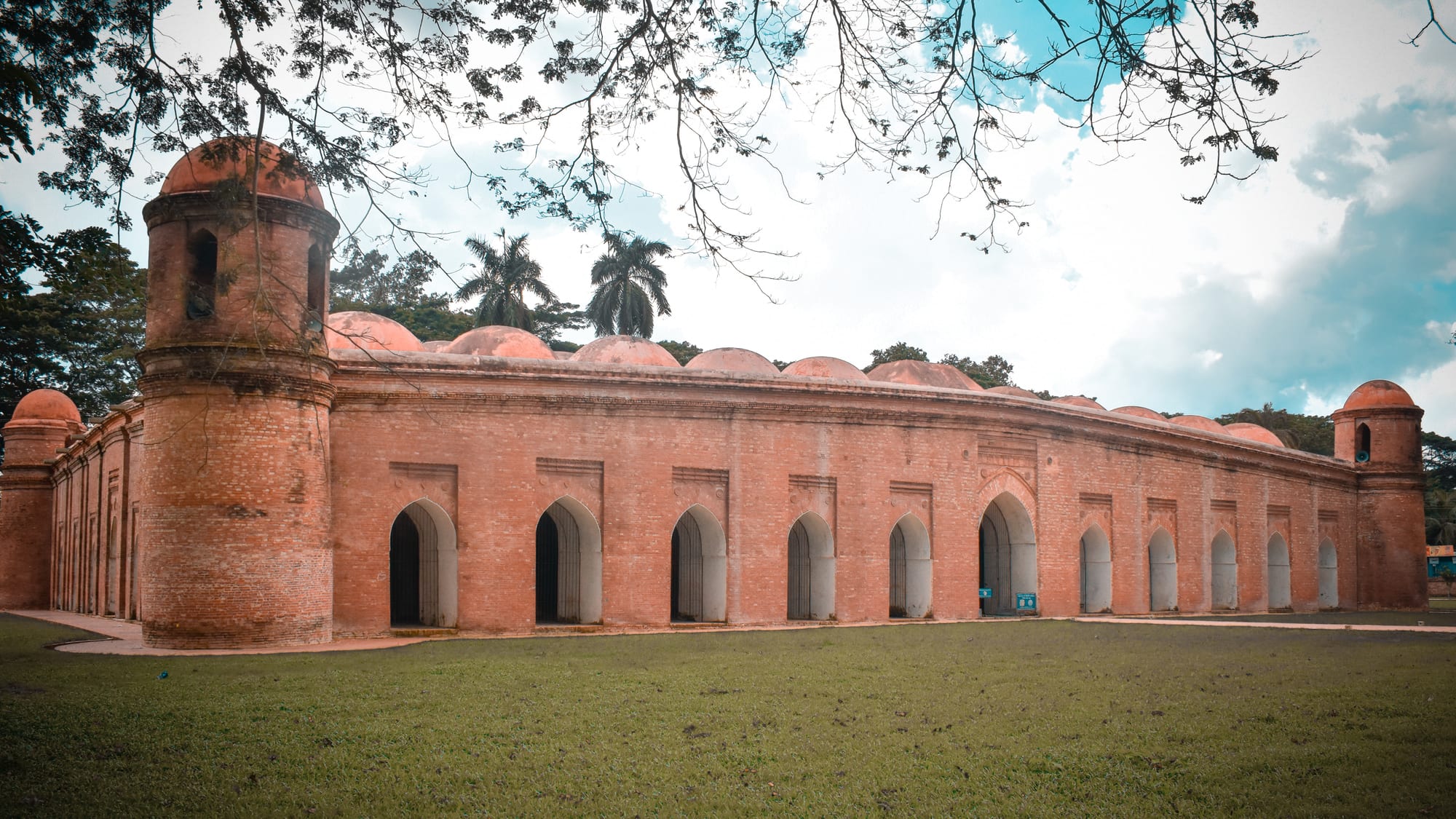
The long brick wall and rows of arched doorways of the Sixty Dome Mosque, with small domes along its roof and corner towers, on a lawn under palms

Khulna, the Sundarbans & the South, Bangladesh

Bagerhat

The Sixty Dome Mosque, the largest of the 15th-century monuments of Bagerhat. (THENKB / Wikimedia Commons · CC BY-SA 4.0)

A small district town in the south-west delta of Bangladesh, east of Khulna, beside the site of the 15th-century city of Khalifatabad, founded by the saint and administrator Khan Jahan Ali. Its brick mosques, tanks and tombs, scattered among villages and rice fields, make up the Historic Mosque City of Bagerhat, a UNESCO World Heritage Site.

Neighbourhoods

  • Bagerhat town centre
    • First-time visitors
    • Local life

    The compact centre beside the Bhairab river, with the district offices, the bazaar, a handful of simple hotels and the bus stand. Almost everything in town is within a rickshaw ride of it.

    Open in Maps
  • The Khalifatabad monument belt
    • Historic district
    • Walks

    The strip of ground along the Khulna road west of town, where the Sixty Dome Mosque stands beside the Ghoradighi tank and smaller mosques sit among orchards, ponds and village lanes. This is where the World Heritage Site is concentrated.

    Open in Maps
  • Around the tomb of Khan Jahan Ali
    • Pilgrimage
    • Local life

    The shrine complex north-west of the centre, with its great tank, tea stalls and sellers of sweets and votive offerings. Pilgrims come from across the region, and the area is at its busiest on Thursdays and at festival times.

    Open in Maps
  • The Rampal and Mongla road
    • Day trips
    • Quiet and residential

    The southern road out of town towards the Pashur river, running through shrimp ponds, embankments and villages to the port of Mongla and the forest edge beyond.

    Open in Maps

Things to do

The Mosque City

  • Sixty Dome Mosquelandmark

    The largest and best known of Khan Jahan Ali's buildings, a vast brick hall whose low domes rest on rows of slim stone columns, built in the mid-15th century.

    Open in Maps
  • Nine Dome Mosquelandmark

    A brick mosque whose central dome is ringed by eight smaller ones, on the west bank of the Thakur Dighi tank near the tomb of Khan Jahan Ali, its mihrab framed by terracotta floral scrolls.

    Open in Maps
  • Singair Mosquelandmark

    A small square mosque under a single dome, about two hundred metres south-east of the Sixty Dome Mosque, its exposed brick walls set with terracotta decoration.

    Open in Maps
  • Bibi Begni Mosquelandmark

    A single-domed 15th-century mosque on the west bank of the Ghora Dighi tank, about eight hundred metres west of the Sixty Dome Mosque.

    Open in Maps
  • Chunakhola Mosquelandmark

    A single-domed 15th-century mosque standing alone in the rice fields of Chunakhola village, beyond the main group, its gently curved cornice and mouldings still clear.

    Open in Maps

Short trips from the town

  • Mongla Porttransit hub

    Bangladesh's second busiest seaport after Chittagong, on the Pashur river south of Bagerhat, and the closest jumping-off point for boats into the mangroves.

    Open in Maps
  • The Sundarbanspark

    The largest mangrove forest in the world and a UNESCO World Heritage Site, visited on licensed boat trips through tidal channels where deer, crocodiles and kingfishers are common and tigers are rarely seen.

    Open in Maps
  • Khan Jahan Ali Bridgelandmark

    The 1.6-kilometre bridge over the Rupsha river at Khulna, on the road in from the west, named after the founder of Bagerhat.

    Open in Maps

Seasonal events

  • Eid al-Fitr and Eid al-Adhadates move through the year with the lunar calendar

    The main Muslim festivals, when the shrine and the town's mosques draw large congregations and the bazaar is busy in the days before.

  • Pohela Boishakhmid-April

    Bengali New Year, marked with village fairs, sweets and processions across the district.

  • Durga PujaSeptember or October

    The Hindu festival of the autumn, widely observed in this part of the delta, with pandals in the town and surrounding villages.

  • Cool-season visiting monthsNovember to February

    The dry, mild months when the monuments are comfortable to walk between and boat trips into the nearby forest run most regularly.

Eat and drink

Long-standing places and food districts in Bagerhat. Hours, ratings and directions come from your maps app, always current.

Local dishes

  • Golda chingrirestaurant

    The giant freshwater prawn farmed throughout Bagerhat district, most often cooked in coconut milk as malaikari and eaten with rice.

    Open in Maps
  • Chui jhalrestaurant

    The south-west's beef or mutton curry cooked with woody lengths of the chui vine, which give heat and a resinous aroma; it is as common here as in Khulna.

    Open in Maps

Markets and food streets

  • Bagerhat bazaarmarket

    The town market, selling river fish, prawns, coconut, betel nut, winter vegetables and date-palm molasses in season.

    Open in Maps
  • Tea and sweet stalls at the shrineneighborhood

    The line of stalls near the tomb complex serving milky tea, sweets and fried snacks to pilgrims and visitors.

    Open in Maps

Experience Bagerhat

History

Bagerhat stands on what was, in the 15th century, the southern frontier of settled Bengal, a country of tidal creeks and salt forest being cleared for rice. In the mid-15th century a Muslim saint and administrator remembered as Khan Jahan Ali established a town here called Khalifatabad, under the nominal authority of the Sultanate of Bengal. He is credited with cutting roads and excavating enormous freshwater tanks in a saline landscape, and with building mosques across the district; his own tomb, dated by inscription to his death in 1459, stands beside the largest of the tanks.

The architecture of that moment is distinct. The builders used brick, with stone shipped in for columns and door frames, and covered their halls in rows of low domes carried on thick round towers at the corners — a style known from the Sultanate period in Bengal and seen at its fullest in the Sixty Dome Mosque. More than fifty structures of the period survive in the area, many of them half-buried until modern times.

After Khan Jahan Ali's death the town declined. The rivers shifted, the forest crept back, and by the colonial period the mosques stood in jungle and farmland, visited by pilgrims but otherwise forgotten. Bagerhat became a subdivision and later a district headquarters, a modest administrative centre for a farming and fishing hinterland. The monuments were cleared and conserved during the 20th century, and in 1985 UNESCO inscribed the Historic Mosque City of Bagerhat as a World Heritage Site, which is what brings most outside visitors today.

Culture & Customs

The town's identity is bound up with Khan Jahan Ali. He is revered as a saint as much as remembered as a governor, and his shrine draws a steady flow of pilgrims, Muslim and sometimes Hindu, who tie threads, pray and make offerings. The crocodiles kept in the tank beside the tomb are part of the tradition, and their feeding is a local spectacle that has continued for generations.

Around the monuments, life is that of the rural south-west: mosque and madrasa, village bazaars, rice fields and shrimp ponds, and a Hindu minority larger than in most of the country whose Durga Puja pandals go up in autumn. The folk religion of the delta is present here too, and villagers on the forest side of the district invoke Bonbibi, the guardian of the Sundarbans, before entering the mangroves to fish or collect honey.

Manners are conservative and hospitable. Visitors are usually offered tea and asked where they come from, and children accompany strangers happily around the mosque grounds. Local speech is the soft south-western Bengali also heard in Khulna, and the district is proud that its small, quiet town carries one of the country's three World Heritage inscriptions.

Daily Life

Bagerhat town is small — roughly fifty thousand people — and the district around it far larger, with most residents living in villages. The economy rests on farming and on water: paddy rice, coconut, betel nut and vegetables on the higher ground, and shrimp and prawn ponds, known locally as ghers, across the low land. Prawns from these ponds are processed in Khulna and exported, and the money they bring has reshaped village life while turning much former rice land brackish.

Work also comes from the port at Mongla to the south, from the Rampal power station nearby, which has been a long-running environmental controversy because of its closeness to the Sundarbans, and from the forest itself, where licensed fishermen, crab catchers and honey collectors still go out in season. Many families have a member working in Dhaka or abroad.

Days start early with the markets and the tides, and the town is quiet by mid evening. The chronic problems are those of the whole coast: salinity in soil and drinking water, waterlogging after heavy rain, riverbank erosion, and the cyclones that periodically come up the Bay of Bengal, among them Sidr, which made landfall on this coast in November 2007. Conservation of the monuments, and the pressure of the town growing around them, is a continuing local issue.

Food

Bagerhat eats what the delta produces. Golda chingri, the giant freshwater prawn farmed in the ponds all around the town, is the prize dish, usually cooked in coconut milk as malaikari; bagda, the tiger prawn, mostly goes for export. River fish from the Bhairab and Pashur, hilsa in season and mud crab from the mangrove channels fill the market, and dried fish, shutki, is cooked into strong-smelling curries that are a taste of the south-west.

The standard meal is rice with dal, a fish curry and bhorta — vegetables or dried fish mashed with mustard oil, onion and green chilli. Chui jhal, the beef or mutton curry cooked with pieces of the pungent chui vine, is the regional speciality shared with Khulna and appears on most restaurant menus. Coconut finds its way into curries, sweets and rice dishes.

Winter brings khejur gur, the molasses boiled from date-palm sap tapped overnight, which is eaten with rice cakes, stirred into payesh and sold as hard patali cakes. Honey from the Sundarbans, gathered from wild hives by licensed collectors, is sold in jars in the bazaar. Sweet shops near the shrine sell rosogolla and sandesh, and tea is drunk strong, sweet and milky at stalls throughout the day.

Planning tools

Budget

Bagerhat is cheap and has little in the way of hotels, so many people visit it as a day trip from Khulna. Entry to the monuments costs little, food is inexpensive, and the main expense is transport: a hired car or a day of auto-rickshaws to reach the mosques scattered over several kilometres.

Daily Budget Midrange
USD 40–75 (good hotel in Khulna, car with driver, restaurant meals); USD 100–200 per day on a Sundarbans boat trip
Daily Budget Shoestring
USD 15–30 (simple hotel or a day trip from Khulna, local food, rickshaws and buses)

Hiring an auto-rickshaw for a half-day is the practical way to link the mosques, which are spread along and off the Khulna road.

Best Time to Visit

November to February is the comfortable season, dry and mild, and the same months when boats run into the Sundarbans nearby. March to May is hot and humid, the monsoon from June to September brings heavy rain that makes the village paths between the smaller mosques muddy, and cyclone risk is highest in spring and late autumn.

Suggested Number of Days

The monuments can be seen in a single unhurried day, which is why most people come out from Khulna and return the same evening. Staying longer makes sense only when the visit is combined with the port and the forest to the south.

First Visit
1 day
With Surroundings
2–3 days

Transportation

Auto-rickshaws, battery-powered easy-bikes and cycle rickshaws cover the town and the monument belt, with fares agreed in advance. Buses run frequently on the Khulna road, about thirty-five kilometres west, and south towards Mongla and Rampal. There is no rail line to the town.

The mosques lie several kilometres apart along and off the main road, so a hired vehicle for a few hours saves a great deal of walking in the heat.

Airport & Station Connections

Most visitors arrive by road from Khulna, about thirty-five kilometres west, which takes roughly an hour by bus or car. Buses also run direct from Dhaka, about 320 kilometres away, in six hours or so via the Padma Bridge. The nearest airport with domestic flights is at Jashore, some three hours north-west by road.

Walkability

The town centre is small and flat and easily walked. The monuments, however, are spread over several kilometres of the Khulna road and the lanes off it, with the Sixty Dome Mosque about five kilometres from the centre, so walking between all of them is a long, hot undertaking; the grounds of each site are pleasant on foot.

Safety

Bagerhat is a quiet district town with little crime, and visitors are few enough to be greeted with curiosity. The practical risks are traffic on the Khulna road, heat and sun at the open monument sites, and the tank beside the shrine, which holds crocodiles and should not be entered. Cyclone warnings in spring and late autumn are taken seriously across the coast.

Keep away from the water's edge at the shrine tank, carry water and cover up at the open sites, and check cyclone warnings in the storm seasons. Check current official travel advice before travelling.

Climate

A hot and humid delta climate close to the Bay of Bengal. The pre-monsoon months are the hottest, the monsoon from June to September brings most of the rain, and winter is dry and mild with fog on the rivers at dawn.

Summer
hot and very humid, commonly 30–38°C before the monsoon, then heavy rain from June
Winter
dry and mild, about 12–26°C, with damp, foggy mornings

Local Customs

The mosques are historic monuments, but several are still used for prayer and the tomb of Khan Jahan Ali is an active shrine. Shoes come off before entering, and modest dress — covered shoulders and knees, and a scarf for women — is expected at all of them. Prayer times take precedence over sightseeing, and non-Muslims are not admitted to some interiors during them.

Ask before photographing worshippers or the inside of the shrine, keep voices low in prayer halls, and do not disturb the crocodiles or feed them at the tank.

Common Payment Methods

The currency is the Bangladeshi taka, and cash is needed for almost everything here: entry tickets, rickshaws, stalls and small hotels. There are bank ATMs in the town centre, though international cards are not accepted at all of them, so it is sensible to draw cash in Khulna first.