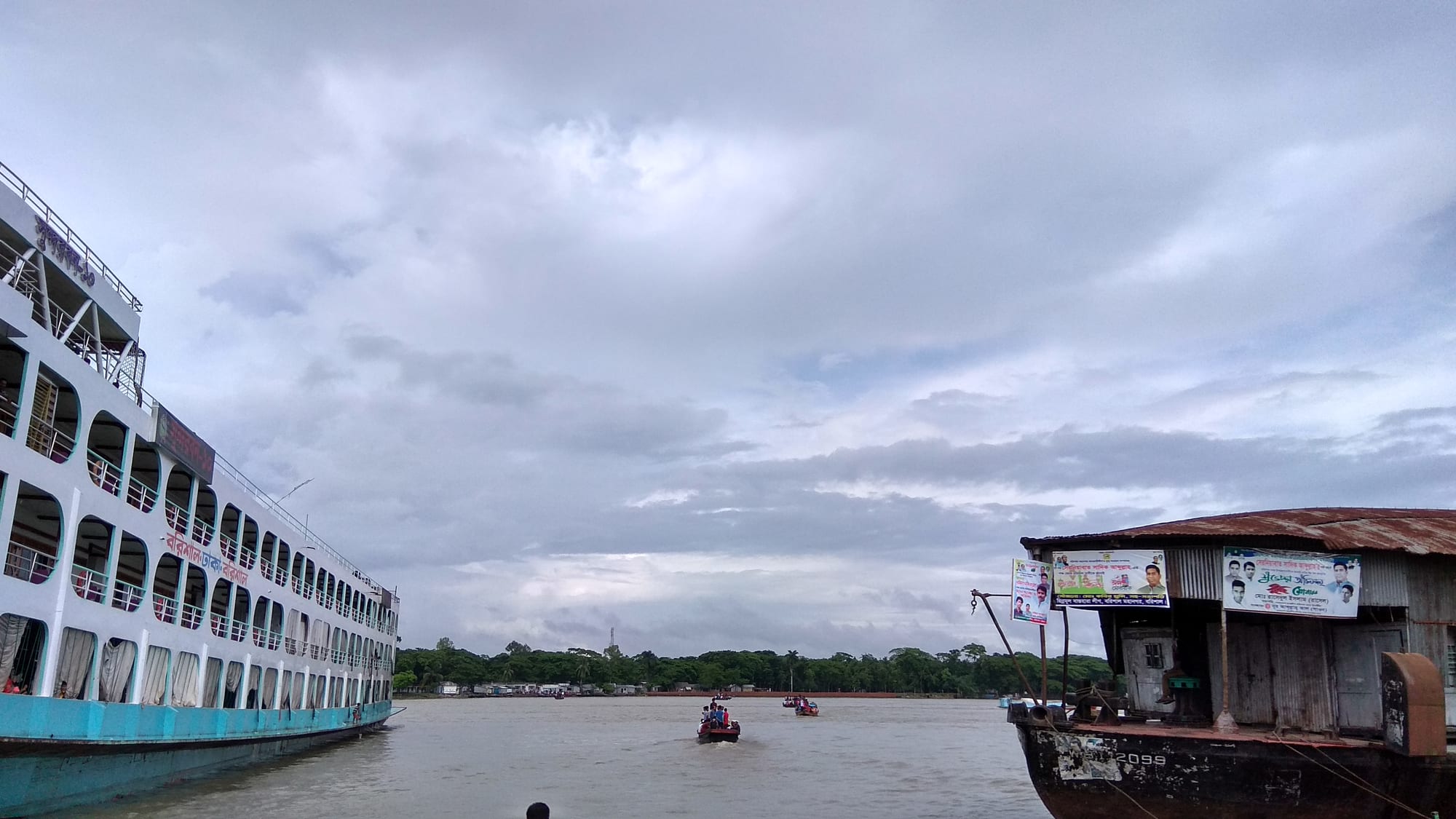
A large white passenger launch moored at Barishal's river port on the Kirtankhola, with small boats on the brown water and a tin-roofed pontoon opposite

Khulna, the Sundarbans & the South, Bangladesh

Barishal

A passenger launch at Barishal river port on the Kirtankhola river. (Lonely Explorer / Wikimedia Commons · CC BY-SA 4.0)

The main city of the southern delta of Bangladesh, spread along the Kirtankhola river among a maze of channels and canals. It grew rich on rice and river trade, and the overnight launches that still run between it and Dhaka remain one of the country's classic journeys. Guava orchards, canal markets and a flat green landscape of water surround it.

Neighbourhoods

  • Sadar Road and the city centre
    • First-time visitors
    • Shopping
    • Best for food

    The main street of Barishal, lined with shops, sweet houses, restaurants and most of the city's hotels, running back from the river through the busiest part of town. Rickshaws crowd it from morning until late.

    Open in Maps
  • The launch ghat and riverfront
    • Local life
    • Close to public transport

    The river port on the Kirtankhola, where the Dhaka launches berth and smaller boats cross to the villages opposite. The embankment fills with people in the evening, and the arrival and departure of the big launches is the city's daily event.

    Open in Maps
  • Band Road and Kirtankhola embankment
    • Walks
    • Quiet and residential

    The road running along the river south of the port, with parks, tea stalls and a view of boats and barges. It is the pleasantest stretch of the city to walk at dusk.

    Open in Maps
  • Nathullabad and the bus terminal
    • Close to public transport
    • Budget stays

    The northern edge of the city, where the inter-district buses arrive from Dhaka, Khulna and Kuakata. It is functional rather than attractive, but it is where many journeys begin and end.

    Open in Maps
  • Kawnia and the canal quarters
    • Local life
    • Markets

    Older residential parts of the city behind the centre, threaded by canals that once carried boats into the heart of Barishal. Small markets, mosques and ponds sit among tightly packed houses.

    Open in Maps

Things to do

Rivers and canals

  • Kirtankhola Riverattraction

    The wide tidal river along the city's eastern edge, busy with launches, cargo boats and ferries, and the reason Barishal exists where it does.

    Open in Maps
  • Durga Sagarpark

    The largest lake in southern Bangladesh, about eleven kilometres north-west of the city at Madhabpasha, excavated in 1780 for Rani Durgabati, mother of Raja Joy Narayan, with an artificial island in the middle and migratory birds in winter.

    Open in Maps

In the city

  • Barisal Zilla Schoollandmark

    One of the oldest schools in the country, founded in 1829, whose colonial building stands in the middle of the city.

    Open in Maps
  • University of Barisalattraction

    A public university established in 2011, its campus spread over fifty acres beside the Dhaka–Patuakhali highway on the bank of the Kirtankhola.

    Open in Maps
  • Oxford Mission Churchlandmark

    The Epiphany church built by the Anglican Oxford Mission between 1903 and 1907, now part of the United Protestant Church of Bangladesh, standing in walled grounds of some thirty-five acres with ponds and rows of palms.

    Open in Maps

Short trips from the city

  • Baitul Aman Jame Masjidlandmark

    A modern white mosque complex at Guthia, north-west of the city, opened in 2003 on fourteen acres with an eidgah, a madrasa and three lakes, and much visited at weekends.

    Open in Maps
  • Bhimruli floating marketmarket

    The best known of the canal markets of Jhalokati district, where guava, hog plum and vegetables are sold from small wooden boats gathered at a junction of channels.

    Open in Maps
  • Kuakatabeach

    A long sandy beach on the Bay of Bengal in Patuakhali district, where both sunrise and sunset can be watched over the sea, about four hours south by road.

    Open in Maps
  • Jhalokatiattraction

    The small riverside district town south-west of Barishal, the centre of the guava-growing country and its canal markets.

    Open in Maps

Seasonal events

  • Guava and canal market seasonJuly to September

    The monsoon months when the guava harvest fills the canals of Jhalokati and Pirojpur with loaded boats and the floating markets are at their busiest.

  • Pohela Boishakhmid-April

    Bengali New Year, marked with processions, fairs and music along the riverfront and in the city's parks.

  • Durga PujaSeptember or October

    The southern delta has a substantial Hindu population, and pandals go up across the city and the villages for several days each autumn.

  • Eid al-Fitr and Eid al-Adhadates move through the year with the lunar calendar

    The main Muslim festivals, when launches and buses to and from Dhaka are packed for days and the markets are at their fullest beforehand.

  • Boat racesafter the monsoon, roughly August to October

    Village rowing races on the rivers and canals of the delta, drawing crowds to the banks with long narrow boats and drums.

Eat and drink

Long-standing places and food districts in Barishal. Hours, ratings and directions come from your maps app, always current.

Barishal classics

  • Ilish from the delta riversrestaurant

    The hilsa caught in the Meghna and the channels around Bhola, fried in mustard oil, cooked with mustard paste as shorshe ilish or steamed in banana leaf — the fish that defines the southern table.

    Open in Maps
  • Guava and delta fruitmarket

    Jhalokati and Pirojpur, just outside the city, form the country's main guava-growing belt, and the fruit reaches Barishal's markets by boat in the rains along with hog plum and coconut.

    Open in Maps

Markets and food streets

  • Sadar Road eating housesneighborhood

    The line of rice-and-curry hotels, biryani counters, sweet shops and tea stalls along the city's main street.

    Open in Maps
  • Port Road fish marketmarket

    The riverside wholesale market where hilsa and other delta fish are landed and auctioned, liveliest very early in the morning.

    Open in Maps
  • Barishal bazaarmarket

    The city's produce market, selling rice, coconut, betel nut, vegetables and river fish from the surrounding districts.

    Open in Maps

Experience Barishal

History

The land Barishal stands on is young, built by the silt of the Ganges and Meghna, and for centuries this was the country of Chandradwip, a Hindu kingdom of the southern delta whose rulers later moved their seat inland as the rivers shifted. Arakanese raiders known as the Maghs, backed by Portuguese mercenaries and pirates, preyed on the coast into the 17th century, and villages were built back from the open water because of them.

Under British rule the district of Bakerganj was created in 1797, and the town that grew at the meeting of the Kirtankhola and the trade routes became its headquarters. It prospered on rice, which was shipped out in enormous quantities to Kolkata and beyond, and on river commerce; steamer services connected it to Kolkata and Dhaka, the Zilla School opened in 1829, and the Oxford Mission built its church and schools in the early 20th century. The name Barishal is usually derived from the Perso-Arabic phrase Bahr-e-Sawal.

The 20th century brought disaster and politics in equal measure. Sher-e-Bangla A. K. Fazlul Huq, the peasant leader and premier of undivided Bengal, came from this district. The Bhola cyclone of 12 November 1970, the deadliest tropical cyclone on record, devastated the coast south of the city and killed at least 300,000 people, and the failure of the response fed the anger that led to the war of 1971, in which the region saw heavy fighting. Barishal Division was created on 1 January 1993, and the municipality, dating from 1876, became a city corporation in 2002; and the opening of the Padma Bridge in 2022 has, for the first time, made Dhaka a half-day away by road.

Culture & Customs

Barishal's reputation in Bangladesh rests on its speech and its temperament. The Barishali dialect is instantly recognisable and much imitated, and people from the region are said to argue politics harder and joke more sharply than anyone else in the country. Students from the south have long been prominent in national movements, and the city's political meetings are well attended and loud.

It is also a literary place. The poet Jibanananda Das, one of the most important figures in modern Bengali verse, was born and taught here, and his imagery of rivers, kingfishers and rice fields belongs to this landscape. The district produced Fazlul Huq, whose memory is honoured across the south, and a long line of teachers and lawyers trained at the old colleges.

Religious life is mixed. Mosques and madrasas are numerous, the Hindu minority is larger than in most of Bangladesh and fills the autumn with Durga Puja, and the Oxford Mission church has kept a small Christian community since the colonial period. Rivers shape the calendar as much as religion does: boat races after the monsoon, ferry crossings to village fairs, and the arrival of the launches, which remains a social event as much as a timetable.

Daily Life

About 400,000 people live in the city, and several million in the division around it. Barishal is a trading and administrative centre rather than an industrial one: rice, guava, coconut, betel nut and fish come in from the surrounding districts, government offices and colleges employ many residents, and the river port handles passengers and cargo. Much of the division's income arrives as remittances from family members working in Dhaka, in Chattogram or in the Gulf.

The day is set by the tides and the launches. The fish market works before dawn, Sadar Road fills through the morning, the heat empties the streets in the early afternoon, and the embankment comes alive again at dusk. Most people live in low brick or tin-roofed houses along lanes off the main roads, with canals and ponds between them, and newer flats are rising near the university and the northern approaches.

The city's difficulties are those of a delta: waterlogging after heavy rain, canals that have been filled in or silted up, salinity creeping inland from the coast, and riverbank erosion that takes land and houses each year. Cyclones and storm surges strike the districts to the south, and each one brings families north to Barishal. Better road links since the Padma Bridge have brought investment and also drawn more young people away to Dhaka.

Food

Barishal eats fish, rice and coconut. Ilish, the hilsa, is the great prize, netted in the Meghna and the channels around Bhola; it is fried in mustard oil, cooked with mustard paste as shorshe ilish, or steamed in banana leaf, and the roe is eaten as a delicacy. The classic pairing is with panta bhat, rice soaked overnight in water. Prawns, small delta fish and dried fish, shutki, fill the rest of the market.

The everyday meal is rice with dal, a fish curry and bhorta — vegetables or dried fish mashed with mustard oil, onion and green chilli — and coconut milk thickens many dishes here as it does across the south. Duck cooked with coconut is a winter dish of the delta villages, and khichuri appears on rainy days.

Fruit is the region's other signature. The guava orchards of Jhalokati and Pirojpur supply markets across Bangladesh, and hog plum, coconut, betel nut and bananas grow along every canal bank. Winter brings date-palm molasses from tapped trees, eaten with pitha rice cakes and stirred into payesh. Sweet shops on Sadar Road sell rosogolla, sandesh and curd, and tea is drunk strong, sweet and milky at stalls along the embankment late into the evening.

Planning tools

Budget

Barishal is inexpensive. Hotels are plain and cheap, meals cost very little, and rickshaws cover the city for small change. The overnight launch from Dhaka is the item where price varies most, from deck space costing almost nothing to a private cabin, and a trip further south to the coast adds transport costs.

Daily Budget Midrange
USD 40–75 (good hotel, car with driver, restaurant meals, a cabin on the launch)
Daily Budget Shoestring
USD 15–30 (simple hotel, local food, buses and launch deck or seat)

A cabin on the Dhaka launch is worth booking a day or two ahead, and much earlier around the Eid holidays.

Best Time to Visit

November to February is the most comfortable season, dry and mild, and the best time for river journeys. The canal markets of the guava country are at their most active in the monsoon between July and September, when the water is high, though travel is wetter then. Cyclone risk is highest in April and May and again in October and November.

Suggested Number of Days

The city itself is small and quickly seen, and many people treat it as a stop on a river journey. Longer stays are built around the canal country to the south-west and the coast beyond, both of which are slow to reach by boat and road.

First Visit
1–2 days
With Surroundings
3–4 days

Transportation

Cycle rickshaws, easy-bikes and CNG auto-rickshaws cover the city, and fares are settled before setting off. Overnight launches connect the river port with Dhaka, and smaller boats and ferries cross the Kirtankhola and serve villages that roads do not reach. Buses to Dhaka, Khulna and Kuakata leave from the Nathullabad terminal, and speedboats run on some routes.

Boats remain the practical way into the canal country south-west of the city, and are hired by the hour or the day at the ghats.

Airport & Station Connections

Since the Padma Bridge opened in 2022, buses from Dhaka take roughly four to five hours by road. The overnight launch from Sadarghat in Dhaka is the traditional alternative, leaving in the evening and arriving at dawn. Barishal also has a small airport with domestic flights to Dhaka, about twelve kilometres north of the centre.

Walkability

The centre is flat, compact and walkable, and Sadar Road to the riverfront takes only a few minutes on foot. Pavements are narrow or broken and the traffic of rickshaws and easy-bikes is constant, so most short trips are made by rickshaw. The embankment along the Kirtankhola is the best walk in the city.

Safety

Barishal is a calm provincial city and serious crime against visitors is rare. The real risks are on the water: overcrowded launches and small boats, fog on the rivers in winter and storms in the cyclone seasons have all caused accidents in the delta. Traffic and petty theft in crowded markets are the everyday concerns ashore.

Avoid visibly overcrowded boats and night crossings in bad weather, take cyclone warnings seriously between April and November, and keep valuables out of sight in the bazaars. Check current official travel advice before travelling.

Climate

A hot, humid delta climate with heavy monsoon rain. Barishal is one of the wetter parts of Bangladesh, and tidal flooding reaches the low ground around the city. Winter is dry and mild with fog on the rivers at dawn, and cyclones from the Bay of Bengal are a seasonal threat.

Summer
hot and very humid, commonly 30–36°C before the monsoon, then heavy and persistent rain from June to September
Winter
dry and mild, about 12–27°C, with damp, foggy mornings on the water

Local Customs

Modest dress is expected, with shoulders and knees covered and a scarf for women at mosques and shrines, where shoes are removed. The city has a substantial Hindu minority, and both Muslim and Hindu festivals are public occasions. Barishal people have a reputation across Bangladesh for a distinctive dialect, sharp humour and forthright political argument, and visitors are drawn into conversation readily.

Ask before photographing people, particularly women and those praying; alcohol is not openly sold; tipping is not customary, though boatmen and drivers welcome small amounts.

Common Payment Methods

The currency is the Bangladeshi taka, and cash is used for nearly everything, including launch tickets, boats and small hotels. ATMs in the city centre accept international cards at some banks but not all, and card payment is limited to larger hotels and a few shops. Carry cash before heading into the canal country or south to the coast.